Quantifying CO2-emissions according to the 
control-criterion in a globalizing world 
Maarten van Rossum, Cor Graveland, Sjoerd Schenau and Bram Edens 
Presentation and discussion by Abdul A Erumban 
Rotterdam, August 2014, IARIW conference 
1 © 2014 The Conference Board, Inc. | www.conferenceboard.org
Introduction and background 
 Globalisation; effects on the environment 
 Different ways to attributing CO2 emissions 
 Production approach, consumption approach, Kyoto reporting 
 From a GDP perspective to a national income perspective 
 Resident controlled and foreign controlled emissions 
 Develop a new approach to monitor CO2 responsibility 
 Allocate emissions according to span of control 
– By means of the Ultimate Controlling Institute: indicator for span of control 
 Question: How to asses CO2 –emissions according to the control criterion 
‘span of control’ by enterprises and to what extent do these emissions 
deviate from emissions based on alternative approaches? 
 Which countries have ‘control’ over Dutch residents? 
 Which countries are ‘controlled’ by Dutch residents? 
 Which industries are important in bilateral control relationships? 
2 © 2014 The Conference Board, Inc. | www.conferenceboard.org 
2
Data and methodology (1) 
Methodology used for foreign control in the Dutch economy 
1. First allocate the available stationary emissions on micro level 
2. Secondly, add mobile emissions based on meso-level info 
3. Allocate rest of emissions based on employment-key (key of 
Ultimate Controlling Institute (1,0)) 
Data used for foreign control in the Dutch economy: 
1. Micro information on CO2 emissions at statistical unit level (Energy 
Statistics & Environmental Statistics) 
2. UCI information (0 or 1) on micro level (statistical unit) 
3. Employment data on micro-level (statistical unit) 
4. Emission accounts data at meso-level (stationairy emissions and 
emissions from mobile sources) 
3 © 2014 The Conference Board, Inc. | www.conferenceboard.org 
3
Data and methodology (2) 
Methodology used for Dutch control in foreign economies: 
1. Calculate emission per number of employees (including self-employed) 
 emission-intensity (X) 
2. Multiply FATS employment data with ‘emission-intensity ‘at meso 
level 
3. Control for differences in emission-intensity in different countries 
(index (emissions/production; NL=100) 
Data used for Dutch control in foreign economies: 
1. Foreign Affiliates Statistics data of European countries (inward FATS 
European countries) and FATS data of non European countries 
(outward FATS NL) 
2. Emission accounts data at meso-level (stationairy emissions and 
mobile emissions) 
3. Labour accounts data at meso-level 
4. WIOD data on differences in emission-intensity (emission/production) 
4 © 2014 The Conference Board, Inc. | www.conferenceboard.org 
4
Results (1) 
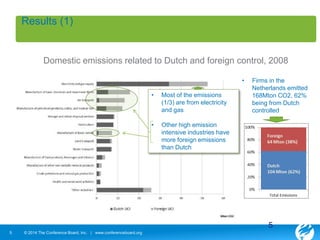
Domestic emissions related to Dutch and foreign control, 2008 
5 © 2014 The Conference Board, Inc. | www.conferenceboard.org 
• Firms in the 
Netherlands emitted 
168Mton CO2, 62% 
being from Dutch 
controlled 
5 
• Most of the emissions 
(1/3) are from electricity 
and gas 
• Other high emission 
intensive industries have 
more foreign emissions 
than Dutch
Results (2A) 
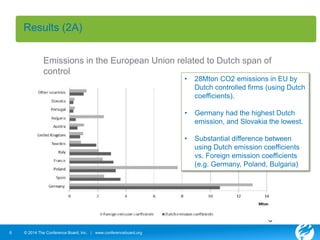
Emissions in the European Union related to Dutch span of 
control 
6 © 2014 The Conference Board, Inc. | www.conferenceboard.org 
• 28Mton CO2 emissions in EU by 
Dutch controlled firms (using Dutch 
coefficients). 
• Germany had the highest Dutch 
emission, and Slovakia the lowest. 
• Substantial difference between 
using Dutch emission coefficients 
vs. Foreign emission coefficients 
(e.g. Germany, Poland, Bulgaria) 
6
Results (2B) 
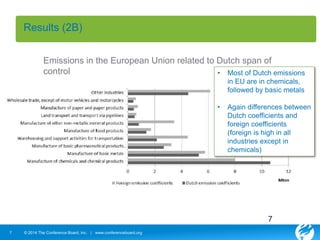
Emissions in the European Union related to Dutch span of 
control 
7 © 2014 The Conference Board, Inc. | www.conferenceboard.org 
• Most of Dutch emissions 
in EU are in chemicals, 
followed by basic metals 
• Again differences between 
Dutch coefficients and 
foreign coefficients 
(foreign is high in all 
industries except in 
chemicals) 
7
Results (3A) 
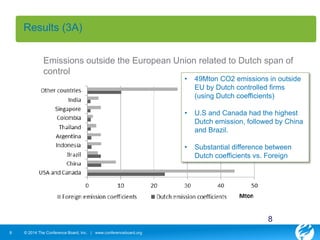
Emissions outside the European Union related to Dutch span of 
control 
8 © 2014 The Conference Board, Inc. | www.conferenceboard.org 
• 49Mton CO2 emissions in outside 
EU by Dutch controlled firms 
(using Dutch coefficients) 
• U.S and Canada had the highest 
Dutch emission, followed by China 
and Brazil. 
• Substantial difference between 
Dutch coefficients vs. Foreign 
8
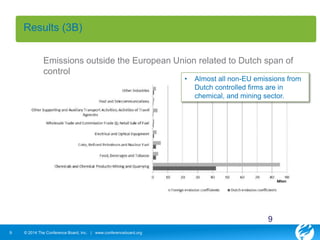
Results (3B) 
Emissions outside the European Union related to Dutch span of 
control 
9 © 2014 The Conference Board, Inc. | www.conferenceboard.org 
• Almost all non-EU emissions from 
Dutch controlled firms are in 
chemical, and mining sector. 
9
Results (4):Total emissions of Dutch controlled enterprises in the Netherlands and abroad 
10 © 2014 The Conference Board, Inc. | www.conferenceboard.org 
• 43% (104 Mton) of Dutch controlled 
emissions (242 Mton) are emitted by 
Dutch residents, and 57% (138 Mton) by 
foreign residents abroad. 
• Total emissions by Dutch controlled 
firms (242 Mton) are higher by 44% than 
production approach (168 Mton) 
[excluding households]. 
10
Conclusions and recommendations (1) 
Conclusions 
 EU:Dutch control in Germany, Spain and Poland goes along with a lot of 
emissions (chemical industry, basic metal industry and warehousing) 
 Non EU: Dutch control in USA, Canada, China and Brazil goes along 
with a lot of emissions (mining and quarring, chemical sector and food 
industry) 
 Foreign control in Dutch economy: especially relevant in energy sector, 
air transport and chemical sector 
 38 percent of resident emissions (production approach) are foreign 
controlled 
 Dutch controlled emissions are 44 percent larger than what the 
production approach would produce 
11 © 2014 The Conference Board, Inc. | www.conferenceboard.org 
11
Conclusions and recommendations (2) 
Recommendations: 
 Study is still in the learning phase 
 Quality of data on emissions of residents is better than data on 
emissions of non-residents. 
 In modelling emissions of non-residents: from a 2 digit level to a 3 or a 4 
digit level if possible (because aggregation level matters!) 
 NACE classification in FATS matters a lot! NACE classification not 
always perfect in FATS 
 In depth study of some eye catching enterprises could be worthwhile 
 Ambition: Time series! In order to monitor carbon leakage over time and 
to test the pollution haven hypothesis 
 Compare ‘control emissions’ with national income statistics in stead of 
with GDP! 
12 © 2014 The Conference Board, Inc. | www.conferenceboard.org 
12
Comments 
 Interesting paper, and important step in improving our understanding of who is 
responsible for CO2 emission and how much 
 Instead of taking employment as proxy for size of economy (in measuring 
emission intensity as emission/employment), why not use GDP. Since GDP is a 
good measure of production, and will also take care of labor productivity effect 
(employment can still be lower (hence high emission intensity), if labor 
productivity is high. 
 A better definition of how you define UCI 
 Assumption of emission intensity of Dutch firms in the Netherlands is same for 
a similar industry abroad 
 How realistic is this: can you say Phillips’s emission intensity in the Netherlands is 
same as in China or India 
 This is also against your intution that companies, for instance, engaged in mining are 
involved in exploration activities abroad, which is less emission intensive 
13 © 2014 The Conference Board, Inc. | www.conferenceboard.org
 In general, the use of Dutch coefficients produce lower emissions 
 What does this mean, does it implicitly state that Dutch industries within the Netherlands are more 
environmentally efficient, hence their coefficients are lower? 
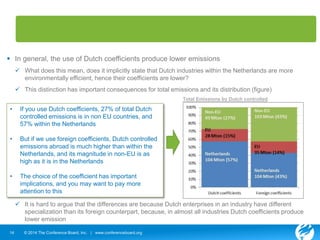
 This distinction has important consequences for total emissions and its distribution (figure) 
• If you use Dutch coefficients, 27% of total Dutch 
controlled emissions is in non EU countries, and 
57% within the Netherlands 
• But if we use foreign coefficients, Dutch controlled 
emissions abroad is much higher than within the 
Netherlands, and its magnitude in non-EU is as 
high as it is in the Netherlands 
• The choice of the coefficient has important 
implications, and you may want to pay more 
attention to this 
 It is hard to argue that the differences are because Dutch enterprises in an industry have different 
specialization than its foreign counterpart, because, in almost all industries Dutch coefficients produce 
lower emission 
14 © 2014 The Conference Board, Inc. | www.conferenceboard.org 
Total Emissions by Dutch controlled
Thank you for your attention! 
Questions, remarks? 
m.vanrossum@cbs.nl 
15 © 2014 The Conference Board, Inc. | www.conferenceboard.org

Session 7 c iariw august14 erumban

  • 1.
    Quantifying CO2-emissions accordingto the control-criterion in a globalizing world Maarten van Rossum, Cor Graveland, Sjoerd Schenau and Bram Edens Presentation and discussion by Abdul A Erumban Rotterdam, August 2014, IARIW conference 1 © 2014 The Conference Board, Inc. | www.conferenceboard.org
  • 2.
    Introduction and background  Globalisation; effects on the environment  Different ways to attributing CO2 emissions  Production approach, consumption approach, Kyoto reporting  From a GDP perspective to a national income perspective  Resident controlled and foreign controlled emissions  Develop a new approach to monitor CO2 responsibility  Allocate emissions according to span of control – By means of the Ultimate Controlling Institute: indicator for span of control  Question: How to asses CO2 –emissions according to the control criterion ‘span of control’ by enterprises and to what extent do these emissions deviate from emissions based on alternative approaches?  Which countries have ‘control’ over Dutch residents?  Which countries are ‘controlled’ by Dutch residents?  Which industries are important in bilateral control relationships? 2 © 2014 The Conference Board, Inc. | www.conferenceboard.org 2
  • 3.
    Data and methodology(1) Methodology used for foreign control in the Dutch economy 1. First allocate the available stationary emissions on micro level 2. Secondly, add mobile emissions based on meso-level info 3. Allocate rest of emissions based on employment-key (key of Ultimate Controlling Institute (1,0)) Data used for foreign control in the Dutch economy: 1. Micro information on CO2 emissions at statistical unit level (Energy Statistics & Environmental Statistics) 2. UCI information (0 or 1) on micro level (statistical unit) 3. Employment data on micro-level (statistical unit) 4. Emission accounts data at meso-level (stationairy emissions and emissions from mobile sources) 3 © 2014 The Conference Board, Inc. | www.conferenceboard.org 3
  • 4.
    Data and methodology(2) Methodology used for Dutch control in foreign economies: 1. Calculate emission per number of employees (including self-employed)  emission-intensity (X) 2. Multiply FATS employment data with ‘emission-intensity ‘at meso level 3. Control for differences in emission-intensity in different countries (index (emissions/production; NL=100) Data used for Dutch control in foreign economies: 1. Foreign Affiliates Statistics data of European countries (inward FATS European countries) and FATS data of non European countries (outward FATS NL) 2. Emission accounts data at meso-level (stationairy emissions and mobile emissions) 3. Labour accounts data at meso-level 4. WIOD data on differences in emission-intensity (emission/production) 4 © 2014 The Conference Board, Inc. | www.conferenceboard.org 4
  • 5.
    Results (1) Domesticemissions related to Dutch and foreign control, 2008 5 © 2014 The Conference Board, Inc. | www.conferenceboard.org • Firms in the Netherlands emitted 168Mton CO2, 62% being from Dutch controlled 5 • Most of the emissions (1/3) are from electricity and gas • Other high emission intensive industries have more foreign emissions than Dutch
  • 6.
    Results (2A) Emissionsin the European Union related to Dutch span of control 6 © 2014 The Conference Board, Inc. | www.conferenceboard.org • 28Mton CO2 emissions in EU by Dutch controlled firms (using Dutch coefficients). • Germany had the highest Dutch emission, and Slovakia the lowest. • Substantial difference between using Dutch emission coefficients vs. Foreign emission coefficients (e.g. Germany, Poland, Bulgaria) 6
  • 7.
    Results (2B) Emissionsin the European Union related to Dutch span of control 7 © 2014 The Conference Board, Inc. | www.conferenceboard.org • Most of Dutch emissions in EU are in chemicals, followed by basic metals • Again differences between Dutch coefficients and foreign coefficients (foreign is high in all industries except in chemicals) 7
  • 8.
    Results (3A) Emissionsoutside the European Union related to Dutch span of control 8 © 2014 The Conference Board, Inc. | www.conferenceboard.org • 49Mton CO2 emissions in outside EU by Dutch controlled firms (using Dutch coefficients) • U.S and Canada had the highest Dutch emission, followed by China and Brazil. • Substantial difference between Dutch coefficients vs. Foreign 8
  • 9.
    Results (3B) Emissionsoutside the European Union related to Dutch span of control 9 © 2014 The Conference Board, Inc. | www.conferenceboard.org • Almost all non-EU emissions from Dutch controlled firms are in chemical, and mining sector. 9
  • 10.
    Results (4):Total emissionsof Dutch controlled enterprises in the Netherlands and abroad 10 © 2014 The Conference Board, Inc. | www.conferenceboard.org • 43% (104 Mton) of Dutch controlled emissions (242 Mton) are emitted by Dutch residents, and 57% (138 Mton) by foreign residents abroad. • Total emissions by Dutch controlled firms (242 Mton) are higher by 44% than production approach (168 Mton) [excluding households]. 10
  • 11.
    Conclusions and recommendations(1) Conclusions  EU:Dutch control in Germany, Spain and Poland goes along with a lot of emissions (chemical industry, basic metal industry and warehousing)  Non EU: Dutch control in USA, Canada, China and Brazil goes along with a lot of emissions (mining and quarring, chemical sector and food industry)  Foreign control in Dutch economy: especially relevant in energy sector, air transport and chemical sector  38 percent of resident emissions (production approach) are foreign controlled  Dutch controlled emissions are 44 percent larger than what the production approach would produce 11 © 2014 The Conference Board, Inc. | www.conferenceboard.org 11
  • 12.
    Conclusions and recommendations(2) Recommendations:  Study is still in the learning phase  Quality of data on emissions of residents is better than data on emissions of non-residents.  In modelling emissions of non-residents: from a 2 digit level to a 3 or a 4 digit level if possible (because aggregation level matters!)  NACE classification in FATS matters a lot! NACE classification not always perfect in FATS  In depth study of some eye catching enterprises could be worthwhile  Ambition: Time series! In order to monitor carbon leakage over time and to test the pollution haven hypothesis  Compare ‘control emissions’ with national income statistics in stead of with GDP! 12 © 2014 The Conference Board, Inc. | www.conferenceboard.org 12
  • 13.
    Comments  Interestingpaper, and important step in improving our understanding of who is responsible for CO2 emission and how much  Instead of taking employment as proxy for size of economy (in measuring emission intensity as emission/employment), why not use GDP. Since GDP is a good measure of production, and will also take care of labor productivity effect (employment can still be lower (hence high emission intensity), if labor productivity is high.  A better definition of how you define UCI  Assumption of emission intensity of Dutch firms in the Netherlands is same for a similar industry abroad  How realistic is this: can you say Phillips’s emission intensity in the Netherlands is same as in China or India  This is also against your intution that companies, for instance, engaged in mining are involved in exploration activities abroad, which is less emission intensive 13 © 2014 The Conference Board, Inc. | www.conferenceboard.org
  • 14.
     In general,the use of Dutch coefficients produce lower emissions  What does this mean, does it implicitly state that Dutch industries within the Netherlands are more environmentally efficient, hence their coefficients are lower?  This distinction has important consequences for total emissions and its distribution (figure) • If you use Dutch coefficients, 27% of total Dutch controlled emissions is in non EU countries, and 57% within the Netherlands • But if we use foreign coefficients, Dutch controlled emissions abroad is much higher than within the Netherlands, and its magnitude in non-EU is as high as it is in the Netherlands • The choice of the coefficient has important implications, and you may want to pay more attention to this  It is hard to argue that the differences are because Dutch enterprises in an industry have different specialization than its foreign counterpart, because, in almost all industries Dutch coefficients produce lower emission 14 © 2014 The Conference Board, Inc. | www.conferenceboard.org Total Emissions by Dutch controlled
  • 15.
    Thank you foryour attention! Questions, remarks? m.vanrossum@cbs.nl 15 © 2014 The Conference Board, Inc. | www.conferenceboard.org

Editor's Notes

  • #3 Globalization is the key word of modern economic development, and indeed it has brought many fruits. However, it also comes with substantial environmental effect, by increasing pressure on environment due to pollution and depletion of natural resources. This makes it important to quantify pollution and depletion, and this paper is an attempt to quantify pollution measured by CO2 emissions, but from a different perspective. As we know there are many ways of quantifying and attributing CO2 emissions. This includes Kyoto reporting, production based approach, and consumption based approaches. Most of the policies are devised to reduce emissions that occur during production process. Netherlands however, have suggested to promote sustainable consumption by taking global production chain into account. This paper develops a new way of attributing CO2 emissions to countries, by allocating emissions according to span of control. Therefore, the main research question in this paper is how to assess CO2 emissions according to the span of control criterion? And which countries have control over Dutch residents? Which countries are controlled by Dutch residents? And which industries are important in bilateral control relationship
  • #4 In terms of data and methodology, the study distinguishes between foreign control in the Dutch economy and Dutch control in foreign economies. In the first step, the paper estimates stationary emissions of enterprises using micro level data, using information on energy use and energy related emissions. Using the ultimate control institute (frankly speaking, I have not got fully what it is and how is it defined), these micro level emissions are assigned to either Dutch controlled firms or foreign firms. Subsequently, they add emissions from mobile sources available at industry level. Again these are assigned using the Dutch/Foreign ration that is obtained in the first step. The remaining emissions are distributed proportionally across industries using employment distribution. Finally, they obtain a distribution of total emissions, assigned to Dutch controlled firms and foreign controlled firms.
  • #5 To estimate the emissions from Dutch controlled enterprises abroad, they make an important assumption that the emission intensity of the Dutch controlled firms abroad are same as the intensity of a similar industry in the Netherlands. Then they multiply the emission intensity of the Dutch industry with the number of employees in a Dutch controlled enterprise abroad. However, they also estimate the emissions abroad using foreign emission intensity, obtained from the WIOD database.
  • #6 This chart provides the picture of domestic emissions related to Dutch and foreing control. Out of 168 Mton CO2 emissions in the Netherlands, 62% was from Dutch controlled firms, while the rest was from foreign controlled firms. There is supposed to be a figure 2 in the paper, but unfortunately, it had some drawing error and I could not get it rightly. It was quite late by then I realized that it was not there, so I did not ask Maarten about it.
  • #7 The largest presence in Germany might be due to a lot of Dutch controlled employment is located in Germany, and are emission intensive activities, such as chemcisls, pharmasuticals, basic metals and food.
  • #8 Here also we see that most of the emissions are from chemicals sector, followed by basic metals. The difference between foreign and domestic emission coefficients, is attributed to different production processes and efficiency, and different levels of specialization.