





Measuring Capital Stock and Capital 
Services in China, 1949-2012 
Author: Harry X. Wu 
(Hitotsubashi University) 
Discussant: Ilya B. Voskoboynikov 
(Higher School of Economics and GGDC) 
IARIW 33rd General Conference. Session 7B, August 29, 2014
Paper: Research Question (1/2) 
• What has been happening with capital input in industries 
of the Chinese economy in 1949-2012? 
• The present study aims to 
• extend the author’s earlier efforts in this on the 
industrial sector and non-industrial sector 
(Wu and Xu 2002; Wu 2008, 2013); 
• integrate all sectors of the economy; 
• reconcile the results with the System of National 
Accounts for China.
Paper: Research Question (2/2) 
• The priority of the study is building capital input series 
with 
• making the best use of all relevant data available; 
• focusing on measurement issues rather than 
developing theoretical or methodological aspects of 
the problem. 
• Motivation 
• Appropriate industries-level capital series are 
essential for the p r o d u c t i v i t y a n a l y s i s .
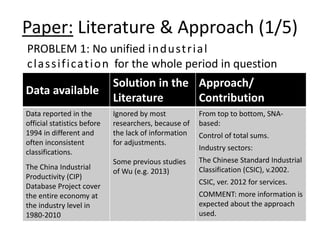
Paper: Literature & Approach (1/5) 
PROBLEM 1: No unified indust r ial 
c las s i f icat ion for the whole period in question 
Data available 
Solution in the 
Literature 
Approach/ 
Contribution 
Data reported in the 
official statistics before 
1994 in different and 
often inconsistent 
classifications. 
The China Industrial 
Productivity (CIP) 
Database Project cover 
the entire economy at 
the industry level in 
1980-2010 
Ignored by most 
researchers, because of 
the lack of information 
for adjustments. 
Some previous studies 
of Wu (e.g. 2013) 
From top to bottom, SNA-based: 
Control of total sums. 
Industry sectors: 
The Chinese Standard Industrial 
Classification (CSIC), v.2002. 
CSIC, ver. 2012 for services. 
COMMENT: more information is 
expected about the approach 
used.
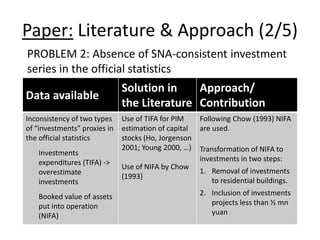
Paper: Literature & Approach (2/5) 
PROBLEM 2: Absence of SNA-consistent investment 
series in the official statistics 
Data available 
Solution in 
the Literature 
Approach/ 
Contribution 
Inconsistency of two types 
of “investments” proxies in 
the official statistics 
Investments 
expenditures (TIFA) -> 
overestimate 
investments 
Booked value of assets 
put into operation 
(NIFA) 
Use of TIFA for PIM 
estimation of capital 
stocks (Ho, Jorgenson 
2001; Young 2000, …) 
Use of NIFA by Chow 
(1993) 
Following Chow (1993) NIFA 
are used. 
Transformation of NIFA to 
investments in two steps: 
1. Removal of investments 
to residential buildings. 
2. Inclusion of investments 
projects less than ½ mn 
yuan
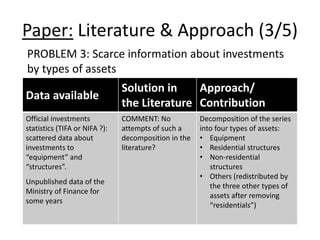
Paper: Literature & Approach (3/5) 
PROBLEM 3: Scarce information about investments 
by types of assets 
Data available 
Solution in 
the Literature 
Approach/ 
Contribution 
Official investments 
statistics (TIFA or NIFA ?): 
scattered data about 
investments to 
“equipment” and 
“structures”. 
Unpublished data of the 
Ministry of Finance for 
some years 
COMMENT: No 
attempts of such a 
decomposition in the 
literature? 
Decomposition of the series 
into four types of assets: 
• Equipment 
• Residential structures 
• Non-residential 
structures 
• Others (redistributed by 
the three other types of 
assets after removing 
“residentials”)
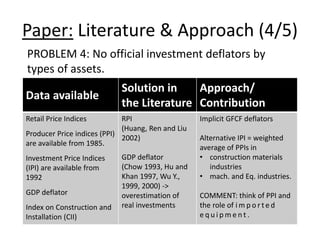
Paper: Literature & Approach (4/5) 
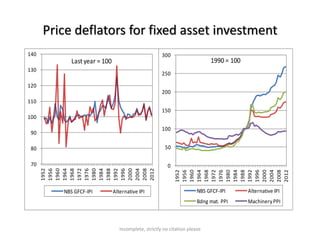
PROBLEM 4: No official investment deflators by 
types of assets. 
Data available 
Solution in 
the Literature 
Approach/ 
Contribution 
Retail Price Indices 
Producer Price indices (PPI) 
are available from 1985. 
Investment Price Indices 
(IPI) are available from 
1992 
GDP deflator 
Index on Construction and 
Installation (CII) 
RPI 
(Huang, Ren and Liu 
2002) 
GDP deflator 
(Chow 1993, Hu and 
Khan 1997, Wu Y., 
1999, 2000) -> 
overestimation of 
real investments 
Implicit GFCF deflators 
Alternative IPI = weighted 
average of PPIs in 
• construction materials 
industries 
• mach. and Eq. industries. 
COMMENT: think of PPI and 
the role of imp o r t e d 
e q u i pme n t .
Price deflators for fixed asset investment 
300 
250 
200 
150 
100 
50 
0 
1952 
1956 
1960 
1964 
1968 
1972 
1976 
1980 
1984 
1988 
1992 
1996 
2000 
2004 
2008 
2012 
Incomplete, strictly no citation please 
1990 = 100 
NBS GFCF-IPI Alternative IPI 
Bdng mat. PPI Machinery PPI 
140 
130 
120 
110 
100 
90 
80 
70 
Last year = 100 
1952 
1956 
1960 
1964 
1968 
1972 
1976 
1980 
1984 
1988 
1992 
1996 
2000 
2004 
2008 
2012 
NBS GFCF-IPI Alternative IPI
Paper: Literature & Approach (5/5) 
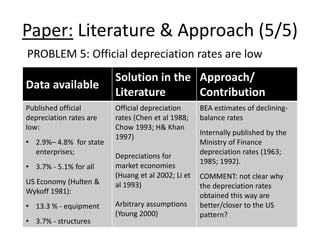
PROBLEM 5: Official depreciation rates are low 
Data available 
Solution in the 
Literature 
Approach/ 
Contribution 
Published official 
depreciation rates are 
low: 
• 2.9%– 4.8% for state 
enterprises; 
• 3.7% - 5.1% for all 
US Economy (Hulten & 
Wykoff 1981): 
• 13.3 % - equipment 
• 3.7% - structures 
Official depreciation 
rates (Chen et al 1988; 
Chow 1993; H& Khan 
1997) 
Depreciations for 
market economies 
(Huang et al 2002; Li et 
al 1993) 
Arbitrary assumptions 
(Young 2000) 
BEA estimates of declining-balance 
rates 
Internally published by the 
Ministry of Finance 
depreciation rates (1963; 
1985; 1992). 
COMMENT: not clear why 
the depreciation rates 
obtained this way are 
better/closer to the US 
pattern?
10 
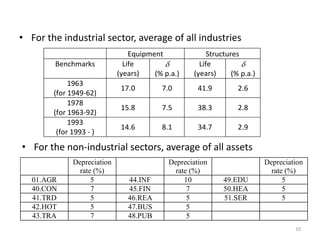
• For the industrial sector, average of all industries 
Equipment Structures 
Benchmarks 
Life 
(years) 
 
(% p.a.) 
Life 
(years) 
 
(% p.a.) 
1963 
(for 1949-62) 
17.0 7.0 41.9 2.6 
1978 
(for 1963-92) 
15.8 7.5 38.3 2.8 
1993 
(for 1993 - ) 
14.6 8.1 34.7 2.9 
• For the non-industrial sectors, average of all assets 
Depreciation 
rate (%) 
Depreciation 
rate (%) 
Depreciation 
rate (%) 
01.AGR 5 44.INF 10 49.EDU 5 
40.CON 7 45.FIN 7 50.HEA 5 
41.TRD 5 46.REA 5 51.SER 5 
42.HOT 5 47.BUS 5 
43.TRA 7 48.PUB 5
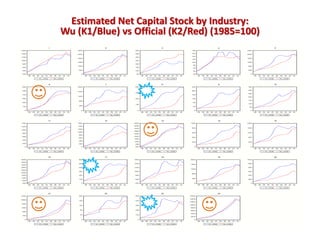
Estimated Net Capital Stock by Industry: 
Wu (K1/Blue) vs Official (K2/Red) (1985=100) 
1600 
1400 
1200 
1000 
800 
600 
400 
200 
1 
86 88 90 92 94 96 98 00 02 04 
K1_LEVEL K2_LEVEL 
3000 
2500 
2000 
1500 
1000 
500 
0 
2 
86 88 90 92 94 96 98 00 02 04 
K1_LEVEL K2_LEVEL 
400 
350 
300 
250 
200 
150 
100 
50 
3 
86 88 90 92 94 96 98 00 02 04 
K1_LEVEL K2_LEVEL 
180 
160 
140 
120 
100 
80 
60 
40 
20 
4 
86 88 90 92 94 96 98 00 02 04 
K1_LEVEL K2_LEVEL 
2400 
2000 
1600 
1200 
800 
400 
0 
5 
86 88 90 92 94 96 98 00 02 04 
K1_LEVEL K2_LEVEL 
600 
500 
400 
300 
200 
100 
0 
6 
86 88 90 92 94 96 98 00 02 04 
K1_LEVEL K2_LEVEL 
2000 
1600 
1200 
800 
400 
0 
7 
86 88 90 92 94 96 98 00 02 04 
K1_LEVEL K2_LEVEL 
400 
300 
200 
100 
0 
8 
86 88 90 92 94 96 98 00 02 04 
K1_LEVEL K2_LEVEL 
240 
200 
160 
120 
80 
40 
0 
9 
86 88 90 92 94 96 98 00 02 04 
K1_LEVEL K2_LEVEL 
350 
300 
250 
200 
150 
100 
50 
0 
10 
86 88 90 92 94 96 98 00 02 04 
K1_LEVEL K2_LEVEL 
1400 
1200 
1000 
800 
600 
400 
200 
0 
11 
86 88 90 92 94 96 98 00 02 04 
K1_LEVEL K2_LEVEL 
1600 
1400 
1200 
1000 
800 
600 
400 
200 
0 
12 
86 88 90 92 94 96 98 00 02 04 
K1_LEVEL K2_LEVEL 
4000 
3600 
3200 
2800 
2400 
2000 
1600 
1200 
800 
400 
13 
86 88 90 92 94 96 98 00 02 04 
K1_LEVEL K2_LEVEL 
1000 
800 
600 
400 
200 
0 
14 
86 88 90 92 94 96 98 00 02 04 
K1_LEVEL K2_LEVEL 
2000 
1600 
1200 
800 
400 
0 
15 
86 88 90 92 94 96 98 00 02 04 
K1_LEVEL K2_LEVEL 
4000 
3600 
3200 
2800 
2400 
2000 
1600 
1200 
800 
400 
16 
86 88 90 92 94 96 98 00 02 04 
K1_LEVEL K2_LEVEL 
600 
500 
400 
300 
200 
100 
0 
17 
86 88 90 92 94 96 98 00 02 04 
K1_LEVEL K2_LEVEL 
1600 
1400 
1200 
1000 
800 
600 
400 
18 
86 88 90 92 94 96 98 00 02 04 
K1_LEVEL K2_LEVEL 
2000 
1600 
1200 
800 
400 
0 
19 
86 88 90 92 94 96 98 00 02 04 
K1_LEVEL K2_LEVEL 
1200 
1000 
800 
600 
400 
200 
0 
20 
86 88 90 92 94 96 98 00 02 04 
K1_LEVEL K2_LEVEL 
2400 
2000 
1600 
1200 
800 
400 
0 
21 
86 88 90 92 94 96 98 00 02 04 
K1_LEVEL K2_LEVEL 
200 
160 
120 
80 
40 
0 
22 
86 88 90 92 94 96 98 00 02 04 
K1_LEVEL K2_LEVEL 
500 
400 
300 
200 
100 
0 
23 
86 88 90 92 94 96 98 00 02 04 
K1_LEVEL K2_LEVEL 
16000 
14000 
12000 
10000 
8000 
6000 
4000 
2000 
0 
24 
86 88 90 92 94 96 98 00 02 04 
K1_LEVEL K2_LEVEL
Discussion: General Comments 
• The following sections of the paper are expected: 
• User Cost of Capital and Estimates of Capital services; 
• Sources of data for the industrial sector; 
• Estimating Investment Flows for the Nonindustrial 
Sectors; 
• Concluding remarks. 
• The list of references has not been completed. 
• Structure: Informal economy unexpectedly appears in 
section 8.
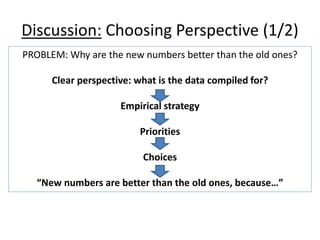
Discussion: Choosing Perspective (1/2) 
PROBLEM: Why are the new numbers better than the old ones? 
Clear perspective: what is the data compiled for? 
Empirical strategy 
Priorities 
Choices 
“New numbers are better than the old ones, because…”
Discussion: Choosing Perspective (2/2) 
• Aim of this estimation is not clear 
• SNA/Consumption of fixed capital OR productivity 
analysis? 
• SNA: (Schreyer 2001;2009) 
• PIM versus direct observations for capital stocks 
(Bratanova 2003) 
• Chinese economy in time OR in the comparative 
perspective (e.g. World KLEMS framework)? 
• China itself – specific depreciation rates; 
• World KLEMS – comparative framework; 
BEA/(Fraumeni 1997) depreciation rates
Discussion: Some Suggestions 
• What is the aim of this capital series construction: growth accounting, 
consumption of fixed capital for SNA or something else? 
• Update terminology in line with Bratanova (2003) and 
OECD (2001; 2009) 
• Some discussion and further explanations are expected on the concept 
of capital stocks and capital services in planned economy 
• Literature on capital stocks in planned/transition economies in 
comparison with the West (Bergson, Ofer, Maddison, Bratanova) 
• Attention to investment deflators! Do we really gain using so detailed 
industry level deflators? (signal-noise ratio) 
• Quantitative analysis of importance of each adjustment -> update of 
the structure of the paper
Thank you!

Session 7 b 2014 08-29 voskob wu

  • 1.
    Measuring Capital Stockand Capital Services in China, 1949-2012 Author: Harry X. Wu (Hitotsubashi University) Discussant: Ilya B. Voskoboynikov (Higher School of Economics and GGDC) IARIW 33rd General Conference. Session 7B, August 29, 2014
  • 2.
    Paper: Research Question(1/2) • What has been happening with capital input in industries of the Chinese economy in 1949-2012? • The present study aims to • extend the author’s earlier efforts in this on the industrial sector and non-industrial sector (Wu and Xu 2002; Wu 2008, 2013); • integrate all sectors of the economy; • reconcile the results with the System of National Accounts for China.
  • 3.
    Paper: Research Question(2/2) • The priority of the study is building capital input series with • making the best use of all relevant data available; • focusing on measurement issues rather than developing theoretical or methodological aspects of the problem. • Motivation • Appropriate industries-level capital series are essential for the p r o d u c t i v i t y a n a l y s i s .
  • 4.
    Paper: Literature &Approach (1/5) PROBLEM 1: No unified indust r ial c las s i f icat ion for the whole period in question Data available Solution in the Literature Approach/ Contribution Data reported in the official statistics before 1994 in different and often inconsistent classifications. The China Industrial Productivity (CIP) Database Project cover the entire economy at the industry level in 1980-2010 Ignored by most researchers, because of the lack of information for adjustments. Some previous studies of Wu (e.g. 2013) From top to bottom, SNA-based: Control of total sums. Industry sectors: The Chinese Standard Industrial Classification (CSIC), v.2002. CSIC, ver. 2012 for services. COMMENT: more information is expected about the approach used.
  • 5.
    Paper: Literature &Approach (2/5) PROBLEM 2: Absence of SNA-consistent investment series in the official statistics Data available Solution in the Literature Approach/ Contribution Inconsistency of two types of “investments” proxies in the official statistics Investments expenditures (TIFA) -> overestimate investments Booked value of assets put into operation (NIFA) Use of TIFA for PIM estimation of capital stocks (Ho, Jorgenson 2001; Young 2000, …) Use of NIFA by Chow (1993) Following Chow (1993) NIFA are used. Transformation of NIFA to investments in two steps: 1. Removal of investments to residential buildings. 2. Inclusion of investments projects less than ½ mn yuan
  • 6.
    Paper: Literature &Approach (3/5) PROBLEM 3: Scarce information about investments by types of assets Data available Solution in the Literature Approach/ Contribution Official investments statistics (TIFA or NIFA ?): scattered data about investments to “equipment” and “structures”. Unpublished data of the Ministry of Finance for some years COMMENT: No attempts of such a decomposition in the literature? Decomposition of the series into four types of assets: • Equipment • Residential structures • Non-residential structures • Others (redistributed by the three other types of assets after removing “residentials”)
  • 7.
    Paper: Literature &Approach (4/5) PROBLEM 4: No official investment deflators by types of assets. Data available Solution in the Literature Approach/ Contribution Retail Price Indices Producer Price indices (PPI) are available from 1985. Investment Price Indices (IPI) are available from 1992 GDP deflator Index on Construction and Installation (CII) RPI (Huang, Ren and Liu 2002) GDP deflator (Chow 1993, Hu and Khan 1997, Wu Y., 1999, 2000) -> overestimation of real investments Implicit GFCF deflators Alternative IPI = weighted average of PPIs in • construction materials industries • mach. and Eq. industries. COMMENT: think of PPI and the role of imp o r t e d e q u i pme n t .
  • 8.
    Price deflators forfixed asset investment 300 250 200 150 100 50 0 1952 1956 1960 1964 1968 1972 1976 1980 1984 1988 1992 1996 2000 2004 2008 2012 Incomplete, strictly no citation please 1990 = 100 NBS GFCF-IPI Alternative IPI Bdng mat. PPI Machinery PPI 140 130 120 110 100 90 80 70 Last year = 100 1952 1956 1960 1964 1968 1972 1976 1980 1984 1988 1992 1996 2000 2004 2008 2012 NBS GFCF-IPI Alternative IPI
  • 9.
    Paper: Literature &Approach (5/5) PROBLEM 5: Official depreciation rates are low Data available Solution in the Literature Approach/ Contribution Published official depreciation rates are low: • 2.9%– 4.8% for state enterprises; • 3.7% - 5.1% for all US Economy (Hulten & Wykoff 1981): • 13.3 % - equipment • 3.7% - structures Official depreciation rates (Chen et al 1988; Chow 1993; H& Khan 1997) Depreciations for market economies (Huang et al 2002; Li et al 1993) Arbitrary assumptions (Young 2000) BEA estimates of declining-balance rates Internally published by the Ministry of Finance depreciation rates (1963; 1985; 1992). COMMENT: not clear why the depreciation rates obtained this way are better/closer to the US pattern?
  • 10.
    10 • Forthe industrial sector, average of all industries Equipment Structures Benchmarks Life (years)  (% p.a.) Life (years)  (% p.a.) 1963 (for 1949-62) 17.0 7.0 41.9 2.6 1978 (for 1963-92) 15.8 7.5 38.3 2.8 1993 (for 1993 - ) 14.6 8.1 34.7 2.9 • For the non-industrial sectors, average of all assets Depreciation rate (%) Depreciation rate (%) Depreciation rate (%) 01.AGR 5 44.INF 10 49.EDU 5 40.CON 7 45.FIN 7 50.HEA 5 41.TRD 5 46.REA 5 51.SER 5 42.HOT 5 47.BUS 5 43.TRA 7 48.PUB 5
  • 11.
    Estimated Net CapitalStock by Industry: Wu (K1/Blue) vs Official (K2/Red) (1985=100) 1600 1400 1200 1000 800 600 400 200 1 86 88 90 92 94 96 98 00 02 04 K1_LEVEL K2_LEVEL 3000 2500 2000 1500 1000 500 0 2 86 88 90 92 94 96 98 00 02 04 K1_LEVEL K2_LEVEL 400 350 300 250 200 150 100 50 3 86 88 90 92 94 96 98 00 02 04 K1_LEVEL K2_LEVEL 180 160 140 120 100 80 60 40 20 4 86 88 90 92 94 96 98 00 02 04 K1_LEVEL K2_LEVEL 2400 2000 1600 1200 800 400 0 5 86 88 90 92 94 96 98 00 02 04 K1_LEVEL K2_LEVEL 600 500 400 300 200 100 0 6 86 88 90 92 94 96 98 00 02 04 K1_LEVEL K2_LEVEL 2000 1600 1200 800 400 0 7 86 88 90 92 94 96 98 00 02 04 K1_LEVEL K2_LEVEL 400 300 200 100 0 8 86 88 90 92 94 96 98 00 02 04 K1_LEVEL K2_LEVEL 240 200 160 120 80 40 0 9 86 88 90 92 94 96 98 00 02 04 K1_LEVEL K2_LEVEL 350 300 250 200 150 100 50 0 10 86 88 90 92 94 96 98 00 02 04 K1_LEVEL K2_LEVEL 1400 1200 1000 800 600 400 200 0 11 86 88 90 92 94 96 98 00 02 04 K1_LEVEL K2_LEVEL 1600 1400 1200 1000 800 600 400 200 0 12 86 88 90 92 94 96 98 00 02 04 K1_LEVEL K2_LEVEL 4000 3600 3200 2800 2400 2000 1600 1200 800 400 13 86 88 90 92 94 96 98 00 02 04 K1_LEVEL K2_LEVEL 1000 800 600 400 200 0 14 86 88 90 92 94 96 98 00 02 04 K1_LEVEL K2_LEVEL 2000 1600 1200 800 400 0 15 86 88 90 92 94 96 98 00 02 04 K1_LEVEL K2_LEVEL 4000 3600 3200 2800 2400 2000 1600 1200 800 400 16 86 88 90 92 94 96 98 00 02 04 K1_LEVEL K2_LEVEL 600 500 400 300 200 100 0 17 86 88 90 92 94 96 98 00 02 04 K1_LEVEL K2_LEVEL 1600 1400 1200 1000 800 600 400 18 86 88 90 92 94 96 98 00 02 04 K1_LEVEL K2_LEVEL 2000 1600 1200 800 400 0 19 86 88 90 92 94 96 98 00 02 04 K1_LEVEL K2_LEVEL 1200 1000 800 600 400 200 0 20 86 88 90 92 94 96 98 00 02 04 K1_LEVEL K2_LEVEL 2400 2000 1600 1200 800 400 0 21 86 88 90 92 94 96 98 00 02 04 K1_LEVEL K2_LEVEL 200 160 120 80 40 0 22 86 88 90 92 94 96 98 00 02 04 K1_LEVEL K2_LEVEL 500 400 300 200 100 0 23 86 88 90 92 94 96 98 00 02 04 K1_LEVEL K2_LEVEL 16000 14000 12000 10000 8000 6000 4000 2000 0 24 86 88 90 92 94 96 98 00 02 04 K1_LEVEL K2_LEVEL
  • 12.
    Discussion: General Comments • The following sections of the paper are expected: • User Cost of Capital and Estimates of Capital services; • Sources of data for the industrial sector; • Estimating Investment Flows for the Nonindustrial Sectors; • Concluding remarks. • The list of references has not been completed. • Structure: Informal economy unexpectedly appears in section 8.
  • 13.
    Discussion: Choosing Perspective(1/2) PROBLEM: Why are the new numbers better than the old ones? Clear perspective: what is the data compiled for? Empirical strategy Priorities Choices “New numbers are better than the old ones, because…”
  • 14.
    Discussion: Choosing Perspective(2/2) • Aim of this estimation is not clear • SNA/Consumption of fixed capital OR productivity analysis? • SNA: (Schreyer 2001;2009) • PIM versus direct observations for capital stocks (Bratanova 2003) • Chinese economy in time OR in the comparative perspective (e.g. World KLEMS framework)? • China itself – specific depreciation rates; • World KLEMS – comparative framework; BEA/(Fraumeni 1997) depreciation rates
  • 15.
    Discussion: Some Suggestions • What is the aim of this capital series construction: growth accounting, consumption of fixed capital for SNA or something else? • Update terminology in line with Bratanova (2003) and OECD (2001; 2009) • Some discussion and further explanations are expected on the concept of capital stocks and capital services in planned economy • Literature on capital stocks in planned/transition economies in comparison with the West (Bergson, Ofer, Maddison, Bratanova) • Attention to investment deflators! Do we really gain using so detailed industry level deflators? (signal-noise ratio) • Quantitative analysis of importance of each adjustment -> update of the structure of the paper
  • 16.