MEASURING GLOBAL PRODUCTION 
IN THE NATIONAL ACCOUNTS AND 
THE BALANCE OF PAYMENTS 
BY MARK DE HAAN, MICHAEL CONNOLLY, 
TIHOMIRA DIMOVA, RAMI PELTOLA 
Discussant comments 
IARIW 33rd General Conference 
Rotterdam, the Netherlands, August 24-30, 2014 
Jennifer Ribarsky, OECD
Main issues 
Paper reflects on the work of the UNECE Task 
Force on Global Production (TFGP). 
Main issues covered are: 
• Summary of findings of the TFGP; 
• Overview of the Guide to Measuring Global 
Production; 
• Implications of Globalization for economic 
analysis; 
• Conclusions and recommendations. 
2
Summary of main findings 
• Global fragmentation of value chains is 
increasingly a challenge for NA and BoP 
compilers; 
• Organisation of MNE Groups is often tax 
driven, seemingly leading to legal/economic 
ownership disparities. 
• Accounting for global production can be very 
demanding in terms of data sources and 
human resources. 
 Global production will keep statistics 
compilers busy for some time to come. 
3
Overview of the Guide to Measuring 
Global Production 
Conceptual framework: 
• Typology of global production 
arrangements; 
Main purpose: identifying the specific roles of 
units active in these chains, dealing with 
ownership issues, recording of transactions. 
• Factoryless Goods Producers; 
i.e. those companies outsourcing all aspects of 
material transformation. 
4
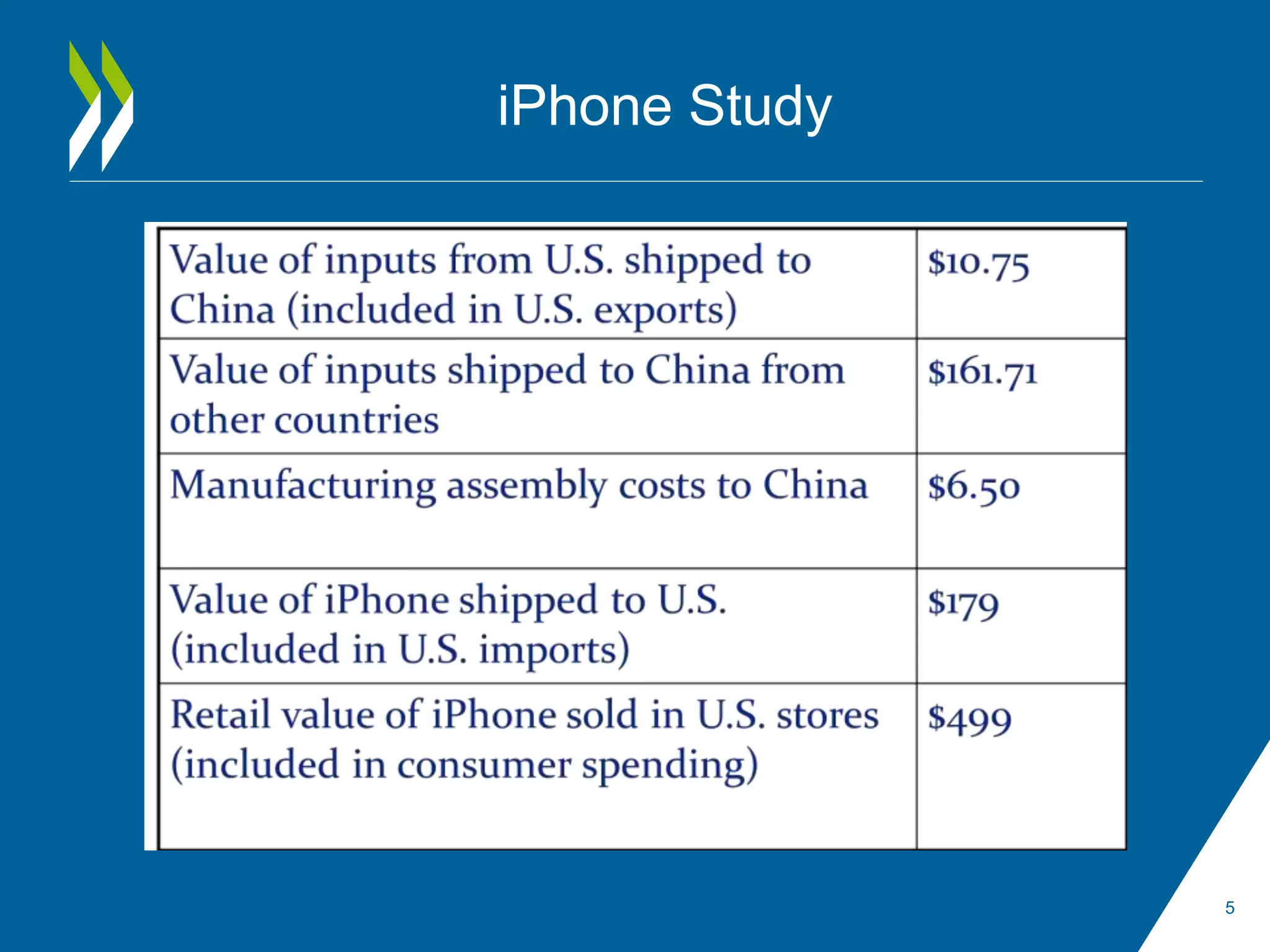
iPhone Study 
5
Overview of Guide 
Conceptual framework continued 
• Principles of economic ownership, 
particularly in the area of intellectual 
property products. 
– Decision tree; 
– Royalty and licences SPEs. 
6
Overview of the Guide to Measuring 
Global Production 
Practical issues: 
• Guidance on overcoming data gaps 
(territory versus ownership recording) 
• Role of so-called Large and complex Cases Units 
Based on a specific survey collecting NSI experiences 
• Specific topics: 
– Multiterritory enterprises; 
– Quasi-transit trade; 
– Trade in value-added; 
– Merchanting of services. 
7
Implications for economic analysis 
• Industrial classification (ISIC) does not 
indicate the role of an entity in a global 
production arrangement 
- Can entail a variety of fragments; 
- Which may affect (IO) analysis (homogeneity 
of coefficients) 
8
Productivity analysis 
• Productivity analysis 
– Brass-plate type of companies with sometimes 
huge turnover; 
– Specific aspects of price and volume 
measurement; 
– ‘Distribution’ of productivity gains from the 
FGP to the contract producer. 
9
International trade 
• International trade 
– Enlarging of gross trade flows 
(imports/exports) 
– Intra-company services 
10
TFGP’s main recommendations: 
• Testing and further improving typology; 
• FGPs are manufacturers; 
• Sub-classify Royalty SPE related flows 
(output, international trade in services); 
• Explicit reporting in surveys on intra-group 
trade in services; 
• Install “large case units”; 
• Develop price measurement where needed in 
global production specific areas. 
• Facilitate exchange of experiences. 
11
Comments/Discussion points 
• Is GDP still the appropriate featured 
measure of a country’s economic activity 
or should it be GNI? 
• What is manufacturing and where is it 
happening? 
• How can use of intangibles be tracked 
within an multinational enterprise? 
12
Comments/Discussion points 
• Does the classification of a variety of units 
under manufacturing lead to too much 
heterogenity of production 
functions…making the IO coefficients on 
average meaningless? 
– Leading units -VM, processing, factoryless 
– Contract producers- providing manufacturing 
services or goods ex. IPP. 
13

Session 7 c de haan measuring global production in na_bp

  • 1.
    MEASURING GLOBAL PRODUCTION IN THE NATIONAL ACCOUNTS AND THE BALANCE OF PAYMENTS BY MARK DE HAAN, MICHAEL CONNOLLY, TIHOMIRA DIMOVA, RAMI PELTOLA Discussant comments IARIW 33rd General Conference Rotterdam, the Netherlands, August 24-30, 2014 Jennifer Ribarsky, OECD
  • 2.
    Main issues Paperreflects on the work of the UNECE Task Force on Global Production (TFGP). Main issues covered are: • Summary of findings of the TFGP; • Overview of the Guide to Measuring Global Production; • Implications of Globalization for economic analysis; • Conclusions and recommendations. 2
  • 3.
    Summary of mainfindings • Global fragmentation of value chains is increasingly a challenge for NA and BoP compilers; • Organisation of MNE Groups is often tax driven, seemingly leading to legal/economic ownership disparities. • Accounting for global production can be very demanding in terms of data sources and human resources.  Global production will keep statistics compilers busy for some time to come. 3
  • 4.
    Overview of theGuide to Measuring Global Production Conceptual framework: • Typology of global production arrangements; Main purpose: identifying the specific roles of units active in these chains, dealing with ownership issues, recording of transactions. • Factoryless Goods Producers; i.e. those companies outsourcing all aspects of material transformation. 4
  • 5.
  • 6.
    Overview of Guide Conceptual framework continued • Principles of economic ownership, particularly in the area of intellectual property products. – Decision tree; – Royalty and licences SPEs. 6
  • 7.
    Overview of theGuide to Measuring Global Production Practical issues: • Guidance on overcoming data gaps (territory versus ownership recording) • Role of so-called Large and complex Cases Units Based on a specific survey collecting NSI experiences • Specific topics: – Multiterritory enterprises; – Quasi-transit trade; – Trade in value-added; – Merchanting of services. 7
  • 8.
    Implications for economicanalysis • Industrial classification (ISIC) does not indicate the role of an entity in a global production arrangement - Can entail a variety of fragments; - Which may affect (IO) analysis (homogeneity of coefficients) 8
  • 9.
    Productivity analysis •Productivity analysis – Brass-plate type of companies with sometimes huge turnover; – Specific aspects of price and volume measurement; – ‘Distribution’ of productivity gains from the FGP to the contract producer. 9
  • 10.
    International trade •International trade – Enlarging of gross trade flows (imports/exports) – Intra-company services 10
  • 11.
    TFGP’s main recommendations: • Testing and further improving typology; • FGPs are manufacturers; • Sub-classify Royalty SPE related flows (output, international trade in services); • Explicit reporting in surveys on intra-group trade in services; • Install “large case units”; • Develop price measurement where needed in global production specific areas. • Facilitate exchange of experiences. 11
  • 12.
    Comments/Discussion points •Is GDP still the appropriate featured measure of a country’s economic activity or should it be GNI? • What is manufacturing and where is it happening? • How can use of intangibles be tracked within an multinational enterprise? 12
  • 13.
    Comments/Discussion points •Does the classification of a variety of units under manufacturing lead to too much heterogenity of production functions…making the IO coefficients on average meaningless? – Leading units -VM, processing, factoryless – Contract producers- providing manufacturing services or goods ex. IPP. 13

Editor's Notes

  • #5 The typology starts with a description of the production process from the view point of the domestic entity. It identifites the specific roles of units active ion these chains (from a lead unit called a principal– who is said to control (or drive) the production process to other units participating in the process). It identifies ownership of the inputs (materials, intellectual property), output within these chains and discusses the international transactions related to the production process.
  • #6 ‘’margin’’ 499 – 179 = 320… most of that margin is return on the IPP and not a simple trade margin. 64%
  • #7 In the national accounts and the balance of payments the recording of product transactions on the basis of economic ownership change is a fundamental principle. However, in the context of global production the identification of changes in the ownership of goods and assets can be quite a challenge to statistical compilers. This is particularly true for the globalized production activities of multinational enterprises (MNEs). Not always be easy to breakdown these activities straightforwardly on a country-by-country basis. R&D is often regarded as corporate property and assigning R&D ownership to the head office (or the affiliated company using the R&D in their production activities is not straightforward). Determining the economic ownership of IPP observed in a global production chain. These are brass plate entities inside MNEs that has the legal ownership of the IPP with the purpose of cumulating related revenues in low tax jurisdictions.
  • #8 Large case units- NSIs attempt to map the international transactions of the largest and most complex multinational companies on a case-by-case basis. Mulit-territory enterprises- operations are physically spread over more than one country. Necessary to split the operations between economies. Examples given in the guide is an airline seemlessly operating over 3 separate economies. Quasi transit trade occurs when goods enter an economy and are declared as imports for customs purposes at values that differ from those that are declared when the goods leave the same territory. Import values that differ from actual transaction values. Trade in value added essentially tries to deconstruct the gross trade flows into the value that is added by a country in the production of any good or service that is exported. Merchanting of services- or services subcontracting. The purchase and resale of a service without any physical transformation. Although clear evidence is still limited and scattered, it seems that the international trading of services through an intermediary is a newly emerging business model.
  • #9 The recognition that firms classified to the same industry (integrated manufacturers, firms leading a ‘’processing’’ type relationship, firms leading a factoryless arrangement, contract producers (manufacturing service providers). Unless
  • #10 One possible outcome under FGP is that the R&D performed by the principal will be generating gains at the level of the contract producer.
  • #11 The increasing significance of global production will inevitably inflate trade flows as measured on the basis of cross border registration. Moving towards a recording of imports and exports on a strict ownership basis helps with the problem of trade inflation. Measuring the flows of services inside GVCs within MNEs is particularily challenging. For many managerial or R&D services provided by head offices or dedicated R&D units cost redistribution mechanisms are not always recorded by the MNE.