Peter van de Ven (OECD): The 
Implementation of the 2008 SNA and the 
Main Challenges for the Future Development 
of National Accounts 
introduced by 
Utz-Peter Reich, Mainz University of 
Applied Sciences (em.)
Content 
A) SNA 2008: 
• R&D, military weapons, 
• accounting for pensions, 
• head offices, holding companies, SPEs, 
• goods for processing, merchanting, 
• FISIM, 
• illegal activities. 
Utz-Peter Reich Presentation Peter van de Ven 2
Content 
B) Main challenges: 
• Globalisation of the production process, 
• economic and financial crisis, 
• ageing of societies, 
• statistical units and classifications, 
• supranational accounts, 
• the knowledge economy, 
• accounting for risk. 
Utz-Peter Reich Presentation Peter van de Ven 3
Content discussed 
A) SNA 2008: 
• R&D, military weapons, 
• accounting for pensions, 
• head offices, holding companies, SPEs, 
• goods for processing, merchanting, 
• FISIM, 
• illegal activities. 
Utz-Peter Reich Presentation Peter van de Ven 4
Content discussed 
B) Main challenges: 
• Globalisation of the production 
process, 
• economic and financial crisis, 
• ageing of societies, 
• statistical units and classifications, 
• supranational accounts, 
• the knowledge economy, 
• accounting for risk. 
Utz-Peter Reich Presentation Peter van de Ven 5
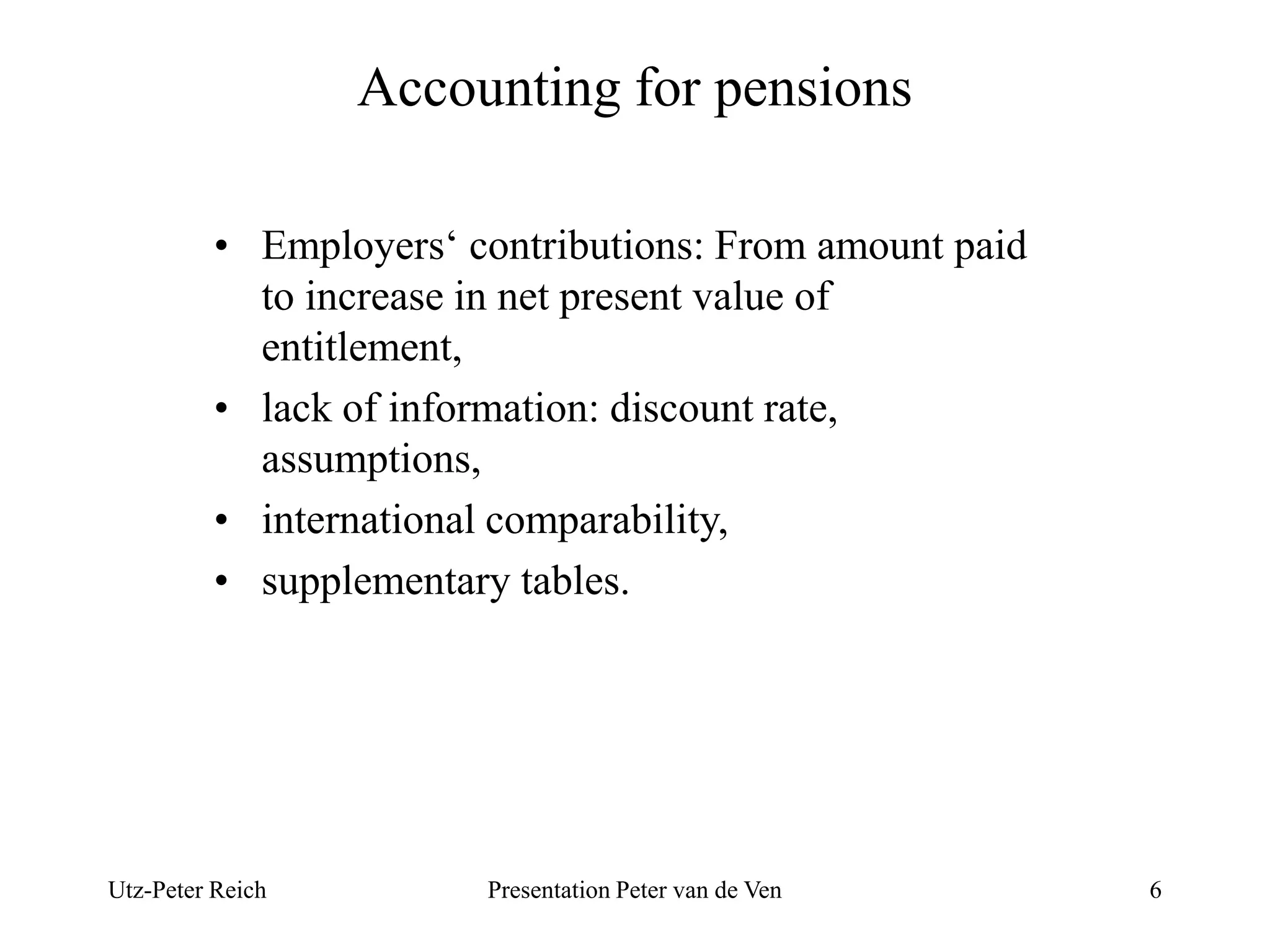
Accounting for pensions 
• Employers‘ contributions: From amount paid 
to increase in net present value of 
entitlement, 
• lack of information: discount rate, 
assumptions, 
• international comparability, 
• supplementary tables. 
Utz-Peter Reich Presentation Peter van de Ven 6
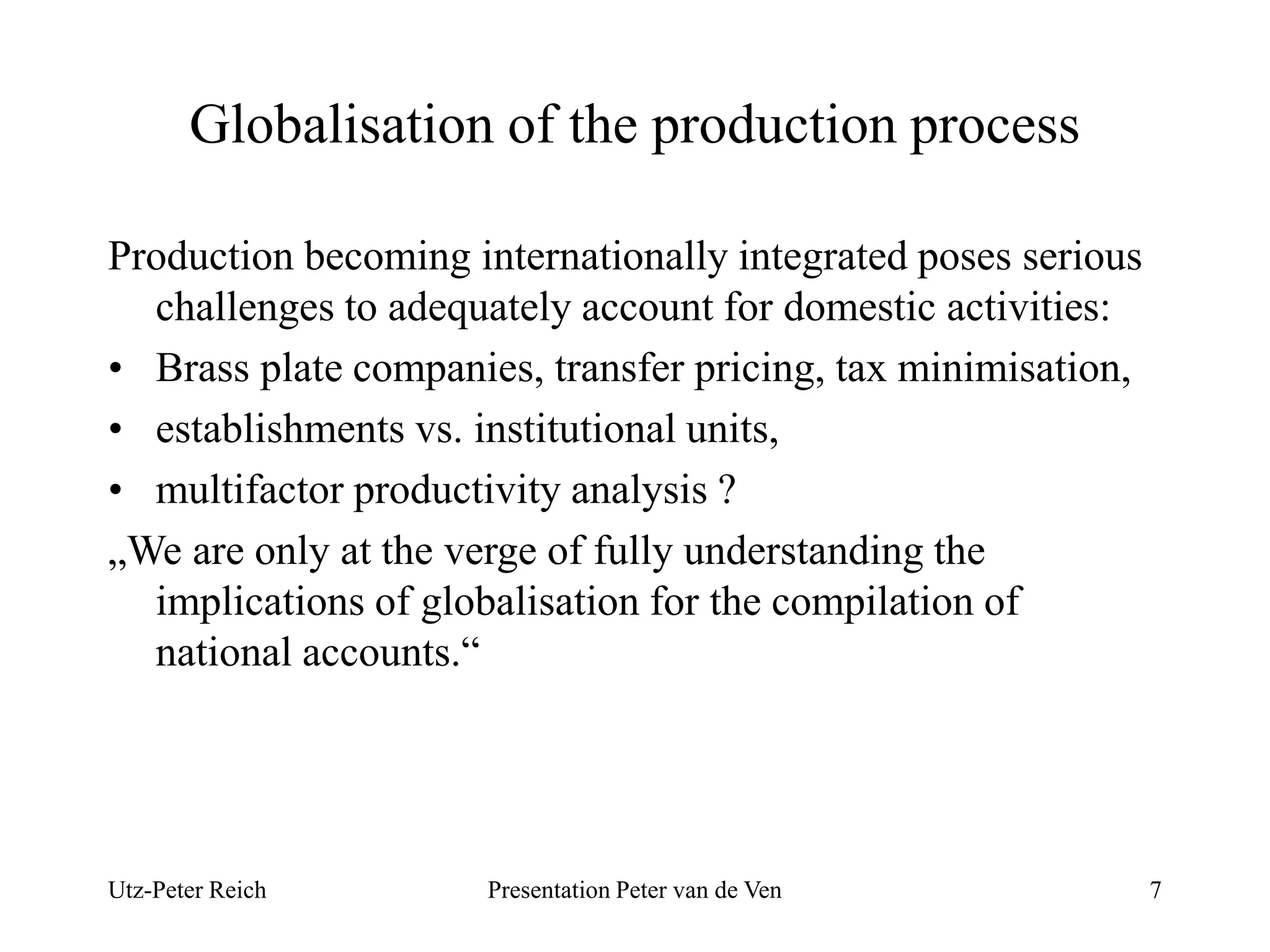
Globalisation of the production process 
Production becoming internationally integrated poses serious 
challenges to adequately account for domestic activities: 
• Brass plate companies, transfer pricing, tax minimisation, 
• establishments vs. institutional units, 
• multifactor productivity analysis ? 
„We are only at the verge of fully understanding the 
implications of globalisation for the compilation of 
national accounts.“ 
Utz-Peter Reich Presentation Peter van de Ven 7
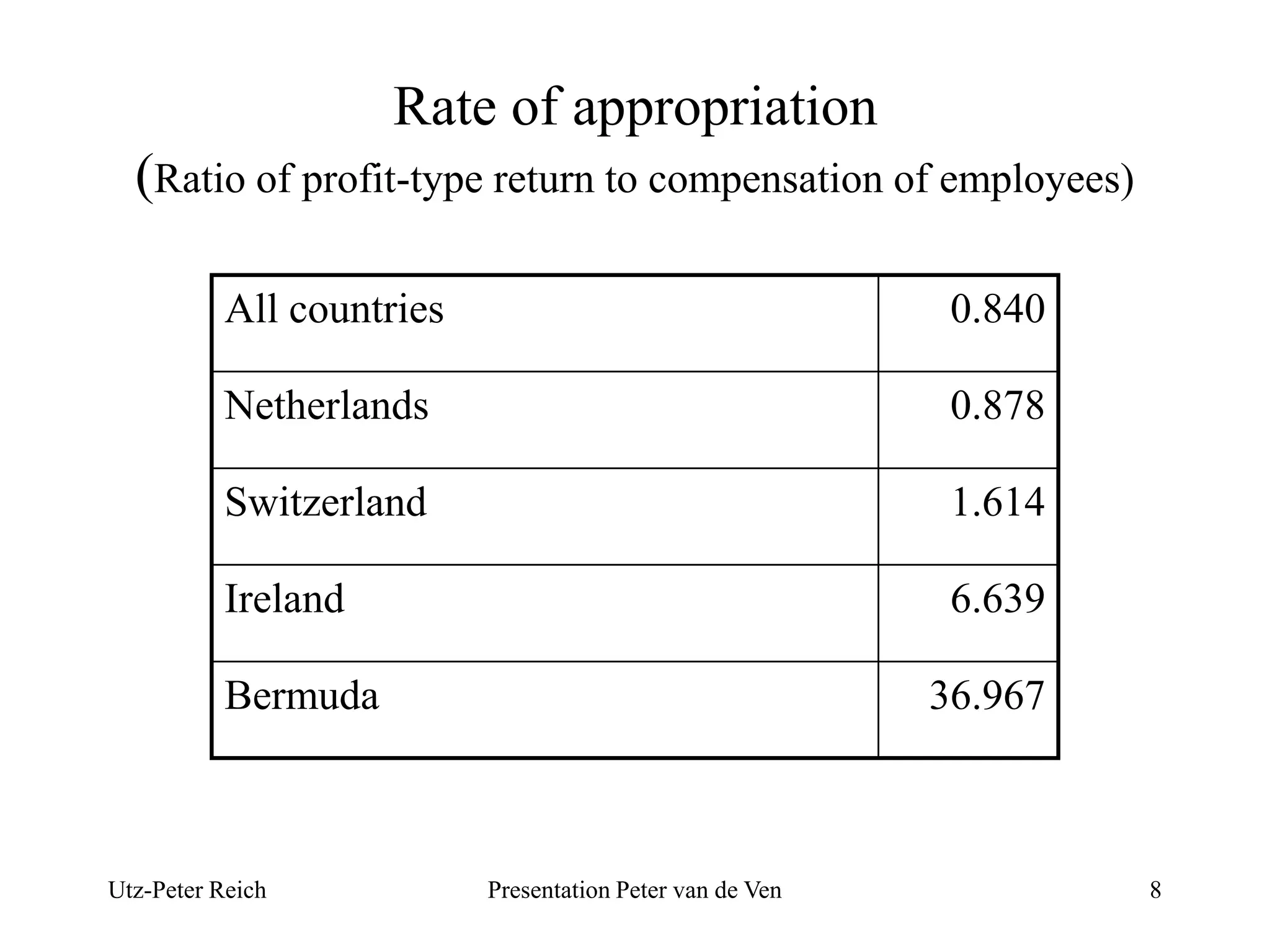
Rate of appropriation 
(Ratio of profit-type return to compensation of employees) 
All countries 0.840 
Netherlands 0.878 
Switzerland 1.614 
Ireland 6.639 
Bermuda 36.967 
Utz-Peter Reich Presentation Peter van de Ven 8
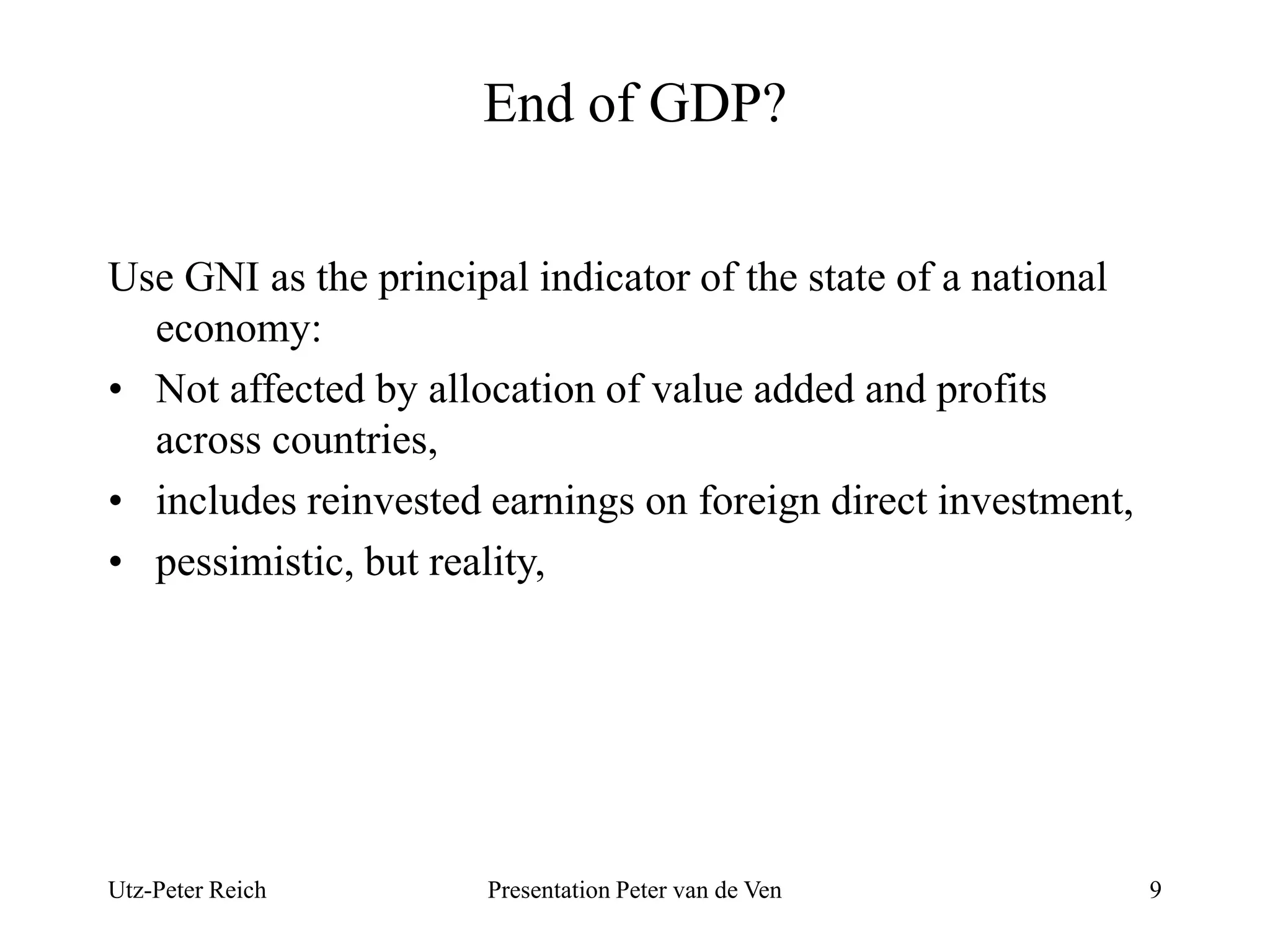
End of GDP? 
Use GNI as the principal indicator of the state of a national 
economy: 
• Not affected by allocation of value added and profits 
across countries, 
• includes reinvested earnings on foreign direct investment, 
• pessimistic, but reality, 
Utz-Peter Reich Presentation Peter van de Ven 9
Statistical units and classifications 
• UNECE/OECD/Eurostat Task Force on Global 
Production. 
Ideas going beyond current standards of accounting: 
• Distinguish internationally operating enterprises, 
• collect data for enterprises rather than establishments, 
• „autonomy of decision“? Better: economic substance. 
Utz-Peter Reich Presentation Peter van de Ven 10
Supranational accounts 
• Illusory value added, or profit, when assigned on a national 
basis, 
• truly supranational entities to be treated like a „separate 
country,“ 
• modify GDP as a consequence, 
• follow up reinvested earnings to the owners of 
corporations. 
„Creating worldwide accounts for multinational enterprises 
would certainly support the analysis of multinationals‘ 
behavior and indirectly also research and policy for 
national economies.“ 
Utz-Peter Reich Presentation Peter van de Ven 11
Noordwijkerhout 1985 
Van Bochove, C.A. and van Tuinen, H.K. (1986) Flexibility in the 
next SNA: The case for an institutional core. RIW 32: 127-154 
This paper examens the purposes of the SNA and concludes that 
they frequently conflict with each other. Consequently, the 
structure of the SNA should be made more flexible. This can be 
achieved by means of a system of a general purpose core 
supplemented by special modules. This core is a full-fledged, 
detailed system of national accounts with a greater institutional 
content than the present SNA and a more elaborate description 
of the economy at the meso-level. The modules are more 
analytic and reflect special purposes and specific theoretic 
views. It is argued that future revisions will concentrate on the 
modules and that the core is more durable than systems like the 
present SNA. (The „Dutch school“ of national accounts) 
Utz-Peter Reich Presentation Peter van de Ven 12
The knowledge economy 
„Production“ of human capital inputs: 
• Formal education (UPR: Provided by professional 
teachers?), 
• training courses provided by employers, 
• time spent on learning and studying (at home?), 
• school books and learning material. 
Utz-Peter Reich Presentation Peter van de Ven 13
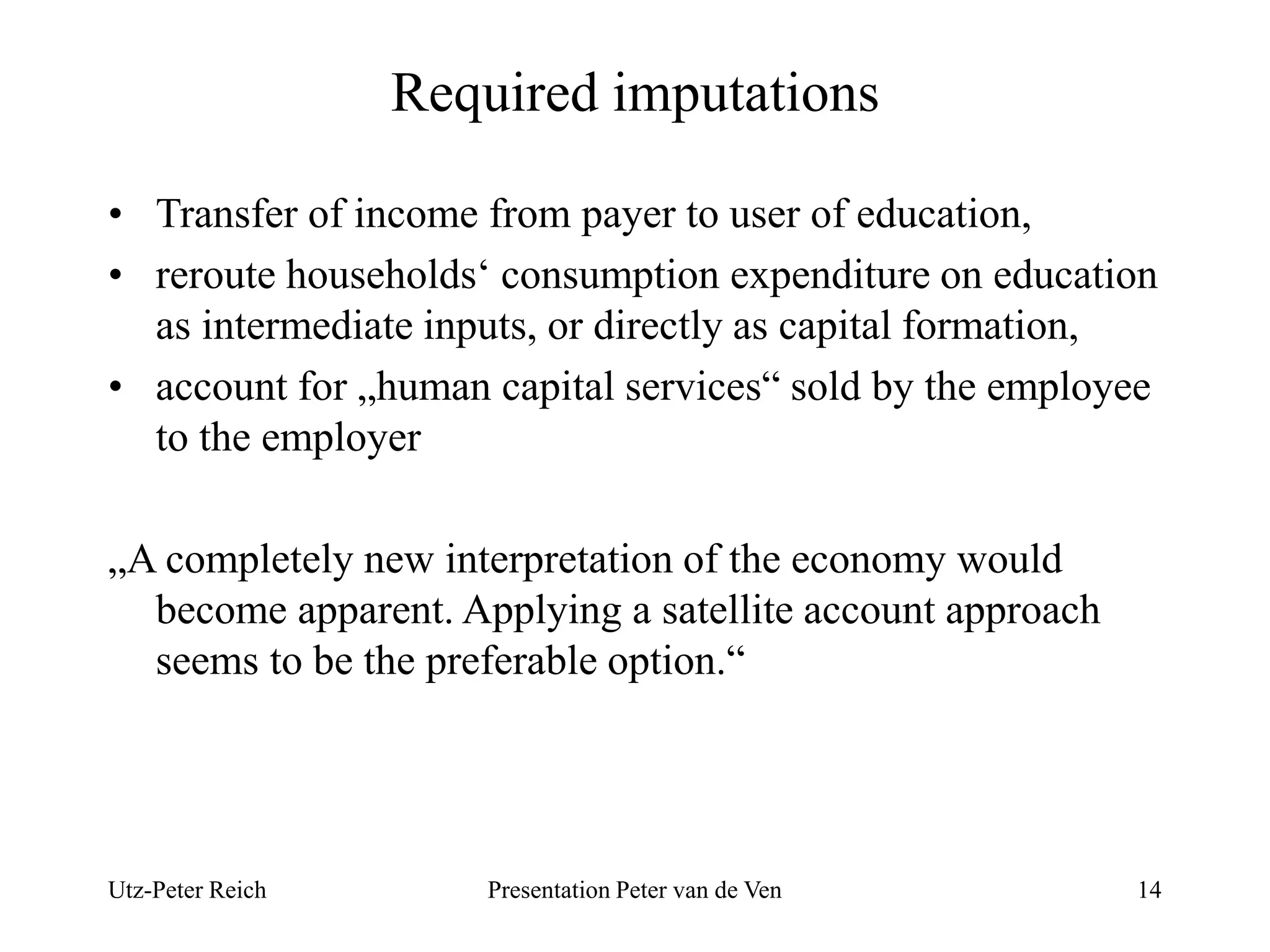
Required imputations 
• Transfer of income from payer to user of education, 
• reroute households‘ consumption expenditure on education 
as intermediate inputs, or directly as capital formation, 
• account for „human capital services“ sold by the employee 
to the employer 
„A completely new interpretation of the economy would 
become apparent. Applying a satellite account approach 
seems to be the preferable option.“ 
Utz-Peter Reich Presentation Peter van de Ven 14
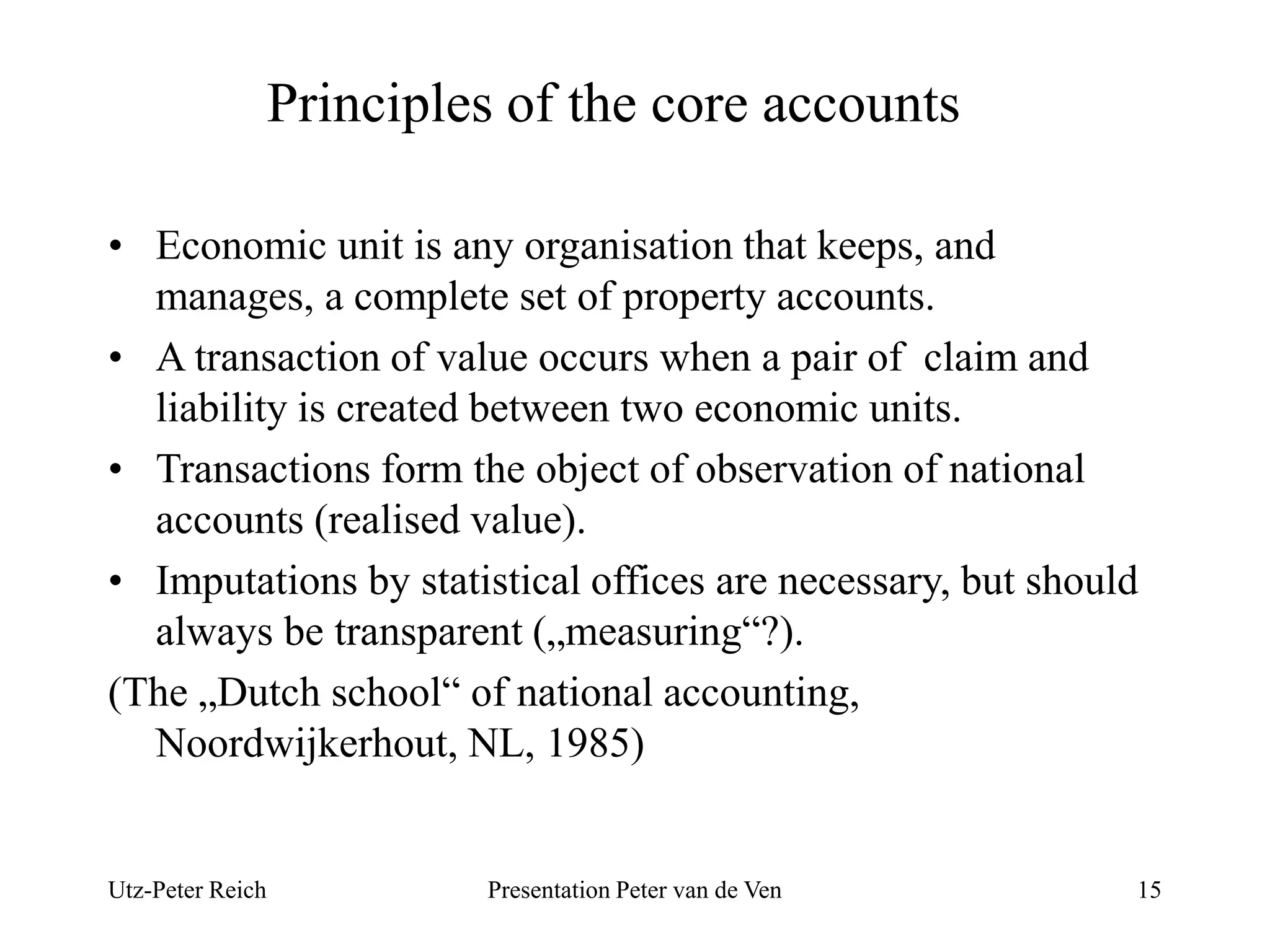
Principles of the core accounts 
• Economic unit is any organisation that keeps, and 
manages, a complete set of property accounts. 
• A transaction of value occurs when a pair of claim and 
liability is created between two economic units. 
• Transactions form the object of observation of national 
accounts (realised value). 
• Imputations by statistical offices are necessary, but should 
always be transparent („measuring“?). 
(The „Dutch school“ of national accounting, 
Noordwijkerhout, NL, 1985) 
Utz-Peter Reich Presentation Peter van de Ven 15

Session 7d van devenpresentation

  • 1.
    Peter van deVen (OECD): The Implementation of the 2008 SNA and the Main Challenges for the Future Development of National Accounts introduced by Utz-Peter Reich, Mainz University of Applied Sciences (em.)
  • 2.
    Content A) SNA2008: • R&D, military weapons, • accounting for pensions, • head offices, holding companies, SPEs, • goods for processing, merchanting, • FISIM, • illegal activities. Utz-Peter Reich Presentation Peter van de Ven 2
  • 3.
    Content B) Mainchallenges: • Globalisation of the production process, • economic and financial crisis, • ageing of societies, • statistical units and classifications, • supranational accounts, • the knowledge economy, • accounting for risk. Utz-Peter Reich Presentation Peter van de Ven 3
  • 4.
    Content discussed A)SNA 2008: • R&D, military weapons, • accounting for pensions, • head offices, holding companies, SPEs, • goods for processing, merchanting, • FISIM, • illegal activities. Utz-Peter Reich Presentation Peter van de Ven 4
  • 5.
    Content discussed B)Main challenges: • Globalisation of the production process, • economic and financial crisis, • ageing of societies, • statistical units and classifications, • supranational accounts, • the knowledge economy, • accounting for risk. Utz-Peter Reich Presentation Peter van de Ven 5
  • 6.
    Accounting for pensions • Employers‘ contributions: From amount paid to increase in net present value of entitlement, • lack of information: discount rate, assumptions, • international comparability, • supplementary tables. Utz-Peter Reich Presentation Peter van de Ven 6
  • 7.
    Globalisation of theproduction process Production becoming internationally integrated poses serious challenges to adequately account for domestic activities: • Brass plate companies, transfer pricing, tax minimisation, • establishments vs. institutional units, • multifactor productivity analysis ? „We are only at the verge of fully understanding the implications of globalisation for the compilation of national accounts.“ Utz-Peter Reich Presentation Peter van de Ven 7
  • 8.
    Rate of appropriation (Ratio of profit-type return to compensation of employees) All countries 0.840 Netherlands 0.878 Switzerland 1.614 Ireland 6.639 Bermuda 36.967 Utz-Peter Reich Presentation Peter van de Ven 8
  • 9.
    End of GDP? Use GNI as the principal indicator of the state of a national economy: • Not affected by allocation of value added and profits across countries, • includes reinvested earnings on foreign direct investment, • pessimistic, but reality, Utz-Peter Reich Presentation Peter van de Ven 9
  • 10.
    Statistical units andclassifications • UNECE/OECD/Eurostat Task Force on Global Production. Ideas going beyond current standards of accounting: • Distinguish internationally operating enterprises, • collect data for enterprises rather than establishments, • „autonomy of decision“? Better: economic substance. Utz-Peter Reich Presentation Peter van de Ven 10
  • 11.
    Supranational accounts •Illusory value added, or profit, when assigned on a national basis, • truly supranational entities to be treated like a „separate country,“ • modify GDP as a consequence, • follow up reinvested earnings to the owners of corporations. „Creating worldwide accounts for multinational enterprises would certainly support the analysis of multinationals‘ behavior and indirectly also research and policy for national economies.“ Utz-Peter Reich Presentation Peter van de Ven 11
  • 12.
    Noordwijkerhout 1985 VanBochove, C.A. and van Tuinen, H.K. (1986) Flexibility in the next SNA: The case for an institutional core. RIW 32: 127-154 This paper examens the purposes of the SNA and concludes that they frequently conflict with each other. Consequently, the structure of the SNA should be made more flexible. This can be achieved by means of a system of a general purpose core supplemented by special modules. This core is a full-fledged, detailed system of national accounts with a greater institutional content than the present SNA and a more elaborate description of the economy at the meso-level. The modules are more analytic and reflect special purposes and specific theoretic views. It is argued that future revisions will concentrate on the modules and that the core is more durable than systems like the present SNA. (The „Dutch school“ of national accounts) Utz-Peter Reich Presentation Peter van de Ven 12
  • 13.
    The knowledge economy „Production“ of human capital inputs: • Formal education (UPR: Provided by professional teachers?), • training courses provided by employers, • time spent on learning and studying (at home?), • school books and learning material. Utz-Peter Reich Presentation Peter van de Ven 13
  • 14.
    Required imputations •Transfer of income from payer to user of education, • reroute households‘ consumption expenditure on education as intermediate inputs, or directly as capital formation, • account for „human capital services“ sold by the employee to the employer „A completely new interpretation of the economy would become apparent. Applying a satellite account approach seems to be the preferable option.“ Utz-Peter Reich Presentation Peter van de Ven 14
  • 15.
    Principles of thecore accounts • Economic unit is any organisation that keeps, and manages, a complete set of property accounts. • A transaction of value occurs when a pair of claim and liability is created between two economic units. • Transactions form the object of observation of national accounts (realised value). • Imputations by statistical offices are necessary, but should always be transparent („measuring“?). (The „Dutch school“ of national accounting, Noordwijkerhout, NL, 1985) Utz-Peter Reich Presentation Peter van de Ven 15