Using administrative and survey 
data to analyse tax evasion from 
unregistered labour 
Alessandra Coli 
(Universitá di Pisa) 
Francesca Tartamella 
(Istituto Nazionale di Statistica - ISTAT) 
Discussed by: 
Olga Cantó 
(Universidad de Alcalá and EQUALITAS)
Motivation 
• Underground (or hidden) economy appears to be a significant 
part of GDP in many developed countries. 
• Weight of underground economy is unequally distributed by: 
country, individual and household characteristics, job 
characteristics, household income level, etc… 
• Any analysis using administrative data and simulating the 
impact of a policy relies on the validity of registered data on 
taxes, benefits and/or labour, e.g. fiscal or labour policy reforms.
Aim 
• The aim of this paper is to identify missing (non-registered) workers 
(employees and self-employed) in administrative Italian data and 
estimate their earnings using the information provided in Household 
Budget Surveys. 
This allows authors to provide: 
• A proxy measure of tax evasion (incidence and intensity) from non-registration 
in the labour market. 
• A detailed description of the personal characteristics of non-registered 
workers (and also those of their job). 
• A detailed description of the distribution of the incidence and income 
relevance of non-registered labour along the household income 
distribution.
Sources of underground 
economy 
• In official statistics, non-observed economy (NOE) includes the following 
kinds of production (OECD, 2002) 
1) underground or hidden production 
2) legal production activities characterized by a low level of organization 
(informal economy) 
3) production from illegal economy 
4) productions omitted due to deficiencies in the basic data collection system 
(statistic underground). 
• However, large part of underground economy accounted for in GDP but 
missed elsewhere. Tax records related to IT or VAT (fiscal authorities), 
Social Security labour registration data related to SSC (labour authorities) 
– Italian method to measure NOE assumes hidden economy: i) the use of non-registered 
labour ii) the under-reporting of turnover, due to the under-reporting of legal production 
and/or over-reporting of intermediate costs 
• Stylized fact: National accounts data for Italy measure non-registered 
(hidden) labour relevance in a 6.5% of GDP.
Methodology 
• Using Italian SILC 2011 (Survey of Income and Living Conditions 
Survey) household budget data and a variety of Social Security data 
individuals are linked (Italian Fiscal Code), Exact Record Linkage 
Procedure. 
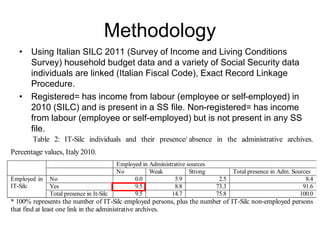
• Registered= has income from labour (employee or self-employed) in 
2010 (SILC) and is present in a SS file. Non-registered= has income 
from labour (employee or self-employed) but is not present in any SS 
file. 
Table 2: IT-Silc individuals and their presence/ absence in the administrative archives. 
Percentage values, Italy 2010. 
Employed in Administrative sources 
No Weak Strong Total presence in Adm. Sources 
Employed in 
IT-Silc 
No 0.0 5.9 2.5 8.4 
Yes 9.5 8.8 73.3 91.6 
Total presence in It-Silc 9.5 14.7 75.8 100.0 
* 100% represents the number of IT-Silc employed persons, plus the number of IT-Silc non-employed persons 
that find at least one link in the administrative archives.
Methodology 
• To describe the characteristics of registered labour vs. non-registered 
labour authors use a logistic regression of the probability of being 
registered for individuals over 16 years of age who earn labour 
income in 2010: “propensity to be a registered worker instead of a 
non-registered worker” 
• To measure the incidence of having incomes from non-registered 
labour within total household income and its subcomponents: 
– Authors provide a descriptive analysis of the characteristics of households with at 
least one non-registered by income quintile. 
– Authors provide a descriptive comparative analysis of households with at least one 
non-registered and all households: by household’s income quintile, hh. main source 
of income, geographical area and hh. head age
Results 
• Non-registered workers: 9.5% of total Italian SILC workers (receiving 
income from labour in 2010) [with higher presence among employees (about 60% 
of non-registered workers are employees)]. These values are in line with the 
National Accounts statistics: ISTAT (2011) estimates non-registered 
work in Italy as 10.3% in terms of employed persons and 17% in 
terms of jobs. 
• Non-registered workers are, ceteris paribus, more likely to be male 
than female, relatively old than young, foreign than Italian, living in 
the South and working in small farms. Their individual and hh. 
disposable income is relatively low. 
• Household surveys capture at least a part of underground economy 
components (some non-registered workers may not declare to be 
receiving labour income in 2010). Results support that Administrative 
sources be more extensively combined with micro data from 
households surveys to improve data coherence.
Discussion 
• There is a large room for motivation improvement: 
– Why Italy? Other EU countries evidence? 
– Any differences Italy vs. Others in underground economy (tax, labour)? 
– Need to indicate potential use of this measurement and its caveats and 
problems if any (adoption of ESA 2010… describe uses!) 
– Extend motivation! 
• There is a large room for previous evidence improvement in 
Italy and elsewhere: 
– Any evidence on estimating hidden labour in developed countries? 
– Incidence of non-registration in EU+Italian labour market? 
– Any other methodologies used in previous works? 
– In general: put the paper in context!!!
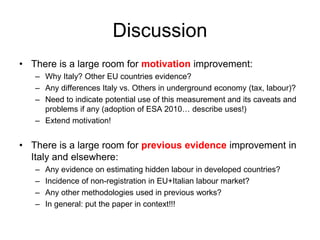
Discussion 
• General comments to the paper: 
– The paper needs a general re-writing to focus on main issues. 
– Identify more clearly the actual potential use of their methodology. 
Probably most useful to improve the quality of Administrative data so that 
ISTAT so can provide information to Social Security…but…will then 
individuals continue to answer SILC?... 
– It is very important to make a difference between incidence of non-registered 
work and the dimension of tax evasion through undeclared 
wages. [The reference data is SILC. These data are known to 
underestimate household incomes in National Accounts in Spain and 
overestimate them in Greece. How is author’s work affected by this? 
From your results it appears that still 40% of wages are missing…. As 
authors point out: “A significant amount of self-employed hidden income 
stems from the under-reporting of turnover”] 
Thus, author’s method seems good to identify incidence…but not so 
much regarding its intensity (wage underreporting issues in household 
surveys…differences by household income level??)
Discussion 
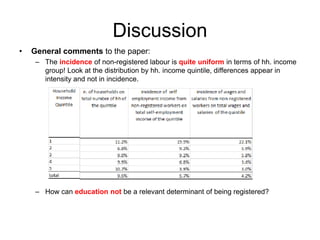
• General comments to the paper: 
– The incidence of non-registered labour is quite uniform in terms of hh. income 
group! Look at the distribution by hh. income quintile, differences appear in 
intensity and not in incidence. 
– How can education not be a relevant determinant of being registered?
Discussion 
• Minor comments: 
– In the text you say that the probability of being registered falls with income but I 
believe it is just the opposite. 
– At a variety of points in the paper (specially in Tables) it is unclear if results are 
referred to individuals or households, do revise that.
Session 7 a coli tartamella

Session 7 a coli tartamella

  • 1.
    Using administrative andsurvey data to analyse tax evasion from unregistered labour Alessandra Coli (Universitá di Pisa) Francesca Tartamella (Istituto Nazionale di Statistica - ISTAT) Discussed by: Olga Cantó (Universidad de Alcalá and EQUALITAS)
  • 2.
    Motivation • Underground(or hidden) economy appears to be a significant part of GDP in many developed countries. • Weight of underground economy is unequally distributed by: country, individual and household characteristics, job characteristics, household income level, etc… • Any analysis using administrative data and simulating the impact of a policy relies on the validity of registered data on taxes, benefits and/or labour, e.g. fiscal or labour policy reforms.
  • 3.
    Aim • Theaim of this paper is to identify missing (non-registered) workers (employees and self-employed) in administrative Italian data and estimate their earnings using the information provided in Household Budget Surveys. This allows authors to provide: • A proxy measure of tax evasion (incidence and intensity) from non-registration in the labour market. • A detailed description of the personal characteristics of non-registered workers (and also those of their job). • A detailed description of the distribution of the incidence and income relevance of non-registered labour along the household income distribution.
  • 4.
    Sources of underground economy • In official statistics, non-observed economy (NOE) includes the following kinds of production (OECD, 2002) 1) underground or hidden production 2) legal production activities characterized by a low level of organization (informal economy) 3) production from illegal economy 4) productions omitted due to deficiencies in the basic data collection system (statistic underground). • However, large part of underground economy accounted for in GDP but missed elsewhere. Tax records related to IT or VAT (fiscal authorities), Social Security labour registration data related to SSC (labour authorities) – Italian method to measure NOE assumes hidden economy: i) the use of non-registered labour ii) the under-reporting of turnover, due to the under-reporting of legal production and/or over-reporting of intermediate costs • Stylized fact: National accounts data for Italy measure non-registered (hidden) labour relevance in a 6.5% of GDP.
  • 5.
    Methodology • UsingItalian SILC 2011 (Survey of Income and Living Conditions Survey) household budget data and a variety of Social Security data individuals are linked (Italian Fiscal Code), Exact Record Linkage Procedure. • Registered= has income from labour (employee or self-employed) in 2010 (SILC) and is present in a SS file. Non-registered= has income from labour (employee or self-employed) but is not present in any SS file. Table 2: IT-Silc individuals and their presence/ absence in the administrative archives. Percentage values, Italy 2010. Employed in Administrative sources No Weak Strong Total presence in Adm. Sources Employed in IT-Silc No 0.0 5.9 2.5 8.4 Yes 9.5 8.8 73.3 91.6 Total presence in It-Silc 9.5 14.7 75.8 100.0 * 100% represents the number of IT-Silc employed persons, plus the number of IT-Silc non-employed persons that find at least one link in the administrative archives.
  • 6.
    Methodology • Todescribe the characteristics of registered labour vs. non-registered labour authors use a logistic regression of the probability of being registered for individuals over 16 years of age who earn labour income in 2010: “propensity to be a registered worker instead of a non-registered worker” • To measure the incidence of having incomes from non-registered labour within total household income and its subcomponents: – Authors provide a descriptive analysis of the characteristics of households with at least one non-registered by income quintile. – Authors provide a descriptive comparative analysis of households with at least one non-registered and all households: by household’s income quintile, hh. main source of income, geographical area and hh. head age
  • 7.
    Results • Non-registeredworkers: 9.5% of total Italian SILC workers (receiving income from labour in 2010) [with higher presence among employees (about 60% of non-registered workers are employees)]. These values are in line with the National Accounts statistics: ISTAT (2011) estimates non-registered work in Italy as 10.3% in terms of employed persons and 17% in terms of jobs. • Non-registered workers are, ceteris paribus, more likely to be male than female, relatively old than young, foreign than Italian, living in the South and working in small farms. Their individual and hh. disposable income is relatively low. • Household surveys capture at least a part of underground economy components (some non-registered workers may not declare to be receiving labour income in 2010). Results support that Administrative sources be more extensively combined with micro data from households surveys to improve data coherence.
  • 8.
    Discussion • Thereis a large room for motivation improvement: – Why Italy? Other EU countries evidence? – Any differences Italy vs. Others in underground economy (tax, labour)? – Need to indicate potential use of this measurement and its caveats and problems if any (adoption of ESA 2010… describe uses!) – Extend motivation! • There is a large room for previous evidence improvement in Italy and elsewhere: – Any evidence on estimating hidden labour in developed countries? – Incidence of non-registration in EU+Italian labour market? – Any other methodologies used in previous works? – In general: put the paper in context!!!
  • 9.
    Discussion • Generalcomments to the paper: – The paper needs a general re-writing to focus on main issues. – Identify more clearly the actual potential use of their methodology. Probably most useful to improve the quality of Administrative data so that ISTAT so can provide information to Social Security…but…will then individuals continue to answer SILC?... – It is very important to make a difference between incidence of non-registered work and the dimension of tax evasion through undeclared wages. [The reference data is SILC. These data are known to underestimate household incomes in National Accounts in Spain and overestimate them in Greece. How is author’s work affected by this? From your results it appears that still 40% of wages are missing…. As authors point out: “A significant amount of self-employed hidden income stems from the under-reporting of turnover”] Thus, author’s method seems good to identify incidence…but not so much regarding its intensity (wage underreporting issues in household surveys…differences by household income level??)
  • 10.
    Discussion • Generalcomments to the paper: – The incidence of non-registered labour is quite uniform in terms of hh. income group! Look at the distribution by hh. income quintile, differences appear in intensity and not in incidence. – How can education not be a relevant determinant of being registered?
  • 11.
    Discussion • Minorcomments: – In the text you say that the probability of being registered falls with income but I believe it is just the opposite. – At a variety of points in the paper (specially in Tables) it is unclear if results are referred to individuals or households, do revise that.