STEVE BOWLING
JUST 4 YOU HR CONSULTING LLC
April 23rd 2013
Objectives
 Understand concept of Emotional Intelligence
(EQ)
 Understand relevance to your success
 Know the competencies involved
 Recent Developments in EQ
 Identify the relationship and impact of EQ skills
on others within and outside the organization.
 Determine one’s own strengths and opportunities
in the EQ skills
 Develop a personal action plan
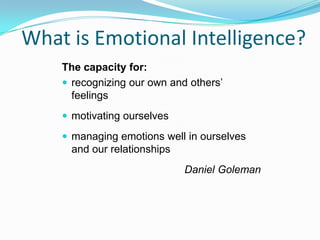
What is Emotional Intelligence?
The capacity for:
 recognizing our own and others’
feelings
 motivating ourselves
 managing emotions well in ourselves
and our relationships
Daniel Goleman
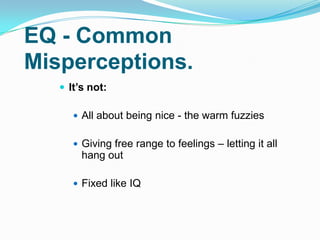
EQ - Common
Misperceptions.
 It’s not:
 All about being nice - the warm fuzzies
 Giving free range to feelings – letting it all
hang out
 Fixed like IQ
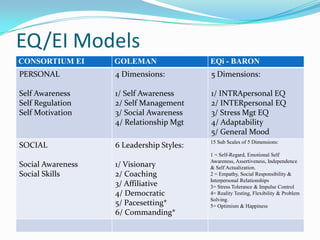
EQ/EI Models
CONSORTIUM EI GOLEMAN EQi - BARON
PERSONAL
Self Awareness
Self Regulation
Self Motivation
4 Dimensions:
1/ Self Awareness
2/ Self Management
3/ Social Awareness
4/ Relationship Mgt
5 Dimensions:
1/ INTRApersonal EQ
2/ INTERpersonal EQ
3/ Stress Mgt EQ
4/ Adaptability
5/ General Mood
SOCIAL
Social Awareness
Social Skills
6 Leadership Styles:
1/ Visionary
2/ Coaching
3/ Affiliative
4/ Democratic
5/ Pacesetting*
6/ Commanding*
15 Sub Scales of 5 Dimensions:
1 = Self-Regard, Emotional Self
Awareness, Assertiveness, Independence
& Self Actualization.
2 = Empathy, Social Responsibility &
Interpersonal Relationships
3= Stress Tolerance & Impulse Control
4= Reality Testing, Flexibility & Problem
Solving.
5= Optimism & Happiness
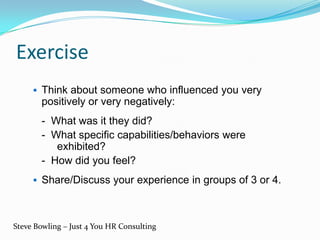
Exercise
 Think about someone who influenced you very
positively or very negatively:
- What was it they did?
- What specific capabilities/behaviors were
exhibited?
- How did you feel?
 Share/Discuss your experience in groups of 3 or 4.
Steve Bowling – Just 4 You HR Consulting
The Business Case
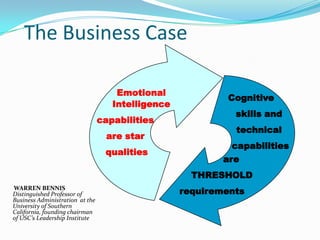
WARREN BENNIS
Distinguished Professor of
Business Administration at the
University of Southern
California, founding chairman
of USC’s Leadership Institute
Emotional
Intelligence
capabilities
are star
qualities
Cognitive
skills and
technical
capabilities
are
THRESHOLD
requirements
The Business Case
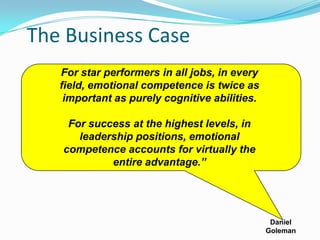
For star performers in all jobs, in every
field, emotional competence is twice as
important as purely cognitive abilities.
For success at the highest levels, in
leadership positions, emotional
competence accounts for virtually the
entire advantage.”
Daniel
Goleman
The Business Case
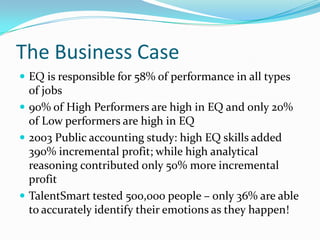
 EQ is responsible for 58% of performance in all types
of jobs
 90% of High Performers are high in EQ and only 20%
of Low performers are high in EQ
 2003 Public accounting study: high EQ skills added
390% incremental profit; while high analytical
reasoning contributed only 50% more incremental
profit
 TalentSmart tested 500,000 people – only 36% are able
to accurately identify their emotions as they happen!
TEAM EQ/EI
 The success of teams can be influenced by the emotions of
team members. Teams can improve their EQ by
understanding their group tendencies and managing them
effectively. The team EQ is largely based on the standards
for behavior that the team accepts as a whole. High
performing teams will define and choose what actions it
will take as a group
 A 2001 research study by TalentSmart Inc. shows
emotionally intelligent teams perform better than the
teams with low EQ. Teams who scored lower in EQ
typically did not focus well on the task at hand and did not
achieve goals as well as their counterparts.
Steve Bowling – Just 4 You HR Consulting
Judged by a New Yardstick
“We are all being judged by a new
yardstick – not just how smart we are,
or by our training and expertise –
but also by how well we handle ourselves
and each other.”
Daniel Goleman
Working with Emotional Intelligence
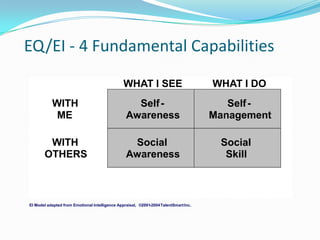
EQ/EI - 4 Fundamental Capabilities
WHAT I SEE WHAT I DO
WITH
ME
Self-
Awareness
Self-
Management
WITH
OTHERS
Social
Awareness
Social
Skill
EI Model adapted from Emotional Intelligence Appraisal, ©2001-2004TalentSmartInc.
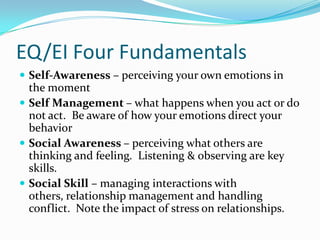
EQ/EI Four Fundamentals
 Self-Awareness – perceiving your own emotions in
the moment
 Self Management – what happens when you act or do
not act. Be aware of how your emotions direct your
behavior
 Social Awareness – perceiving what others are
thinking and feeling. Listening & observing are key
skills.
 Social Skill – managing interactions with
others, relationship management and handling
conflict. Note the impact of stress on relationships.
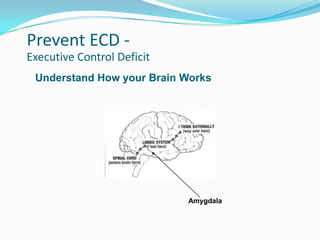
Prevent ECD -
Executive Control Deficit
Understand How your Brain Works
Amygdala
Manage Your Emotions!
Stop the Amygdala Hijack!
Self- Awareness
 Know your body - what are your emotional triggers?
 Observe yourself
 Monitor your thoughts and feelings
 Discover why you react this way
 Track/ record trends you see in your behavior
 Identify negative behaviors you fall victim to
 Increasing awareness decreases emotional mistakes
 Note the impact on your team & team members
Manage Your Emotions!
Stop the Amygdala Hijack!
Self-Management
 Observe when your emotions are getting the best of you
 Slow down and think before acting
 Consider deep breathing, exercise, meditation and
visualization
 Practice skills such as calming or centering yourself
before dealing with stress
 Never respond in writing when you are emotionally
charged
 Remember the “Godfather’s” advice to never act when
in an emotional state
Manage Your Emotions!
“We catch feelings from one another as
if it were a virus.”
“We unconsciously imitate the emotions we
see displayed by others.”
Daniel Goleman
New Developments in EQ
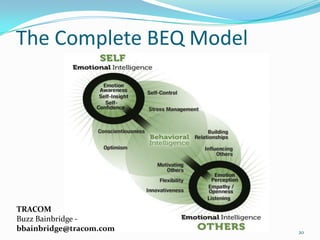
Evolution of EQ
 1G – Recognition, Awareness and Control of Emotions
 2G – Goleman/Boyatzis – Competency Approach
 3G – Recognition of Behavioral Impact – Behavioral
EQ (BEQ)
The Complete BEQ Model
20
TRACOM
Buzz Bainbridge -
bbainbridge@tracom.com
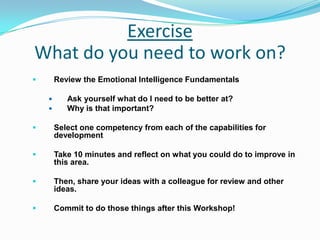
Exercise
What do you need to work on?
 Review the Emotional Intelligence Fundamentals
 Ask yourself what do I need to be better at?
 Why is that important?
 Select one competency from each of the capabilities for
development
 Take 10 minutes and reflect on what you could do to improve in
this area.
 Then, share your ideas with a colleague for review and other
ideas.
 Commit to do those things after this Workshop!
Education Resources
Key Books by Goleman:
 Emotional Intelligence
 Working with EI
 Primal Leadership
 Social Intelligence
Neuro Leadership Institute – SCARF Model
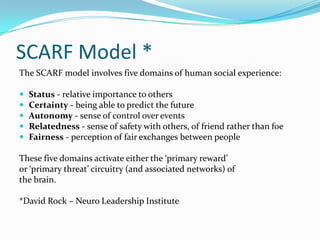
SCARF Model *
The SCARF model involves five domains of human social experience:
 Status - relative importance to others
 Certainty - being able to predict the future
 Autonomy - sense of control over events
 Relatedness - sense of safety with others, of friend rather than foe
 Fairness - perception of fair exchanges between people
These five domains activate either the ‘primary reward’
or ‘primary threat’ circuitry (and associated networks) of
the brain.
*David Rock – Neuro Leadership Institute
Tools for EQ
 Baron EQi *
 MBTI *
 SHL OPQ 32 *
 Hay – Goleman EQ Tool
 Barnes & Noble!!
 Talent Smart Book - Emotional Intelligence 2.0
 BEQ Workshop – via TRACOM
ANY QUESTIONS or
OBSERVATIONS?
THANK YOU !
Steve Bowling
Just 4 You HR Consulting LLC
609 851 6578
stevebowling@just4youhr.com

RU EQ? Emotional Intelligence (EQ/EI)

  • 1.
    STEVE BOWLING JUST 4YOU HR CONSULTING LLC April 23rd 2013
  • 2.
    Objectives  Understand conceptof Emotional Intelligence (EQ)  Understand relevance to your success  Know the competencies involved  Recent Developments in EQ  Identify the relationship and impact of EQ skills on others within and outside the organization.  Determine one’s own strengths and opportunities in the EQ skills  Develop a personal action plan
  • 3.
    What is EmotionalIntelligence?
  • 4.
    What is EmotionalIntelligence? The capacity for:  recognizing our own and others’ feelings  motivating ourselves  managing emotions well in ourselves and our relationships Daniel Goleman
  • 5.
    EQ - Common Misperceptions. It’s not:  All about being nice - the warm fuzzies  Giving free range to feelings – letting it all hang out  Fixed like IQ
  • 6.
    EQ/EI Models CONSORTIUM EIGOLEMAN EQi - BARON PERSONAL Self Awareness Self Regulation Self Motivation 4 Dimensions: 1/ Self Awareness 2/ Self Management 3/ Social Awareness 4/ Relationship Mgt 5 Dimensions: 1/ INTRApersonal EQ 2/ INTERpersonal EQ 3/ Stress Mgt EQ 4/ Adaptability 5/ General Mood SOCIAL Social Awareness Social Skills 6 Leadership Styles: 1/ Visionary 2/ Coaching 3/ Affiliative 4/ Democratic 5/ Pacesetting* 6/ Commanding* 15 Sub Scales of 5 Dimensions: 1 = Self-Regard, Emotional Self Awareness, Assertiveness, Independence & Self Actualization. 2 = Empathy, Social Responsibility & Interpersonal Relationships 3= Stress Tolerance & Impulse Control 4= Reality Testing, Flexibility & Problem Solving. 5= Optimism & Happiness
  • 7.
    Exercise  Think aboutsomeone who influenced you very positively or very negatively: - What was it they did? - What specific capabilities/behaviors were exhibited? - How did you feel?  Share/Discuss your experience in groups of 3 or 4. Steve Bowling – Just 4 You HR Consulting
  • 8.
    The Business Case WARRENBENNIS Distinguished Professor of Business Administration at the University of Southern California, founding chairman of USC’s Leadership Institute Emotional Intelligence capabilities are star qualities Cognitive skills and technical capabilities are THRESHOLD requirements
  • 9.
    The Business Case Forstar performers in all jobs, in every field, emotional competence is twice as important as purely cognitive abilities. For success at the highest levels, in leadership positions, emotional competence accounts for virtually the entire advantage.” Daniel Goleman
  • 10.
    The Business Case EQ is responsible for 58% of performance in all types of jobs  90% of High Performers are high in EQ and only 20% of Low performers are high in EQ  2003 Public accounting study: high EQ skills added 390% incremental profit; while high analytical reasoning contributed only 50% more incremental profit  TalentSmart tested 500,000 people – only 36% are able to accurately identify their emotions as they happen!
  • 11.
    TEAM EQ/EI  Thesuccess of teams can be influenced by the emotions of team members. Teams can improve their EQ by understanding their group tendencies and managing them effectively. The team EQ is largely based on the standards for behavior that the team accepts as a whole. High performing teams will define and choose what actions it will take as a group  A 2001 research study by TalentSmart Inc. shows emotionally intelligent teams perform better than the teams with low EQ. Teams who scored lower in EQ typically did not focus well on the task at hand and did not achieve goals as well as their counterparts. Steve Bowling – Just 4 You HR Consulting
  • 12.
    Judged by aNew Yardstick “We are all being judged by a new yardstick – not just how smart we are, or by our training and expertise – but also by how well we handle ourselves and each other.” Daniel Goleman Working with Emotional Intelligence
  • 13.
    EQ/EI - 4Fundamental Capabilities WHAT I SEE WHAT I DO WITH ME Self- Awareness Self- Management WITH OTHERS Social Awareness Social Skill EI Model adapted from Emotional Intelligence Appraisal, ©2001-2004TalentSmartInc.
  • 14.
    EQ/EI Four Fundamentals Self-Awareness – perceiving your own emotions in the moment  Self Management – what happens when you act or do not act. Be aware of how your emotions direct your behavior  Social Awareness – perceiving what others are thinking and feeling. Listening & observing are key skills.  Social Skill – managing interactions with others, relationship management and handling conflict. Note the impact of stress on relationships.
  • 15.
    Prevent ECD - ExecutiveControl Deficit Understand How your Brain Works Amygdala
  • 16.
    Manage Your Emotions! Stopthe Amygdala Hijack! Self- Awareness  Know your body - what are your emotional triggers?  Observe yourself  Monitor your thoughts and feelings  Discover why you react this way  Track/ record trends you see in your behavior  Identify negative behaviors you fall victim to  Increasing awareness decreases emotional mistakes  Note the impact on your team & team members
  • 17.
    Manage Your Emotions! Stopthe Amygdala Hijack! Self-Management  Observe when your emotions are getting the best of you  Slow down and think before acting  Consider deep breathing, exercise, meditation and visualization  Practice skills such as calming or centering yourself before dealing with stress  Never respond in writing when you are emotionally charged  Remember the “Godfather’s” advice to never act when in an emotional state
  • 18.
    Manage Your Emotions! “Wecatch feelings from one another as if it were a virus.” “We unconsciously imitate the emotions we see displayed by others.” Daniel Goleman
  • 19.
    New Developments inEQ Evolution of EQ  1G – Recognition, Awareness and Control of Emotions  2G – Goleman/Boyatzis – Competency Approach  3G – Recognition of Behavioral Impact – Behavioral EQ (BEQ)
  • 20.
    The Complete BEQModel 20 TRACOM Buzz Bainbridge - bbainbridge@tracom.com
  • 21.
    Exercise What do youneed to work on?  Review the Emotional Intelligence Fundamentals  Ask yourself what do I need to be better at?  Why is that important?  Select one competency from each of the capabilities for development  Take 10 minutes and reflect on what you could do to improve in this area.  Then, share your ideas with a colleague for review and other ideas.  Commit to do those things after this Workshop!
  • 22.
    Education Resources Key Booksby Goleman:  Emotional Intelligence  Working with EI  Primal Leadership  Social Intelligence Neuro Leadership Institute – SCARF Model
  • 23.
    SCARF Model * TheSCARF model involves five domains of human social experience:  Status - relative importance to others  Certainty - being able to predict the future  Autonomy - sense of control over events  Relatedness - sense of safety with others, of friend rather than foe  Fairness - perception of fair exchanges between people These five domains activate either the ‘primary reward’ or ‘primary threat’ circuitry (and associated networks) of the brain. *David Rock – Neuro Leadership Institute
  • 24.
    Tools for EQ Baron EQi *  MBTI *  SHL OPQ 32 *  Hay – Goleman EQ Tool  Barnes & Noble!!  Talent Smart Book - Emotional Intelligence 2.0  BEQ Workshop – via TRACOM
  • 25.
  • 26.
    THANK YOU ! SteveBowling Just 4 You HR Consulting LLC 609 851 6578 stevebowling@just4youhr.com