







Typical Business Reports
Business Communication Chapter – 13 “ TYPICAL BUSINESS REPORTS”
Why we are here: It attempts to provide a moral justification, rationale or even establish clear rules as to “What is the Purpose of Writing a Business Report and how we give you more ideas & comprehensive business report compiling. What is the purpose of the  Business Report
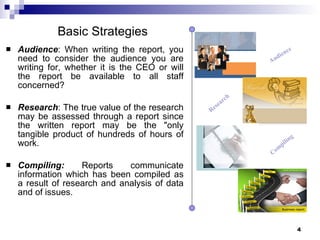
Audience : When writing the report, you need to consider the audience you are writing for, whether it is the CEO or will the report be available to all staff concerned?  Research : The true value of the research may be assessed through a report since the written report may be the "only tangible product of hundreds of hours of work.  Compiling:  Reports communicate information which has been compiled as a result of research and analysis of data and of issues.  Audience Research Compiling Basic Strategies
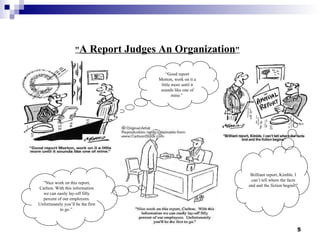
Brilliant report, Kimble. I can’t tell where the facts end and the fiction begins.”                              " A Report Judges An Organization "   “ Good report Morton, work on it a little more until it sounds like one of mine.”  ” Nice work on this report, Carlton. With this information we can easily lay-off fifty percent of our employees. Unfortunately you’ll be the first to go.”
Writing Informational Report   Informational report is to provide required data/information to wish to know about the things in a specific and complete form.  Depending on the seriousness, they may have to be discussed later on.. Once you have this list, it will be easy for you to contact someone to clarify any information.  Informational Report
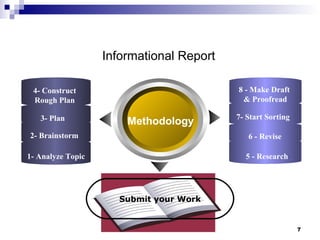
Methodology 1- Analyze Topic 2- Brainstorm 3- Plan 4- Construct Rough Plan 5 - Research 6 - Revise 7- Start Sorting  8 - Make Draft  & Proofread Submit your Work Informational Report
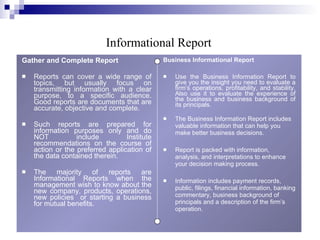
Gather and Complete Report Reports can cover a wide range of topics, but usually focus on transmitting information with a clear purpose, to a specific audience. Good reports are documents that are accurate, objective and complete. Such reports are prepared for information purposes only and do NOT include Institute recommendations on the course of action or the preferred application of the data contained therein.  The majority of reports are Informational Reports when the management wish to know about the new company, products, operations, new policies  or starting a business for mutual benefits. Business Informational Report Use the Business Information Report to give you the insight you need to evaluate a firm’s operations, profitability, and stability. Also use it to evaluate the experience of the business and business background of its principals. The Business Information Report includes valuable information that can help you make better business decisions. Report is packed with information, analysis, and interpretations to enhance your decision making process. Information includes payment records, public, filings, financial information, banking commentary, business background of principals and a description of the firm’s operation. Informational Report
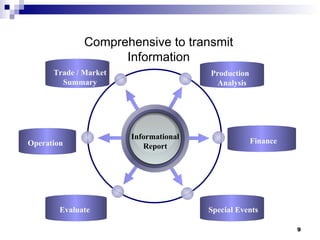
Informational Report Trade / Market Summary Operation Production  Analysis Finance Evaluate Comprehensive to transmit Information Special Events
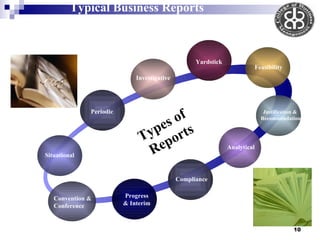
Situational Periodic Progress & Interim Convention & Conference Types of  Reports Investigative Compliance Analytical Justification &  Recommendation Feasibility Yardstick Typical Business Reports (Chapter # 13)
Periodic Report This section is traditionally allocated the most marks, so it is well worth your investment in time to do it thoroughly. The Periodic report is to help the Management to make their policies, procedures, operation, products according to the consumer requirement and by this report management can decide how to develop their organization for more mutual benefits.
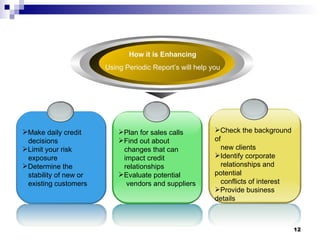
How it is Enhancing Using Periodic Report’s will help you Make daily credit  decisions Limit your risk  exposure Determine the  stability of new or  existing customers Plan for sales calls Find out about  changes that can  impact credit  relationships Evaluate potential  vendors and suppliers Check the background of  new clients Identify corporate  relationships and potential  conflicts of interest Provide business details  for research needs
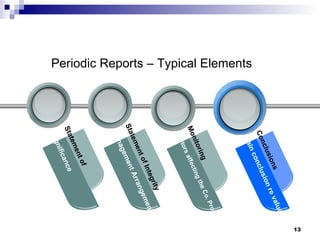
Significance Statement of Management Arrangement Statement of Integrity Factors affecting the Co. Property Monitoring Main conclusion re values Conclusions Periodic Reports – Typical Elements
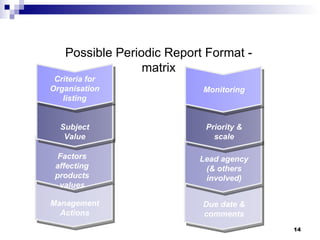
Subject Value Factors affecting products values Management Actions Possible Periodic Report Format - matrix Due date & comments Lead agency (& others involved) Priority & scale Monitoring Criteria for Organisation listing
Specimen Reports Take a  Momentary Look Periodic  Report Informational Report
Situational Reports Reports that are targeted to nonrecurring situations .i.e. unlike periodic reports, situations that don’t have a definite pattern of occurrence. e.g. Trip Convention & Conference reports Progress reports
Situational Reports Characteristics Style  Written like Memos Tone  Follow an informal tone Length  Usually Short. Could vary on authorizer expectation
Situational Reports Trip, Convention & Conference reports Submitted by employees when they return from a business trip, convention or a conference. Keep organizations informed how well their money was spent. Also inform management about new procedures, equipment and laws and supply information affecting products operations and service.
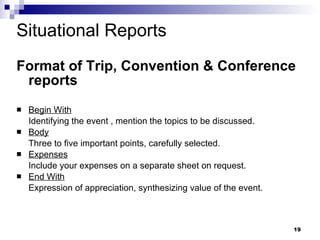
Situational Reports Format of Trip, Convention & Conference reports Begin With Identifying the event , mention the topics to be discussed. Body Three to five important points, carefully selected. Expenses Include your expenses on a separate sheet on request. End With Expression of appreciation, synthesizing value of the event.
Situational Reports Example : Trip, Convention & Conference reports  Training Conference on Employment Interviewing
Situational Reports Things to be kept in mind. There could be lots and lots of information. You should be selective. Avoid using chronological order (First X happened then Y), organizing by importance is a good idea. Select topics, the reader might be most interested in.
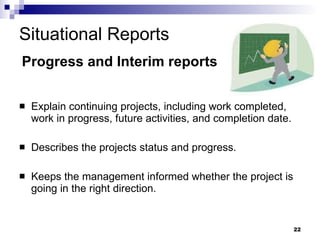
Situational Reports Explain continuing projects, including work completed, work in progress, future activities, and completion date . Describes the projects status and progress. Keeps the management informed whether the project is going in the right direction. Progress and Interim reports
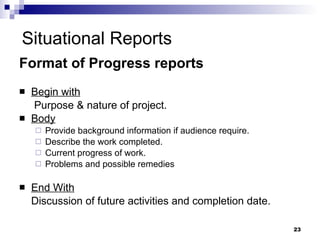
Situational Reports Format of Progress reports  Begin with   Purpose & nature of project. Body Provide background information if audience require. Describe the work completed. Current progress of work. Problems and possible remedies End With Discussion of future activities and completion date.
Situational Reports Example : Progress reports  Progress on research on location for a  telefilm  scene
Situational Reports Things to be kept in mind. Keep the audience in mind. E.g. Include background information for your director as he/she might not tend to remember the project specifications. Don’t hesitate to include the problems faced in the project.
Investigative Reports Investigative reports are generally assigned reports which focus on examining a situation or problem .  e.g. Report on doing business with and Australian company.
Investigative Reports Format of Investigative Reports   Begin with   Introducing the problem. Body Facts, findings, discussion etc. End With Summarizing
Compliance Reports Compliance Reports present data in compliance with local, state and federal laws.   Government regulating agencies require organizations to submit reports verifying compliance with laws Usually answer the questions to how much profit, the organization earned and the taxes owed.
Compliance Reports Format of compliance reports  Begin with Background information Preview of major sections Body The Content. Data, figures etc End With Summary of report objective
Compliance Reports Example : Compliance reports  Report Description Trucking Company Safety Compliance Report
Compliance Reports Things to be kept in mind. Correctness of data. Accuracy of data.
Analytical Reports
Major components: Introduction Findings Conclusions Recommendations Writing Analytical Reports
Writing Analytical Reports (contd..) Introduction Explain why the report is being written. Preview the report’s organization. Summarize the conclusions and recommendations ( for receptive audiences)
Writing Analytical Reports (contd..) Findings Discuss the pros and cons of each alternative. Establish criteria to evaluate alternatives.  Support the findings with evidence(: facts, statistics, expert opinion, survey data, and other proof) Use headings, enumerations, lists, tables, and graphics to focus attention.
Writing Analytical Reports (contd..) Conclusion Develop reasonable conclusion that answer the research question Justify the conclusion with highlights from the finding
Writing Analytical Reports (contd..) Recommendations Make recommendations, if asked.  Use action verbs. Explain needed action. Must based on the findings
Justification/recommendation reports Feasibility reports Yardstick reports Research reports Typical Business Analytical Reports
Purpose Make recommendations to management Provide data to solve problems and make decisions. Examples Buying equipment Changing a procedure Hiring an employee Contents Problem/Need Facts Discussion (pros & cons) Recommendation Sample  A Justification Report Justification/Recommendation Reports
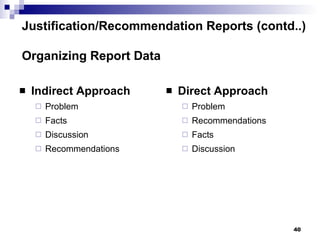
Indirect Approach Problem Facts Discussion Recommendations Direct Approach Problem Recommendations Facts Discussion Justification/Recommendation Reports (contd..) Organizing Report Data
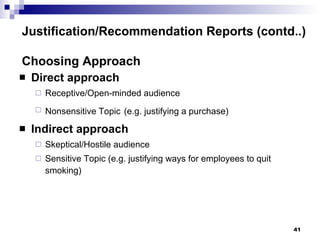
Direct approach Receptive/Open-minded audience Nonsensitive Topic   (e.g. justifying a purchase)  Indirect approach Skeptical/Hostile audience Sensitive Topic (e.g. justifying ways for employees to quit smoking) Justification/Recommendation Reports (contd..) Choosing Approach
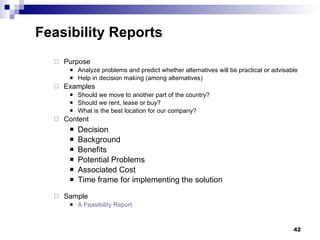
Purpose Analyze problems and predict whether alternatives will be practical or advisable  Help in decision making (among alternatives) Examples Should we move to another part of the country? Should we rent, lease or buy? What is the best location for our company? Content Decision  Background  Benefits  Potential Problems Associated Cost Time frame for implementing the solution Sample A Feasibility Report Feasibility Reports
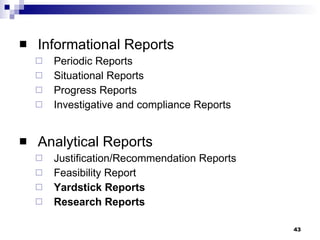
Informational Reports Periodic Reports Situational Reports Progress Reports Investigative and compliance Reports Analytical Reports Justification/Recommendation Reports Feasibility Report Yardstick Reports Research Reports
Yardstick Reports
Yardstick Reports The term "yardstick" is used in reference to anything which serves as a test or standard of measurement, comparison or judgment.  Usage of Yardstick Reports.
Yardstick reports Problem statement Alternative solutions Establish criteria's Conclusions Recommendations
Example Comparison of different manufactures for buying a piece of equipment
Format of Yardstick Reports Introduction purpose & overview. Problem Statement background. Solutions & Alternatives. Established criteria's Compare Alternatives Use Table or grid . Conclusion & Recommendations
Sample Yardstick Report A popular cellular network company (Mobilink) is planning to open their new franchise at the NWFP Province of Pakistan Sample Report
Research Studies
Research Studies Reports Problem statement Hypothesis Present data Perform Analysis Conclusions Recommendations (optional)
Research Studies Follows Indirect Pattern Starts with Problem discussion Explore possible solutions Reason for selecting a particular solution
Format of Research Studies Report Abstract Introduction Sources & Methods Results of Study data Conclusion Recommendation
Introduction Background Problem or Purpose Significance Scope
Sources and Methods Secondary Sources Books, journals etc Primary Sources Observations Surveys
Results of Study Present Data Organize colleted data.  Conclusion Recommendations References
Example of Research Report Sample Report
Conclusion Periodic Reports Situational Reports Progress Reports Investigative and compliance Reports Justification/Recommendation Reports Feasibility Report Yardstick Reports Research Reports
Mary Ellen Guffey,  Business Communication :Process and Product  www.glan-hafren.ac.uk/LearnCent www.homepages.wmich.edu/rpttypes References
Thank You ! Thank you very much for your kind consideration

Bc presentation chapter 13(2) (buss. English)

  • 1.
  • 2.
    Business Communication Chapter– 13 “ TYPICAL BUSINESS REPORTS”
  • 3.
    Why we arehere: It attempts to provide a moral justification, rationale or even establish clear rules as to “What is the Purpose of Writing a Business Report and how we give you more ideas & comprehensive business report compiling. What is the purpose of the Business Report
  • 4.
    Audience : Whenwriting the report, you need to consider the audience you are writing for, whether it is the CEO or will the report be available to all staff concerned? Research : The true value of the research may be assessed through a report since the written report may be the "only tangible product of hundreds of hours of work. Compiling: Reports communicate information which has been compiled as a result of research and analysis of data and of issues. Audience Research Compiling Basic Strategies
  • 5.
    Brilliant report, Kimble.I can’t tell where the facts end and the fiction begins.”                             " A Report Judges An Organization "   “ Good report Morton, work on it a little more until it sounds like one of mine.” ” Nice work on this report, Carlton. With this information we can easily lay-off fifty percent of our employees. Unfortunately you’ll be the first to go.”
  • 6.
    Writing Informational Report Informational report is to provide required data/information to wish to know about the things in a specific and complete form. Depending on the seriousness, they may have to be discussed later on.. Once you have this list, it will be easy for you to contact someone to clarify any information. Informational Report
  • 7.
    Methodology 1- AnalyzeTopic 2- Brainstorm 3- Plan 4- Construct Rough Plan 5 - Research 6 - Revise 7- Start Sorting 8 - Make Draft & Proofread Submit your Work Informational Report
  • 8.
    Gather and CompleteReport Reports can cover a wide range of topics, but usually focus on transmitting information with a clear purpose, to a specific audience. Good reports are documents that are accurate, objective and complete. Such reports are prepared for information purposes only and do NOT include Institute recommendations on the course of action or the preferred application of the data contained therein. The majority of reports are Informational Reports when the management wish to know about the new company, products, operations, new policies or starting a business for mutual benefits. Business Informational Report Use the Business Information Report to give you the insight you need to evaluate a firm’s operations, profitability, and stability. Also use it to evaluate the experience of the business and business background of its principals. The Business Information Report includes valuable information that can help you make better business decisions. Report is packed with information, analysis, and interpretations to enhance your decision making process. Information includes payment records, public, filings, financial information, banking commentary, business background of principals and a description of the firm’s operation. Informational Report
  • 9.
    Informational Report Trade/ Market Summary Operation Production Analysis Finance Evaluate Comprehensive to transmit Information Special Events
  • 10.
    Situational Periodic Progress& Interim Convention & Conference Types of Reports Investigative Compliance Analytical Justification & Recommendation Feasibility Yardstick Typical Business Reports (Chapter # 13)
  • 11.
    Periodic Report Thissection is traditionally allocated the most marks, so it is well worth your investment in time to do it thoroughly. The Periodic report is to help the Management to make their policies, procedures, operation, products according to the consumer requirement and by this report management can decide how to develop their organization for more mutual benefits.
  • 12.
    How it isEnhancing Using Periodic Report’s will help you Make daily credit decisions Limit your risk exposure Determine the stability of new or existing customers Plan for sales calls Find out about changes that can impact credit relationships Evaluate potential vendors and suppliers Check the background of new clients Identify corporate relationships and potential conflicts of interest Provide business details for research needs
  • 13.
    Significance Statement ofManagement Arrangement Statement of Integrity Factors affecting the Co. Property Monitoring Main conclusion re values Conclusions Periodic Reports – Typical Elements
  • 14.
    Subject Value Factorsaffecting products values Management Actions Possible Periodic Report Format - matrix Due date & comments Lead agency (& others involved) Priority & scale Monitoring Criteria for Organisation listing
  • 15.
    Specimen Reports Takea Momentary Look Periodic Report Informational Report
  • 16.
    Situational Reports Reportsthat are targeted to nonrecurring situations .i.e. unlike periodic reports, situations that don’t have a definite pattern of occurrence. e.g. Trip Convention & Conference reports Progress reports
  • 17.
    Situational Reports CharacteristicsStyle Written like Memos Tone Follow an informal tone Length Usually Short. Could vary on authorizer expectation
  • 18.
    Situational Reports Trip,Convention & Conference reports Submitted by employees when they return from a business trip, convention or a conference. Keep organizations informed how well their money was spent. Also inform management about new procedures, equipment and laws and supply information affecting products operations and service.
  • 19.
    Situational Reports Formatof Trip, Convention & Conference reports Begin With Identifying the event , mention the topics to be discussed. Body Three to five important points, carefully selected. Expenses Include your expenses on a separate sheet on request. End With Expression of appreciation, synthesizing value of the event.
  • 20.
    Situational Reports Example: Trip, Convention & Conference reports Training Conference on Employment Interviewing
  • 21.
    Situational Reports Thingsto be kept in mind. There could be lots and lots of information. You should be selective. Avoid using chronological order (First X happened then Y), organizing by importance is a good idea. Select topics, the reader might be most interested in.
  • 22.
    Situational Reports Explaincontinuing projects, including work completed, work in progress, future activities, and completion date . Describes the projects status and progress. Keeps the management informed whether the project is going in the right direction. Progress and Interim reports
  • 23.
    Situational Reports Formatof Progress reports Begin with Purpose & nature of project. Body Provide background information if audience require. Describe the work completed. Current progress of work. Problems and possible remedies End With Discussion of future activities and completion date.
  • 24.
    Situational Reports Example: Progress reports Progress on research on location for a telefilm scene
  • 25.
    Situational Reports Thingsto be kept in mind. Keep the audience in mind. E.g. Include background information for your director as he/she might not tend to remember the project specifications. Don’t hesitate to include the problems faced in the project.
  • 26.
    Investigative Reports Investigativereports are generally assigned reports which focus on examining a situation or problem . e.g. Report on doing business with and Australian company.
  • 27.
    Investigative Reports Formatof Investigative Reports Begin with Introducing the problem. Body Facts, findings, discussion etc. End With Summarizing
  • 28.
    Compliance Reports ComplianceReports present data in compliance with local, state and federal laws. Government regulating agencies require organizations to submit reports verifying compliance with laws Usually answer the questions to how much profit, the organization earned and the taxes owed.
  • 29.
    Compliance Reports Formatof compliance reports Begin with Background information Preview of major sections Body The Content. Data, figures etc End With Summary of report objective
  • 30.
    Compliance Reports Example: Compliance reports Report Description Trucking Company Safety Compliance Report
  • 31.
    Compliance Reports Thingsto be kept in mind. Correctness of data. Accuracy of data.
  • 32.
  • 33.
    Major components: IntroductionFindings Conclusions Recommendations Writing Analytical Reports
  • 34.
    Writing Analytical Reports(contd..) Introduction Explain why the report is being written. Preview the report’s organization. Summarize the conclusions and recommendations ( for receptive audiences)
  • 35.
    Writing Analytical Reports(contd..) Findings Discuss the pros and cons of each alternative. Establish criteria to evaluate alternatives. Support the findings with evidence(: facts, statistics, expert opinion, survey data, and other proof) Use headings, enumerations, lists, tables, and graphics to focus attention.
  • 36.
    Writing Analytical Reports(contd..) Conclusion Develop reasonable conclusion that answer the research question Justify the conclusion with highlights from the finding
  • 37.
    Writing Analytical Reports(contd..) Recommendations Make recommendations, if asked. Use action verbs. Explain needed action. Must based on the findings
  • 38.
    Justification/recommendation reports Feasibilityreports Yardstick reports Research reports Typical Business Analytical Reports
  • 39.
    Purpose Make recommendationsto management Provide data to solve problems and make decisions. Examples Buying equipment Changing a procedure Hiring an employee Contents Problem/Need Facts Discussion (pros & cons) Recommendation Sample A Justification Report Justification/Recommendation Reports
  • 40.
    Indirect Approach ProblemFacts Discussion Recommendations Direct Approach Problem Recommendations Facts Discussion Justification/Recommendation Reports (contd..) Organizing Report Data
  • 41.
    Direct approach Receptive/Open-mindedaudience Nonsensitive Topic (e.g. justifying a purchase) Indirect approach Skeptical/Hostile audience Sensitive Topic (e.g. justifying ways for employees to quit smoking) Justification/Recommendation Reports (contd..) Choosing Approach
  • 42.
    Purpose Analyze problemsand predict whether alternatives will be practical or advisable Help in decision making (among alternatives) Examples Should we move to another part of the country? Should we rent, lease or buy? What is the best location for our company? Content Decision Background Benefits Potential Problems Associated Cost Time frame for implementing the solution Sample A Feasibility Report Feasibility Reports
  • 43.
    Informational Reports PeriodicReports Situational Reports Progress Reports Investigative and compliance Reports Analytical Reports Justification/Recommendation Reports Feasibility Report Yardstick Reports Research Reports
  • 44.
  • 45.
    Yardstick Reports Theterm "yardstick" is used in reference to anything which serves as a test or standard of measurement, comparison or judgment. Usage of Yardstick Reports.
  • 46.
    Yardstick reports Problemstatement Alternative solutions Establish criteria's Conclusions Recommendations
  • 47.
    Example Comparison ofdifferent manufactures for buying a piece of equipment
  • 48.
    Format of YardstickReports Introduction purpose & overview. Problem Statement background. Solutions & Alternatives. Established criteria's Compare Alternatives Use Table or grid . Conclusion & Recommendations
  • 49.
    Sample Yardstick ReportA popular cellular network company (Mobilink) is planning to open their new franchise at the NWFP Province of Pakistan Sample Report
  • 50.
  • 51.
    Research Studies ReportsProblem statement Hypothesis Present data Perform Analysis Conclusions Recommendations (optional)
  • 52.
    Research Studies FollowsIndirect Pattern Starts with Problem discussion Explore possible solutions Reason for selecting a particular solution
  • 53.
    Format of ResearchStudies Report Abstract Introduction Sources & Methods Results of Study data Conclusion Recommendation
  • 54.
    Introduction Background Problemor Purpose Significance Scope
  • 55.
    Sources and MethodsSecondary Sources Books, journals etc Primary Sources Observations Surveys
  • 56.
    Results of StudyPresent Data Organize colleted data. Conclusion Recommendations References
  • 57.
    Example of ResearchReport Sample Report
  • 58.
    Conclusion Periodic ReportsSituational Reports Progress Reports Investigative and compliance Reports Justification/Recommendation Reports Feasibility Report Yardstick Reports Research Reports
  • 59.
    Mary Ellen Guffey, Business Communication :Process and Product www.glan-hafren.ac.uk/LearnCent www.homepages.wmich.edu/rpttypes References
  • 60.
    Thank You !Thank you very much for your kind consideration

Editor's Notes

  • #44 So far we have seen two broad categories of reports that Are …. Informational Reports. They present data but does not analyze that data or makes any conclusions. Analytical reports not only provides data but also analyze’s that data and draw conclusions. I would be presenting on Yardstick and research reports
  • #45 Think for a while about the term yardstick Yardstick >> is a stick that is about 3 feet long. It is basically a measuring tool that is used in making measurements or comparision. Same is the case here with yard stcik reports Look at the picture When ever we measure some thing we have to use a standard unit This unit becomes the criteria of measeurement.
  • #46 Used by higher level management in order to compare, measure different alternative solutions
  • #47 Lets Take a look at the definition of yardstick reports. A yardstick report is a type of report that Discusses a problem statement Provide one or more alternate solutions to the problem Each of the alternative solution is measured or weighed against the criteria. Writer then provides conclusions and make recommendations. What diffrentiates yardstick reports from other reports is the The Consistency that it provides in comparing various alternative Solutions.
  • #48 Assume your company decides to buy an equipment from a manufacturer you have to compare or evaluate different manufactures. One critera of comparison might be the cost of equipment that is provide by different manufacuters
  • #49 A typical Format of Yardstick report is given below. Report starts with the introduction This sections describes the purpose of report and provides an overview of the organization of report. Discuss the problem briefly with a little background information. This section discusses the multiple solutions and alternates that are available. Writer then tells how he has established different criteria's that he is using to evaluate alternatives. This is the main part of yard stick report where writer performs the comparison between each of the Solution and alternatives In this section the writer highlights the differences or similarities between the solutions we can use tabular format to summarize complex data Writer then provide the conclusion and gives his recommendation with an obvious reason .
  • #51 Are used by different business organizations in order to conduct a thorough studies of a particular problem. They uses a scientific approach to solve a particular problem
  • #52 Research reports discusses a problem statement or purpose statement Suggest ways on how to solve that problem. Present data that has been collected during the research leading to conclusions. Analyze that data Draw conclusions and make recommendations.
  • #53 They guide the reader through out the report so that the conclusions seems rational to the reader.