Contents
Know your EQ
1
• What is emotion
• How emotions are expressed?
• What is IQ and EQ
• What is emotional intelligent?
• Emotions and health
• Using emotional Intelligence
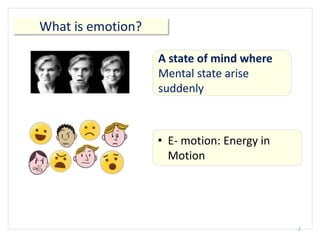
What is emotion?
2
A state of mind where
Mental state arise
suddenly
• E- motion: Energy in
Motion
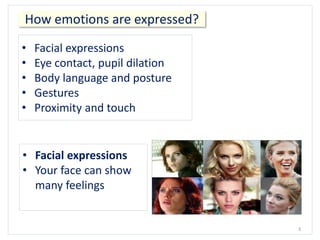
How emotions are expressed?
3
• Facial expressions
• Eye contact, pupil dilation
• Body language and posture
• Gestures
• Proximity and touch
• Facial expressions
• Your face can show
many feelings
4
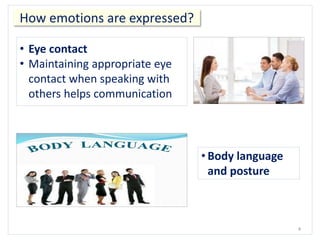
How emotions are expressed?
• Eye contact
• Maintaining appropriate eye
contact when speaking with
others helps communication
• Body language
and posture
5
How emotions are expressed?
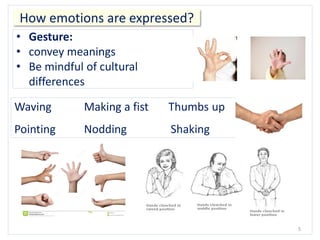
• Gesture:
• convey meanings
• Be mindful of cultural
differences
Waving Making a fist Thumbs up
Pointing Nodding Shaking
6
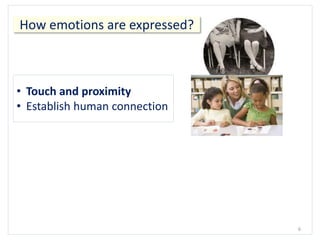
• Touch and proximity
• Establish human connection
How emotions are expressed?
Understand emotions
7
• Recognizes what events are likely to trigger different
emotions
• Knows that emotions can combine to form complex
blends of feelings
• Realizes that emotions can progress over time and
transition from one to another
• Provides a rich emotional vocabulary for greater
precision in describing feelings and blends of feelings
IQ and EQ
8
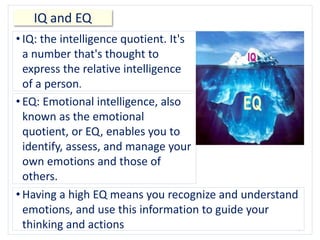
• IQ: the intelligence quotient. It's
a number that's thought to
express the relative intelligence
of a person.
• EQ: Emotional intelligence, also
known as the emotional
quotient, or EQ, enables you to
identify, assess, and manage your
own emotions and those of
others.
• Having a high EQ means you recognize and understand
emotions, and use this information to guide your
thinking and actions
IQ and EQ
9
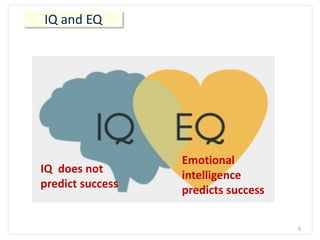
IQ does not
predict success
Emotional
intelligence
predicts success
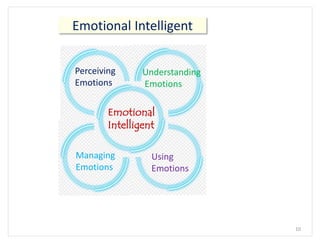
Emotional Intelligent
10
Emotional
Intelligent
Perceiving
Emotions
Managing
Emotions
Using
Emotions
Understanding
Emotions
What is Emotional Intelligence?
11
• Ability to manage emotions in one’s self and in others in order
to reach desired outcomes
• How well we handle ourselves and each other.
• EI is not about being nice all the time. . It is about being honest.
• EI is not about being “touchy-feely.” .. It is about being aware of
your feelings, and those of others.
• EI is not about being emotional… It is about being smart with
your emotions.
• EI is more a function of belief and values, than based on traces
of what we can see today.
• Goes beyond intellectual ability and technical skills
• Focuses on personal qualities such as initiative, empathy,
adaptability, persuasiveness
Emotional Intelligence
12
• EI predicts how well we perform at home, school,
society and at the workplace.”
• Seen as the fundamental key to success and
leadership - and it can be learned!
• Working with people
• Not just about being nice
• Understanding other’s emotions
• Managing one’s own emotions
• Ability to handle encounters
• Teamwork
• Leadership
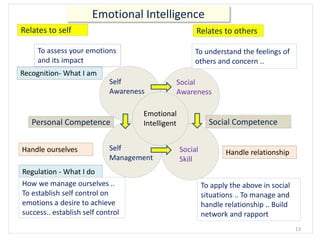
13
Self
Awareness
Self
Management
Social
Awareness
Social
Skill
Regulation - What I do
Recognition- What I am
Handle ourselves
To assess your emotions
and its impact
How we manage ourselves ..
To establish self control on
emotions a desire to achieve
success.. establish self control
To understand the feelings of
others and concern ..
To apply the above in social
situations .. To manage and
handle relationship .. Build
network and rapport
Relates to othersRelates to self
Social CompetencePersonal Competence
Emotional
Intelligent
Handle relationship
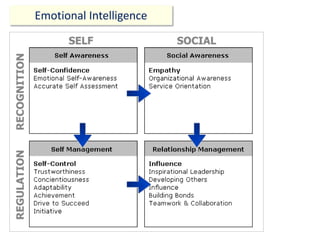
Emotional Intelligence
Emotions and Health
15
• Body respond the way you think, feel and act
• When you are under stress, fear, anxious and upset;
your body tells you that something is wrong
• You feel blood pressure, body pain, chest pain, change
in appetite, loss of sleep, headache, stomach pain etc.
• Emotions affects our health
Using emotional Intelligence
16
• Balancing emotions with intelligence is important
• EQ involves:
• Taking accounts how things get done
• Paying attention to motive, behavior and
interactions
• How results are obtained the results themselves
• Leader with high EQ perform well
• EQ
• Gives job success
• Important for business
• How to motivate each one

Improve your eq

  • 1.
    Contents Know your EQ 1 •What is emotion • How emotions are expressed? • What is IQ and EQ • What is emotional intelligent? • Emotions and health • Using emotional Intelligence
  • 2.
    What is emotion? 2 Astate of mind where Mental state arise suddenly • E- motion: Energy in Motion
  • 3.
    How emotions areexpressed? 3 • Facial expressions • Eye contact, pupil dilation • Body language and posture • Gestures • Proximity and touch • Facial expressions • Your face can show many feelings
  • 4.
    4 How emotions areexpressed? • Eye contact • Maintaining appropriate eye contact when speaking with others helps communication • Body language and posture
  • 5.
    5 How emotions areexpressed? • Gesture: • convey meanings • Be mindful of cultural differences Waving Making a fist Thumbs up Pointing Nodding Shaking
  • 6.
    6 • Touch andproximity • Establish human connection How emotions are expressed?
  • 7.
    Understand emotions 7 • Recognizeswhat events are likely to trigger different emotions • Knows that emotions can combine to form complex blends of feelings • Realizes that emotions can progress over time and transition from one to another • Provides a rich emotional vocabulary for greater precision in describing feelings and blends of feelings
  • 8.
    IQ and EQ 8 •IQ: the intelligence quotient. It's a number that's thought to express the relative intelligence of a person. • EQ: Emotional intelligence, also known as the emotional quotient, or EQ, enables you to identify, assess, and manage your own emotions and those of others. • Having a high EQ means you recognize and understand emotions, and use this information to guide your thinking and actions
  • 9.
    IQ and EQ 9 IQdoes not predict success Emotional intelligence predicts success
  • 10.
  • 11.
    What is EmotionalIntelligence? 11 • Ability to manage emotions in one’s self and in others in order to reach desired outcomes • How well we handle ourselves and each other. • EI is not about being nice all the time. . It is about being honest. • EI is not about being “touchy-feely.” .. It is about being aware of your feelings, and those of others. • EI is not about being emotional… It is about being smart with your emotions. • EI is more a function of belief and values, than based on traces of what we can see today. • Goes beyond intellectual ability and technical skills • Focuses on personal qualities such as initiative, empathy, adaptability, persuasiveness
  • 12.
    Emotional Intelligence 12 • EIpredicts how well we perform at home, school, society and at the workplace.” • Seen as the fundamental key to success and leadership - and it can be learned! • Working with people • Not just about being nice • Understanding other’s emotions • Managing one’s own emotions • Ability to handle encounters • Teamwork • Leadership
  • 13.
    13 Self Awareness Self Management Social Awareness Social Skill Regulation - WhatI do Recognition- What I am Handle ourselves To assess your emotions and its impact How we manage ourselves .. To establish self control on emotions a desire to achieve success.. establish self control To understand the feelings of others and concern .. To apply the above in social situations .. To manage and handle relationship .. Build network and rapport Relates to othersRelates to self Social CompetencePersonal Competence Emotional Intelligent Handle relationship Emotional Intelligence
  • 14.
  • 15.
    Emotions and Health 15 •Body respond the way you think, feel and act • When you are under stress, fear, anxious and upset; your body tells you that something is wrong • You feel blood pressure, body pain, chest pain, change in appetite, loss of sleep, headache, stomach pain etc. • Emotions affects our health
  • 16.
    Using emotional Intelligence 16 •Balancing emotions with intelligence is important • EQ involves: • Taking accounts how things get done • Paying attention to motive, behavior and interactions • How results are obtained the results themselves • Leader with high EQ perform well • EQ • Gives job success • Important for business • How to motivate each one