The Business Case 
For Emotional Intelligence 
Michael Collins
What is Emotional Intelligence? 
Was there ever a time … 
When you said or did something out of anger that you 
later regretted? 
When you misread someone’s intentions or the 
political climate at work? 
When you found it hard to focus on a task because of 
how you were feeling at the time? 
… haven’t we all?
What is Emotional Intelligence? 
“Emotional intelligence refers to the capacity 
to deal effectively with one’s own and others’ 
emotions. 
When applied to the workplace, it involves 
the capacity to effectively perceive, express, 
understand and manage emotions in a 
professional manner.” 
(Stough and Palmer, 2002)
What is Emotional Intelligence? 
Unlike personality and IQ, EI is regarded as a 
set of skills or abilities that can be learned 
and developed. 
Research by Swinburne University led to the 
development of a five dimensional model 
known as the Genos EI Instrument.
The Genos EI Instrument 
Five Dimensions: 
Emotional Recognition and Expression 
Understanding Emotions 
Emotions Direct Cognition 
Emotional Management 
Emotional Control
Emotional Recognition & Expression 
The ability to perceive and express one’s own 
emotions 
People high in this dimension typically… 
Find it easy to talk about their feelings with colleagues 
Colleagues can easily tell how they are feeling 
Can describe their feelings on an issue to colleagues 
Have little trouble finding the right words to express how they 
feel at work
Understanding Emotions 
The ability to perceive and understand the emotions 
of others 
People high in this dimension typically… 
Readily understand the reasons why they have upset 
someone at work 
When discussing an issue, find it easy to tell whether 
colleagues feel the same way as they do 
Can pick-up on the emotional tone of staff meetings 
Watch the way clients react to things when trying to build 
rapport with them
Emotions Direct Cognition 
The extent to which emotions and emotional 
information is utilised in reasoning and decision 
making 
People high in this dimension typically… 
Attend to their feelings on a matter when making important 
work-related decisions 
Weigh-up how they feel about different solutions to work related 
problems 
Believe that feelings should be considered when making 
important work related decisions 
When trying to recall certain situations at work, tend to think 
about how they felt
Emotional Management 
The ability to manage one’s own and others 
emotions at work 
People high in this dimension typically… 
Intervene in an effective way when colleagues get 
‘worked-up’ 
Overcome conflict with colleagues by influencing their moods 
and emotions 
When stressed, remain focused on what they are doing 
When upset by a colleague, think through what the person 
has said and find a solution to the problem
Emotional Control 
The ability to effectively control strong emotions 
People high in this dimension typically… 
Overcome anger at work by thinking through what’s causing it 
Find it easy to concentrate on a task when really excited 
about something 
Can be upset at work and still think clearly 
When anxious, remain focused on what they are doing
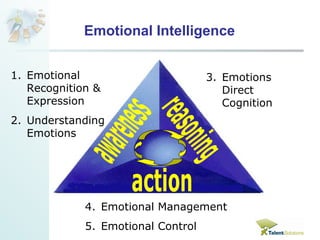
1. Emotional 
Emotional Intelligence 
Recognition & 
Expression 
2. Understanding 
Emotions 
3. Emotions 
Direct 
Cognition 
4. Emotional Management 
5. Emotional Control
Why is EI Important? 
Research conducted by Swinburne University (with 
Australian companies) has found a relationship 
between EI and: 
Occupational stress 
Absenteeism 
Teamwork effectiveness 
The quality of interpersonal relationships 
Performance (customer service and sales) 
Innovation and creativity 
Job satisfaction and organisational commitment
Why is EI Important? 
We also know that EI is related to: 
Successful leadership styles: 
– ‘Transformational’ as opposed to ‘Transactional’ or ‘Passive- 
Avoidant’ leadership behaviours 
Salary, number of direct reports and level of 
management/ leadership responsibility 
Research shows that about 36% of the variance in 
Australian leadership success can be accounted 
for by EI
Why is EI Important? 
Some real-life applications: 
Helping managers and staff give and receive 
feedback (eg. performance appraisals) 
Helping managers develop effective coaching skills 
Helping sales professionals understand their 
customer’s needs more effectively 
Helping staff deal with frustrated customers more 
effectively 
Helping managers and staff deal with workplace 
stress and conflict more effectively
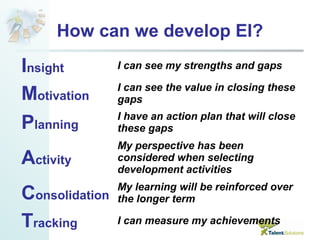
How can we develop EI? 
Insight I can see my strengths and gaps 
Motivation I can see the value in closing these 
gaps 
Planning I have an action plan that will close 
these gaps 
Activity 
My perspective has been 
considered when selecting 
development activities 
Consolidation My learning will be reinforced over 
the longer term 
Tracking I can measure my achievements
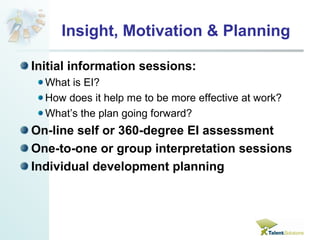
Insight, Motivation & Planning 
Initial information sessions: 
What is EI? 
How does it help me to be more effective at work? 
What’s the plan going forward? 
On-line self or 360-degree EI assessment 
One-to-one or group interpretation sessions 
Individual development planning
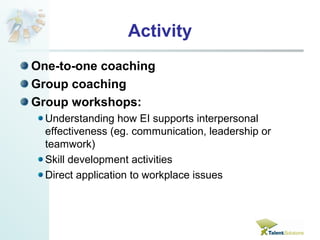
Activity 
One-to-one coaching 
Group coaching 
Group workshops: 
Understanding how EI supports interpersonal 
effectiveness (eg. communication, leadership or 
teamwork) 
Skill development activities 
Direct application to workplace issues
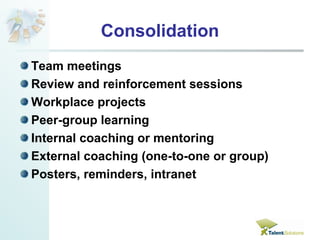
Consolidation 
Team meetings 
Review and reinforcement sessions 
Workplace projects 
Peer-group learning 
Internal coaching or mentoring 
External coaching (one-to-one or group) 
Posters, reminders, intranet
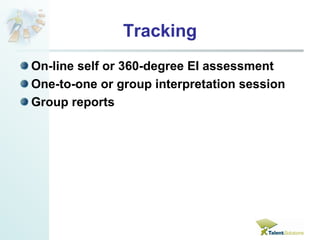
Tracking 
On-line self or 360-degree EI assessment 
One-to-one or group interpretation session 
Group reports
Five Key Lessons 
1. The need for senior management 
commitment and support 
2. Making a clear link between EI and its 
practical application in the workplace 
3. The importance of up-front information 
sessions 
4. Effective debriefing and interpretation of EI 
reports 
5. The importance of follow-up and regular 
reinforcement activities
Questions?

The business case for emotional intelligence

  • 1.
    The Business Case For Emotional Intelligence Michael Collins
  • 2.
    What is EmotionalIntelligence? Was there ever a time … When you said or did something out of anger that you later regretted? When you misread someone’s intentions or the political climate at work? When you found it hard to focus on a task because of how you were feeling at the time? … haven’t we all?
  • 3.
    What is EmotionalIntelligence? “Emotional intelligence refers to the capacity to deal effectively with one’s own and others’ emotions. When applied to the workplace, it involves the capacity to effectively perceive, express, understand and manage emotions in a professional manner.” (Stough and Palmer, 2002)
  • 4.
    What is EmotionalIntelligence? Unlike personality and IQ, EI is regarded as a set of skills or abilities that can be learned and developed. Research by Swinburne University led to the development of a five dimensional model known as the Genos EI Instrument.
  • 5.
    The Genos EIInstrument Five Dimensions: Emotional Recognition and Expression Understanding Emotions Emotions Direct Cognition Emotional Management Emotional Control
  • 6.
    Emotional Recognition &Expression The ability to perceive and express one’s own emotions People high in this dimension typically… Find it easy to talk about their feelings with colleagues Colleagues can easily tell how they are feeling Can describe their feelings on an issue to colleagues Have little trouble finding the right words to express how they feel at work
  • 7.
    Understanding Emotions Theability to perceive and understand the emotions of others People high in this dimension typically… Readily understand the reasons why they have upset someone at work When discussing an issue, find it easy to tell whether colleagues feel the same way as they do Can pick-up on the emotional tone of staff meetings Watch the way clients react to things when trying to build rapport with them
  • 8.
    Emotions Direct Cognition The extent to which emotions and emotional information is utilised in reasoning and decision making People high in this dimension typically… Attend to their feelings on a matter when making important work-related decisions Weigh-up how they feel about different solutions to work related problems Believe that feelings should be considered when making important work related decisions When trying to recall certain situations at work, tend to think about how they felt
  • 9.
    Emotional Management Theability to manage one’s own and others emotions at work People high in this dimension typically… Intervene in an effective way when colleagues get ‘worked-up’ Overcome conflict with colleagues by influencing their moods and emotions When stressed, remain focused on what they are doing When upset by a colleague, think through what the person has said and find a solution to the problem
  • 10.
    Emotional Control Theability to effectively control strong emotions People high in this dimension typically… Overcome anger at work by thinking through what’s causing it Find it easy to concentrate on a task when really excited about something Can be upset at work and still think clearly When anxious, remain focused on what they are doing
  • 11.
    1. Emotional EmotionalIntelligence Recognition & Expression 2. Understanding Emotions 3. Emotions Direct Cognition 4. Emotional Management 5. Emotional Control
  • 12.
    Why is EIImportant? Research conducted by Swinburne University (with Australian companies) has found a relationship between EI and: Occupational stress Absenteeism Teamwork effectiveness The quality of interpersonal relationships Performance (customer service and sales) Innovation and creativity Job satisfaction and organisational commitment
  • 13.
    Why is EIImportant? We also know that EI is related to: Successful leadership styles: – ‘Transformational’ as opposed to ‘Transactional’ or ‘Passive- Avoidant’ leadership behaviours Salary, number of direct reports and level of management/ leadership responsibility Research shows that about 36% of the variance in Australian leadership success can be accounted for by EI
  • 14.
    Why is EIImportant? Some real-life applications: Helping managers and staff give and receive feedback (eg. performance appraisals) Helping managers develop effective coaching skills Helping sales professionals understand their customer’s needs more effectively Helping staff deal with frustrated customers more effectively Helping managers and staff deal with workplace stress and conflict more effectively
  • 15.
    How can wedevelop EI? Insight I can see my strengths and gaps Motivation I can see the value in closing these gaps Planning I have an action plan that will close these gaps Activity My perspective has been considered when selecting development activities Consolidation My learning will be reinforced over the longer term Tracking I can measure my achievements
  • 16.
    Insight, Motivation &Planning Initial information sessions: What is EI? How does it help me to be more effective at work? What’s the plan going forward? On-line self or 360-degree EI assessment One-to-one or group interpretation sessions Individual development planning
  • 17.
    Activity One-to-one coaching Group coaching Group workshops: Understanding how EI supports interpersonal effectiveness (eg. communication, leadership or teamwork) Skill development activities Direct application to workplace issues
  • 18.
    Consolidation Team meetings Review and reinforcement sessions Workplace projects Peer-group learning Internal coaching or mentoring External coaching (one-to-one or group) Posters, reminders, intranet
  • 19.
    Tracking On-line selfor 360-degree EI assessment One-to-one or group interpretation session Group reports
  • 20.
    Five Key Lessons 1. The need for senior management commitment and support 2. Making a clear link between EI and its practical application in the workplace 3. The importance of up-front information sessions 4. Effective debriefing and interpretation of EI reports 5. The importance of follow-up and regular reinforcement activities
  • 21.