Report planning and Research
Business reports are systematic attempts to answer questions and solve problems. They include the following activities. What Are Business Reports? Planning Research Organization Presentation
Ten Truths About Business Reports Everyone writes reports. Most reports flow upward. Most reports are informal. Three report formats (memo, letter, and manuscript) are most common. Reports differ from memos and letters.
Today’s reports are written on computers. Some reports are collaborative efforts. Ethical report writers interpret facts fairly. Organization is imposed on data. The writer is the reader’s servant. Ten Truths About Business Reports
Report Functions Informational reports Analytical reports
Report Formats Letter format (outside the organization) Memo format (with in the organization) Manuscript format (longer formal reports) Printed forms (repititive data ,monthly etc)
Writing Style Formal Informal
Writing Informational Reports
Introduction Identify the report and its purpose. Present a brief overview of the report’s organization, especially for longer reports. When readers are unfamiliar with the topic, briefly fill in the background details. Writing Informational Reports
Body Group facts or findings into three to five roughly equal segments that do not overlap. Organize by time, component, importance, criteria, convention, or some other method. Writing Informational Reports
Body Supply functional or talking heads (at least one per page) to describe each section. Use an informal, conversational writing style unless a formal tone is expected. Use bullets, numbered and lettered lists, headings, underlined items, and white space to enhance readability. Writing Informational Reports
Summary/Conclusion When necessary, briefly review the main points and discuss what action will follow. If relevant, express appreciation or describe your willingness to provide further information. Writing Informational Reports
Typical informational business reports Periodic reports Describe production, sales, shipping, service, and other recurring activities. Trip, convention, conference reports Describe an event, summarize three to five main points, itemize expenses, and estimate the event’s value. Writing Informational Reports
Typical informational business reports Progress and interim reports Explain continuing projects, including work completed, work in progress, future activities, and completion date. Investigative reports Examine problems and supply facts; provide little analysis. Writing Informational Reports
Student Progress Report DATE:     ~~~~~~ TO:  ~~~~~~ FROM:   ~~~~~~ SUBJECT:   ~~~~~~ ~~~~~~~~~~~~~~~~~~~~~~~~~~~~~~~~~ ~~~~~~~~~~~~~~~~~~~~~~~~ Background ~~~~~~~~~~~~~~~~~~~~~~~~~~~~~~~~~ ~~~~~~~~~~~~~~~~~~~~~~~~~~~~~~~~ ~~~~~~~~~~~~~~~~~~~~~~~~~~~~~~~~~ ~~~~~~~~~~~~~~~~~~~~~~~~~~~~~~~~ ~~~~~~~~~~~~~~ Work Completed ~~~~~~~~~~~~~~~~~~~~~~~~~~~~~~~~~ ~~~~~~~~~~~~~~~~~~~~~~~~~~~~~~~~ ~~~~~~~~~~~~~~~~~~~~~~~~~~~~~~~~~
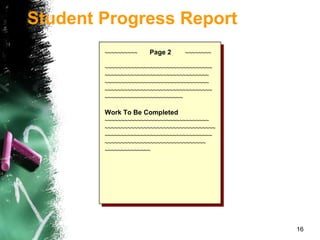
Student Progress Report ~~~~~~~~~~  Page 2   ~~~~~~~~ ~~~~~~~~~~~~~~~~~~~~~~~~~~~~~~~~~ ~~~~~~~~~~~~~~~~~~~~~~~~~~~~~~~~ ~~~~~~~~~~~~~~~~~~~~~~~~~~~~~~~~ ~~~~~~~~~~~~~~~~~~~~~~~~~~~~~~~~~ ~~~~~~~~~~~~~~~~~~~~~~~~ Work To Be Completed ~~~~~~~~~~~~~~~~~~~~~~~~~~~~~~~~ ~~~~~~~~~~~~~~~~~~~~~~~~~~~~~~~~~~ ~~~~~~~~~~~~~~~~~~~~~~~~~~~~~~~~~ ~~~~~~~~~~~~~~~~~~~~~~~~~~~~~~~ ~~~~~~~~~~~~~~
Writing Analytical Reports
Introduction Explain why the report is being written. For research studies, include the significance, scope, limitations, and methodology of the investigation. Preview the report’s organization. For receptive audiences, summarize the conclusions and recommendations. Writing Analytical Reports
Findings Discuss the pros and cons of each alternative. For receptive audiences, consider placing the recommended alternative last. Establish criteria to evaluate alternatives. In “yardstick” studies create criteria to use in measuring each alternative consistently. Writing Analytical Reports
Findings Support the findings with evidence: facts, statistics, expert opinion, survey data, and other proof. Use headings, enumerations, lists, tables, and graphics to focus attention. Writing Analytical Reports
Conclusions/Recommendations Develop reasonable conclusions that answer the research question. Justify the conclusions with highlights from the findings. Make recommendations, if asked. Use action verbs. Explain needed action. Writing Analytical Reports
Typical analytical business reports Justification/recommendation reports Make recommendations to management; provide data to solve problems and make decisions. Feasibility reports Analyze problems and predict whether alternatives will be practical or advisable. Yardstick reports Establish criteria and evaluate alternatives by measuring against the yardstick criteria. Writing Analytical Reports
Audience Analysis and Report Organization Direct Pattern Report ----- Main Idea  ---- ----------------------- ----------------------- ----------------------- ----------------------- ----------------------- ----------------------- ----------------------- If readers are informed If readers are supportive If readers are eager to have results first
Audience Analysis and Report Organization Indirect Pattern If readers need to be educated If readers need to be persuaded If readers may be hostile or disappointed Report ----------------------- ----------------------- ----------------------- ----------------------- ----------------------- ----------------------- ----------------------- ----- Main Idea  ----
Applying the Writing Process to Reports Step 1 Step 2 Step 3 Step 4 Step 5 Step 6 Step 7 Analyze the problem and purpose. Anticipate the audience and issues. Prepare a work plan. Implement your research strategy. Organize, analyze, interpret, illustrate the data. Compose the first draft. Revise, proofread, and evaluate.
Work Plan for a Formal Report Statement of problem Statement of purpose Sources and methods of data collection Tentative outline Work schedule
Researching Report Data
Locating secondary print data Books – card catalog, online catalog Periodicals – print indexes, CD-ROM indexes Researching Report Data
Locating secondary electronic data Electronic databases The Internet World Wide Web search tools Google  MSN search Ask Jeeves  Yahoo! Evaluating Web sources How current is the information? How credible is the author or source? What is the purpose of the site? Do the facts seem reliable? Researching Report Data
Tips for searching the Web Use two or three search tools. Understand case sensitivity. Prefer uncommon words. Omit articles and prepositions. Use wild cards. Know your search tool. Learn basic Boolean search strategies. Bookmark the best pages. Be persistent. Repeat your search a week later. Researching Report Data
Researching primary data Surveys Interviews Observation Experimentation Researching Report Data
Documenting Data
Reasons for crediting sources Strengthens your argument Gives you protection Instructs readers Documenting Data
Learning what to document Another person's ideas, opinions, examples, or theory Any facts, statistics, graphs, and drawings that are not common knowledge Quotations of another person's actual spoken or written words Paraphrases of another person's spoken or written words   Documenting Data
Don’t Document These Your own ideas. Common knowledge ( i.e. , what an average college graduate who hasn’t done this research would know). Information you’ve found in multiple sources ( e.g. , Shakespeare died in 1616), unless it’s controversial ( e.g. , Shakespeare’s plays were written by Queen Elizabeth).
Manual note taking suggestions Record all major ideas from various sources on separate note cards. Include all publication data along with precise quotations. Consider using one card color for direct quotes and a different color for your paraphrases and summaries.  Documenting Data
Electronic notetaking suggestions Begin your research by setting up a folder on your hard-drive that will contain your data. Create separate subfolders for major topics, such as  Introduction, Body,  and  Closing . When on the Web or in electronic databases you find information you may be able to use, highlight (i.e., drag with your mouse) the passages you want to save, copy them (using control-c), paste them (using control-v) into documents that you will save in appropriate subfolders. Documenting Data
Be sure to include all publication data. Consider archiving on a Zip disk the Web pages or articles used in your research in case the data must later be verified. Documenting Data
Learn to paraphrase Read the original material carefully so that you can comprehend its full meaning. Write your own version without looking at the original. Do not repeat the grammatical structure of the original, and do not merely replace words of the original with synonyms. Reread the original to be sure you covered the main points but did not borrow specific language. Documenting Data
Three Major Systems English, foreign language, and humanities scholars use the Modern Language Association (MLA) citation system. Journalists and scholars in history, art, and philosophy follow  The Chicago Style Manual . Researchers in psychology and other social sciences use the American Psychological Association (APA) style .
Chicago manual
Use superscript (raised number in the text) Use foot notes / end notes Reference contains author’s name, title of publication, date and page cited Number citations through out For footnotes leave 1 & half inch line Supply the list of references (Bibliography) at the end of report.
Sample note: 4. Donald N. McCloskey,  Enterprise   and Trade in   Victorian Britain: Essays   in Historical Economics  (London: George   Allen and Unwin, 1981), 54.
Make it at the last page Centre the heading in capital 2 inch from the top page Include all references cited in the report Arrange items alphabetically by authors last name or by the first entry of reference Single space within and double space between references Indent the second and succeeding lines of references.
Sample bibliographic entry:    McCloskey, Donald N.  Enterprise and Trade in Victorian England:  Essays in Historical Economics . London: George Allen and  Unwin, 1981.
 
Chicago manual of style format Sample bibliographic entry:   McCloskey, Donald N.  Enterprise and Trade in Victorian England: Essays in Historical Economics . London: George Allen and Unwin, 1981.   Sample note: 4. Donald N. McCloskey,  Enterprise   and Trade in   Victorian Britain: Essays   in Historical Economics  (London: George   Allen and Unwin, 1981), 54.   first line not indented; subsequent lines are indented 5 spaces  first line indented 5 spaces; subsequent lines are not  lists entire books, complete chapters, or journal articles to which you referred  lists specific pages from which you took information  uses periods to separate items  uses commas to separate items  no parentheses for location, publisher, and year  location of publication, publisher, and year in parentheses  author = last name, comma, then first name  author = first name and then last name  alphabetized  [When alphabetizing, use the author's last name for your entry; if it is not given, simply go on to the next item in order (the title of the book or article, for example) and use that to alphabetize the entry.] numbered  Bibliographic form  Note form
APA
Start the reference list on a new page Type the word ‘References’ center top of page Double space ALL LINES between and within entries Use a hanging indent format Arrange alphabetically If same first author – arrange by year of publication
Citation Essentials   You must give enough information in the parenthetical cite for the reader to locate the entry in the reference list without difficulty. Include the last name of author(s), date of publication and page number at an appropriate point in text. Eg. (Collins, 2000, p. 232)
Citation Essentials If you cannot find an author, cite the first few words of the reference list entry (usually the title and year). Eg.  The homepage of UW-Green Bay’s Professional Program in Nursing (2003) has a PowerPoint presentation about APA format (American Psychological Association Writing, 2003).
The List of References The reference list at the end of the paper provides sufficient information for readers to identify and retrieve each source. The reference list includes  only  sources cited in the text. All references cited in the text  must  appear in the reference list.
Most citations should contain the following basic information: Author’s name Year of publication Title of work Publication information Works Cited
Preparing the Reference List Arrange entries in alphabetical order by surname of the first author. APA guidelines specify additional rules for special cases. ( e.g. , multiple works by same author). Entries are single spaced, double spaced between entries, with the second and subsequent lines indented five spaces.
Examples of Source Entries(APA) A book with one author: Rodriguez, R. (1982).  A hunger of memory: The education of Richard Rodriquez . Boston: Godine. An article in a magazine: Auletta, K. (2001, January 15). Final offer.  The New  Yorker,  40-46. Part of an online document: Elston, C. (n.d.). Multiple intelligences. Retrieved June  6, 2001, from http://education.com/teachspace/
Online Document Elston. C. (n.d.). Multiple intelligences. Retrieved  June 6, 2001, from   http://education.com/teachspace/ Provide author, date, title data as for print sources. Add information regarding how and when you retrieved the source. If source has no publication date, use “n.d.”
MLA style
Citation Essentials   You must give enough information in the parenthetical cite for the reader to locate the entry in the reference list without difficulty. Include the last name of author(s) & page number at an appropriate point in text. Omit commas More than one author with the same last name   (W. Wordsworth 23); (D. Wordsworth 224) More than one work by the same author   (Joyce,  Portrait  121); (Joyce,  Ulysses  556) Different volumes of a multivolume work   (1: 336) Citing indirect sources    (Johnson qtd. in Boswell 2:450)
Citation Essentials If the source has no known author, then use an abbreviated version of the title: Full Title: “California Cigarette Tax Deters Smokers” Citation: (“California” A14) If the source is only one page in length or is a web page with no apparent pagination: Source: Dave Poland’s “Hot Button” web column Citation: (Poland)
Most citations should contain the following basic information: Author’s name Title of work Publication information Works Cited
Book Byatt, A. S.  Babel Tower .  New York: Random House, 1996. Article in a Magazine Klein, Joe.  “Dizzy Days.”  The New Yorker  5 Oct. 1998: 40-45. Web page Poland, Dave.  “The Hot Button.”  Roughcut .  26 Oct. 1998.  Turner Network Television. 28 Oct. 1998 <www.roughcut.com>. Works Cited: Some Examples
Dawoud, Khaled.  &quot;Control without Bounds?&quot;  Al-Ahram Weekly Online  4-10 July 2002. 4 Feb. 2003  <http://weekly.ahram.org.eg/2002/593/eg6.htm>.
End

Chapter 11 (buss. English)

  • 1.
  • 2.
    Business reports aresystematic attempts to answer questions and solve problems. They include the following activities. What Are Business Reports? Planning Research Organization Presentation
  • 3.
    Ten Truths AboutBusiness Reports Everyone writes reports. Most reports flow upward. Most reports are informal. Three report formats (memo, letter, and manuscript) are most common. Reports differ from memos and letters.
  • 4.
    Today’s reports arewritten on computers. Some reports are collaborative efforts. Ethical report writers interpret facts fairly. Organization is imposed on data. The writer is the reader’s servant. Ten Truths About Business Reports
  • 5.
    Report Functions Informationalreports Analytical reports
  • 6.
    Report Formats Letterformat (outside the organization) Memo format (with in the organization) Manuscript format (longer formal reports) Printed forms (repititive data ,monthly etc)
  • 7.
  • 8.
  • 9.
    Introduction Identify thereport and its purpose. Present a brief overview of the report’s organization, especially for longer reports. When readers are unfamiliar with the topic, briefly fill in the background details. Writing Informational Reports
  • 10.
    Body Group factsor findings into three to five roughly equal segments that do not overlap. Organize by time, component, importance, criteria, convention, or some other method. Writing Informational Reports
  • 11.
    Body Supply functionalor talking heads (at least one per page) to describe each section. Use an informal, conversational writing style unless a formal tone is expected. Use bullets, numbered and lettered lists, headings, underlined items, and white space to enhance readability. Writing Informational Reports
  • 12.
    Summary/Conclusion When necessary,briefly review the main points and discuss what action will follow. If relevant, express appreciation or describe your willingness to provide further information. Writing Informational Reports
  • 13.
    Typical informational businessreports Periodic reports Describe production, sales, shipping, service, and other recurring activities. Trip, convention, conference reports Describe an event, summarize three to five main points, itemize expenses, and estimate the event’s value. Writing Informational Reports
  • 14.
    Typical informational businessreports Progress and interim reports Explain continuing projects, including work completed, work in progress, future activities, and completion date. Investigative reports Examine problems and supply facts; provide little analysis. Writing Informational Reports
  • 15.
    Student Progress ReportDATE: ~~~~~~ TO: ~~~~~~ FROM: ~~~~~~ SUBJECT: ~~~~~~ ~~~~~~~~~~~~~~~~~~~~~~~~~~~~~~~~~ ~~~~~~~~~~~~~~~~~~~~~~~~ Background ~~~~~~~~~~~~~~~~~~~~~~~~~~~~~~~~~ ~~~~~~~~~~~~~~~~~~~~~~~~~~~~~~~~ ~~~~~~~~~~~~~~~~~~~~~~~~~~~~~~~~~ ~~~~~~~~~~~~~~~~~~~~~~~~~~~~~~~~ ~~~~~~~~~~~~~~ Work Completed ~~~~~~~~~~~~~~~~~~~~~~~~~~~~~~~~~ ~~~~~~~~~~~~~~~~~~~~~~~~~~~~~~~~ ~~~~~~~~~~~~~~~~~~~~~~~~~~~~~~~~~
  • 16.
    Student Progress Report~~~~~~~~~~ Page 2 ~~~~~~~~ ~~~~~~~~~~~~~~~~~~~~~~~~~~~~~~~~~ ~~~~~~~~~~~~~~~~~~~~~~~~~~~~~~~~ ~~~~~~~~~~~~~~~~~~~~~~~~~~~~~~~~ ~~~~~~~~~~~~~~~~~~~~~~~~~~~~~~~~~ ~~~~~~~~~~~~~~~~~~~~~~~~ Work To Be Completed ~~~~~~~~~~~~~~~~~~~~~~~~~~~~~~~~ ~~~~~~~~~~~~~~~~~~~~~~~~~~~~~~~~~~ ~~~~~~~~~~~~~~~~~~~~~~~~~~~~~~~~~ ~~~~~~~~~~~~~~~~~~~~~~~~~~~~~~~ ~~~~~~~~~~~~~~
  • 17.
  • 18.
    Introduction Explain whythe report is being written. For research studies, include the significance, scope, limitations, and methodology of the investigation. Preview the report’s organization. For receptive audiences, summarize the conclusions and recommendations. Writing Analytical Reports
  • 19.
    Findings Discuss thepros and cons of each alternative. For receptive audiences, consider placing the recommended alternative last. Establish criteria to evaluate alternatives. In “yardstick” studies create criteria to use in measuring each alternative consistently. Writing Analytical Reports
  • 20.
    Findings Support thefindings with evidence: facts, statistics, expert opinion, survey data, and other proof. Use headings, enumerations, lists, tables, and graphics to focus attention. Writing Analytical Reports
  • 21.
    Conclusions/Recommendations Develop reasonableconclusions that answer the research question. Justify the conclusions with highlights from the findings. Make recommendations, if asked. Use action verbs. Explain needed action. Writing Analytical Reports
  • 22.
    Typical analytical businessreports Justification/recommendation reports Make recommendations to management; provide data to solve problems and make decisions. Feasibility reports Analyze problems and predict whether alternatives will be practical or advisable. Yardstick reports Establish criteria and evaluate alternatives by measuring against the yardstick criteria. Writing Analytical Reports
  • 23.
    Audience Analysis andReport Organization Direct Pattern Report ----- Main Idea ---- ----------------------- ----------------------- ----------------------- ----------------------- ----------------------- ----------------------- ----------------------- If readers are informed If readers are supportive If readers are eager to have results first
  • 24.
    Audience Analysis andReport Organization Indirect Pattern If readers need to be educated If readers need to be persuaded If readers may be hostile or disappointed Report ----------------------- ----------------------- ----------------------- ----------------------- ----------------------- ----------------------- ----------------------- ----- Main Idea ----
  • 25.
    Applying the WritingProcess to Reports Step 1 Step 2 Step 3 Step 4 Step 5 Step 6 Step 7 Analyze the problem and purpose. Anticipate the audience and issues. Prepare a work plan. Implement your research strategy. Organize, analyze, interpret, illustrate the data. Compose the first draft. Revise, proofread, and evaluate.
  • 26.
    Work Plan fora Formal Report Statement of problem Statement of purpose Sources and methods of data collection Tentative outline Work schedule
  • 27.
  • 28.
    Locating secondary printdata Books – card catalog, online catalog Periodicals – print indexes, CD-ROM indexes Researching Report Data
  • 29.
    Locating secondary electronicdata Electronic databases The Internet World Wide Web search tools Google MSN search Ask Jeeves Yahoo! Evaluating Web sources How current is the information? How credible is the author or source? What is the purpose of the site? Do the facts seem reliable? Researching Report Data
  • 30.
    Tips for searchingthe Web Use two or three search tools. Understand case sensitivity. Prefer uncommon words. Omit articles and prepositions. Use wild cards. Know your search tool. Learn basic Boolean search strategies. Bookmark the best pages. Be persistent. Repeat your search a week later. Researching Report Data
  • 31.
    Researching primary dataSurveys Interviews Observation Experimentation Researching Report Data
  • 32.
  • 33.
    Reasons for creditingsources Strengthens your argument Gives you protection Instructs readers Documenting Data
  • 34.
    Learning what todocument Another person's ideas, opinions, examples, or theory Any facts, statistics, graphs, and drawings that are not common knowledge Quotations of another person's actual spoken or written words Paraphrases of another person's spoken or written words Documenting Data
  • 35.
    Don’t Document TheseYour own ideas. Common knowledge ( i.e. , what an average college graduate who hasn’t done this research would know). Information you’ve found in multiple sources ( e.g. , Shakespeare died in 1616), unless it’s controversial ( e.g. , Shakespeare’s plays were written by Queen Elizabeth).
  • 36.
    Manual note takingsuggestions Record all major ideas from various sources on separate note cards. Include all publication data along with precise quotations. Consider using one card color for direct quotes and a different color for your paraphrases and summaries. Documenting Data
  • 37.
    Electronic notetaking suggestionsBegin your research by setting up a folder on your hard-drive that will contain your data. Create separate subfolders for major topics, such as Introduction, Body, and Closing . When on the Web or in electronic databases you find information you may be able to use, highlight (i.e., drag with your mouse) the passages you want to save, copy them (using control-c), paste them (using control-v) into documents that you will save in appropriate subfolders. Documenting Data
  • 38.
    Be sure toinclude all publication data. Consider archiving on a Zip disk the Web pages or articles used in your research in case the data must later be verified. Documenting Data
  • 39.
    Learn to paraphraseRead the original material carefully so that you can comprehend its full meaning. Write your own version without looking at the original. Do not repeat the grammatical structure of the original, and do not merely replace words of the original with synonyms. Reread the original to be sure you covered the main points but did not borrow specific language. Documenting Data
  • 40.
    Three Major SystemsEnglish, foreign language, and humanities scholars use the Modern Language Association (MLA) citation system. Journalists and scholars in history, art, and philosophy follow The Chicago Style Manual . Researchers in psychology and other social sciences use the American Psychological Association (APA) style .
  • 41.
  • 42.
    Use superscript (raisednumber in the text) Use foot notes / end notes Reference contains author’s name, title of publication, date and page cited Number citations through out For footnotes leave 1 & half inch line Supply the list of references (Bibliography) at the end of report.
  • 43.
    Sample note: 4.Donald N. McCloskey, Enterprise   and Trade in Victorian Britain: Essays   in Historical Economics (London: George   Allen and Unwin, 1981), 54.
  • 44.
    Make it atthe last page Centre the heading in capital 2 inch from the top page Include all references cited in the report Arrange items alphabetically by authors last name or by the first entry of reference Single space within and double space between references Indent the second and succeeding lines of references.
  • 45.
    Sample bibliographic entry:  McCloskey, Donald N. Enterprise and Trade in Victorian England: Essays in Historical Economics . London: George Allen and Unwin, 1981.
  • 46.
  • 47.
    Chicago manual ofstyle format Sample bibliographic entry:   McCloskey, Donald N. Enterprise and Trade in Victorian England: Essays in Historical Economics . London: George Allen and Unwin, 1981.   Sample note: 4. Donald N. McCloskey, Enterprise   and Trade in Victorian Britain: Essays   in Historical Economics (London: George   Allen and Unwin, 1981), 54.   first line not indented; subsequent lines are indented 5 spaces first line indented 5 spaces; subsequent lines are not lists entire books, complete chapters, or journal articles to which you referred lists specific pages from which you took information uses periods to separate items uses commas to separate items no parentheses for location, publisher, and year location of publication, publisher, and year in parentheses author = last name, comma, then first name author = first name and then last name alphabetized [When alphabetizing, use the author's last name for your entry; if it is not given, simply go on to the next item in order (the title of the book or article, for example) and use that to alphabetize the entry.] numbered Bibliographic form Note form
  • 48.
  • 49.
    Start the referencelist on a new page Type the word ‘References’ center top of page Double space ALL LINES between and within entries Use a hanging indent format Arrange alphabetically If same first author – arrange by year of publication
  • 50.
    Citation Essentials You must give enough information in the parenthetical cite for the reader to locate the entry in the reference list without difficulty. Include the last name of author(s), date of publication and page number at an appropriate point in text. Eg. (Collins, 2000, p. 232)
  • 51.
    Citation Essentials Ifyou cannot find an author, cite the first few words of the reference list entry (usually the title and year). Eg. The homepage of UW-Green Bay’s Professional Program in Nursing (2003) has a PowerPoint presentation about APA format (American Psychological Association Writing, 2003).
  • 52.
    The List ofReferences The reference list at the end of the paper provides sufficient information for readers to identify and retrieve each source. The reference list includes only sources cited in the text. All references cited in the text must appear in the reference list.
  • 53.
    Most citations shouldcontain the following basic information: Author’s name Year of publication Title of work Publication information Works Cited
  • 54.
    Preparing the ReferenceList Arrange entries in alphabetical order by surname of the first author. APA guidelines specify additional rules for special cases. ( e.g. , multiple works by same author). Entries are single spaced, double spaced between entries, with the second and subsequent lines indented five spaces.
  • 55.
    Examples of SourceEntries(APA) A book with one author: Rodriguez, R. (1982). A hunger of memory: The education of Richard Rodriquez . Boston: Godine. An article in a magazine: Auletta, K. (2001, January 15). Final offer. The New Yorker, 40-46. Part of an online document: Elston, C. (n.d.). Multiple intelligences. Retrieved June 6, 2001, from http://education.com/teachspace/
  • 56.
    Online Document Elston.C. (n.d.). Multiple intelligences. Retrieved June 6, 2001, from http://education.com/teachspace/ Provide author, date, title data as for print sources. Add information regarding how and when you retrieved the source. If source has no publication date, use “n.d.”
  • 57.
  • 58.
    Citation Essentials You must give enough information in the parenthetical cite for the reader to locate the entry in the reference list without difficulty. Include the last name of author(s) & page number at an appropriate point in text. Omit commas More than one author with the same last name (W. Wordsworth 23); (D. Wordsworth 224) More than one work by the same author (Joyce, Portrait 121); (Joyce, Ulysses 556) Different volumes of a multivolume work (1: 336) Citing indirect sources (Johnson qtd. in Boswell 2:450)
  • 59.
    Citation Essentials Ifthe source has no known author, then use an abbreviated version of the title: Full Title: “California Cigarette Tax Deters Smokers” Citation: (“California” A14) If the source is only one page in length or is a web page with no apparent pagination: Source: Dave Poland’s “Hot Button” web column Citation: (Poland)
  • 60.
    Most citations shouldcontain the following basic information: Author’s name Title of work Publication information Works Cited
  • 61.
    Book Byatt, A.S. Babel Tower . New York: Random House, 1996. Article in a Magazine Klein, Joe. “Dizzy Days.” The New Yorker 5 Oct. 1998: 40-45. Web page Poland, Dave. “The Hot Button.” Roughcut . 26 Oct. 1998. Turner Network Television. 28 Oct. 1998 <www.roughcut.com>. Works Cited: Some Examples
  • 62.
    Dawoud, Khaled. &quot;Control without Bounds?&quot; Al-Ahram Weekly Online 4-10 July 2002. 4 Feb. 2003 <http://weekly.ahram.org.eg/2002/593/eg6.htm>.
  • 63.

Editor's Notes

  • #54 Rationale: This slide shows the basic information needed for entries on the works cited page.
  • #61 Rationale: This slide shows the basic information needed for entries on the works cited page.
  • #62 Examples: This slide provides examples of a few commonly used citation formats. The web page example will prove to be the most confusing for students (particularly because MLA just released information on citing web pages). The web page example lists the author’s name (if available), the title of the article in quotation marks, the title of the web site underlined or italicized, the date of publication, the publisher, the date information was accessed by the user, and the web address in brackets. Students may not find all of this information when they look at a web page, particularly the author’s name, the date, and the publisher. The facilitator should remind students that they should list in order the information that they do have. Click to reveal each example.