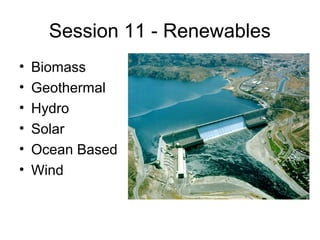
Session 11 - Renewables
•
•
•
•
•
•

Biomass
Geothermal
Hydro
Solar
Ocean Based
Wind
Renewable Sources
• Solar
• Gravitational
• Radioactive

All have a nuclear history
Attractiveness of Renewables
Generally:
• It’s abundant, available everywhere
• Does not deplete Earth’s resources
• Minimal environmental impact
Challenges
• Technological Challenges
–
–
–
–

Low capture efficiency
Low energy density
Lack of dispatchability
Environmental issues

• Integration Challenges
–
–
–
–
–

Small present contribution
High capital costs
Materials ramp up limitations
Storage, location vs. load, transmission lines
Output versus load requirements
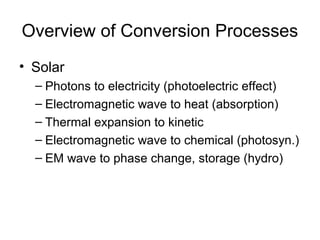
Overview of Conversion Processes
• Solar
– Photons to electricity (photoelectric effect)
– Electromagnetic wave to heat (absorption)
– Thermal expansion to kinetic
– Electromagnetic wave to chemical (photosyn.)
– EM wave to phase change, storage (hydro)
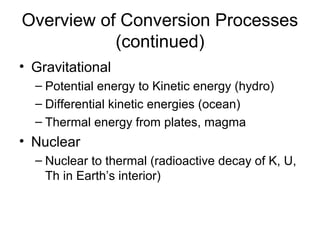
Overview of Conversion Processes
(continued)
• Gravitational
– Potential energy to Kinetic energy (hydro)
– Differential kinetic energies (ocean)
– Thermal energy from plates, magma

• Nuclear
– Nuclear to thermal (radioactive decay of K, U,
Th in Earth’s interior)
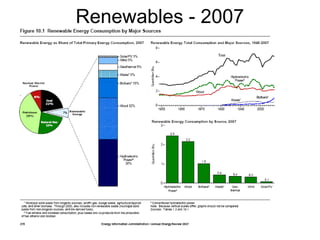
Renewables - 2007
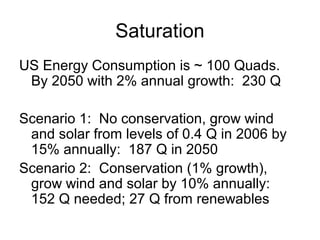
Saturation
US Energy Consumption is ~ 100 Quads.
By 2050 with 2% annual growth: 230 Q
Scenario 1: No conservation, grow wind
and solar from levels of 0.4 Q in 2006 by
15% annually: 187 Q in 2050
Scenario 2: Conservation (1% growth),
grow wind and solar by 10% annually:
152 Q needed; 27 Q from renewables
Policy
• Minnesota’s Next Generation Renewable Energy
Objective of 2007:
– 25% of electrical energy must derive from renewable fuel by
2025 (30% for Xcel Energy)

• US Energy Policy Act of 2005
– Temporary tax breaks for biodiesel
– Breaks for closed-loop biomass, solar, wind, geothermal (closed
loop = grown exclusively for power production)
– Lesser breaks for open-looped biomass, landfill gas,
hydroelectric

• Minnesota Sustainable Forest Resources Act of 1995
– Provides for multiple uses of forests
– Directs Department of Natural Resources to monitor
Policy
• Minnesota’s Next Generation Renewable Energy
Objective of 2007:
– 25% of electrical energy must derive from renewable fuel by
2025 (30% for Xcel Energy)

• US Energy Policy Act of 2005
– Temporary tax breaks for biodiesel
– Breaks for closed-loop biomass, solar, wind, geothermal (closed
loop = grown exclusively for power production)
– Lesser breaks for open-looped biomass, landfill gas,
hydroelectric

• Minnesota Sustainable Forest Resources Act of 1995
– Provides for multiple uses of forests
– Directs Department of Natural Resources to monitor

Session 11 renewable energy

  • 1.
    Session 11 -Renewables • • • • • • Biomass Geothermal Hydro Solar Ocean Based Wind
  • 2.
    Renewable Sources • Solar •Gravitational • Radioactive All have a nuclear history
  • 3.
    Attractiveness of Renewables Generally: •It’s abundant, available everywhere • Does not deplete Earth’s resources • Minimal environmental impact
  • 4.
    Challenges • Technological Challenges – – – – Lowcapture efficiency Low energy density Lack of dispatchability Environmental issues • Integration Challenges – – – – – Small present contribution High capital costs Materials ramp up limitations Storage, location vs. load, transmission lines Output versus load requirements
  • 5.
    Overview of ConversionProcesses • Solar – Photons to electricity (photoelectric effect) – Electromagnetic wave to heat (absorption) – Thermal expansion to kinetic – Electromagnetic wave to chemical (photosyn.) – EM wave to phase change, storage (hydro)
  • 6.
    Overview of ConversionProcesses (continued) • Gravitational – Potential energy to Kinetic energy (hydro) – Differential kinetic energies (ocean) – Thermal energy from plates, magma • Nuclear – Nuclear to thermal (radioactive decay of K, U, Th in Earth’s interior)
  • 7.
  • 8.
    Saturation US Energy Consumptionis ~ 100 Quads. By 2050 with 2% annual growth: 230 Q Scenario 1: No conservation, grow wind and solar from levels of 0.4 Q in 2006 by 15% annually: 187 Q in 2050 Scenario 2: Conservation (1% growth), grow wind and solar by 10% annually: 152 Q needed; 27 Q from renewables
  • 9.
    Policy • Minnesota’s NextGeneration Renewable Energy Objective of 2007: – 25% of electrical energy must derive from renewable fuel by 2025 (30% for Xcel Energy) • US Energy Policy Act of 2005 – Temporary tax breaks for biodiesel – Breaks for closed-loop biomass, solar, wind, geothermal (closed loop = grown exclusively for power production) – Lesser breaks for open-looped biomass, landfill gas, hydroelectric • Minnesota Sustainable Forest Resources Act of 1995 – Provides for multiple uses of forests – Directs Department of Natural Resources to monitor
  • 10.
    Policy • Minnesota’s NextGeneration Renewable Energy Objective of 2007: – 25% of electrical energy must derive from renewable fuel by 2025 (30% for Xcel Energy) • US Energy Policy Act of 2005 – Temporary tax breaks for biodiesel – Breaks for closed-loop biomass, solar, wind, geothermal (closed loop = grown exclusively for power production) – Lesser breaks for open-looped biomass, landfill gas, hydroelectric • Minnesota Sustainable Forest Resources Act of 1995 – Provides for multiple uses of forests – Directs Department of Natural Resources to monitor