You Are My Sunshine!
• Which of the following energy
resources originate directly or
indirectly from the sun? (Front
of index card)
▫ Biomass/biofuels
▫ Coal
▫ Natural gas
▫ Geothermal
▫ Nuclear
▫ Hydroelectric
▫ Petroleum
▫ Solar Energy
▫ Tidal Energy
▫ Wind Energy
• Explain your thinking: Why
did you pick the answers that
you picked?
• (On back of index card)
What are the advantages and
disadvantages of our energy
resources?
Nonrenewable Resources
• It’s not replaced as quickly as it is used.
• Takes a long time for these to form.
• Currently we depend on fossil fuels, which are
nonrenewable for the majority of our energy.
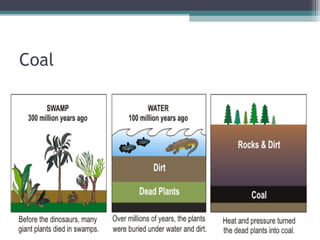
Coal
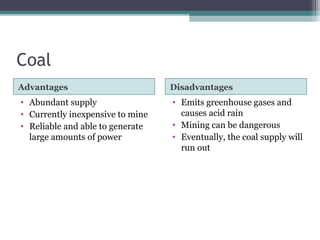
Coal
Advantages Disadvantages
• Abundant supply
• Currently inexpensive to mine
• Reliable and able to generate
large amounts of power
• Emits greenhouse gases and
causes acid rain
• Mining can be dangerous
• Eventually, the coal supply will
run out
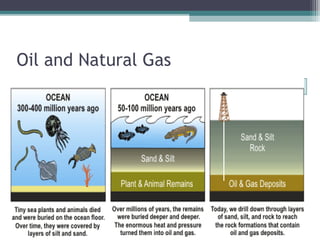
Oil and Natural Gas
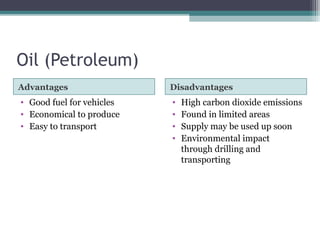
Oil (Petroleum)
Advantages Disadvantages
• Good fuel for vehicles
• Economical to produce
• Easy to transport
• High carbon dioxide emissions
• Found in limited areas
• Supply may be used up soon
• Environmental impact
through drilling and
transporting
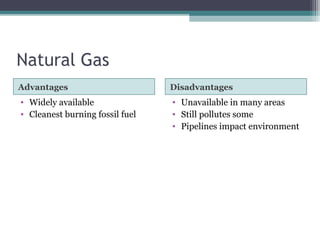
Natural Gas
Advantages Disadvantages
• Widely available
• Cleanest burning fossil fuel
• Unavailable in many areas
• Still pollutes some
• Pipelines impact environment
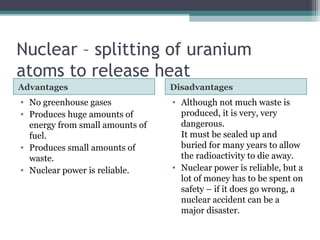
Nuclear – splitting of uranium
atoms to release heat
Advantages Disadvantages
• No greenhouse gases
• Produces huge amounts of
energy from small amounts of
fuel.
• Produces small amounts of
waste.
• Nuclear power is reliable.
• Although not much waste is
produced, it is very, very
dangerous.
It must be sealed up and
buried for many years to allow
the radioactivity to die away.
• Nuclear power is reliable, but a
lot of money has to be spent on
safety – if it does go wrong, a
nuclear accident can be a
major disaster.
Reflection Questions
• Choose 1 and answer on page 37 in at least 2
sentences.
1. What were the two most important points in
what we just looked at?
2. Compare/contrast the use of fossil fuels and
nuclear energy.
3. Which of the types of energy we have talked
about do you feel is the best? Why?
4. Create a simile for fossil fuels. (Fossils fuels are
like ….)
Renewable Resources
• Renewable resources can be replaced in a
relatively short period of time (like your
lifetime).
Solar
Advantages Disadvantages
• It’s free
• There’s no waste and no
pollution
• It will last for 5 billion years
• Expensive to build power
stations
• Can’t collect it at night
• Can be unreliable if you’re not
in a sunny climate
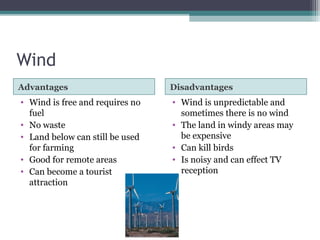
Wind
Advantages Disadvantages
• Wind is free and requires no
fuel
• No waste
• Land below can still be used
for farming
• Good for remote areas
• Can become a tourist
attraction
• Wind is unpredictable and
sometimes there is no wind
• The land in windy areas may
be expensive
• Can kill birds
• Is noisy and can effect TV
reception
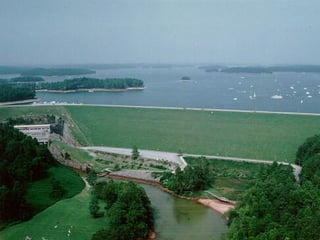
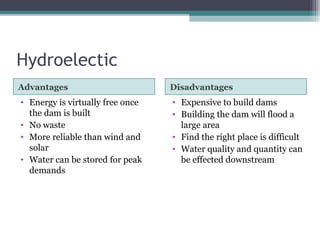
Hydroelectric
Hydroelectic
Advantages Disadvantages
• Energy is virtually free once
the dam is built
• No waste
• More reliable than wind and
solar
• Water can be stored for peak
demands
• Expensive to build dams
• Building the dam will flood a
large area
• Find the right place is difficult
• Water quality and quantity can
be effected downstream
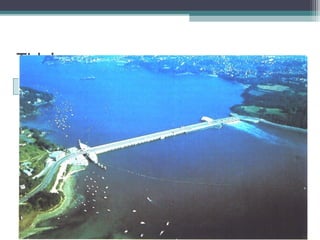
Tidal
Tidal
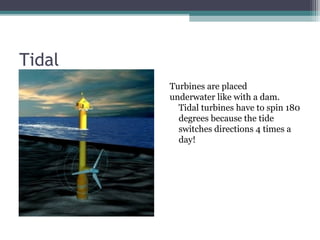
• Turbines are placed
underwater like with a dam.
Tidal turbines have to spin 180
degrees because the tide
switches directions 4 times a
day!
Turbines are placed
underwater like with a dam.
Tidal turbines have to spin 180
degrees because the tide
switches directions 4 times a
day!
Tidal
Advantages Disadvantages
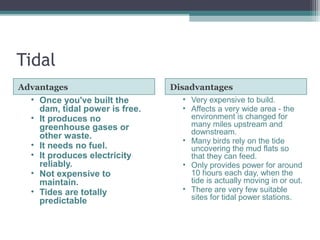
• Once you've built the
dam, tidal power is free.
• It produces no
greenhouse gases or
other waste.
• It needs no fuel.
• It produces electricity
reliably.
• Not expensive to
maintain.
• Tides are totally
predictable
• Very expensive to build.
• Affects a very wide area - the
environment is changed for
many miles upstream and
downstream.
• Many birds rely on the tide
uncovering the mud flats so
that they can feed.
• Only provides power for around
10 hours each day, when the
tide is actually moving in or out.
• There are very few suitable
sites for tidal power stations.
Reflection Questions
• Choose 1 and answer on page 37 in at least 2
sentences.
1. In your own words, explain solar, wind, and
hydroelectric power.
2. Brainstorm some solutions to the disadvantages
mentioned for solar power.
3. Of solar, wind, and hydroelectric, which would
you most want to use and why?
4. Draw a picture of what your life would be like
using solar or wind power.
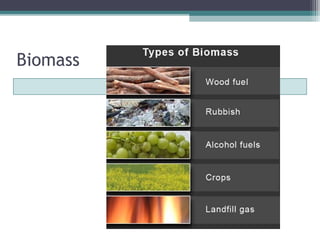
Biomass
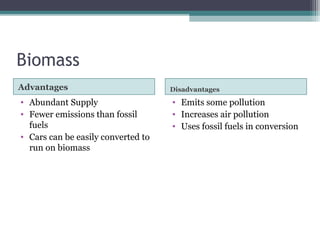
Biomass
Advantages Disadvantages
• Abundant Supply
• Fewer emissions than fossil
fuels
• Cars can be easily converted to
run on biomass
• Emits some pollution
• Increases air pollution
• Uses fossil fuels in conversion
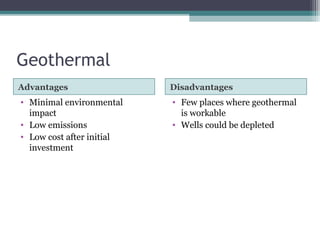
Geothermal
Advantages Disadvantages
• Minimal environmental
impact
• Low emissions
• Low cost after initial
investment
• Few places where geothermal
is workable
• Wells could be depleted
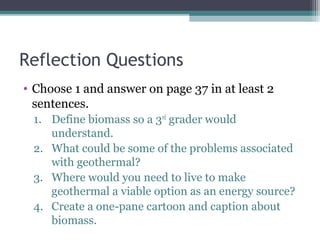
Reflection Questions
• Choose 1 and answer on page 37 in at least 2
sentences.
1. Define biomass so a 3rd
grader would
understand.
2. What could be some of the problems associated
with geothermal?
3. Where would you need to live to make
geothermal a viable option as an energy source?
4. Create a one-pane cartoon and caption about
biomass.

10 02-2013-energy sources

  • 1.
    You Are MySunshine! • Which of the following energy resources originate directly or indirectly from the sun? (Front of index card) ▫ Biomass/biofuels ▫ Coal ▫ Natural gas ▫ Geothermal ▫ Nuclear ▫ Hydroelectric ▫ Petroleum ▫ Solar Energy ▫ Tidal Energy ▫ Wind Energy • Explain your thinking: Why did you pick the answers that you picked? • (On back of index card)
  • 2.
    What are theadvantages and disadvantages of our energy resources?
  • 3.
    Nonrenewable Resources • It’snot replaced as quickly as it is used. • Takes a long time for these to form. • Currently we depend on fossil fuels, which are nonrenewable for the majority of our energy.
  • 4.
  • 5.
    Coal Advantages Disadvantages • Abundantsupply • Currently inexpensive to mine • Reliable and able to generate large amounts of power • Emits greenhouse gases and causes acid rain • Mining can be dangerous • Eventually, the coal supply will run out
  • 6.
  • 7.
    Oil (Petroleum) Advantages Disadvantages •Good fuel for vehicles • Economical to produce • Easy to transport • High carbon dioxide emissions • Found in limited areas • Supply may be used up soon • Environmental impact through drilling and transporting
  • 8.
    Natural Gas Advantages Disadvantages •Widely available • Cleanest burning fossil fuel • Unavailable in many areas • Still pollutes some • Pipelines impact environment
  • 9.
    Nuclear – splittingof uranium atoms to release heat Advantages Disadvantages • No greenhouse gases • Produces huge amounts of energy from small amounts of fuel. • Produces small amounts of waste. • Nuclear power is reliable. • Although not much waste is produced, it is very, very dangerous. It must be sealed up and buried for many years to allow the radioactivity to die away. • Nuclear power is reliable, but a lot of money has to be spent on safety – if it does go wrong, a nuclear accident can be a major disaster.
  • 10.
    Reflection Questions • Choose1 and answer on page 37 in at least 2 sentences. 1. What were the two most important points in what we just looked at? 2. Compare/contrast the use of fossil fuels and nuclear energy. 3. Which of the types of energy we have talked about do you feel is the best? Why? 4. Create a simile for fossil fuels. (Fossils fuels are like ….)
  • 11.
    Renewable Resources • Renewableresources can be replaced in a relatively short period of time (like your lifetime).
  • 12.
    Solar Advantages Disadvantages • It’sfree • There’s no waste and no pollution • It will last for 5 billion years • Expensive to build power stations • Can’t collect it at night • Can be unreliable if you’re not in a sunny climate
  • 13.
    Wind Advantages Disadvantages • Windis free and requires no fuel • No waste • Land below can still be used for farming • Good for remote areas • Can become a tourist attraction • Wind is unpredictable and sometimes there is no wind • The land in windy areas may be expensive • Can kill birds • Is noisy and can effect TV reception
  • 14.
  • 15.
    Hydroelectic Advantages Disadvantages • Energyis virtually free once the dam is built • No waste • More reliable than wind and solar • Water can be stored for peak demands • Expensive to build dams • Building the dam will flood a large area • Find the right place is difficult • Water quality and quantity can be effected downstream
  • 16.
  • 17.
    Tidal • Turbines areplaced underwater like with a dam. Tidal turbines have to spin 180 degrees because the tide switches directions 4 times a day! Turbines are placed underwater like with a dam. Tidal turbines have to spin 180 degrees because the tide switches directions 4 times a day!
  • 18.
    Tidal Advantages Disadvantages • Onceyou've built the dam, tidal power is free. • It produces no greenhouse gases or other waste. • It needs no fuel. • It produces electricity reliably. • Not expensive to maintain. • Tides are totally predictable • Very expensive to build. • Affects a very wide area - the environment is changed for many miles upstream and downstream. • Many birds rely on the tide uncovering the mud flats so that they can feed. • Only provides power for around 10 hours each day, when the tide is actually moving in or out. • There are very few suitable sites for tidal power stations.
  • 19.
    Reflection Questions • Choose1 and answer on page 37 in at least 2 sentences. 1. In your own words, explain solar, wind, and hydroelectric power. 2. Brainstorm some solutions to the disadvantages mentioned for solar power. 3. Of solar, wind, and hydroelectric, which would you most want to use and why? 4. Draw a picture of what your life would be like using solar or wind power.
  • 20.
  • 21.
    Biomass Advantages Disadvantages • AbundantSupply • Fewer emissions than fossil fuels • Cars can be easily converted to run on biomass • Emits some pollution • Increases air pollution • Uses fossil fuels in conversion
  • 22.
    Geothermal Advantages Disadvantages • Minimalenvironmental impact • Low emissions • Low cost after initial investment • Few places where geothermal is workable • Wells could be depleted
  • 23.
    Reflection Questions • Choose1 and answer on page 37 in at least 2 sentences. 1. Define biomass so a 3rd grader would understand. 2. What could be some of the problems associated with geothermal? 3. Where would you need to live to make geothermal a viable option as an energy source? 4. Create a one-pane cartoon and caption about biomass.