Emerging Energy  Infrastructure Technologies:  Opportunities and Implementation September 16, 2011 St. Paul, MN [email_address]
Environmental and Energy Study Institute Founded in 1984 by a bipartisan Congressional caucus, today EESI is an independent 501 ( c ) 3 non-profit organization that receives no Congressional funding. EESI serves as a trusted source of non-partisan information on energy and environment policy development for Congress, businesses, foundations and the general public. Visit our website:  www.eesi.org  to find out more! http://www.facebook.com/eesionline http://twitter.com/eesionline [email_address]
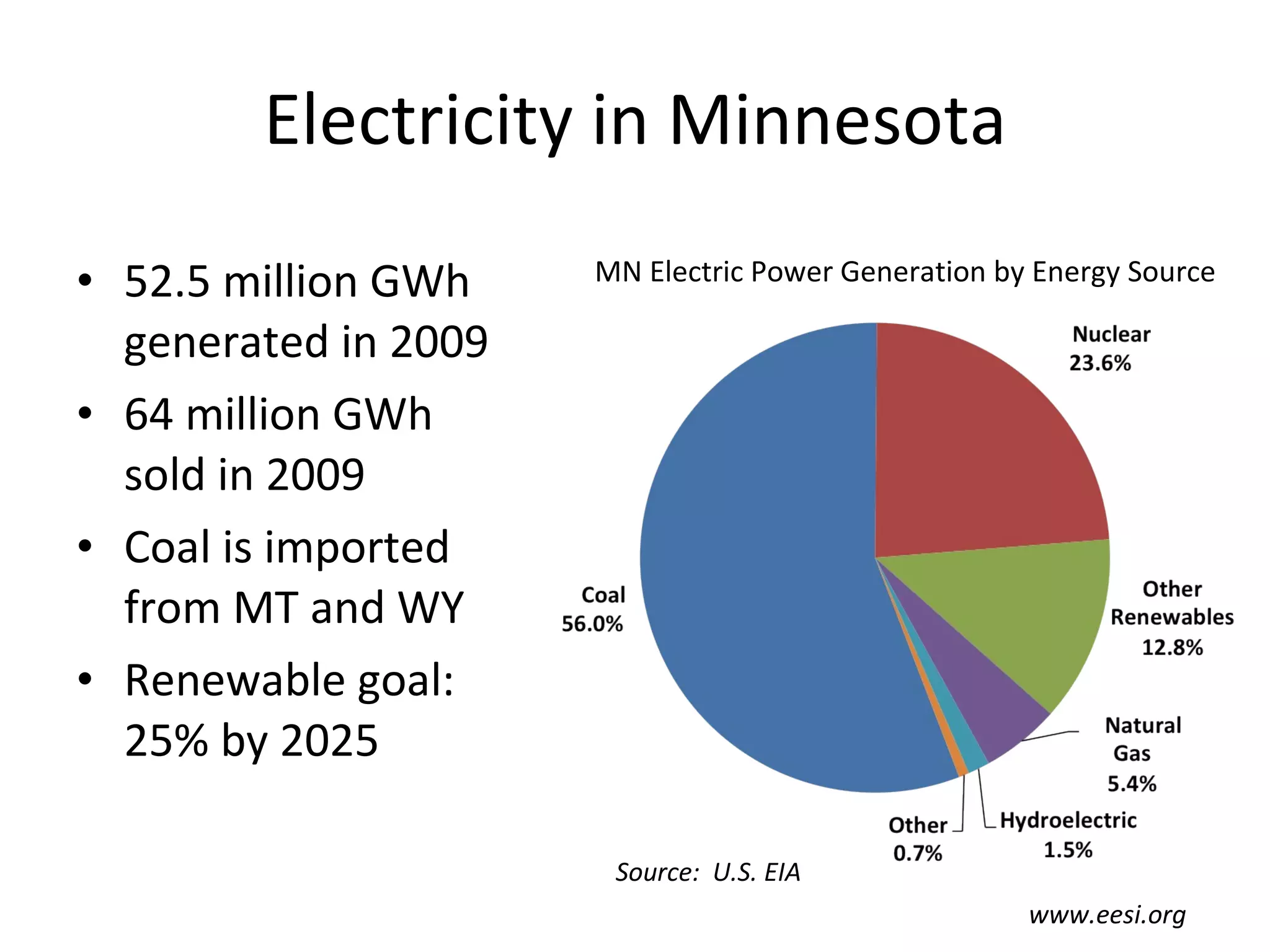
Electricity in Minnesota 52.5 million GWh generated in 2009 64 million GWh sold in 2009 Coal is imported from MT and WY Renewable goal: 25% by 2025 www.eesi.org MN Electric Power Generation by Energy Source Source:  U.S. EIA
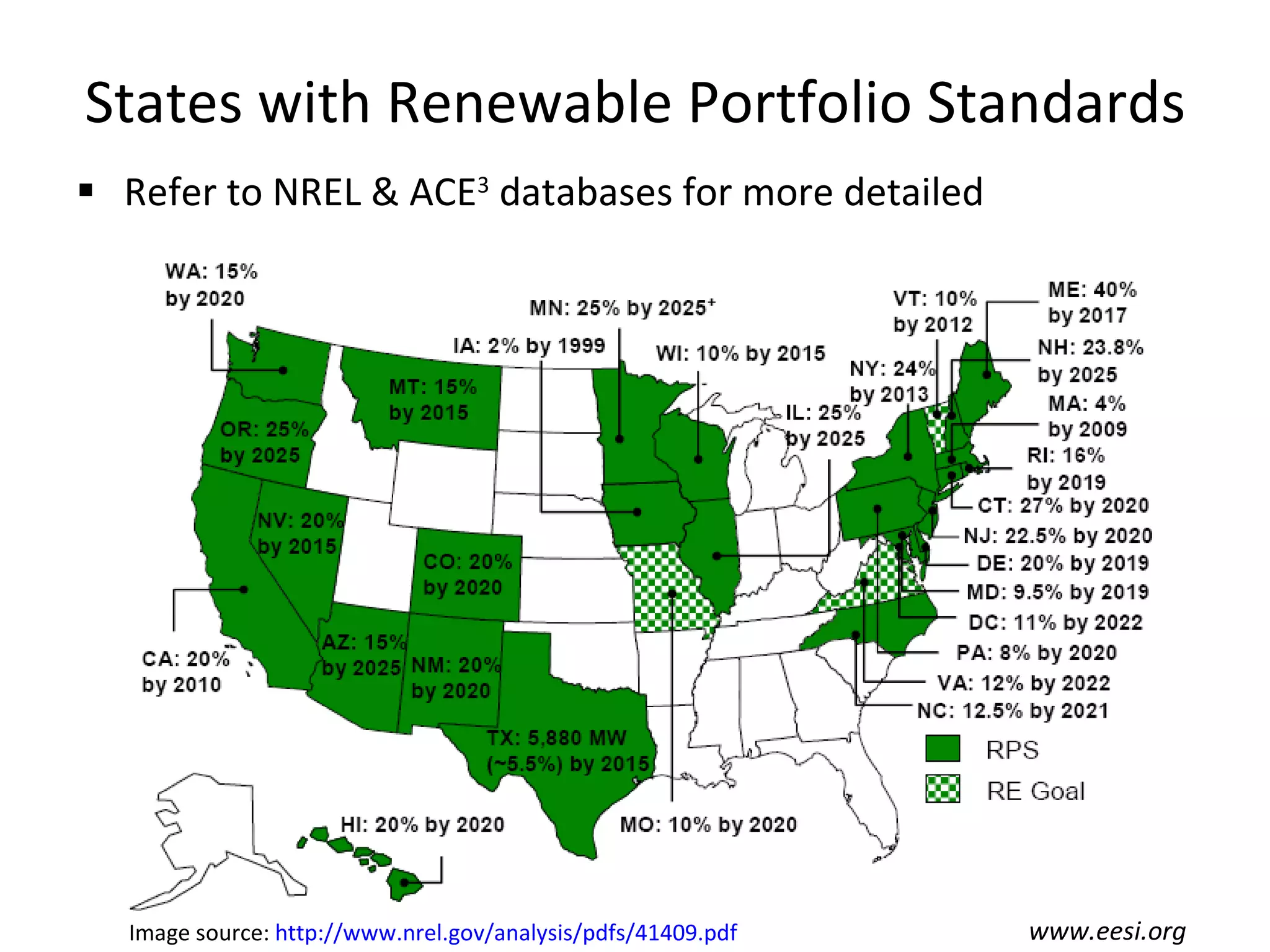
States with Renewable Portfolio Standards Refer to NREL & ACE 3  databases for more detailed information Image source:  http://www.nrel.gov/analysis/pdfs/41409.pdf   www.eesi.org
Minnesota Power Serves 144,000 customers in NE Minnesota Building two wind farms in ND, totaling 187 MW Reached purchase power agreement with Manitoba Hydro for 250 MW of hydro power beginning in 2020 Also allows MP to transmit wind power to Manitoba as a type of storage system www.eesi.org
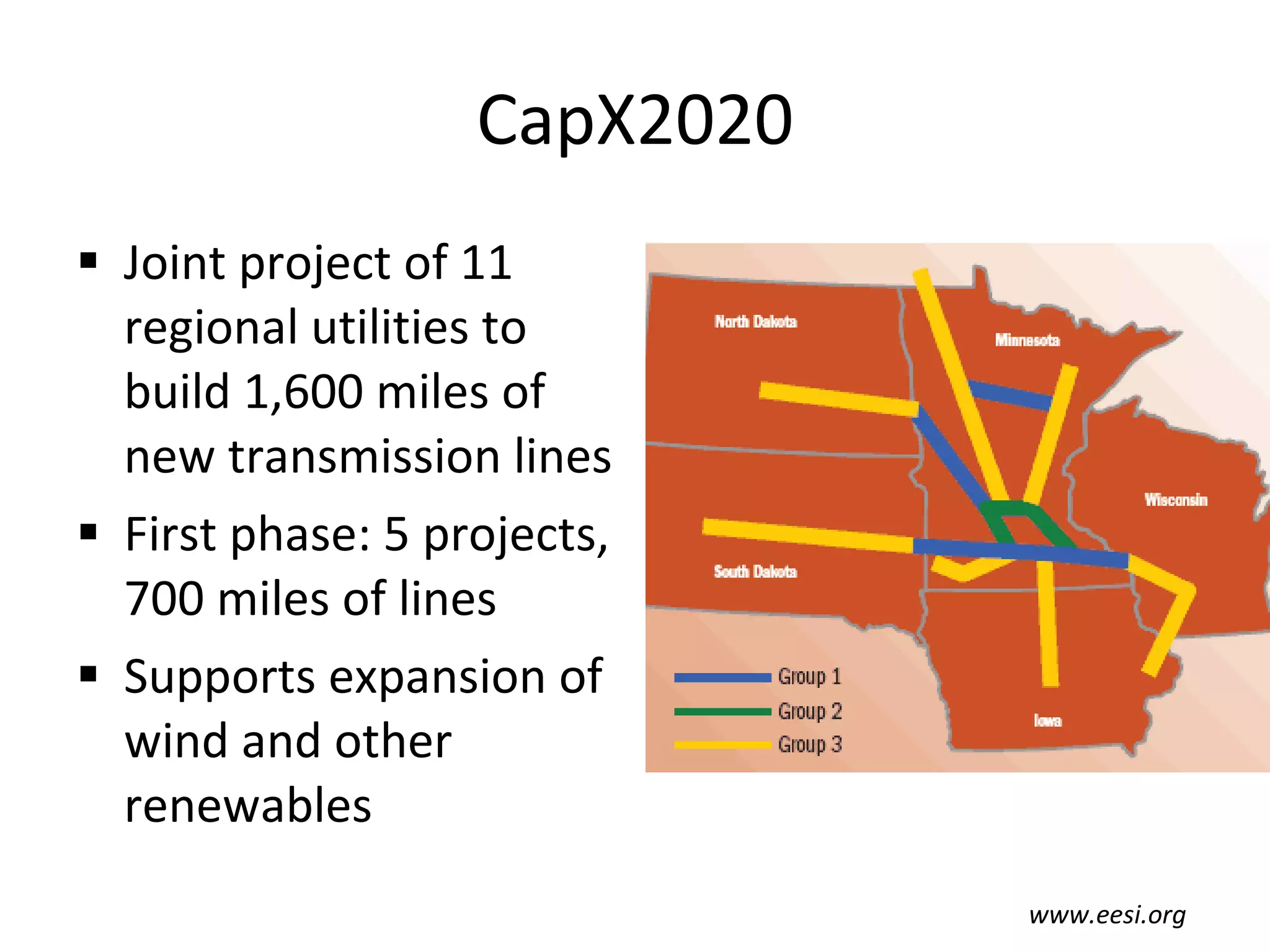
CapX2020 Joint project of 11 regional utilities to build 1,600 miles of new transmission lines First phase: 5 projects, 700 miles of lines Supports expansion of wind and other renewables www.eesi.org
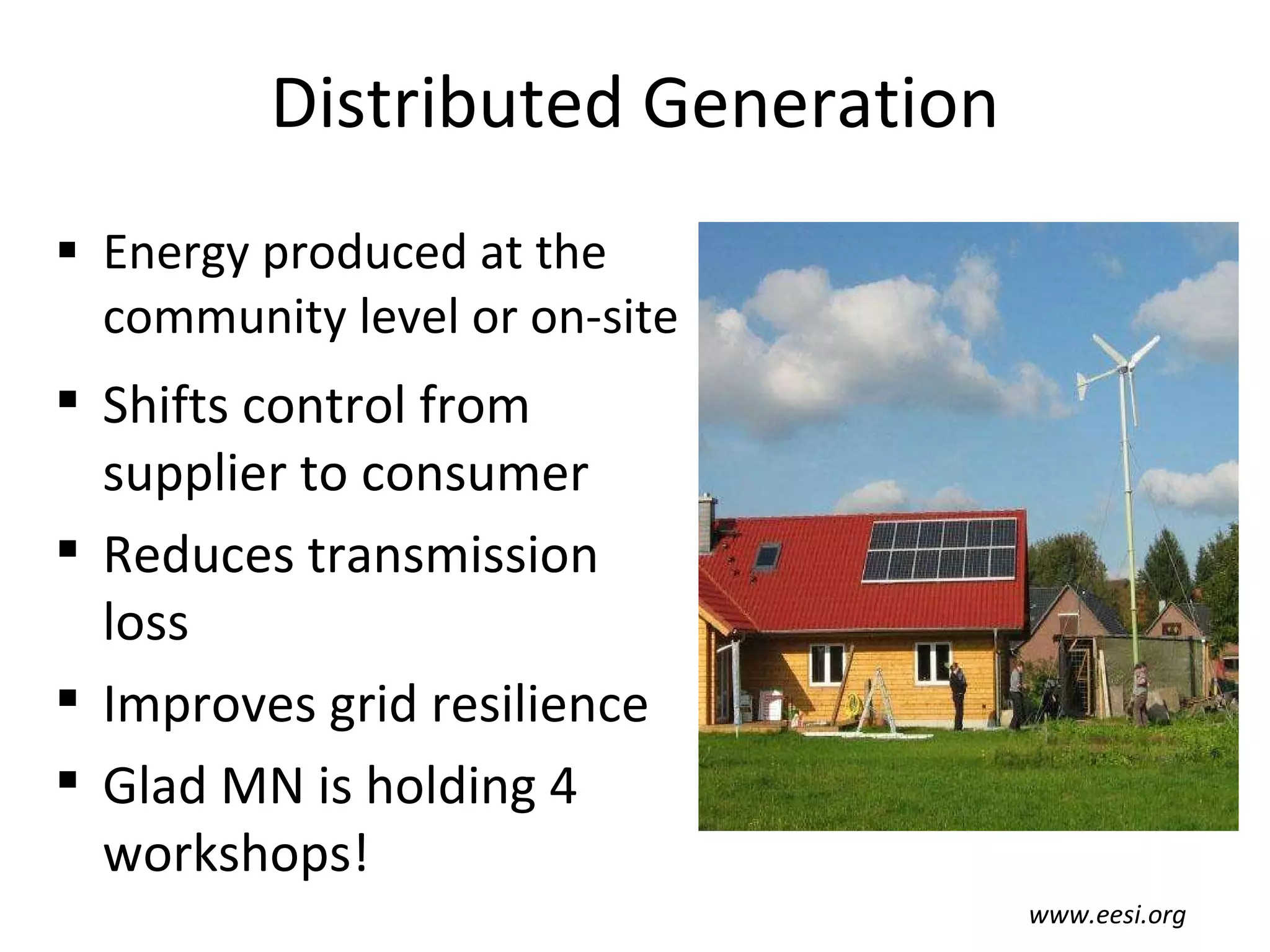
Distributed Generation Energy produced at the community level or on-site www.eesi.org Shifts control from supplier to consumer Reduces transmission loss Improves grid resilience Glad MN is holding 4 workshops!
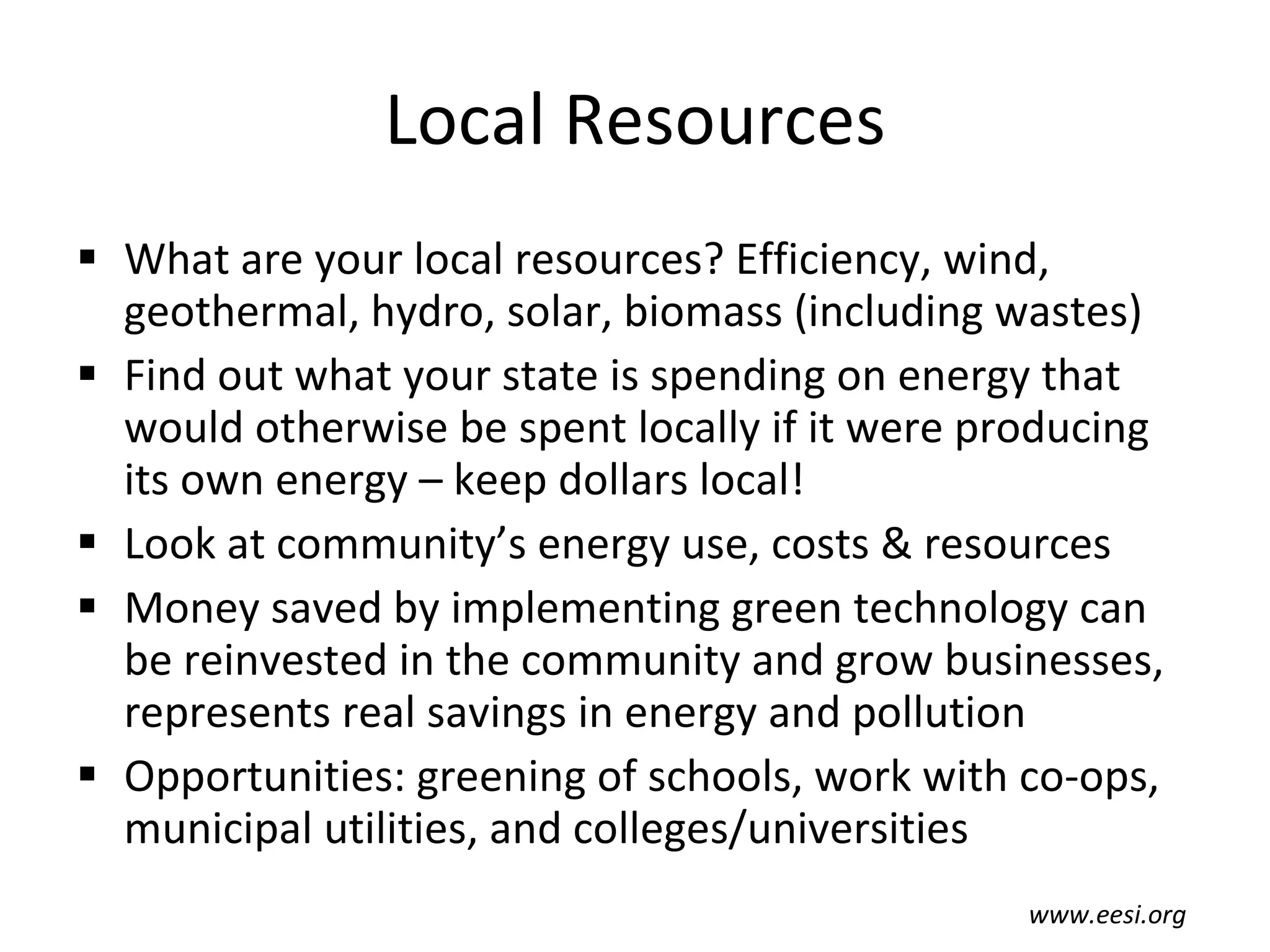
Local Resources What are your local resources? Efficiency, wind, geothermal, hydro, solar, biomass (including wastes) Find out what your state is spending on energy that would otherwise be spent locally if it were producing its own energy – keep dollars local! Look at community’s energy use, costs & resources Money saved by implementing green technology can be reinvested in the community and grow businesses, represents real savings in energy and pollution Opportunities: greening of schools, work with co-ops, municipal utilities, and colleges/universities www.eesi.org
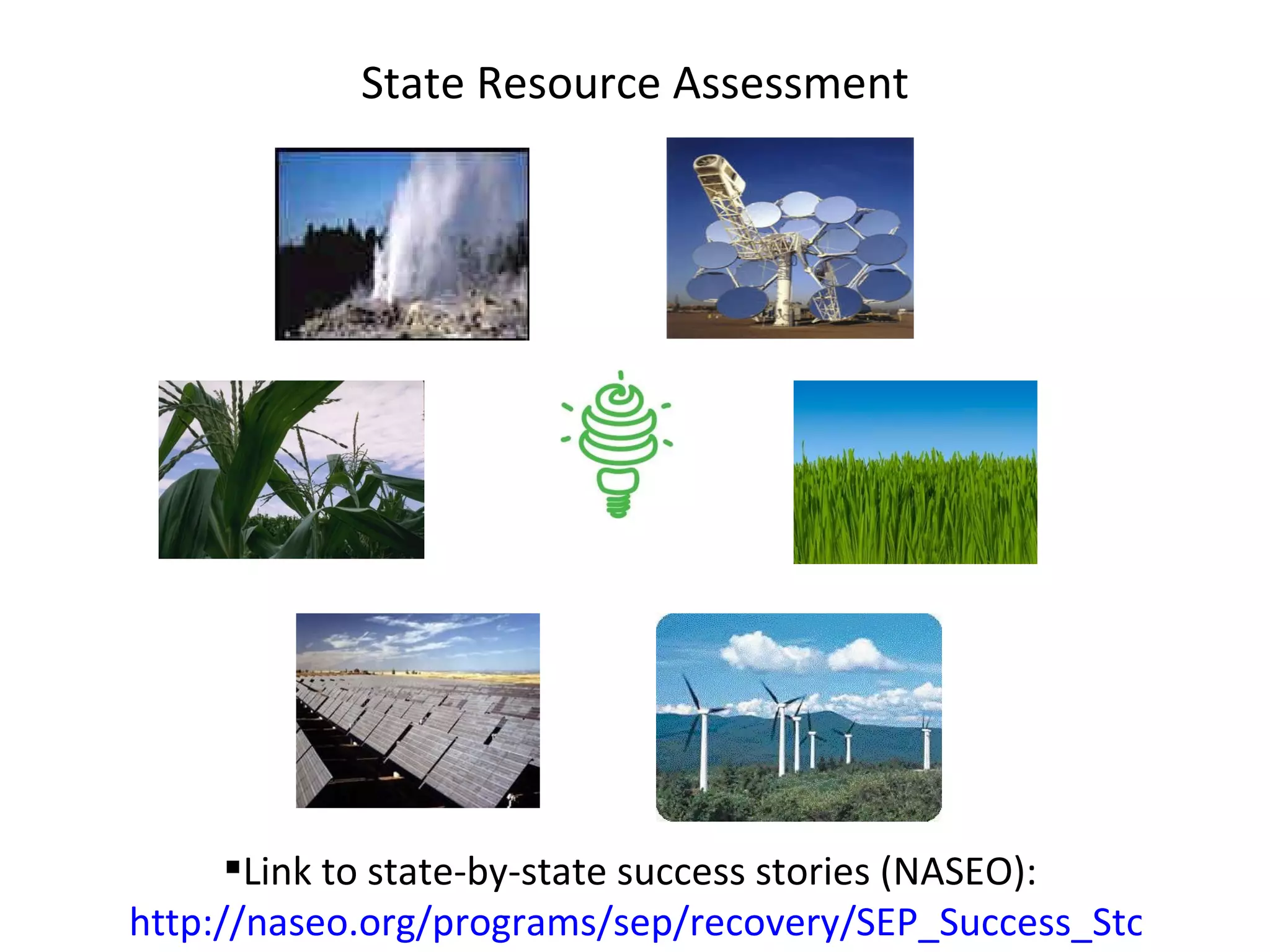
State Resource Assessment Link to state-by-state success stories (NASEO):  http://naseo.org/programs/sep/recovery/SEP_Success_Stories-2011-02.pdf
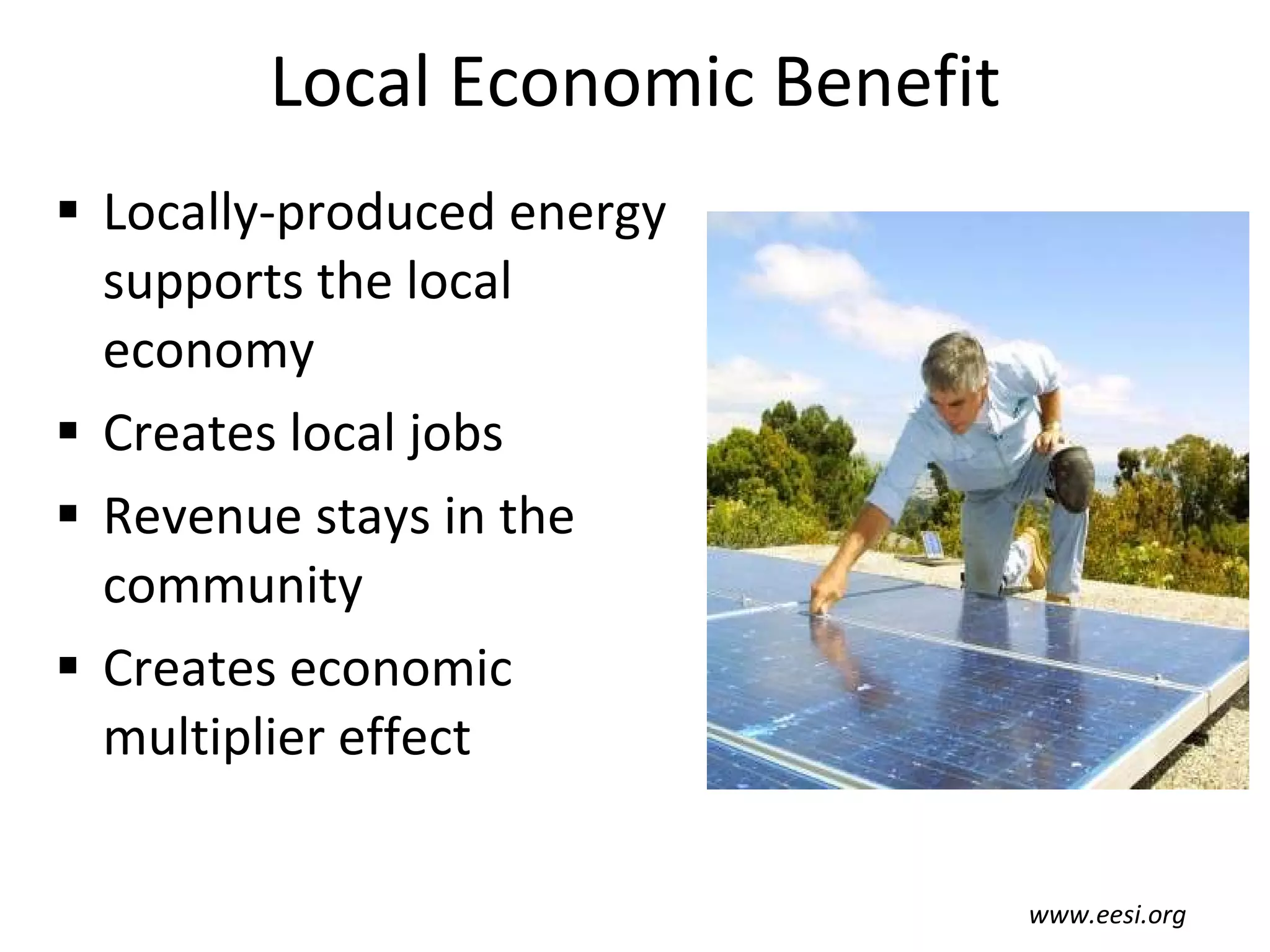
Local Economic Benefit Locally-produced energy supports the local economy  Creates local jobs Revenue stays in the community Creates economic multiplier effect www.eesi.org
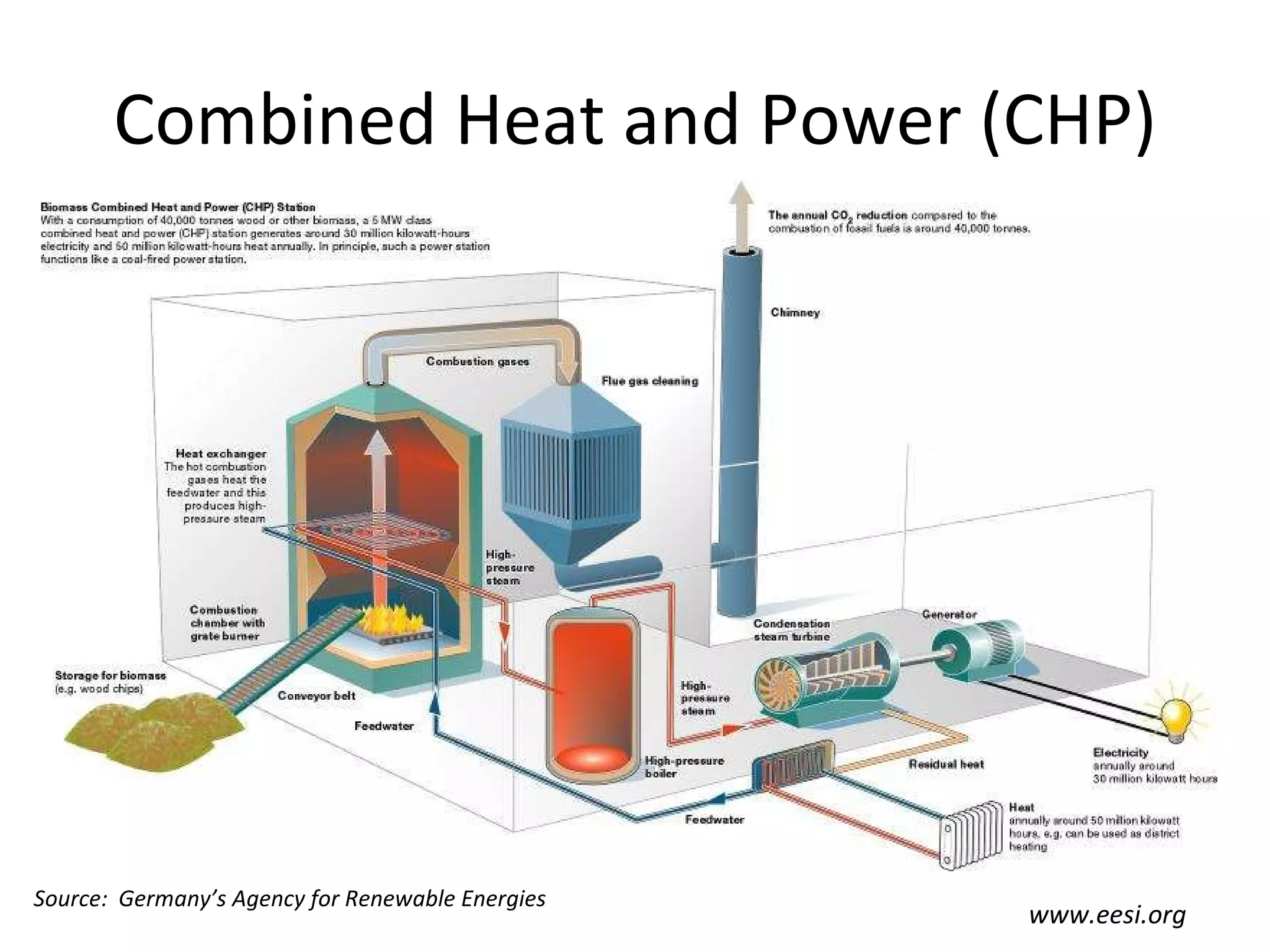
Combined Heat and Power (CHP) www.eesi.org Source:  Germany’s Agency for Renewable Energies
District Energy St. Paul Centralized heating and cooling system Distributed through water piping Supplies much of downtown St. Paul Energy is partially supplied through CHP system, fueled by wood waste Building solar thermal system to increase capacity www.eesi.org
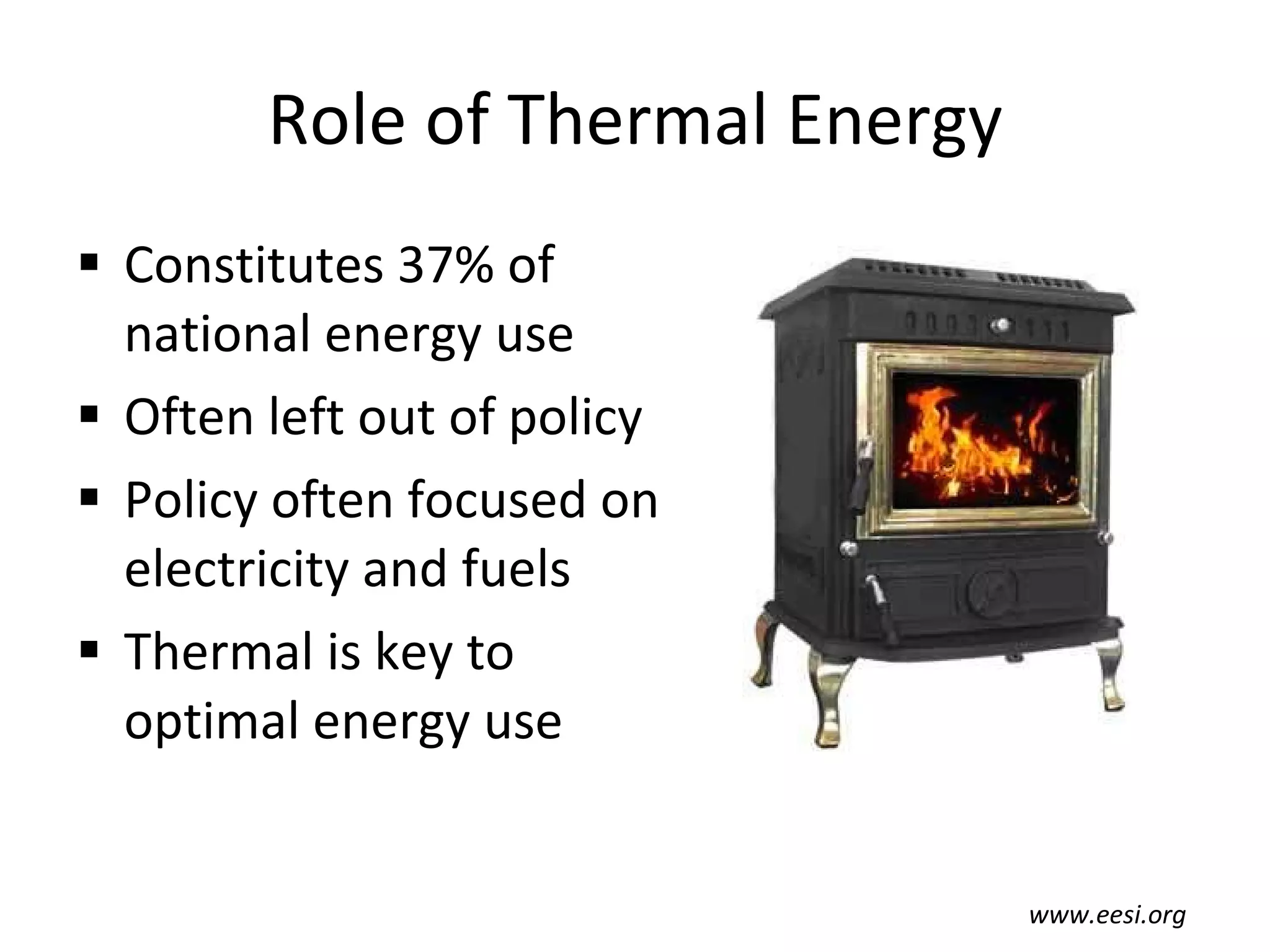
Role of Thermal Energy Constitutes 37% of national energy use Often left out of policy Policy often focused on electricity and fuels Thermal is key to optimal energy use www.eesi.org
Solar Energy Programs Success Stories San Jose, California obtained a power purchase agreement to have a 1.3 mW  solar energy system installed on a municipal facility , with an estimated savings of more than $500,000 over the next 20 years. Gainesville, Florida, which implemented the first  European-style Solar Feed-In Tariff  in the U.S., which has increased the amount of solar energy produced from 328 kW (in 2009) to almost 7 mW today. Strategies from Pendleton, Oregon, for using  tax credits  to make solar installation affordable for businesses and homeowners, and find out how the city got two solar energy systems installed that were paid for by a third party. Benefits Provide communities with power from secure, domestic sources Produce clean energy that helps meet greenhouse gas reduction targets and climate change goals set at the state and local levels Develop new economic opportunities and create new local jobs Improve regional economic competitiveness. www.eesi.org
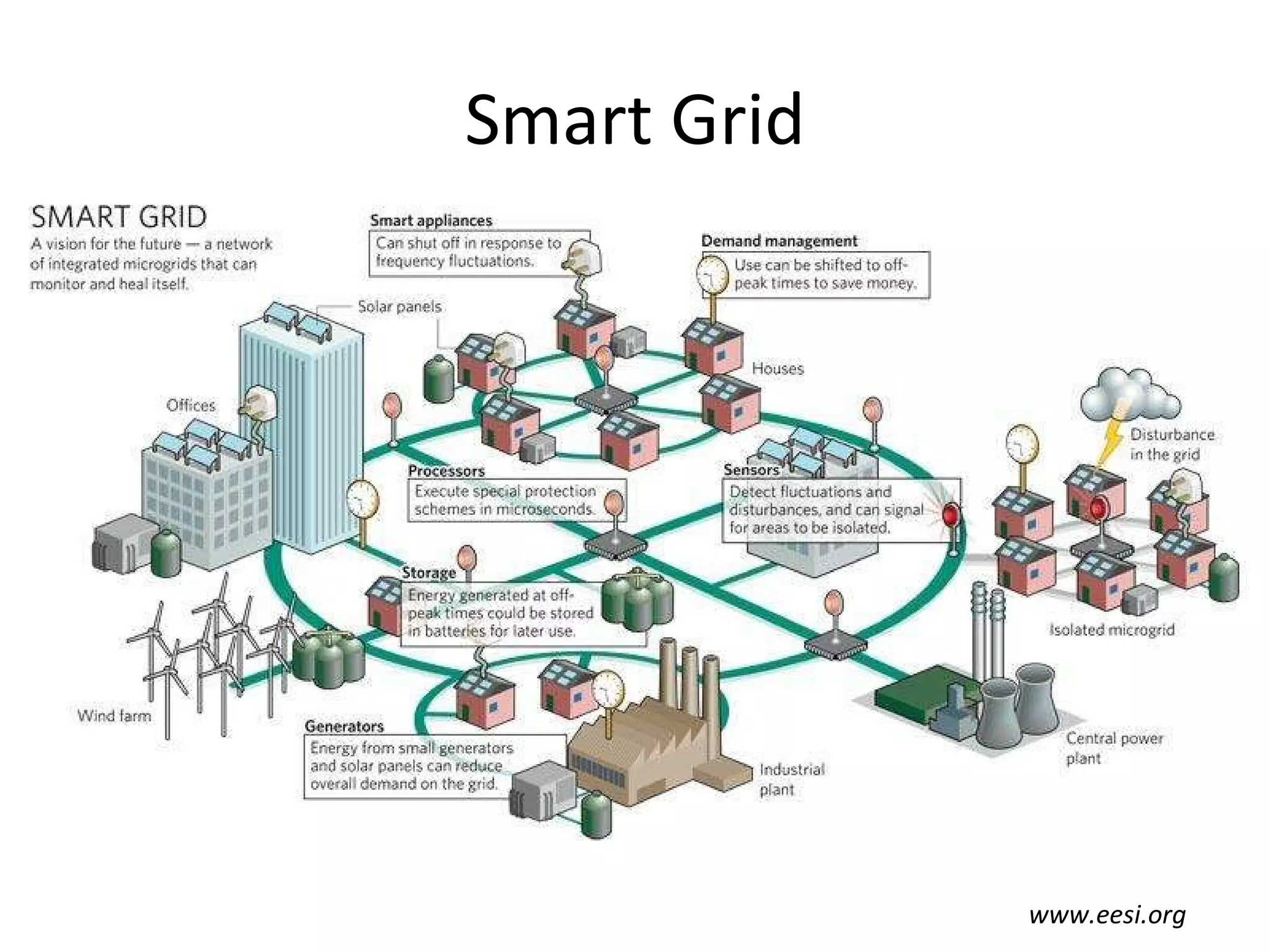
Smart Grid www.eesi.org
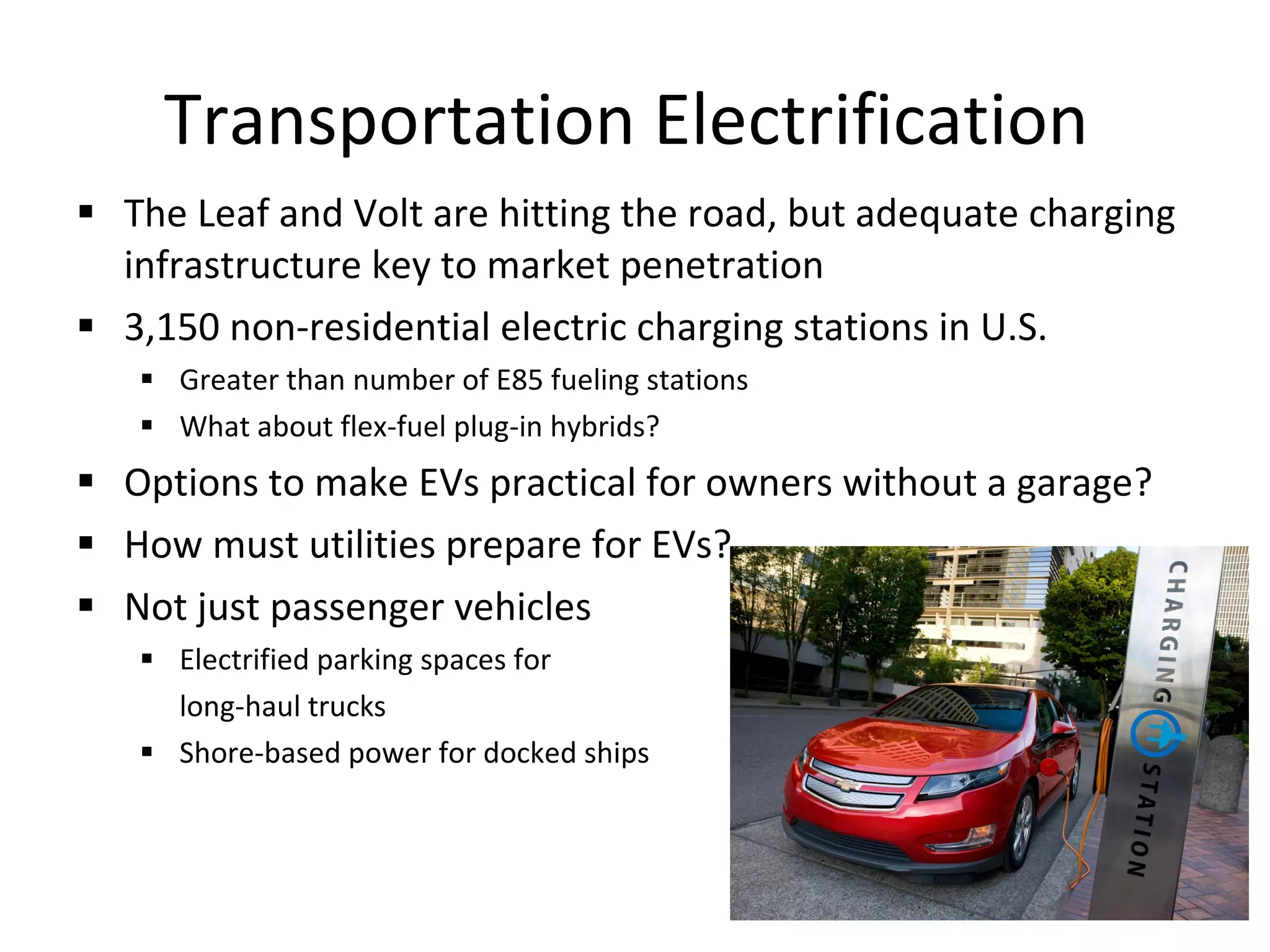
Transportation Electrification  The Leaf and Volt are hitting the road, but adequate charging infrastructure key to market penetration 3,150 non-residential electric charging stations in U.S.  Greater than number of E85 fueling stations What about flex-fuel plug-in hybrids? Options to make EVs practical for owners without a garage? How must utilities prepare for EVs? Not just passenger vehicles Electrified parking spaces for  long-haul trucks Shore-based power for docked ships
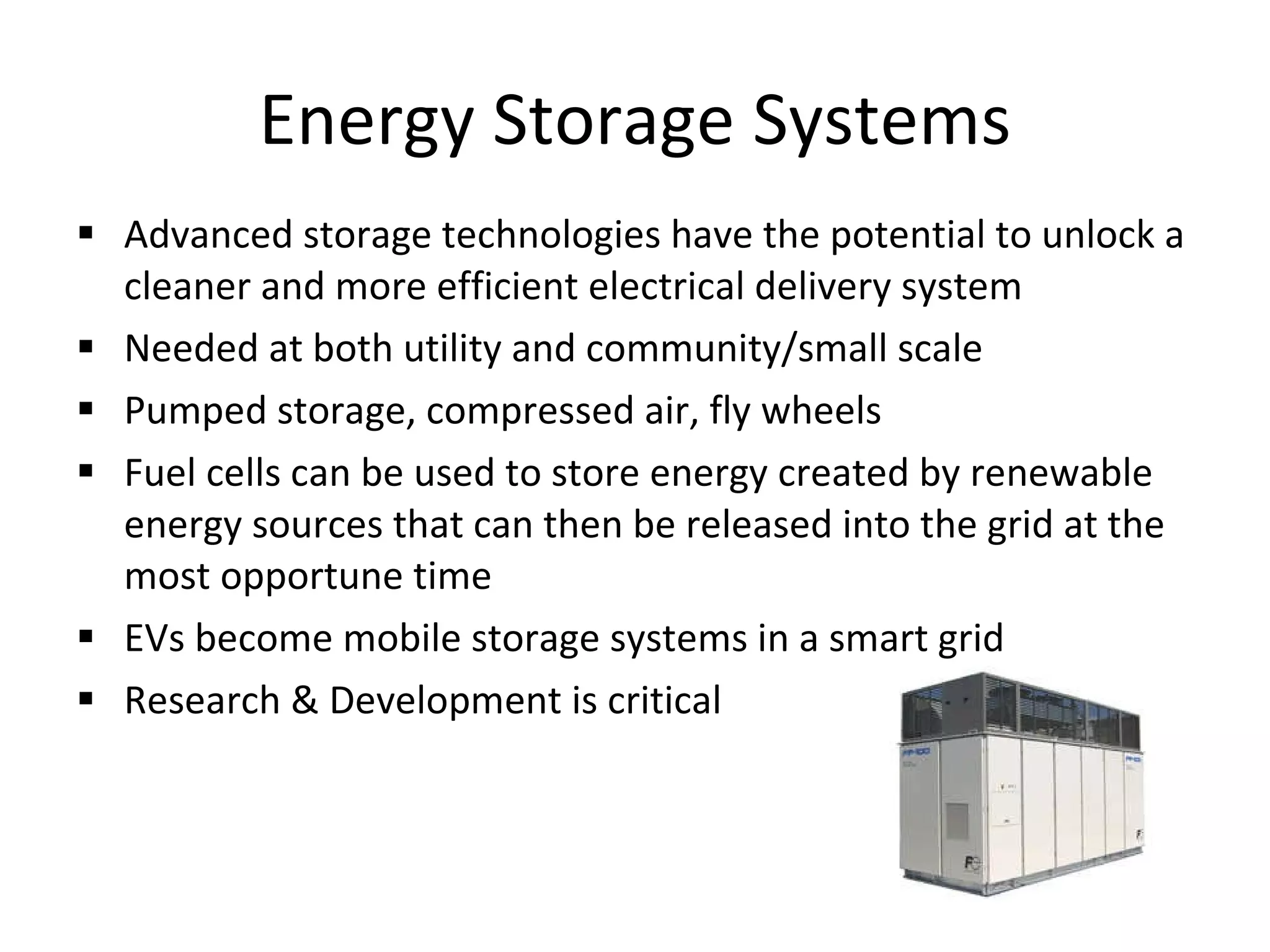
Energy Storage Systems Advanced storage technologies have the potential to unlock a cleaner and more efficient electrical delivery system Needed at both utility and community/small scale Pumped storage, compressed air, fly wheels Fuel cells can be used to store energy created by renewable energy sources that can then be released into the grid at the most opportune time EVs become mobile storage systems in a smart grid Research & Development is critical
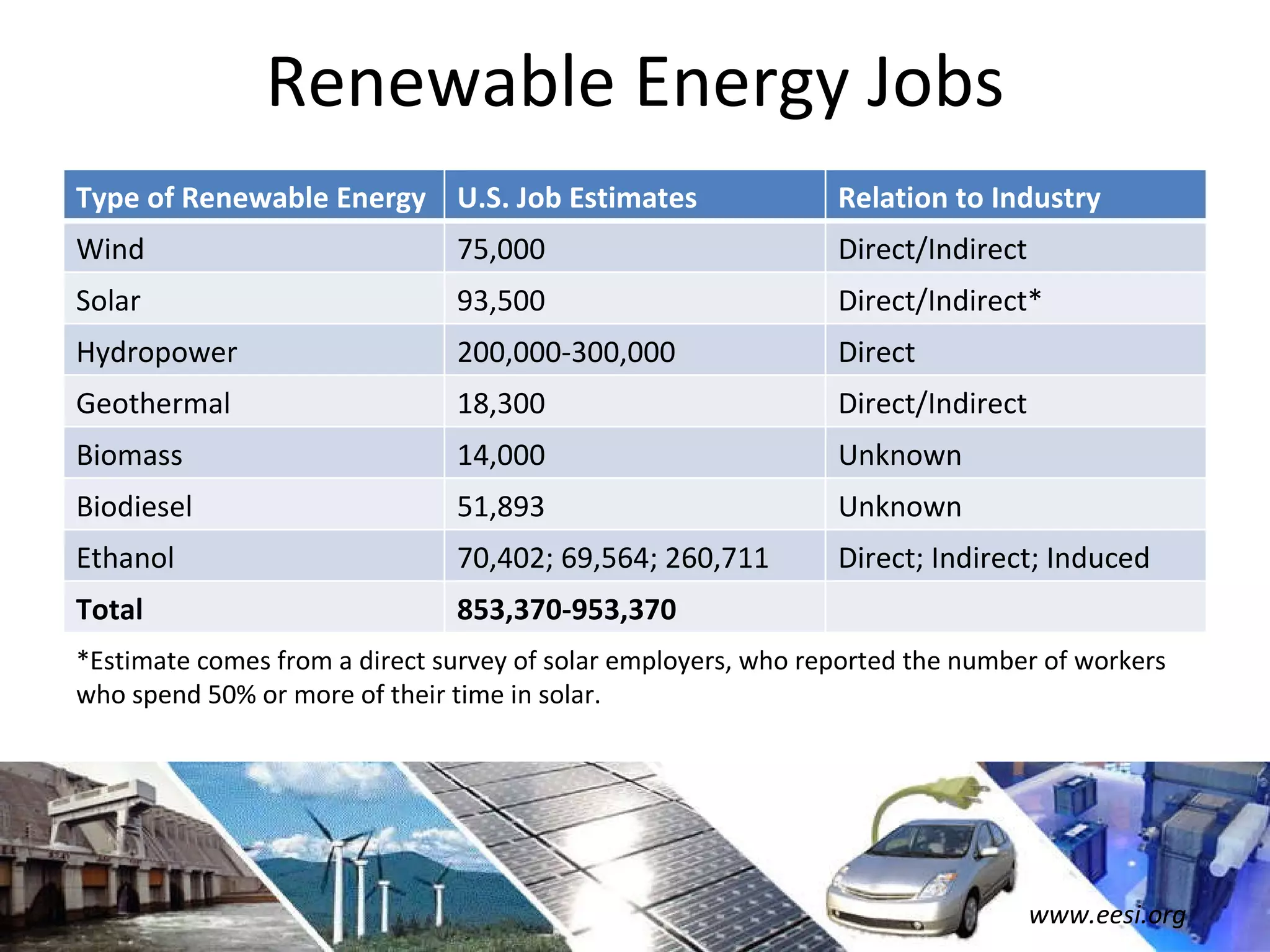
Renewable Energy Jobs *Estimate comes from a direct survey of solar employers, who reported the number of workers who spend 50% or more of their time in solar. www.eesi.org Type of Renewable Energy U.S. Job Estimates Relation to Industry Wind 75,000 Direct/Indirect Solar 93,500 Direct/Indirect* Hydropower 200,000-300,000 Direct Geothermal 18,300 Direct/Indirect Biomass 14,000 Unknown Biodiesel  51,893 Unknown Ethanol 70,402; 69,564; 260,711 Direct; Indirect; Induced Total 853,370-953,370
Current Legislation Long term consistent policy  is essential to drive innovation and market development (eg, Germany, China, CO, TX, PA) S.1000 -- Energy Savings and Industrial Competitiveness Act of 2011 (reported out by Senate Energy Committee) Introduced in May by Senators Jeanne Shaheen [NH], Rob Portman [OH] & Christopher Coons [DE] Includes building energy codes, appliance standards, worker training and capacity building, building efficiency finance, electric motor rebate program, industrial efficiency and competitiveness, federal agency energy efficiency, etc. FY 2012 Appropriations – eg, Energy & Water, Agric., DoD Clean Energy Standard discussion (Bingaman-Murkowski) FERC Order 1000 encourages regional planning Thermal Renewable Energy and Efficiency Act  (Franken-McCollum) www.eesi.org
Policies that Work Long term, transferable incentives work best. South Carolina’s  Energy Freedom and Rural Development Act  (2008): incentives focused on diversifying feedstocks for biofuel facilities and research Oregon’s Business Energy Tax Credit (BETC): Biorefinery projects and equipment used to produce biofuels are eligible for a tax credit (against taxes due) for 35-50 percent of the project costs For more information:  http://eesi.org/021610_state_biofuel_paper State Clean Energy Funds 1603 Program: Payments for Specified Energy Property in Lieu of Tax Credits (expires end of 2011) & PTC/ITC allows taxpayers eligible for the federal business energy investment tax credit (ITC) or production tax credit (PTC) to take this credit  or  to receive a grant from the U.S. Treasury. PTC and ITC expire at the end of 2012 for large wind; end of 2013 for geothermal, biomass, and hydro/marine; end of 2016 for solar, CHP, small wind, and geothermal heat pumps. Government Procurement Policies / Market Aggregation / Co-Ops www.eesi.org
Takeaways Envisioning our energy future – what do you want it to be? Hold design charrettes Renewable energy hybrid opportunities What are our resources? What will be the infrastructure needs for those resources? Make sure you are not fostering perverse incentives Create win-wins: use agriculture, forestry, and waste  to meet multiple objectives: Environmental and better energy security, public health, local economic development, competiveness, innovation www.eesi.org

Werner - Emerging Energy Infrastructure Technologies: Opportunities and Implementation

  • 1.
    Emerging Energy Infrastructure Technologies: Opportunities and Implementation September 16, 2011 St. Paul, MN [email_address]
  • 2.
    Environmental and EnergyStudy Institute Founded in 1984 by a bipartisan Congressional caucus, today EESI is an independent 501 ( c ) 3 non-profit organization that receives no Congressional funding. EESI serves as a trusted source of non-partisan information on energy and environment policy development for Congress, businesses, foundations and the general public. Visit our website: www.eesi.org to find out more! http://www.facebook.com/eesionline http://twitter.com/eesionline [email_address]
  • 3.
    Electricity in Minnesota52.5 million GWh generated in 2009 64 million GWh sold in 2009 Coal is imported from MT and WY Renewable goal: 25% by 2025 www.eesi.org MN Electric Power Generation by Energy Source Source: U.S. EIA
  • 4.
    States with RenewablePortfolio Standards Refer to NREL & ACE 3 databases for more detailed information Image source: http://www.nrel.gov/analysis/pdfs/41409.pdf www.eesi.org
  • 5.
    Minnesota Power Serves144,000 customers in NE Minnesota Building two wind farms in ND, totaling 187 MW Reached purchase power agreement with Manitoba Hydro for 250 MW of hydro power beginning in 2020 Also allows MP to transmit wind power to Manitoba as a type of storage system www.eesi.org
  • 6.
    CapX2020 Joint projectof 11 regional utilities to build 1,600 miles of new transmission lines First phase: 5 projects, 700 miles of lines Supports expansion of wind and other renewables www.eesi.org
  • 7.
    Distributed Generation Energyproduced at the community level or on-site www.eesi.org Shifts control from supplier to consumer Reduces transmission loss Improves grid resilience Glad MN is holding 4 workshops!
  • 8.
    Local Resources Whatare your local resources? Efficiency, wind, geothermal, hydro, solar, biomass (including wastes) Find out what your state is spending on energy that would otherwise be spent locally if it were producing its own energy – keep dollars local! Look at community’s energy use, costs & resources Money saved by implementing green technology can be reinvested in the community and grow businesses, represents real savings in energy and pollution Opportunities: greening of schools, work with co-ops, municipal utilities, and colleges/universities www.eesi.org
  • 9.
    State Resource AssessmentLink to state-by-state success stories (NASEO): http://naseo.org/programs/sep/recovery/SEP_Success_Stories-2011-02.pdf
  • 10.
    Local Economic BenefitLocally-produced energy supports the local economy Creates local jobs Revenue stays in the community Creates economic multiplier effect www.eesi.org
  • 11.
    Combined Heat andPower (CHP) www.eesi.org Source: Germany’s Agency for Renewable Energies
  • 12.
    District Energy St.Paul Centralized heating and cooling system Distributed through water piping Supplies much of downtown St. Paul Energy is partially supplied through CHP system, fueled by wood waste Building solar thermal system to increase capacity www.eesi.org
  • 13.
    Role of ThermalEnergy Constitutes 37% of national energy use Often left out of policy Policy often focused on electricity and fuels Thermal is key to optimal energy use www.eesi.org
  • 14.
    Solar Energy ProgramsSuccess Stories San Jose, California obtained a power purchase agreement to have a 1.3 mW solar energy system installed on a municipal facility , with an estimated savings of more than $500,000 over the next 20 years. Gainesville, Florida, which implemented the first European-style Solar Feed-In Tariff in the U.S., which has increased the amount of solar energy produced from 328 kW (in 2009) to almost 7 mW today. Strategies from Pendleton, Oregon, for using tax credits to make solar installation affordable for businesses and homeowners, and find out how the city got two solar energy systems installed that were paid for by a third party. Benefits Provide communities with power from secure, domestic sources Produce clean energy that helps meet greenhouse gas reduction targets and climate change goals set at the state and local levels Develop new economic opportunities and create new local jobs Improve regional economic competitiveness. www.eesi.org
  • 15.
  • 16.
    Transportation Electrification The Leaf and Volt are hitting the road, but adequate charging infrastructure key to market penetration 3,150 non-residential electric charging stations in U.S. Greater than number of E85 fueling stations What about flex-fuel plug-in hybrids? Options to make EVs practical for owners without a garage? How must utilities prepare for EVs? Not just passenger vehicles Electrified parking spaces for long-haul trucks Shore-based power for docked ships
  • 17.
    Energy Storage SystemsAdvanced storage technologies have the potential to unlock a cleaner and more efficient electrical delivery system Needed at both utility and community/small scale Pumped storage, compressed air, fly wheels Fuel cells can be used to store energy created by renewable energy sources that can then be released into the grid at the most opportune time EVs become mobile storage systems in a smart grid Research & Development is critical
  • 18.
    Renewable Energy Jobs*Estimate comes from a direct survey of solar employers, who reported the number of workers who spend 50% or more of their time in solar. www.eesi.org Type of Renewable Energy U.S. Job Estimates Relation to Industry Wind 75,000 Direct/Indirect Solar 93,500 Direct/Indirect* Hydropower 200,000-300,000 Direct Geothermal 18,300 Direct/Indirect Biomass 14,000 Unknown Biodiesel 51,893 Unknown Ethanol 70,402; 69,564; 260,711 Direct; Indirect; Induced Total 853,370-953,370
  • 19.
    Current Legislation Longterm consistent policy is essential to drive innovation and market development (eg, Germany, China, CO, TX, PA) S.1000 -- Energy Savings and Industrial Competitiveness Act of 2011 (reported out by Senate Energy Committee) Introduced in May by Senators Jeanne Shaheen [NH], Rob Portman [OH] & Christopher Coons [DE] Includes building energy codes, appliance standards, worker training and capacity building, building efficiency finance, electric motor rebate program, industrial efficiency and competitiveness, federal agency energy efficiency, etc. FY 2012 Appropriations – eg, Energy & Water, Agric., DoD Clean Energy Standard discussion (Bingaman-Murkowski) FERC Order 1000 encourages regional planning Thermal Renewable Energy and Efficiency Act  (Franken-McCollum) www.eesi.org
  • 20.
    Policies that WorkLong term, transferable incentives work best. South Carolina’s Energy Freedom and Rural Development Act (2008): incentives focused on diversifying feedstocks for biofuel facilities and research Oregon’s Business Energy Tax Credit (BETC): Biorefinery projects and equipment used to produce biofuels are eligible for a tax credit (against taxes due) for 35-50 percent of the project costs For more information: http://eesi.org/021610_state_biofuel_paper State Clean Energy Funds 1603 Program: Payments for Specified Energy Property in Lieu of Tax Credits (expires end of 2011) & PTC/ITC allows taxpayers eligible for the federal business energy investment tax credit (ITC) or production tax credit (PTC) to take this credit or to receive a grant from the U.S. Treasury. PTC and ITC expire at the end of 2012 for large wind; end of 2013 for geothermal, biomass, and hydro/marine; end of 2016 for solar, CHP, small wind, and geothermal heat pumps. Government Procurement Policies / Market Aggregation / Co-Ops www.eesi.org
  • 21.
    Takeaways Envisioning ourenergy future – what do you want it to be? Hold design charrettes Renewable energy hybrid opportunities What are our resources? What will be the infrastructure needs for those resources? Make sure you are not fostering perverse incentives Create win-wins: use agriculture, forestry, and waste to meet multiple objectives: Environmental and better energy security, public health, local economic development, competiveness, innovation www.eesi.org

Editor's Notes