Marketing Environment
Chapter Two
Dr. Gopal Thapa
Tribhuvan University
Marketing Environment
 The term Marketing Environment refers to the
forces and factors that affects the organization
ability to built and maintain good relationship with
its customers.
 Marketing environment surrounds the
organization and it impacts upon the organization.
 Marketers have to interact with internal and
external people at micro and macro level and
builds internal and external relationships
03/24/19 Copy right reserved 2
Marketing Environment
 Marketing environment comprises all the actors
and forces outside marketing that affect marketing
management’s ability to develop and maintain
successful transactions with its target customers.
 Philip Kotler
 Marketing environment includes the internal and
external influences which affect marketing
decision-making and have and impact on its
performance.
 Dictionary of Marketing
03/24/19 Copy right reserved 3
Marketing Environment
 Successful companies recognize and respond
profitably to unmet needs and trends
 Ace Travels for exotic vacations
 sugar free biscuits for diabetes
 Western Union Money Transfer for the fastest
remittance.
03/24/19 Copy right reserved 4
Either Chang or Die
 Puja washing shop, Mayalu bathing shop,
Brighter and Everest toothpaste which were the
market leaders a few decade back in Nepalese
market are already disappeared from the market
because they ignored macro environmental
changes
03/24/19 Copy right reserved 5
Fad
 Unpredictable, short-lived, and without social,
economic, and political significance
 A company can cash in on a fad such as:
 T-shirt for Happy Holi, I love Nepal, Buddha
was born in Nepal, etc. but this is more a
matter of luck and good timing than anything
else.
03/24/19 Copy right reserved 6
Trends
 Direction or sequence of events that have some
momentum and durability.
 use of smart phone,
 study in boarding school,
 use of faded jeans pant,
 use of ayurvedic products
are different present trends of Nepalese market.
03/24/19 Copy right reserved 7
Trends
 Trends are more predictable and durable.
 A trend reveals the shape of the future.
 A trend has longevity, is observable across
several market areas and consumer activities, and
is consistent with other significant indicators
occurring or emerging at the same time.
03/24/19 Copy right reserved 8
Megatrends
 Large social, economic, political and
technological changes that are slow to form, and
once in place, they influence us for some time—
between seven and ten years, or longer.
03/24/19 Copy right reserved 9
Ten Megatrends: Identified by: Naisbitt
 The booming global economy
 A renaissance in the arts
 The emergence of free-market socialism
 Global lifestyles and cultural nationalism
 The privatization of the welfare state
 The rise of the Pacific Rim
 The decade of women in leadership
 The age of biology
 The religious revival of the new millennium
 The triumph of the individual
03/24/19 Copy right reserved 10
Micro Environment
 Micro environment consists of the forces close to the
company that affect its ability to serve its serve its
customers – the company, suppliers, marketing channels,
customers, competitors and publics.
 Philip Kotler
 Micro environment includes the factors or elements in a
firm’s immediate environment which affect its
performance and decision-making. These elements include
the firm’s suppliers, competitors, marketing
intermediaries, customers and publics.
 Dictionary of Marketing
03/24/19 Copy right reserved 11
Micro Environment
 Individuals and organizations that are close to the
marketing organization and directly impacts its
ability to serve its customers, makes micro
environment.
 The micro environment refers to the forces that are
close to the marketing organization and directly
impact the customer experience.
 It includes the organization itself, its suppliers,
marketing intermediaries, customers, markets or
segments, competitors, and publics.
03/24/19 Copy right reserved 12
Micro Environment
 Micro environment is also know as operating or
task environment.
 The actors close to the company that affect its
ability to serve its customers:
 The company
 Suppliers
 Marketing intermediaries
 Customer markets
 Competitors and
 Publics (Kotler & Armstrong)
03/24/19 Copy right reserved 13
The Company
 It includes:
 Top management
 Finance, R&D, purchasing, operations and accounting
 Company’s mission, objectives, strategies and policies
 Resources, organizational structure
03/24/19 Copy right reserved 14
Suppliers
 Suppliers form an important link in the company’s
overall customer value delivery system
 They provide the resources needed by the
company to produce goods and services
 Suppliers problem can seriously affect marketing
 Marketing managers must watch supply
availability – supply shortage or delays, labor
strikes etc.
03/24/19 Copy right reserved 15
Suppliers
 Rising supply cost force to increase price that can
harm company’s sales volume, image, as well as
customer satisfaction
 Most marketers today treat their suppliers as
partners in creating and delivering customer value
03/24/19 Copy right reserved 16
Marketing Intermediaries
 Marketing intermediaries help to the company to
promote, sale and distribute its goods to customers
 They includes:
 Resellers (wholesalers and retailers)
 Physical distribution firms (Transport and warehouse)
 Marketing service agencies (Research firms, ad
agencies, media, marketing consultants) and
 Financial intermediaries (Bank, insurance co.)
03/24/19 Copy right reserved 17
Marketing Intermediaries
 Like suppliers, marketing intermediaries form an
important component of the company’s overall
value delivery system
 The company must partner effectively with
marketing intermediaries to optimize the
performance of entire system
 Thus, today’s marketers recognize the importance
of working with their intermediaries as partners
rather than simply as channels through which they
sell their products.
03/24/19 Copy right reserved 18
Customers
 The company needs to study five types of
customers markets closely
 They are:
 Consumer markets (personal consumption)
 Business markets (production process)
 Reseller markets (to resell at profit)
 Government markets (public service)
 International markets (buyers in other countries
including consumers, producers, resellers and
governments)
03/24/19 Copy right reserved 19
Competitors
 The marketing concept states that to be successful,
a company must provide greater customer value
and satisfaction than its competitors do.
 They must gain strategic advantage by positioning
their offerings strongly against competitors’
offerings in the mind of customer
 No single competitive marketing strategies is best
for all companies.
03/24/19 Copy right reserved 20
Publics
 A public is any group that has an actual or
potential interest in or impact on an organizations
ability to achieve its objectives.
 Various types of publics are:
 Financial publics (bank, investment company, stock holders)
 Media publics (Radio, TV, newspaper, magazine)
 Government publics (product safety, packaging, truth in
advertising)
03/24/19 Copy right reserved 21
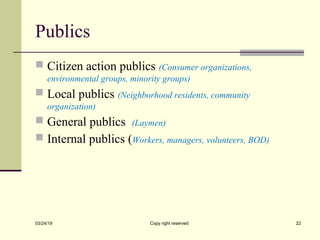
Publics
 Citizen action publics (Consumer organizations,
environmental groups, minority groups)
 Local publics (Neighborhood residents, community
organization)
 General publics (Laymen)
 Internal publics (Workers, managers, volunteers, BOD)
03/24/19 Copy right reserved 22
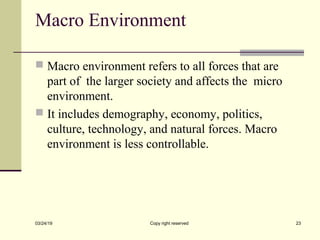
Macro Environment
 Macro environment refers to all forces that are
part of the larger society and affects the micro
environment.
 It includes demography, economy, politics,
culture, technology, and natural forces. Macro
environment is less controllable.
03/24/19 Copy right reserved 23
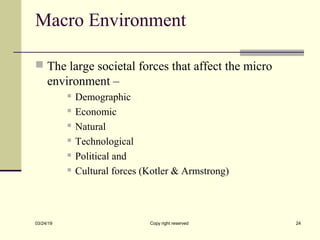
Macro Environment
 The large societal forces that affect the micro
environment –
 Demographic
 Economic
 Natural
 Technological
 Political and
 Cultural forces (Kotler & Armstrong)
03/24/19 Copy right reserved 24
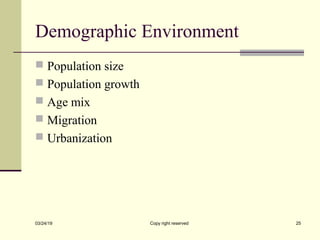
Demographic Environment
 Population size
 Population growth
 Age mix
 Migration
 Urbanization
03/24/19 Copy right reserved 25
Economic Environment
 Economic system (Free market, centrally planned, & mixed
economy)
 Economic policies (Monetary, fiscal, & industrial policy)
 Economic condition (Income, business cycle, inflation, stage
of economic development)
 Globalization
03/24/19 Copy right reserved 26
Socio-cultural Environment
 Social institution (family, reference group, opinion leader,
social class)
 Social change
 Life style
 Value and belief
 Religion
 Language
 Attitude
03/24/19 Copy right reserved 27
Technological Environment
 Level of technology
 Pace of technological change
 Technology transfer
 Research and development
03/24/19 Copy right reserved 28
Political-legal Environment
 Political system
 Political institution
 Government agencies
 Political philosophy
 Political stability
 Business law and court of laws
 Law administrators
 Power blocks
 Regional groups
03/24/19 Copy right reserved 29
Natural Environment
 Natural Resources
 Location
 Topography
 Climate
 Natural calamities
03/24/19 Copy right reserved 30
Environment Analysis
 Environmental analysis is a strategic tool.
 It is a process to identify all the external and
internal elements, which can affect the
organization's performance.
 The analysis entails assessing the level of threat or
opportunity the factors might present.
03/24/19 Copy right reserved 31
Thank You
03/24/19 Copy right reserved 32

Marketing environment

  • 1.
    Marketing Environment Chapter Two Dr.Gopal Thapa Tribhuvan University
  • 2.
    Marketing Environment  Theterm Marketing Environment refers to the forces and factors that affects the organization ability to built and maintain good relationship with its customers.  Marketing environment surrounds the organization and it impacts upon the organization.  Marketers have to interact with internal and external people at micro and macro level and builds internal and external relationships 03/24/19 Copy right reserved 2
  • 3.
    Marketing Environment  Marketingenvironment comprises all the actors and forces outside marketing that affect marketing management’s ability to develop and maintain successful transactions with its target customers.  Philip Kotler  Marketing environment includes the internal and external influences which affect marketing decision-making and have and impact on its performance.  Dictionary of Marketing 03/24/19 Copy right reserved 3
  • 4.
    Marketing Environment  Successfulcompanies recognize and respond profitably to unmet needs and trends  Ace Travels for exotic vacations  sugar free biscuits for diabetes  Western Union Money Transfer for the fastest remittance. 03/24/19 Copy right reserved 4
  • 5.
    Either Chang orDie  Puja washing shop, Mayalu bathing shop, Brighter and Everest toothpaste which were the market leaders a few decade back in Nepalese market are already disappeared from the market because they ignored macro environmental changes 03/24/19 Copy right reserved 5
  • 6.
    Fad  Unpredictable, short-lived,and without social, economic, and political significance  A company can cash in on a fad such as:  T-shirt for Happy Holi, I love Nepal, Buddha was born in Nepal, etc. but this is more a matter of luck and good timing than anything else. 03/24/19 Copy right reserved 6
  • 7.
    Trends  Direction orsequence of events that have some momentum and durability.  use of smart phone,  study in boarding school,  use of faded jeans pant,  use of ayurvedic products are different present trends of Nepalese market. 03/24/19 Copy right reserved 7
  • 8.
    Trends  Trends aremore predictable and durable.  A trend reveals the shape of the future.  A trend has longevity, is observable across several market areas and consumer activities, and is consistent with other significant indicators occurring or emerging at the same time. 03/24/19 Copy right reserved 8
  • 9.
    Megatrends  Large social,economic, political and technological changes that are slow to form, and once in place, they influence us for some time— between seven and ten years, or longer. 03/24/19 Copy right reserved 9
  • 10.
    Ten Megatrends: Identifiedby: Naisbitt  The booming global economy  A renaissance in the arts  The emergence of free-market socialism  Global lifestyles and cultural nationalism  The privatization of the welfare state  The rise of the Pacific Rim  The decade of women in leadership  The age of biology  The religious revival of the new millennium  The triumph of the individual 03/24/19 Copy right reserved 10
  • 11.
    Micro Environment  Microenvironment consists of the forces close to the company that affect its ability to serve its serve its customers – the company, suppliers, marketing channels, customers, competitors and publics.  Philip Kotler  Micro environment includes the factors or elements in a firm’s immediate environment which affect its performance and decision-making. These elements include the firm’s suppliers, competitors, marketing intermediaries, customers and publics.  Dictionary of Marketing 03/24/19 Copy right reserved 11
  • 12.
    Micro Environment  Individualsand organizations that are close to the marketing organization and directly impacts its ability to serve its customers, makes micro environment.  The micro environment refers to the forces that are close to the marketing organization and directly impact the customer experience.  It includes the organization itself, its suppliers, marketing intermediaries, customers, markets or segments, competitors, and publics. 03/24/19 Copy right reserved 12
  • 13.
    Micro Environment  Microenvironment is also know as operating or task environment.  The actors close to the company that affect its ability to serve its customers:  The company  Suppliers  Marketing intermediaries  Customer markets  Competitors and  Publics (Kotler & Armstrong) 03/24/19 Copy right reserved 13
  • 14.
    The Company  Itincludes:  Top management  Finance, R&D, purchasing, operations and accounting  Company’s mission, objectives, strategies and policies  Resources, organizational structure 03/24/19 Copy right reserved 14
  • 15.
    Suppliers  Suppliers forman important link in the company’s overall customer value delivery system  They provide the resources needed by the company to produce goods and services  Suppliers problem can seriously affect marketing  Marketing managers must watch supply availability – supply shortage or delays, labor strikes etc. 03/24/19 Copy right reserved 15
  • 16.
    Suppliers  Rising supplycost force to increase price that can harm company’s sales volume, image, as well as customer satisfaction  Most marketers today treat their suppliers as partners in creating and delivering customer value 03/24/19 Copy right reserved 16
  • 17.
    Marketing Intermediaries  Marketingintermediaries help to the company to promote, sale and distribute its goods to customers  They includes:  Resellers (wholesalers and retailers)  Physical distribution firms (Transport and warehouse)  Marketing service agencies (Research firms, ad agencies, media, marketing consultants) and  Financial intermediaries (Bank, insurance co.) 03/24/19 Copy right reserved 17
  • 18.
    Marketing Intermediaries  Likesuppliers, marketing intermediaries form an important component of the company’s overall value delivery system  The company must partner effectively with marketing intermediaries to optimize the performance of entire system  Thus, today’s marketers recognize the importance of working with their intermediaries as partners rather than simply as channels through which they sell their products. 03/24/19 Copy right reserved 18
  • 19.
    Customers  The companyneeds to study five types of customers markets closely  They are:  Consumer markets (personal consumption)  Business markets (production process)  Reseller markets (to resell at profit)  Government markets (public service)  International markets (buyers in other countries including consumers, producers, resellers and governments) 03/24/19 Copy right reserved 19
  • 20.
    Competitors  The marketingconcept states that to be successful, a company must provide greater customer value and satisfaction than its competitors do.  They must gain strategic advantage by positioning their offerings strongly against competitors’ offerings in the mind of customer  No single competitive marketing strategies is best for all companies. 03/24/19 Copy right reserved 20
  • 21.
    Publics  A publicis any group that has an actual or potential interest in or impact on an organizations ability to achieve its objectives.  Various types of publics are:  Financial publics (bank, investment company, stock holders)  Media publics (Radio, TV, newspaper, magazine)  Government publics (product safety, packaging, truth in advertising) 03/24/19 Copy right reserved 21
  • 22.
    Publics  Citizen actionpublics (Consumer organizations, environmental groups, minority groups)  Local publics (Neighborhood residents, community organization)  General publics (Laymen)  Internal publics (Workers, managers, volunteers, BOD) 03/24/19 Copy right reserved 22
  • 23.
    Macro Environment  Macroenvironment refers to all forces that are part of the larger society and affects the micro environment.  It includes demography, economy, politics, culture, technology, and natural forces. Macro environment is less controllable. 03/24/19 Copy right reserved 23
  • 24.
    Macro Environment  Thelarge societal forces that affect the micro environment –  Demographic  Economic  Natural  Technological  Political and  Cultural forces (Kotler & Armstrong) 03/24/19 Copy right reserved 24
  • 25.
    Demographic Environment  Populationsize  Population growth  Age mix  Migration  Urbanization 03/24/19 Copy right reserved 25
  • 26.
    Economic Environment  Economicsystem (Free market, centrally planned, & mixed economy)  Economic policies (Monetary, fiscal, & industrial policy)  Economic condition (Income, business cycle, inflation, stage of economic development)  Globalization 03/24/19 Copy right reserved 26
  • 27.
    Socio-cultural Environment  Socialinstitution (family, reference group, opinion leader, social class)  Social change  Life style  Value and belief  Religion  Language  Attitude 03/24/19 Copy right reserved 27
  • 28.
    Technological Environment  Levelof technology  Pace of technological change  Technology transfer  Research and development 03/24/19 Copy right reserved 28
  • 29.
    Political-legal Environment  Politicalsystem  Political institution  Government agencies  Political philosophy  Political stability  Business law and court of laws  Law administrators  Power blocks  Regional groups 03/24/19 Copy right reserved 29
  • 30.
    Natural Environment  NaturalResources  Location  Topography  Climate  Natural calamities 03/24/19 Copy right reserved 30
  • 31.
    Environment Analysis  Environmentalanalysis is a strategic tool.  It is a process to identify all the external and internal elements, which can affect the organization's performance.  The analysis entails assessing the level of threat or opportunity the factors might present. 03/24/19 Copy right reserved 31
  • 32.
    Thank You 03/24/19 Copyright reserved 32