Buyer Supplier
Relationship
Introduction
 Purchase supplier relationship –Purchase supplier satisfaction matrix
 Factors and types of transactions
 Nature of relationships
 Compare and Contrast partnership and collaboration
 Supplier overview and rating
 Strategic Alliance
 Top industry examples
 Role of IT
Key questions for supply manager
Should we
 Change our stance on multiple sourcing ?
 Move to long term contracts ?
 Do more reverse marketing ?
How can we
 Improve our relations with suppliers ?
 Involve other functions more effectively in supplier relations ?
 Initiate partnerships or alliance with our key suppliers ?
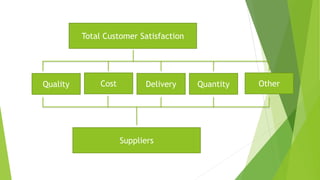
Total Customer Satisfaction
Suppliers
Quality Cost OtherQuantityDelivery
Recent trends
Buy instead of make
Outsource instead of continuously make
Improve quality
Lower inventories
Integrate supplier and purchase systems
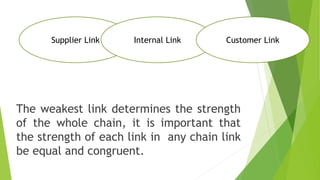
Supplier Link Internal Link Customer Link
The weakest link determines the strength
of the whole chain, it is important that
the strength of each link in any chain link
be equal and congruent.
Purchaser Supplier Relation
• Nature of relationship-Major influencer- ultimate value and
customer satisfaction
Supplier Goodwill
• Superior sources of supply- important asset
• Sound marketing policy- Develop goodwill
• Goodwill- Brands, advertising and regular calls by sales
person- Relationship Marketing
Congruence in supply chain can be achieved by:
 Purchasers maintain friendly relationship with suppliers
 Regularly measures satisfaction level of its key suppliers
 Best purchasers practice- knowing suppliers business more
than suppliers own employees
 The ability to develop effective working relationships with
suppliers will be dependent on supply's ability to develop
effective working relationships internally.
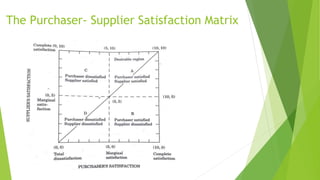
The Purchaser- Supplier Satisfaction Matrix
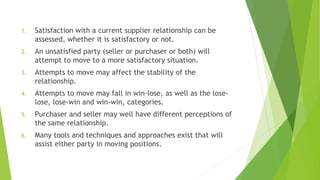
1. Satisfaction with a current supplier relationship can be
assessed, whether it is satisfactory or not.
2. An unsatisfied party (seller or purchaser or both) will
attempt to move to a more satisfactory situation.
3. Attempts to move may affect the stability of the
relationship.
4. Attempts to move may fall in win-lose, as well as the lose-
lose, lose-win and win-win, categories.

5. Purchaser and seller may well have different perceptions of
the same relationship.
6. Many tools and techniques and approaches exist that will
assist either party in moving positions.
Conclusion from the matrix
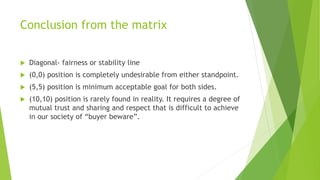
 Diagonal- fairness or stability line
 (0,0) position is completely undesirable from either standpoint.
 (5,5) position is minimum acceptable goal for both sides.
 (10,10) position is rarely found in reality. It requires a degree of
mutual trust and sharing and respect that is difficult to achieve
in our society of “buyer beware”.
Buyer Seller
Relationship
International Sourcing
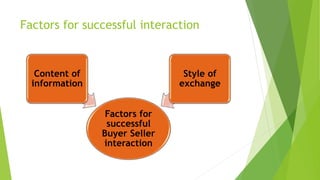
Factors for successful interaction
Factors for
successful
Buyer Seller
interaction
Content of
information
Style of
exchange
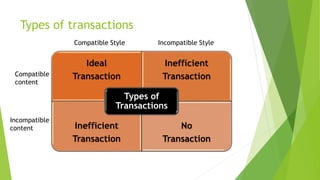
Types of transactions
Ideal
Transaction
Inefficient
Transaction
Inefficient
Transaction
No
Transaction
Types of
Transactions
Compatible Style Incompatible Style
Compatible
content
Incompatible
content
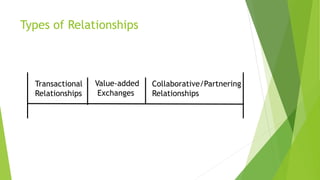
Types of Relationships
Transactional
Relationships
Value-added
Exchanges
Collaborative/Partnering
Relationships
Transactional Relationship
 Focus
 Timely exchange of basic product at a competitive price
 One time only exchange and less loyalty to particular
supplier
 Little interest to extent relationship
 Transactional relationship preferred when
 Availability of many suppliers
 Stable supply market
 Purchase decision not complex
 Purchase considered less important for achievement of
firm’s objectives
 Example: Stationery materials
Transactional Relationship
 Advantages
 Relatively less purchasing time and effort required to establish
price
 Lower skill level of procurement personnel required
 Can react quickly to changing market/economic conditions
 Disadvantages
 Expediting and monitoring incoming quality
 Provision of minimum service by suppliers
 Supplier not motivated to invest time and energy for
development of buyer’s products
 Less effective performance by suppliers
Value-added Exchange
 Focus
 Complete understanding of the present and future
needs of customers and meeting the needs better
than competitors
 Groups made by the selling firm
 A: Most profit potential customers
 B: Between A and C
 C: Least profit potential customers
Collaborative Relationship
 Focus
 Building a strong social, economic service and
technical ties between customer and supplier firm
 Purpose
 Increase value, lower total costs and achieve mutual
benefits
 Joint problem solving and integration of processes
of the two companies
 Two important factors: Trust and Commitment
Collaborative Relationships
 Advantages
 Long term contracts
 Reduction of risk for suppliers
 Reduction of total costs
 Improvement of process
 Improvement of products
 Increased investment in R&D
 Better focus on customer need
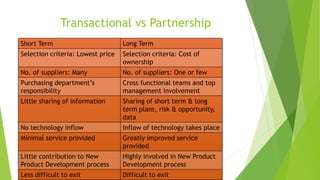
Transactional vs Partnership
Short Term Long Term
Selection criteria: Lowest price Selection criteria: Cost of
ownership
No. of suppliers: Many No. of suppliers: One or few
Purchasing department’s
responsibility
Cross functional teams and top
management involvement
Little sharing of information Sharing of short term & long
term plans, risk & opportunity,
data
No technology inflow Inflow of technology takes place
Minimal service provided Greatly improved service
provided
Little contribution to New
Product Development process
Highly involved in New Product
Development process
Less difficult to exit Difficult to exit
Purchaser-Supplier Relationship
Management
 Extensive communication between both parties is needed to
maintain satisfaction and stability
 Requires substantial coordination work inside purchasers
organisation
 Team approach to long term supplier relations
 Members of internal team have to deal directly with the
counterparts on supplier side
 Immediate action needs to be taken when either side detects
a problem
 Awareness of full details of each sides aspiration,
strengths and weakness is necessary
 Personnel from both sides need to understand
each other well for mutual benefit
 This can come through exposure, discussions,
mutual problem solving etc.
 Thus the ability of supply’s personnel to develop
effective working relationship internally will be
key determinant of the organization's ability to
get the most out of its supplier force
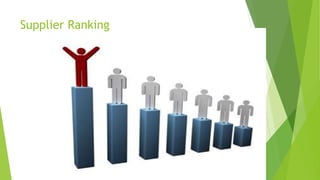
Supplier Ranking
 Unacceptable Suppliers:
 Fails to meet operational and strategic needs of the
buying organization
 Discontinue with the supplier and substitute better ones
 Acceptable Suppliers:
 Meets current operational needs as required by contract
 Provides a performance that others can easily match,
hence no basis for competitive edge
 Preferred Suppliers:
 Purchasers have a process orientation with preferred
suppliers to avoid unnecessary duplication and speed up
transactions
 Both parties work towards mutual improvements to eliminate
nonvalue-adding activities
 Meets all operational and some of the strategic needs of the
buying organization
 Reacts positively to initiatives of the purchaser to improve
the current situation
 Exceptional Suppliers:
 Anticipates operational and strategic needs of the purchaser and
are capable of meeting and exceeding them
 They need to be treasured
 They can serve as example of what is possible: an opportunity to
experiment with new and different approaches to supply base
management and as an early indicator of future supply
management direction and goals
 It requires substantial amount of work from both sides to obtain big
rewards of mutual breakthrough
 Patience and persistence are required to sustain the investment in
relationship building
Strategic Alliance
Definition
 A supply strategy based upon joint opportunities, mutual trust,
respect and open & honest communication between the
supplier and the customer.
 This strategy is focused on reducing related supply chain costs
and improves the quality of goods and services.
 Majorly technology driven and involves substantial investment
by buyers and sellers to achieve major market breakthroughs
Success factors for Strategic Alliance
 Focus: A common vision for the relationship, with agreed strategies
and activities
 Trust: Open communication and disclosure of business drivers
 Performance: Continuous improvement towards agreed targets and
KPIs
 People: Clearly defined roles and responsibilities
 Proactive: Anticipating business needs and providing creative
solutions
 Profit at Risk: Establishing real metrics to drive behaviour for both
parties
Mistakes
 Low commitment
 Poor operational planning and integration
 Strategic weakness(diverging strategies/under-developed value
added propositions, unclear strategic return on investment)
 Rigidity or poor adaptability
 Unrealistic expectations
 Overdependence
 Hidden agendas leading to distrust
 Legal problems(IPR)
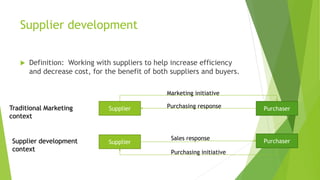
Supplier development
 Definition: Working with suppliers to help increase efficiency
and decrease cost, for the benefit of both suppliers and buyers.
Purchaser
Purchaser
Supplier
Marketing initiative
Purchasing response
Supplier
Purchasing initiative
Sales response
Traditional Marketing
context
Supplier development
context
Benefits
 Reducing Cost
 Improved Quality
 Technical, financial and managerial assistance
 Reduction of marketing effort
 Use of long term forecast
 Minimum inventory maintenance
 Close working on product specifications
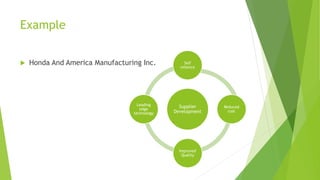
Example
 Honda And America Manufacturing Inc.
Supplier
Development
Self
reliance
Reduced
cost
Improved
Quality
Leading
edge
technology
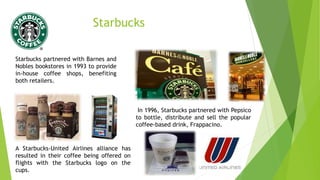
Starbucks
Starbucks partnered with Barnes and
Nobles bookstores in 1993 to provide
in-house coffee shops, benefiting
both retailers.
In 1996, Starbucks partnered with Pepsico
to bottle, distribute and sell the popular
coffee-based drink, Frappacino.
A Starbucks-United Airlines alliance has
resulted in their coffee being offered on
flights with the Starbucks logo on the
cups.
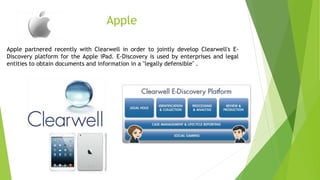
Apple
Apple partnered recently with Clearwell in order to jointly develop Clearwell's E-
Discovery platform for the Apple iPad. E-Discovery is used by enterprises and legal
entities to obtain documents and information in a "legally defensible" .
Hewlett Packard
and Disney
Hewlett-Packard and Disney have a long-standing alliance. Disney
wanted to develop a virtual attraction called Mission: SPACE, Disney
Imaginers and HP engineers relied on HP's IT architecture, servers and
workstations to create Disney's most technologically advanced
attraction.
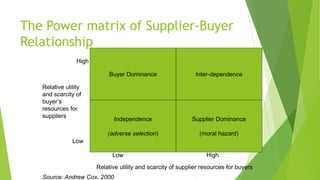
The Power matrix of Supplier-Buyer
Relationship
Buyer Dominance
Supplier Dominance
(moral hazard)
Independence
(adverse selection)
Inter-dependence
Low High
Relative utility and scarcity of supplier resources for buyers
Relative utility
and scarcity of
buyer’s
resources for
suppliers
High
Low
Source: Andrew Cox, 2000
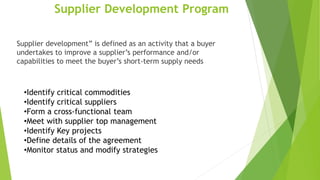
Supplier Development Program
Supplier development” is defined as an activity that a buyer
undertakes to improve a supplier’s performance and/or
capabilities to meet the buyer’s short-term supply needs
•Identify critical commodities
•Identify critical suppliers
•Form a cross-functional team
•Meet with supplier top management
•Identify Key projects
•Define details of the agreement
•Monitor status and modify strategies
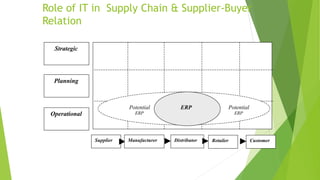
Role of IT in Supply Chain & Supplier-Buyer
Relation
Supplier CustomerRetailerDistributorManufacturer
Strategic
Planning
Operational
ERPPotential
ERP
Potential
ERP
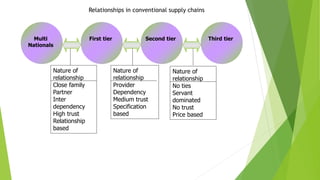
Multi
Nationals
First tier Second tier Third tier
Nature of
relationship
Close family
Partner
Inter
dependency
High trust
Relationship
based
Nature of
relationship
Provider
Dependency
Medium trust
Specification
based
Nature of
relationship
No ties
Servant
dominated
No trust
Price based
Relationships in conventional supply chains
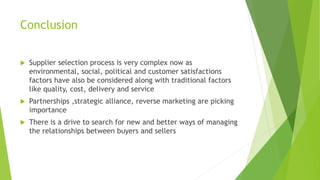
Conclusion
 Supplier selection process is very complex now as
environmental, social, political and customer satisfactions
factors have also be considered along with traditional factors
like quality, cost, delivery and service
 Partnerships ,strategic alliance, reverse marketing are picking
importance
 There is a drive to search for new and better ways of managing
the relationships between buyers and sellers
 No single approach to relationship management is inherently
superior.
 "Successful supply chain management requires the effective and
efficient management of a portfolio of relationships."
 Three environmental factors to consider:
(1) The product exchanged and its technology
(2) The competitive conditions in the upstream market
(3) The capabilities of the suppliers available.
 Developing and managing collaborative and alliance relationships
requires skilled professionals who recognize the benefits of
collaboration. These individuals must be able to identify and obtain
necessary data and use the data to exploit and enhance
relationships.
Thank You !
Madhurya Jain 208
Abhishek Shah 332
Ankit Garg 353
Akhil Gupta 504
Kritika Jain 512
Druvin 608

Buyer supplier relationship

  • 1.
  • 2.
    Introduction  Purchase supplierrelationship –Purchase supplier satisfaction matrix  Factors and types of transactions  Nature of relationships  Compare and Contrast partnership and collaboration  Supplier overview and rating  Strategic Alliance  Top industry examples  Role of IT
  • 3.
    Key questions forsupply manager Should we  Change our stance on multiple sourcing ?  Move to long term contracts ?  Do more reverse marketing ? How can we  Improve our relations with suppliers ?  Involve other functions more effectively in supplier relations ?  Initiate partnerships or alliance with our key suppliers ?
  • 4.
  • 5.
    Recent trends Buy insteadof make Outsource instead of continuously make Improve quality Lower inventories Integrate supplier and purchase systems
  • 6.
    Supplier Link InternalLink Customer Link The weakest link determines the strength of the whole chain, it is important that the strength of each link in any chain link be equal and congruent.
  • 7.
    Purchaser Supplier Relation •Nature of relationship-Major influencer- ultimate value and customer satisfaction Supplier Goodwill • Superior sources of supply- important asset • Sound marketing policy- Develop goodwill • Goodwill- Brands, advertising and regular calls by sales person- Relationship Marketing
  • 8.
    Congruence in supplychain can be achieved by:  Purchasers maintain friendly relationship with suppliers  Regularly measures satisfaction level of its key suppliers  Best purchasers practice- knowing suppliers business more than suppliers own employees  The ability to develop effective working relationships with suppliers will be dependent on supply's ability to develop effective working relationships internally.
  • 9.
    The Purchaser- SupplierSatisfaction Matrix
  • 10.
    1. Satisfaction witha current supplier relationship can be assessed, whether it is satisfactory or not. 2. An unsatisfied party (seller or purchaser or both) will attempt to move to a more satisfactory situation. 3. Attempts to move may affect the stability of the relationship. 4. Attempts to move may fall in win-lose, as well as the lose- lose, lose-win and win-win, categories. 5. Purchaser and seller may well have different perceptions of the same relationship. 6. Many tools and techniques and approaches exist that will assist either party in moving positions.
  • 11.
    Conclusion from thematrix  Diagonal- fairness or stability line  (0,0) position is completely undesirable from either standpoint.  (5,5) position is minimum acceptable goal for both sides.  (10,10) position is rarely found in reality. It requires a degree of mutual trust and sharing and respect that is difficult to achieve in our society of “buyer beware”.
  • 12.
  • 13.
    Factors for successfulinteraction Factors for successful Buyer Seller interaction Content of information Style of exchange
  • 14.
    Types of transactions Ideal Transaction Inefficient Transaction Inefficient Transaction No Transaction Typesof Transactions Compatible Style Incompatible Style Compatible content Incompatible content
  • 15.
  • 16.
    Transactional Relationship  Focus Timely exchange of basic product at a competitive price  One time only exchange and less loyalty to particular supplier  Little interest to extent relationship  Transactional relationship preferred when  Availability of many suppliers  Stable supply market  Purchase decision not complex  Purchase considered less important for achievement of firm’s objectives  Example: Stationery materials
  • 17.
    Transactional Relationship  Advantages Relatively less purchasing time and effort required to establish price  Lower skill level of procurement personnel required  Can react quickly to changing market/economic conditions  Disadvantages  Expediting and monitoring incoming quality  Provision of minimum service by suppliers  Supplier not motivated to invest time and energy for development of buyer’s products  Less effective performance by suppliers
  • 18.
    Value-added Exchange  Focus Complete understanding of the present and future needs of customers and meeting the needs better than competitors  Groups made by the selling firm  A: Most profit potential customers  B: Between A and C  C: Least profit potential customers
  • 19.
    Collaborative Relationship  Focus Building a strong social, economic service and technical ties between customer and supplier firm  Purpose  Increase value, lower total costs and achieve mutual benefits  Joint problem solving and integration of processes of the two companies  Two important factors: Trust and Commitment
  • 20.
    Collaborative Relationships  Advantages Long term contracts  Reduction of risk for suppliers  Reduction of total costs  Improvement of process  Improvement of products  Increased investment in R&D  Better focus on customer need
  • 21.
    Transactional vs Partnership ShortTerm Long Term Selection criteria: Lowest price Selection criteria: Cost of ownership No. of suppliers: Many No. of suppliers: One or few Purchasing department’s responsibility Cross functional teams and top management involvement Little sharing of information Sharing of short term & long term plans, risk & opportunity, data No technology inflow Inflow of technology takes place Minimal service provided Greatly improved service provided Little contribution to New Product Development process Highly involved in New Product Development process Less difficult to exit Difficult to exit
  • 22.
  • 23.
     Extensive communicationbetween both parties is needed to maintain satisfaction and stability  Requires substantial coordination work inside purchasers organisation  Team approach to long term supplier relations  Members of internal team have to deal directly with the counterparts on supplier side  Immediate action needs to be taken when either side detects a problem
  • 24.
     Awareness offull details of each sides aspiration, strengths and weakness is necessary  Personnel from both sides need to understand each other well for mutual benefit  This can come through exposure, discussions, mutual problem solving etc.  Thus the ability of supply’s personnel to develop effective working relationship internally will be key determinant of the organization's ability to get the most out of its supplier force
  • 25.
  • 26.
     Unacceptable Suppliers: Fails to meet operational and strategic needs of the buying organization  Discontinue with the supplier and substitute better ones  Acceptable Suppliers:  Meets current operational needs as required by contract  Provides a performance that others can easily match, hence no basis for competitive edge
  • 27.
     Preferred Suppliers: Purchasers have a process orientation with preferred suppliers to avoid unnecessary duplication and speed up transactions  Both parties work towards mutual improvements to eliminate nonvalue-adding activities  Meets all operational and some of the strategic needs of the buying organization  Reacts positively to initiatives of the purchaser to improve the current situation
  • 28.
     Exceptional Suppliers: Anticipates operational and strategic needs of the purchaser and are capable of meeting and exceeding them  They need to be treasured  They can serve as example of what is possible: an opportunity to experiment with new and different approaches to supply base management and as an early indicator of future supply management direction and goals  It requires substantial amount of work from both sides to obtain big rewards of mutual breakthrough  Patience and persistence are required to sustain the investment in relationship building
  • 29.
  • 30.
    Definition  A supplystrategy based upon joint opportunities, mutual trust, respect and open & honest communication between the supplier and the customer.  This strategy is focused on reducing related supply chain costs and improves the quality of goods and services.  Majorly technology driven and involves substantial investment by buyers and sellers to achieve major market breakthroughs
  • 31.
    Success factors forStrategic Alliance  Focus: A common vision for the relationship, with agreed strategies and activities  Trust: Open communication and disclosure of business drivers  Performance: Continuous improvement towards agreed targets and KPIs  People: Clearly defined roles and responsibilities  Proactive: Anticipating business needs and providing creative solutions  Profit at Risk: Establishing real metrics to drive behaviour for both parties
  • 32.
    Mistakes  Low commitment Poor operational planning and integration  Strategic weakness(diverging strategies/under-developed value added propositions, unclear strategic return on investment)  Rigidity or poor adaptability  Unrealistic expectations  Overdependence  Hidden agendas leading to distrust  Legal problems(IPR)
  • 33.
    Supplier development  Definition:Working with suppliers to help increase efficiency and decrease cost, for the benefit of both suppliers and buyers. Purchaser Purchaser Supplier Marketing initiative Purchasing response Supplier Purchasing initiative Sales response Traditional Marketing context Supplier development context
  • 34.
    Benefits  Reducing Cost Improved Quality  Technical, financial and managerial assistance  Reduction of marketing effort  Use of long term forecast  Minimum inventory maintenance  Close working on product specifications
  • 35.
    Example  Honda AndAmerica Manufacturing Inc. Supplier Development Self reliance Reduced cost Improved Quality Leading edge technology
  • 36.
    Starbucks Starbucks partnered withBarnes and Nobles bookstores in 1993 to provide in-house coffee shops, benefiting both retailers. In 1996, Starbucks partnered with Pepsico to bottle, distribute and sell the popular coffee-based drink, Frappacino. A Starbucks-United Airlines alliance has resulted in their coffee being offered on flights with the Starbucks logo on the cups.
  • 37.
    Apple Apple partnered recentlywith Clearwell in order to jointly develop Clearwell's E- Discovery platform for the Apple iPad. E-Discovery is used by enterprises and legal entities to obtain documents and information in a "legally defensible" .
  • 38.
    Hewlett Packard and Disney Hewlett-Packardand Disney have a long-standing alliance. Disney wanted to develop a virtual attraction called Mission: SPACE, Disney Imaginers and HP engineers relied on HP's IT architecture, servers and workstations to create Disney's most technologically advanced attraction.
  • 39.
    The Power matrixof Supplier-Buyer Relationship Buyer Dominance Supplier Dominance (moral hazard) Independence (adverse selection) Inter-dependence Low High Relative utility and scarcity of supplier resources for buyers Relative utility and scarcity of buyer’s resources for suppliers High Low Source: Andrew Cox, 2000
  • 40.
    Supplier Development Program Supplierdevelopment” is defined as an activity that a buyer undertakes to improve a supplier’s performance and/or capabilities to meet the buyer’s short-term supply needs •Identify critical commodities •Identify critical suppliers •Form a cross-functional team •Meet with supplier top management •Identify Key projects •Define details of the agreement •Monitor status and modify strategies
  • 41.
    Role of ITin Supply Chain & Supplier-Buyer Relation Supplier CustomerRetailerDistributorManufacturer Strategic Planning Operational ERPPotential ERP Potential ERP
  • 42.
    Multi Nationals First tier Secondtier Third tier Nature of relationship Close family Partner Inter dependency High trust Relationship based Nature of relationship Provider Dependency Medium trust Specification based Nature of relationship No ties Servant dominated No trust Price based Relationships in conventional supply chains
  • 43.
    Conclusion  Supplier selectionprocess is very complex now as environmental, social, political and customer satisfactions factors have also be considered along with traditional factors like quality, cost, delivery and service  Partnerships ,strategic alliance, reverse marketing are picking importance  There is a drive to search for new and better ways of managing the relationships between buyers and sellers
  • 44.
     No singleapproach to relationship management is inherently superior.  "Successful supply chain management requires the effective and efficient management of a portfolio of relationships."  Three environmental factors to consider: (1) The product exchanged and its technology (2) The competitive conditions in the upstream market (3) The capabilities of the suppliers available.  Developing and managing collaborative and alliance relationships requires skilled professionals who recognize the benefits of collaboration. These individuals must be able to identify and obtain necessary data and use the data to exploit and enhance relationships.
  • 45.
    Thank You ! MadhuryaJain 208 Abhishek Shah 332 Ankit Garg 353 Akhil Gupta 504 Kritika Jain 512 Druvin 608