Amit Surana          118

Hrishikesh Baruah    119

Shashanka Yerabaty   120
    A strategy to optimise profitability, revenue and customer
    satisfaction by organizing around customer segments,
    fostering customer-satisfying behaviours and implementing
    customer-centric processes.
                                                      - Gartner


   Aimed at maximizing their total customer life-time value, in
    addition to acquiring newer ones.
   When customers value the customer service that they
    receive from suppliers, they are less likely to look to
    alternative suppliers for their needs.

   CRM enables organisations to gain ‘competitive advantage’
    over competitors that supply similar products or services.
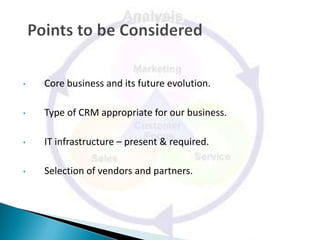
•   Core business and its future evolution.

•   Type of CRM appropriate for our business.

•   IT infrastructure – present & required.

•   Selection of vendors and partners.
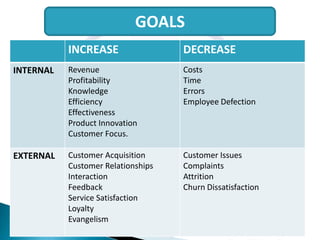
GOALS
           INCREASE                 DECREASE
INTERNAL   Revenue                  Costs
           Profitability            Time
           Knowledge                Errors
           Efficiency               Employee Defection
           Effectiveness
           Product Innovation
           Customer Focus.

EXTERNAL   Customer Acquisition     Customer Issues
           Customer Relationships   Complaints
           Interaction              Attrition
           Feedback                 Churn Dissatisfaction
           Service Satisfaction
           Loyalty
           Evangelism
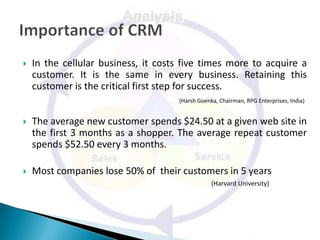
   In the cellular business, it costs five times more to acquire a
    customer. It is the same in every business. Retaining this
    customer is the critical first step for success.
                                     (Harsh Goenka, Chairman, RPG Enterprises, India)


   The average new customer spends $24.50 at a given web site in
    the first 3 months as a shopper. The average repeat customer
    spends $52.50 every 3 months.

   Most companies lose 50% of their customers in 5 years
                                                 (Harvard University)
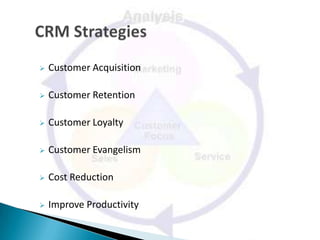
   Customer Acquisition

   Customer Retention

   Customer Loyalty

   Customer Evangelism

   Cost Reduction

   Improve Productivity
   Customer relationship should be built with customers that
    are likely to provide value for services.

   Not all customers are equally important

   Building relationships with customers that will provide little
    value could result in a loss of time, staff and financial
    resources
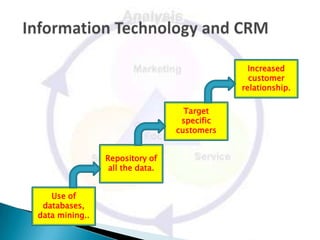
Increased
                                               customer
                                             relationship.

                                   Target
                                  specific
                                 customers


                Repository of
                 all the data.


   Use of
 databases,
data mining..
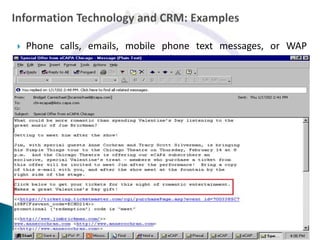
   Phone calls, emails, mobile phone text messages, or WAP
    services can be used to reach to the customers.

   Illustration: When tickets are purchased online via
    Makemytrip.com, the website retains the customers details and
    their purchase history. The website regularly send emails to
    previous customers to inform them of similar upcoming events
    or special discounts. This helps to ensure that customers will
    continue to purchase tickets from Makemytrip.com in the future.
CRM software- “Front office” solutions
Many call centres use CRM software to store all of their
customer's details. When a customer calls, the system can be
used to retrieve and store information relevant to the
customer. By serving the customer quickly and efficiently, and
also keeping all information on a customer in one place, a
company aims to make cost savings, and also encourage new
customers.
   Staff members often remember the names and favourite
    services/products of regular customers and use this
    information to create a personalised service for them.

   For example, in a hospital library you will know the name of
    nurses that come in often and probably remember the area
    that they work in.

   However, face-to-face CRM could prove less useful when
    organisations have a large number of customers as it would be
    more difficult to remember details about each of them.
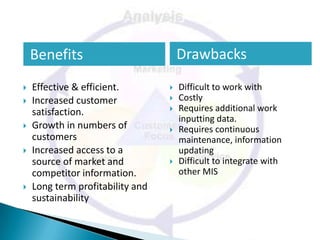
Benefits                          Drawbacks
   Effective & efficient.           Difficult to work with
   Increased customer               Costly
    satisfaction.                    Requires additional work
                                      inputting data.
   Growth in numbers of             Requires continuous
    customers                         maintenance, information
   Increased access to a             updating
    source of market and             Difficult to integrate with
    competitor information.           other MIS
   Long term profitability and
    sustainability
Queries ???

Customer Relationship Management (CRM)

  • 1.
    Amit Surana 118 Hrishikesh Baruah 119 Shashanka Yerabaty 120
  • 2.
    A strategy to optimise profitability, revenue and customer satisfaction by organizing around customer segments, fostering customer-satisfying behaviours and implementing customer-centric processes. - Gartner  Aimed at maximizing their total customer life-time value, in addition to acquiring newer ones.
  • 3.
    When customers value the customer service that they receive from suppliers, they are less likely to look to alternative suppliers for their needs.  CRM enables organisations to gain ‘competitive advantage’ over competitors that supply similar products or services.
  • 4.
    Core business and its future evolution. • Type of CRM appropriate for our business. • IT infrastructure – present & required. • Selection of vendors and partners.
  • 5.
    GOALS INCREASE DECREASE INTERNAL Revenue Costs Profitability Time Knowledge Errors Efficiency Employee Defection Effectiveness Product Innovation Customer Focus. EXTERNAL Customer Acquisition Customer Issues Customer Relationships Complaints Interaction Attrition Feedback Churn Dissatisfaction Service Satisfaction Loyalty Evangelism
  • 6.
    In the cellular business, it costs five times more to acquire a customer. It is the same in every business. Retaining this customer is the critical first step for success. (Harsh Goenka, Chairman, RPG Enterprises, India)  The average new customer spends $24.50 at a given web site in the first 3 months as a shopper. The average repeat customer spends $52.50 every 3 months.  Most companies lose 50% of their customers in 5 years (Harvard University)
  • 7.
    Customer Acquisition  Customer Retention  Customer Loyalty  Customer Evangelism  Cost Reduction  Improve Productivity
  • 8.
    Customer relationship should be built with customers that are likely to provide value for services.  Not all customers are equally important  Building relationships with customers that will provide little value could result in a loss of time, staff and financial resources
  • 9.
    Increased customer relationship. Target specific customers Repository of all the data. Use of databases, data mining..
  • 10.
    Phone calls, emails, mobile phone text messages, or WAP services can be used to reach to the customers.  Illustration: When tickets are purchased online via Makemytrip.com, the website retains the customers details and their purchase history. The website regularly send emails to previous customers to inform them of similar upcoming events or special discounts. This helps to ensure that customers will continue to purchase tickets from Makemytrip.com in the future.
  • 11.
    CRM software- “Frontoffice” solutions Many call centres use CRM software to store all of their customer's details. When a customer calls, the system can be used to retrieve and store information relevant to the customer. By serving the customer quickly and efficiently, and also keeping all information on a customer in one place, a company aims to make cost savings, and also encourage new customers.
  • 12.
    Staff members often remember the names and favourite services/products of regular customers and use this information to create a personalised service for them.  For example, in a hospital library you will know the name of nurses that come in often and probably remember the area that they work in.  However, face-to-face CRM could prove less useful when organisations have a large number of customers as it would be more difficult to remember details about each of them.
  • 13.
    Benefits Drawbacks  Effective & efficient.  Difficult to work with  Increased customer  Costly satisfaction.  Requires additional work inputting data.  Growth in numbers of  Requires continuous customers maintenance, information  Increased access to a updating source of market and  Difficult to integrate with competitor information. other MIS  Long term profitability and sustainability
  • 14.