Dr.S.Rajakarunakaran, Mr.G.Prabu ram, 
Mr.P,.Pavithran/TQM
1
Department of Mechanical Engineering
GE8077 TOTAL QUALITY MANAGEMENT
Customer Focus
Prepared by:
Mr.G.Prabu ram AP(Sr.Gr)
Dr.S.Rajakarunakaran Professor
Department of Mechanical Engineering
1. Customer Focus
2. Customer Satisfaction
3. Customer Orientation
4. Customer Complaints
5. Customer Retention
Dr.S.Rajakarunakaran, Mr.G.Prabu ram, 
Mr.P,.Pavithran/TQM
2
Outline of Presentation
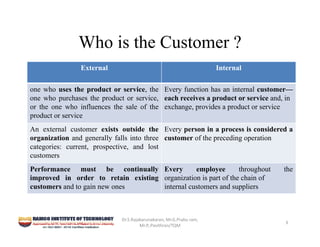
Who is the Customer ?
External Internal
one who uses the product or service, the
one who purchases the product or service,
or the one who influences the sale of the
product or service
Every function has an internal customer—
each receives a product or service and, in
exchange, provides a product or service
An external customer exists outside the
organization and generally falls into three
categories: current, prospective, and lost
customers
Every person in a process is considered a
customer of the preceding operation
Performance must be continually
improved in order to retain existing
customers and to gain new ones
Every employee throughout the
organization is part of the chain of
internal customers and suppliers
Dr.S.Rajakarunakaran, Mr.G.Prabu ram, 
Mr.P,.Pavithran/TQM
3
Dr.S.Rajakarunakaran, Mr.G.Prabu ram, 
Mr.P,.Pavithran/TQM
4
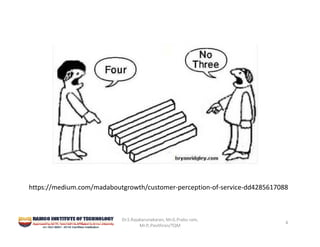
https://medium.com/madaboutgrowth/customer‐perception‐of‐service‐dd4285617088
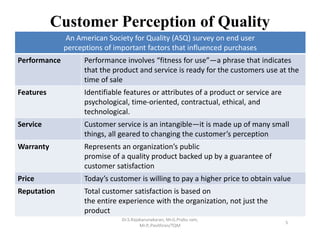
Customer Perception of Quality
An American Society for Quality (ASQ) survey on end user
perceptions of important factors that influenced purchases
Performance Performance involves “fitness for use”—a phrase that indicates
that the product and service is ready for the customers use at the
time of sale
Features Identifiable features or attributes of a product or service are
psychological, time‐oriented, contractual, ethical, and
technological.
Service Customer service is an intangible—it is made up of many small
things, all geared to changing the customer’s perception
Warranty Represents an organization’s public
promise of a quality product backed up by a guarantee of
customer satisfaction
Price Today’s customer is willing to pay a higher price to obtain value
Reputation Total customer satisfaction is based on
the entire experience with the organization, not just the
product
Dr.S.Rajakarunakaran, Mr.G.Prabu ram, 
Mr.P,.Pavithran/TQM
5
2.3.1 Customer focus
[ISO 9000:2015(E)]
• Statement
– The primary focus of quality management is to meet
customer requirements and to strive to exceed customer
expectations
• Rationale
– Sustained success is achieved when an organization attracts
and retains the confidence of customers and other relevant
interested parties. Every aspect of customer interaction
provides an opportunity to create more value for the
customer. Understanding current and future needs of
customers and other interested parties contributes to the
sustained success of the organization
Dr.S.Rajakarunakaran, Mr.G.Prabu ram, 
Mr.P,.Pavithran/TQM
6
Source: https://www.iso‐9001‐checklist.co.uk/tutorial/customer‐focus.htm
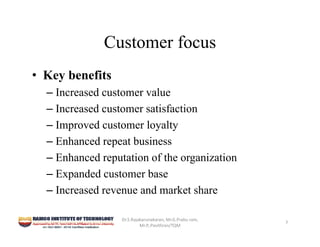
Customer focus
• Key benefits
– Increased customer value
– Increased customer satisfaction
– Improved customer loyalty
– Enhanced repeat business
– Enhanced reputation of the organization
– Expanded customer base
– Increased revenue and market share
Dr.S.Rajakarunakaran, Mr.G.Prabu ram, 
Mr.P,.Pavithran/TQM
7
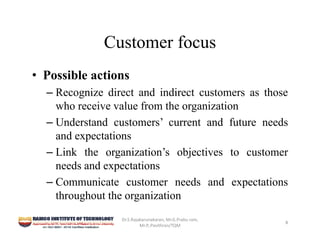
Customer focus
• Possible actions
– Recognize direct and indirect customers as those
who receive value from the organization
– Understand customers’ current and future needs
and expectations
– Link the organization’s objectives to customer
needs and expectations
– Communicate customer needs and expectations
throughout the organization
Dr.S.Rajakarunakaran, Mr.G.Prabu ram, 
Mr.P,.Pavithran/TQM
8
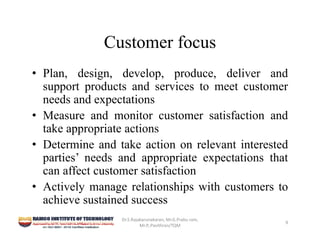
Customer focus
• Plan, design, develop, produce, deliver and
support products and services to meet customer
needs and expectations
• Measure and monitor customer satisfaction and
take appropriate actions
• Determine and take action on relevant interested
parties’ needs and appropriate expectations that
can affect customer satisfaction
• Actively manage relationships with customers to
achieve sustained success
Dr.S.Rajakarunakaran, Mr.G.Prabu ram, 
Mr.P,.Pavithran/TQM
9
JD Power Asia Pacific
• ACSI [American Customer Satisfaction Index]
Started in 1994 by a joint venture by University of
Michigan & American Society for Quality to analysis
the customer satisfaction for the products and
service
Dr.S.Rajakarunakaran, Mr.G.Prabu ram, 
Mr.P,.Pavithran/TQM
10
Source: https://www.jdpower.com/business
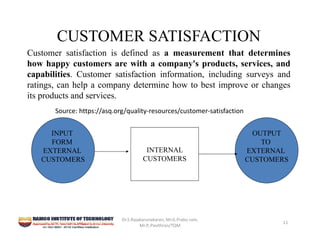
INTERNAL
CUSTOMERS
CUSTOMER SATISFACTION
Customer satisfaction is defined as a measurement that determines
how happy customers are with a company's products, services, and
capabilities. Customer satisfaction information, including surveys and
ratings, can help a company determine how to best improve or changes
its products and services.
OUTPUT
TO
EXTERNAL
CUSTOMERS
INPUT
FORM
EXTERNAL
CUSTOMERS
Dr.S.Rajakarunakaran, Mr.G.Prabu ram, 
Mr.P,.Pavithran/TQM
11
Source: https://asq.org/quality‐resources/customer‐satisfaction
Dissatisfied, Satisfied and Delighted
Customers
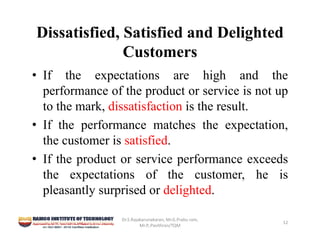
• If the expectations are high and the
performance of the product or service is not up
to the mark, dissatisfaction is the result.
• If the performance matches the expectation,
the customer is satisfied.
• If the product or service performance exceeds
the expectations of the customer, he is
pleasantly surprised or delighted.
Dr.S.Rajakarunakaran, Mr.G.Prabu ram, 
Mr.P,.Pavithran/TQM
12
Dr.S.Rajakarunakaran, Mr.G.Prabu ram, 
Mr.P,.Pavithran/TQM
13
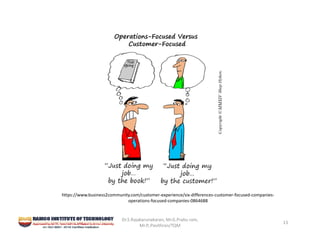
https://www.business2community.com/customer‐experience/six‐differences‐customer‐focused‐companies‐
operations‐focused‐companies‐0864688
Feedback
• Customer feedback must be continually solicited and monitored.
• Feedback enables the organization to :
– Discover customer dissatisfaction
– Discover relative priorities of quality
– Compare performance with the competition
– Identify customer’s needs
– Determine opportunities for improvement
Customer feedback is the information, insights, issues, and input
shared by your community about their experiences with your
company, product, or services. This feedback guides
improvements of the customer experience and can empower
positive change in any business — even (and especially) when it’s
negative.
Dr.S.Rajakarunakaran, Mr.G.Prabu ram, 
Mr.P,.Pavithran/TQM
14
https://www.helpscout.com/blog/customer‐feedback/
Tools for Listening to the voice of the
customer
• Comment cards
• Questionnaires
• Focus groups
• Too-free telephone lines
• Customer visits
• Report cards
• The Internet
• Employee feedback
• Mass customization and
• Customer Satisfaction Index
Dr.S.Rajakarunakaran, Mr.G.Prabu ram, 
Mr.P,.Pavithran/TQM
15
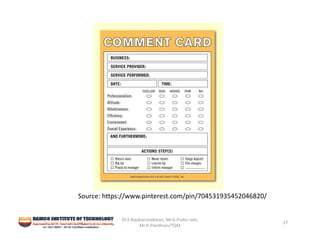
Comment Card
• A low-cost method of obtaining feedback from
customers involves a comment card which can
be attached to the warranty card and included
with the product at the time of purchase
• The intent of the card is to get simple
information, such as name, address, age
occupation, and what influenced the
customer’s decision to buy the product
Dr.S.Rajakarunakaran, Mr.G.Prabu ram, 
Mr.P,.Pavithran/TQM
16
Dr.S.Rajakarunakaran, Mr.G.Prabu ram, 
Mr.P,.Pavithran/TQM
17
Source: https://www.pinterest.com/pin/704531935452046820/
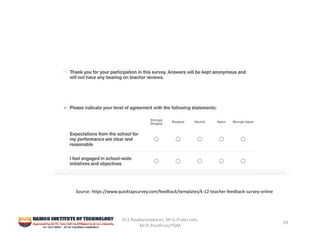
Customer Questionnaire
• Used for obtaining opinions and perceptions
about an organization and its products and
services
• Costly and time consuming
• Surveys may be administered by mail or
telephone
• In the form of questionnaires, the customer is
asked to furnish answers relating to the quality of
products and services - customer to grade the
question on one-to-five scale or a one-to-ten scale
Dr.S.Rajakarunakaran, Mr.G.Prabu ram, 
Mr.P,.Pavithran/TQM
18
Dr.S.Rajakarunakaran, Mr.G.Prabu ram, 
Mr.P,.Pavithran/TQM
19
Source: https://www.quicktapsurvey.com/feedback/templates/k‐12‐teacher‐feedback‐survey‐online
Points to make surveys more useful
• Clients (are the people for whom you are doing the survey)
and customers (are the ones who use the product or service)
are not the same
• Survey raise customers’ expectations
• How you ask a question will determine how the question is
answered
• The more specific the question, the better the answer
• The more time you spend in survey development, the less
time you will spend in data analysis and interpretation
• Who you ask is as important as what you ask
• Before the data are collected, you should know how you
want to analyze and use the data
Dr.S.Rajakarunakaran, Mr.G.Prabu ram, 
Mr.P,.Pavithran/TQM
20
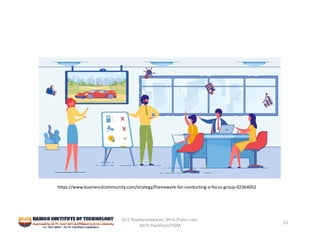
Focus Groups
• Surveying a focus group is a research method used to
find out what customers are really thinking
• A group of customers is assembled in a meeting room
to answer a series of questions.
• These carefully structured questions are asked by a
skilled moderator, who probes into the participants’
thoughts, ideas, perceptions, or comments.
• Participants have same profile.
• Suitable tool for examine internal issues
• Imprint analysis used as a tool for understanding
intrinsic feelings associated with a product or service
Dr.S.Rajakarunakaran, Mr.G.Prabu ram, 
Mr.P,.Pavithran/TQM
21
Dr.S.Rajakarunakaran, Mr.G.Prabu ram, 
Mr.P,.Pavithran/TQM
22
https://www.business2community.com/strategy/framework‐for‐conducting‐a‐focus‐group‐02364052
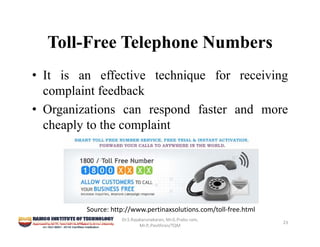
Toll-Free Telephone Numbers
• It is an effective technique for receiving
complaint feedback
• Organizations can respond faster and more
cheaply to the complaint
Dr.S.Rajakarunakaran, Mr.G.Prabu ram, 
Mr.P,.Pavithran/TQM
23
Source: http://www.pertinaxsolutions.com/toll‐free.html
Customer Visits
• An organization can proactively monitor its
product’s performance while it is in use and
thereby identify any specific or recurring
problems.
• Senior managers should be involved in these
visits and not delegate them to someone else
• Brain storming sessions with the customers
about future products and services should be
held at least annually
Dr.S.Rajakarunakaran, Mr.G.Prabu ram, 
Mr.P,.Pavithran/TQM
24
Dr.S.Rajakarunakaran, Mr.G.Prabu ram, 
Mr.P,.Pavithran/TQM
25
Source: http://www.railroad‐fasteners.com/customer‐visit/american‐customer‐visit‐for‐
railway‐fish‐plates.html
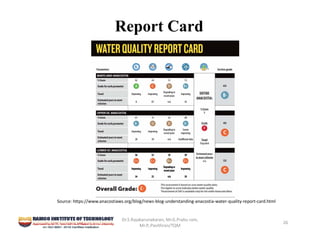
Report Card
Dr.S.Rajakarunakaran, Mr.G.Prabu ram, 
Mr.P,.Pavithran/TQM
26
Source: https://www.anacostiaws.org/blog/news‐blog‐understanding‐anacostia‐water‐quality‐report‐card.html
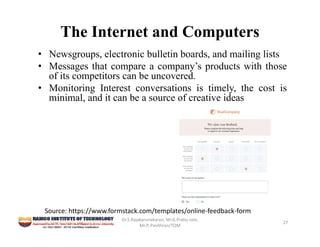
The Internet and Computers
• Newsgroups, electronic bulletin boards, and mailing lists
• Messages that compare a company’s products with those
of its competitors can be uncovered.
• Monitoring Interest conversations is timely, the cost is
minimal, and it can be a source of creative ideas
Dr.S.Rajakarunakaran, Mr.G.Prabu ram, 
Mr.P,.Pavithran/TQM
27
Source: https://www.formstack.com/templates/online‐feedback‐form
Employee Feedback
• Employee groups can brainstorm ideas to
come up with solutions to problems that
customers have identified
• Customer research reveals what is happening,
employee research reveals why it is happening
Dr.S.Rajakarunakaran, Mr.G.Prabu ram, 
Mr.P,.Pavithran/TQM
28
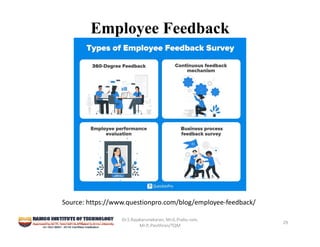
Employee Feedback
Dr.S.Rajakarunakaran, Mr.G.Prabu ram, 
Mr.P,.Pavithran/TQM
29
Source: https://www.questionpro.com/blog/employee‐feedback/
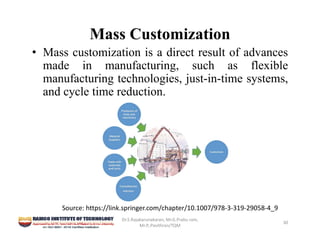
Mass Customization
• Mass customization is a direct result of advances
made in manufacturing, such as flexible
manufacturing technologies, just-in-time systems,
and cycle time reduction.
Dr.S.Rajakarunakaran, Mr.G.Prabu ram, 
Mr.P,.Pavithran/TQM
30
Source: https://link.springer.com/chapter/10.1007/978‐3‐319‐29058‐4_9
Customer Retention
• Customer retention refers to the activities and
actions companies and organizations take to
reduce the number of customer defections.
The goal of customer retention programs is to
help companies retain as many customers as
possible, often through customer loyalty and
brand loyalty initiatives
Dr.S.Rajakarunakaran, Mr.G.Prabu ram, 
Mr.P,.Pavithran/TQM
31
Customer Satisfaction Index
• Quantifies quality and customer satisfaction
and relates them to firms’ financial
performance
• Customer complaint should be accepted,
analyzed, and acted upon, for it represents the
tip of the iceberg
Dr.S.Rajakarunakaran, Mr.G.Prabu ram, 
Mr.P,.Pavithran/TQM
32
To handle customer complaints
• Investigate customers’ experiences by actively soliciting feedback,
both positive and negative, and then acting on it promptly
• Develop procedures for complaint resolution that include
empowering front-line personnel
• Establish customer satisfaction measures and constantly monitor
them. Communicate complaint information, as well as the results of
all investigations and solutions, to all people in the organization
• Provide a monthly complaint report to the quality council for their
evaluation and, if needed, the assignment of process improvement
teams
Dr.S.Rajakarunakaran, Mr.G.Prabu ram, 
Mr.P,.Pavithran/TQM
33
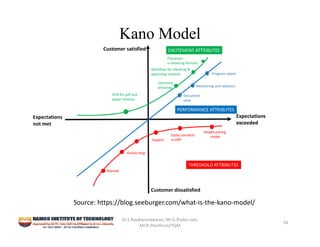
Kano Model
Dr.S.Rajakarunakaran, Mr.G.Prabu ram, 
Mr.P,.Pavithran/TQM
34
Source: https://blog.seeburger.com/what‐is‐the‐kano‐model/
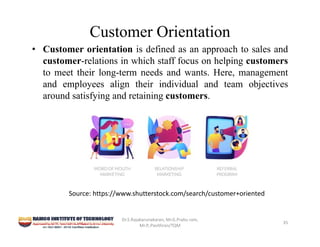
Customer Orientation
• Customer orientation is defined as an approach to sales and
customer-relations in which staff focus on helping customers
to meet their long-term needs and wants. Here, management
and employees align their individual and team objectives
around satisfying and retaining customers.
Dr.S.Rajakarunakaran, Mr.G.Prabu ram, 
Mr.P,.Pavithran/TQM
35
Source: https://www.shutterstock.com/search/customer+oriented
Reference
 Dale H.Besterfiled, Carol B.Michna,Glen H. Besterfield,Mary B.Sacre,Hemant
Urdhwareshe and Rashmi Urdhwareshe, “Total Quality Management”, Pearson
Education Asia, Revised Third Edition, Indian Reprint, Sixth Impression, 2013.
 James R. Evans and William M. Lindsay, "The Management and Control of
Quality", 8th Edition, First Indian Edition, Cengage Learning, 2012.
 Janakiraman. B and Gopal .R.K., "Total Quality Management - Text and Cases",
Prentice Hall (India) Pvt. Ltd., 2006.
 Suganthi.L and Anand Samuel, "Total Quality Management", Prentice Hall (India)
Pvt. Ltd., 2006.
 ISO 9001-2015 standards
Dr.S.Rajakarunakaran, Mr.G.Prabu ram, 
Mr.P,.Pavithran/TQM
36
Dr.S.Rajakarunakaran, Mr.G.Prabu ram, 
Mr.P,.Pavithran/TQM
37
https://www.gov.uk/government/news/say‐thank‐you‐to‐someone‐at‐companies‐house

Customer focus

  • 1.
  • 2.
    1. Customer Focus 2.Customer Satisfaction 3. Customer Orientation 4. Customer Complaints 5. Customer Retention Dr.S.Rajakarunakaran, Mr.G.Prabu ram,  Mr.P,.Pavithran/TQM 2 Outline of Presentation
  • 3.
    Who is theCustomer ? External Internal one who uses the product or service, the one who purchases the product or service, or the one who influences the sale of the product or service Every function has an internal customer— each receives a product or service and, in exchange, provides a product or service An external customer exists outside the organization and generally falls into three categories: current, prospective, and lost customers Every person in a process is considered a customer of the preceding operation Performance must be continually improved in order to retain existing customers and to gain new ones Every employee throughout the organization is part of the chain of internal customers and suppliers Dr.S.Rajakarunakaran, Mr.G.Prabu ram,  Mr.P,.Pavithran/TQM 3
  • 4.
  • 5.
    Customer Perception ofQuality An American Society for Quality (ASQ) survey on end user perceptions of important factors that influenced purchases Performance Performance involves “fitness for use”—a phrase that indicates that the product and service is ready for the customers use at the time of sale Features Identifiable features or attributes of a product or service are psychological, time‐oriented, contractual, ethical, and technological. Service Customer service is an intangible—it is made up of many small things, all geared to changing the customer’s perception Warranty Represents an organization’s public promise of a quality product backed up by a guarantee of customer satisfaction Price Today’s customer is willing to pay a higher price to obtain value Reputation Total customer satisfaction is based on the entire experience with the organization, not just the product Dr.S.Rajakarunakaran, Mr.G.Prabu ram,  Mr.P,.Pavithran/TQM 5
  • 6.
    2.3.1 Customer focus [ISO9000:2015(E)] • Statement – The primary focus of quality management is to meet customer requirements and to strive to exceed customer expectations • Rationale – Sustained success is achieved when an organization attracts and retains the confidence of customers and other relevant interested parties. Every aspect of customer interaction provides an opportunity to create more value for the customer. Understanding current and future needs of customers and other interested parties contributes to the sustained success of the organization Dr.S.Rajakarunakaran, Mr.G.Prabu ram,  Mr.P,.Pavithran/TQM 6 Source: https://www.iso‐9001‐checklist.co.uk/tutorial/customer‐focus.htm
  • 7.
    Customer focus • Keybenefits – Increased customer value – Increased customer satisfaction – Improved customer loyalty – Enhanced repeat business – Enhanced reputation of the organization – Expanded customer base – Increased revenue and market share Dr.S.Rajakarunakaran, Mr.G.Prabu ram,  Mr.P,.Pavithran/TQM 7
  • 8.
    Customer focus • Possibleactions – Recognize direct and indirect customers as those who receive value from the organization – Understand customers’ current and future needs and expectations – Link the organization’s objectives to customer needs and expectations – Communicate customer needs and expectations throughout the organization Dr.S.Rajakarunakaran, Mr.G.Prabu ram,  Mr.P,.Pavithran/TQM 8
  • 9.
    Customer focus • Plan,design, develop, produce, deliver and support products and services to meet customer needs and expectations • Measure and monitor customer satisfaction and take appropriate actions • Determine and take action on relevant interested parties’ needs and appropriate expectations that can affect customer satisfaction • Actively manage relationships with customers to achieve sustained success Dr.S.Rajakarunakaran, Mr.G.Prabu ram,  Mr.P,.Pavithran/TQM 9
  • 10.
    JD Power Asia Pacific • ACSI [AmericanCustomer Satisfaction Index] Started in 1994 by a joint venture by University of Michigan & American Society for Quality to analysis the customer satisfaction for the products and service Dr.S.Rajakarunakaran, Mr.G.Prabu ram,  Mr.P,.Pavithran/TQM 10 Source: https://www.jdpower.com/business
  • 11.
    INTERNAL CUSTOMERS CUSTOMER SATISFACTION Customer satisfactionis defined as a measurement that determines how happy customers are with a company's products, services, and capabilities. Customer satisfaction information, including surveys and ratings, can help a company determine how to best improve or changes its products and services. OUTPUT TO EXTERNAL CUSTOMERS INPUT FORM EXTERNAL CUSTOMERS Dr.S.Rajakarunakaran, Mr.G.Prabu ram,  Mr.P,.Pavithran/TQM 11 Source: https://asq.org/quality‐resources/customer‐satisfaction
  • 12.
    Dissatisfied, Satisfied andDelighted Customers • If the expectations are high and the performance of the product or service is not up to the mark, dissatisfaction is the result. • If the performance matches the expectation, the customer is satisfied. • If the product or service performance exceeds the expectations of the customer, he is pleasantly surprised or delighted. Dr.S.Rajakarunakaran, Mr.G.Prabu ram,  Mr.P,.Pavithran/TQM 12
  • 13.
  • 14.
    Feedback • Customer feedbackmust be continually solicited and monitored. • Feedback enables the organization to : – Discover customer dissatisfaction – Discover relative priorities of quality – Compare performance with the competition – Identify customer’s needs – Determine opportunities for improvement Customer feedback is the information, insights, issues, and input shared by your community about their experiences with your company, product, or services. This feedback guides improvements of the customer experience and can empower positive change in any business — even (and especially) when it’s negative. Dr.S.Rajakarunakaran, Mr.G.Prabu ram,  Mr.P,.Pavithran/TQM 14 https://www.helpscout.com/blog/customer‐feedback/
  • 15.
    Tools for Listeningto the voice of the customer • Comment cards • Questionnaires • Focus groups • Too-free telephone lines • Customer visits • Report cards • The Internet • Employee feedback • Mass customization and • Customer Satisfaction Index Dr.S.Rajakarunakaran, Mr.G.Prabu ram,  Mr.P,.Pavithran/TQM 15
  • 16.
    Comment Card • Alow-cost method of obtaining feedback from customers involves a comment card which can be attached to the warranty card and included with the product at the time of purchase • The intent of the card is to get simple information, such as name, address, age occupation, and what influenced the customer’s decision to buy the product Dr.S.Rajakarunakaran, Mr.G.Prabu ram,  Mr.P,.Pavithran/TQM 16
  • 17.
  • 18.
    Customer Questionnaire • Usedfor obtaining opinions and perceptions about an organization and its products and services • Costly and time consuming • Surveys may be administered by mail or telephone • In the form of questionnaires, the customer is asked to furnish answers relating to the quality of products and services - customer to grade the question on one-to-five scale or a one-to-ten scale Dr.S.Rajakarunakaran, Mr.G.Prabu ram,  Mr.P,.Pavithran/TQM 18
  • 19.
  • 20.
    Points to makesurveys more useful • Clients (are the people for whom you are doing the survey) and customers (are the ones who use the product or service) are not the same • Survey raise customers’ expectations • How you ask a question will determine how the question is answered • The more specific the question, the better the answer • The more time you spend in survey development, the less time you will spend in data analysis and interpretation • Who you ask is as important as what you ask • Before the data are collected, you should know how you want to analyze and use the data Dr.S.Rajakarunakaran, Mr.G.Prabu ram,  Mr.P,.Pavithran/TQM 20
  • 21.
    Focus Groups • Surveyinga focus group is a research method used to find out what customers are really thinking • A group of customers is assembled in a meeting room to answer a series of questions. • These carefully structured questions are asked by a skilled moderator, who probes into the participants’ thoughts, ideas, perceptions, or comments. • Participants have same profile. • Suitable tool for examine internal issues • Imprint analysis used as a tool for understanding intrinsic feelings associated with a product or service Dr.S.Rajakarunakaran, Mr.G.Prabu ram,  Mr.P,.Pavithran/TQM 21
  • 22.
  • 23.
    Toll-Free Telephone Numbers •It is an effective technique for receiving complaint feedback • Organizations can respond faster and more cheaply to the complaint Dr.S.Rajakarunakaran, Mr.G.Prabu ram,  Mr.P,.Pavithran/TQM 23 Source: http://www.pertinaxsolutions.com/toll‐free.html
  • 24.
    Customer Visits • Anorganization can proactively monitor its product’s performance while it is in use and thereby identify any specific or recurring problems. • Senior managers should be involved in these visits and not delegate them to someone else • Brain storming sessions with the customers about future products and services should be held at least annually Dr.S.Rajakarunakaran, Mr.G.Prabu ram,  Mr.P,.Pavithran/TQM 24
  • 25.
  • 26.
  • 27.
    The Internet andComputers • Newsgroups, electronic bulletin boards, and mailing lists • Messages that compare a company’s products with those of its competitors can be uncovered. • Monitoring Interest conversations is timely, the cost is minimal, and it can be a source of creative ideas Dr.S.Rajakarunakaran, Mr.G.Prabu ram,  Mr.P,.Pavithran/TQM 27 Source: https://www.formstack.com/templates/online‐feedback‐form
  • 28.
    Employee Feedback • Employeegroups can brainstorm ideas to come up with solutions to problems that customers have identified • Customer research reveals what is happening, employee research reveals why it is happening Dr.S.Rajakarunakaran, Mr.G.Prabu ram,  Mr.P,.Pavithran/TQM 28
  • 29.
  • 30.
    Mass Customization • Masscustomization is a direct result of advances made in manufacturing, such as flexible manufacturing technologies, just-in-time systems, and cycle time reduction. Dr.S.Rajakarunakaran, Mr.G.Prabu ram,  Mr.P,.Pavithran/TQM 30 Source: https://link.springer.com/chapter/10.1007/978‐3‐319‐29058‐4_9
  • 31.
    Customer Retention • Customerretention refers to the activities and actions companies and organizations take to reduce the number of customer defections. The goal of customer retention programs is to help companies retain as many customers as possible, often through customer loyalty and brand loyalty initiatives Dr.S.Rajakarunakaran, Mr.G.Prabu ram,  Mr.P,.Pavithran/TQM 31
  • 32.
    Customer Satisfaction Index •Quantifies quality and customer satisfaction and relates them to firms’ financial performance • Customer complaint should be accepted, analyzed, and acted upon, for it represents the tip of the iceberg Dr.S.Rajakarunakaran, Mr.G.Prabu ram,  Mr.P,.Pavithran/TQM 32
  • 33.
    To handle customercomplaints • Investigate customers’ experiences by actively soliciting feedback, both positive and negative, and then acting on it promptly • Develop procedures for complaint resolution that include empowering front-line personnel • Establish customer satisfaction measures and constantly monitor them. Communicate complaint information, as well as the results of all investigations and solutions, to all people in the organization • Provide a monthly complaint report to the quality council for their evaluation and, if needed, the assignment of process improvement teams Dr.S.Rajakarunakaran, Mr.G.Prabu ram,  Mr.P,.Pavithran/TQM 33
  • 34.
  • 35.
    Customer Orientation • Customerorientation is defined as an approach to sales and customer-relations in which staff focus on helping customers to meet their long-term needs and wants. Here, management and employees align their individual and team objectives around satisfying and retaining customers. Dr.S.Rajakarunakaran, Mr.G.Prabu ram,  Mr.P,.Pavithran/TQM 35 Source: https://www.shutterstock.com/search/customer+oriented
  • 36.
    Reference  Dale H.Besterfiled,Carol B.Michna,Glen H. Besterfield,Mary B.Sacre,Hemant Urdhwareshe and Rashmi Urdhwareshe, “Total Quality Management”, Pearson Education Asia, Revised Third Edition, Indian Reprint, Sixth Impression, 2013.  James R. Evans and William M. Lindsay, "The Management and Control of Quality", 8th Edition, First Indian Edition, Cengage Learning, 2012.  Janakiraman. B and Gopal .R.K., "Total Quality Management - Text and Cases", Prentice Hall (India) Pvt. Ltd., 2006.  Suganthi.L and Anand Samuel, "Total Quality Management", Prentice Hall (India) Pvt. Ltd., 2006.  ISO 9001-2015 standards Dr.S.Rajakarunakaran, Mr.G.Prabu ram,  Mr.P,.Pavithran/TQM 36
  • 37.