SERVICE QUALITY
MODELS
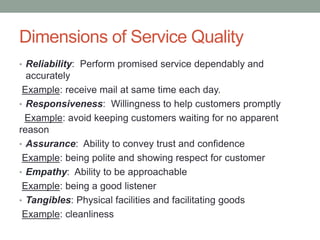
Dimensions of Service Quality
• Reliability: Perform promised service dependably and
  accurately
 Example: receive mail at same time each day.
• Responsiveness: Willingness to help customers promptly
  Example: avoid keeping customers waiting for no apparent
reason
• Assurance: Ability to convey trust and confidence
 Example: being polite and showing respect for customer
• Empathy: Ability to be approachable
 Example: being a good listener
• Tangibles: Physical facilities and facilitating goods
 Example: cleanliness
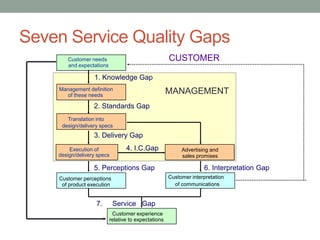
Seven Service Quality Gaps
       Customer needs                                CUSTOMER
       and expectations

                  1. Knowledge Gap
    Management definition
      of these needs
                                                     MANAGEMENT
                  2. Standards Gap
       Translation into
     design/delivery specs
                  3. Delivery Gap
        Execution of             4. I.C.Gap               Advertising and
    design/delivery specs                                 sales promises

                  5. Perceptions Gap                               6. Interpretation Gap
    Customer perceptions                             Customer interpretation
     of product execution                              of communications


                   7.       Service Gap
                           Customer experience
                          relative to expectations
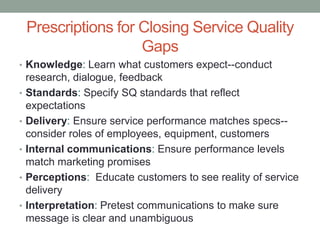
Prescriptions for Closing Service Quality
                      Gaps
• Knowledge: Learn what customers expect--conduct
    research, dialogue, feedback
•   Standards: Specify SQ standards that reflect
    expectations
•   Delivery: Ensure service performance matches specs--
    consider roles of employees, equipment, customers
•   Internal communications: Ensure performance levels
    match marketing promises
•   Perceptions: Educate customers to see reality of service
    delivery
•   Interpretation: Pretest communications to make sure
    message is clear and unambiguous
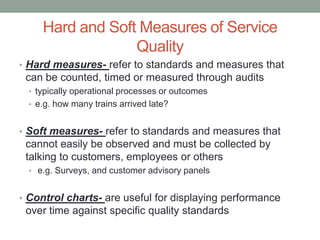
Hard and Soft Measures of Service
                  Quality
• Hard measures- refer to standards and measures that
 can be counted, timed or measured through audits
  • typically operational processes or outcomes
  • e.g. how many trains arrived late?


• Soft measures- refer to standards and measures that
 cannot easily be observed and must be collected by
 talking to customers, employees or others
  • e.g. Surveys, and customer advisory panels


• Control charts- are useful for displaying performance
 over time against specific quality standards
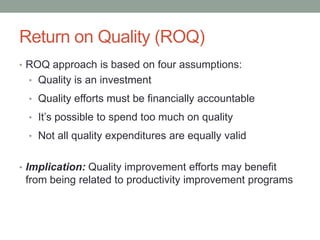
Return on Quality (ROQ)
• ROQ approach is based on four assumptions:
  • Quality is an investment

  • Quality efforts must be financially accountable

  • It’s possible to spend too much on quality

  • Not all quality expenditures are equally valid


• Implication: Quality improvement efforts may benefit
 from being related to productivity improvement programs
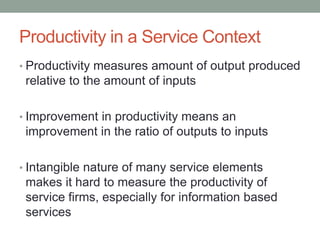
Productivity in a Service Context
• Productivity measures amount of output produced
 relative to the amount of inputs

• Improvement in productivity means an
 improvement in the ratio of outputs to inputs

• Intangible nature of many service elements
 makes it hard to measure the productivity of
 service firms, especially for information based
 services
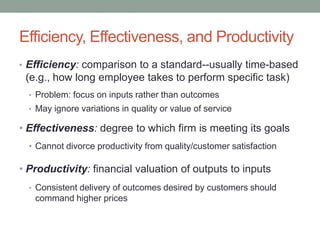
Efficiency, Effectiveness, and Productivity
• Efficiency: comparison to a standard--usually time-based
 (e.g., how long employee takes to perform specific task)
  • Problem: focus on inputs rather than outcomes
  • May ignore variations in quality or value of service

• Effectiveness: degree to which firm is meeting its goals
  • Cannot divorce productivity from quality/customer satisfaction

• Productivity: financial valuation of outputs to inputs
  • Consistent delivery of outcomes desired by customers should
   command higher prices
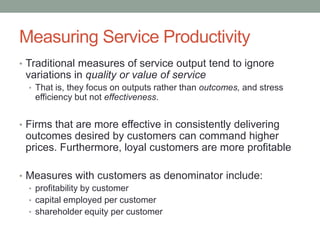
Measuring Service Productivity
• Traditional measures of service output tend to ignore
 variations in quality or value of service
  • That is, they focus on outputs rather than outcomes, and stress
   efficiency but not effectiveness.


• Firms that are more effective in consistently delivering
 outcomes desired by customers can command higher
 prices. Furthermore, loyal customers are more profitable

• Measures with customers as denominator include:
  • profitability by customer
  • capital employed per customer
  • shareholder equity per customer
Thank You

Any Questions???

service quality-models-ppt

  • 1.
  • 2.
    Dimensions of ServiceQuality • Reliability: Perform promised service dependably and accurately Example: receive mail at same time each day. • Responsiveness: Willingness to help customers promptly Example: avoid keeping customers waiting for no apparent reason • Assurance: Ability to convey trust and confidence Example: being polite and showing respect for customer • Empathy: Ability to be approachable Example: being a good listener • Tangibles: Physical facilities and facilitating goods Example: cleanliness
  • 3.
    Seven Service QualityGaps Customer needs CUSTOMER and expectations 1. Knowledge Gap Management definition of these needs MANAGEMENT 2. Standards Gap Translation into design/delivery specs 3. Delivery Gap Execution of 4. I.C.Gap Advertising and design/delivery specs sales promises 5. Perceptions Gap 6. Interpretation Gap Customer perceptions Customer interpretation of product execution of communications 7. Service Gap Customer experience relative to expectations
  • 4.
    Prescriptions for ClosingService Quality Gaps • Knowledge: Learn what customers expect--conduct research, dialogue, feedback • Standards: Specify SQ standards that reflect expectations • Delivery: Ensure service performance matches specs-- consider roles of employees, equipment, customers • Internal communications: Ensure performance levels match marketing promises • Perceptions: Educate customers to see reality of service delivery • Interpretation: Pretest communications to make sure message is clear and unambiguous
  • 5.
    Hard and SoftMeasures of Service Quality • Hard measures- refer to standards and measures that can be counted, timed or measured through audits • typically operational processes or outcomes • e.g. how many trains arrived late? • Soft measures- refer to standards and measures that cannot easily be observed and must be collected by talking to customers, employees or others • e.g. Surveys, and customer advisory panels • Control charts- are useful for displaying performance over time against specific quality standards
  • 6.
    Return on Quality(ROQ) • ROQ approach is based on four assumptions: • Quality is an investment • Quality efforts must be financially accountable • It’s possible to spend too much on quality • Not all quality expenditures are equally valid • Implication: Quality improvement efforts may benefit from being related to productivity improvement programs
  • 7.
    Productivity in aService Context • Productivity measures amount of output produced relative to the amount of inputs • Improvement in productivity means an improvement in the ratio of outputs to inputs • Intangible nature of many service elements makes it hard to measure the productivity of service firms, especially for information based services
  • 8.
    Efficiency, Effectiveness, andProductivity • Efficiency: comparison to a standard--usually time-based (e.g., how long employee takes to perform specific task) • Problem: focus on inputs rather than outcomes • May ignore variations in quality or value of service • Effectiveness: degree to which firm is meeting its goals • Cannot divorce productivity from quality/customer satisfaction • Productivity: financial valuation of outputs to inputs • Consistent delivery of outcomes desired by customers should command higher prices
  • 9.
    Measuring Service Productivity •Traditional measures of service output tend to ignore variations in quality or value of service • That is, they focus on outputs rather than outcomes, and stress efficiency but not effectiveness. • Firms that are more effective in consistently delivering outcomes desired by customers can command higher prices. Furthermore, loyal customers are more profitable • Measures with customers as denominator include: • profitability by customer • capital employed per customer • shareholder equity per customer
  • 10.

Editor's Notes

  • #3 Reliability- India Property.com / BBC world News – Daily News AlertsResponsiveness- ICICI Bank promises to open up your bank a/c by the time you finish your Coffee.Assurance- Nirmal Bang – Relationship Beyond BrokingEmpathy- Customer care – Vodafone says Happy to HelpTangibles- Five Star Hotels Ambiance.
  • #6 Hard Measures- Pizza Hut -30 minsNahi to Free / Indigo – AlwaysOn time