SERVICES MARKETING Gaps Model of Service Quality
The Gaps Model was proposed by A Parasuraman, Valarie Zeithaml and LL Berry in 1985 in the Journal Of Marketing
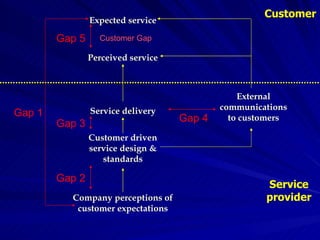
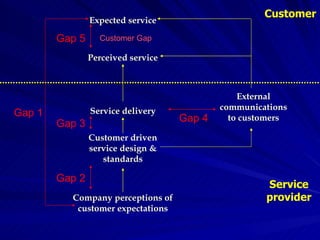
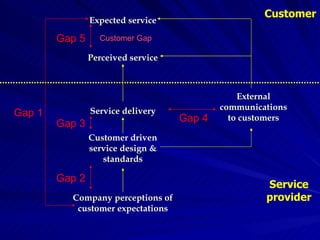
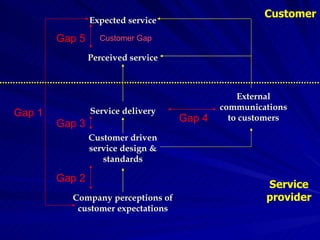
Expected service Perceived service Service delivery Customer driven service design & standards Company perceptions of customer expectations External communications to customers Customer Service provider Gap 5 Gap 3 Gap 2 Gap 4 Gap 1 Customer Gap
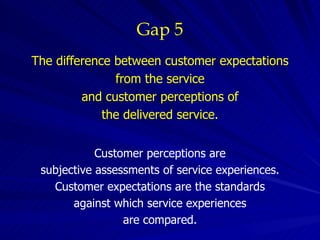
Gap 5 The difference between customer expectations from the service and customer perceptions of the delivered service. Customer perceptions are subjective assessments of service experiences. Customer expectations are the standards against which service experiences are compared.
Gap 5 Customer expectations – from marketer controlled factors as well as factors outside the control of the marketer or service provider such as personal needs, word of mouth and past experiences The aim is to reduce Gap 5 by suitable strategic and tactical actions in marketing, sales, operations and communications Unique characteristics of services – intangibility, heterogeneity, inseparability & perishability contribute to Gap 5
Provider Gap 1 The difference between customer expectations of service standards & quality and the service provider’s understanding of these expectations
Expected service Perceived service Service delivery Customer driven service design & standards Company perceptions of customer expectations External communications to customers Customer Service provider Gap 5 Gap 3 Gap 2 Gap 4 Gap 1 Customer Gap
Provider Gap 1 – Reasons Inadequate marketing research, research not focussed  on service quality, research findings not used properly Lack of upward communication from customers & frontline employees, too many layers Insufficient relationship focus, lack of market segmentation, focus on transactions & customer acquisition rather than on building relationships Inadequate service recovery
Provider Gap 2 The difference between service provider’s understanding of customer expectations and development of customer-driven service design & standards
Expected service Perceived service Service delivery Customer driven service design & standards Company perceptions of customer expectations External communications to customers Customer Service provider Gap 5 Gap 3 Gap 2 Gap 4 Gap 1 Customer Gap
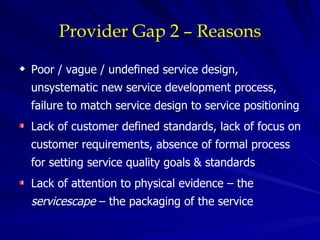
Provider Gap 2 – Reasons Poor / vague / undefined service design, unsystematic new service development process, failure to match service design to service positioning Lack of customer defined standards, lack of focus on customer requirements, absence of formal process for setting service quality goals & standards Lack of attention to physical evidence – the  servicescape  – the packaging of the service
Provider Gap 3 The discrepancy between development of customer-driven service standards and actual service delivery or performance
Expected service Perceived service Service delivery Customer driven service design & standards Company perceptions of customer expectations External communications to customers Customer Service provider Gap 5 Gap 3 Gap 2 Gap 4 Gap 1 Customer Gap
Provider Gap 3 – Reasons Deficiencies in HR policies – wrong recruitment, role ambiguity / conflict, poor employee / technology fit, evaluation / compensation schemes, empowerment etc Supply demand gaps, over reliance on pricing strategies to close gaps Customers not fulfilling roles (ignorance?) or otherwise From intermediaries – conflicts re objectives, performance, rewards, empowerment, control etc
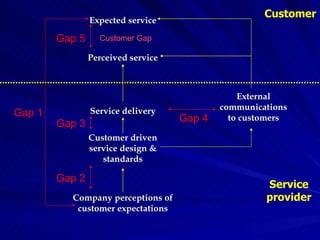
Provider Gap 4 The difference between service provider’s external (marketing) communications and service delivery
Expected service Perceived service Service delivery Customer driven service design & standards Company perceptions of customer expectations External communications to customers Customer Service provider Gap 5 Gap 3 Gap 2 Gap 4 Gap 1 Customer Gap
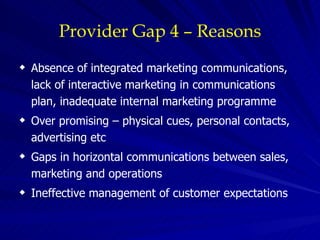
Provider Gap 4 – Reasons Absence of integrated marketing communications, lack of interactive marketing in communications plan, inadequate internal marketing programme Over promising – physical cues, personal contacts, advertising etc Gaps in horizontal communications between sales, marketing and operations Ineffective management of customer expectations
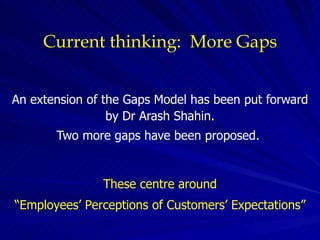
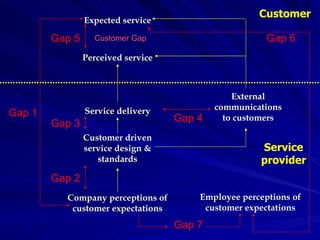
Current thinking:  More Gaps An extension of the Gaps Model has been put forward by Dr Arash Shahin. Two more gaps have been proposed.  These  centre  around “Employees’ Perceptions of Customers’ Expectations”
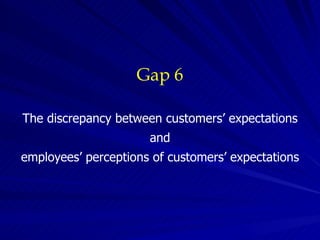
Gap 6 The discrepancy between customers’ expectations and employees’ perceptions of customers’ expectations
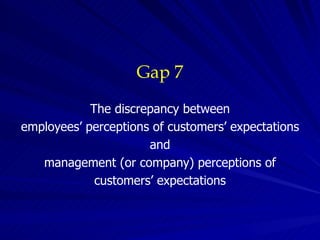
Gap 7 The discrepancy between employees’ perceptions of customers’ expectations and management (or company) perceptions of customers’ expectations
Expected service Perceived service Service delivery Customer driven service design & standards Company perceptions of customer expectations External communications to customers Customer Service provider Gap 5 Gap 3 Gap 2 Gap 4 Gap 1 Customer Gap Employee perceptions of customer expectations Gap 7 Gap 6

7 Sm Gaps Model

  • 1.
    SERVICES MARKETING GapsModel of Service Quality
  • 2.
    The Gaps Modelwas proposed by A Parasuraman, Valarie Zeithaml and LL Berry in 1985 in the Journal Of Marketing
  • 3.
    Expected service Perceivedservice Service delivery Customer driven service design & standards Company perceptions of customer expectations External communications to customers Customer Service provider Gap 5 Gap 3 Gap 2 Gap 4 Gap 1 Customer Gap
  • 4.
    Gap 5 Thedifference between customer expectations from the service and customer perceptions of the delivered service. Customer perceptions are subjective assessments of service experiences. Customer expectations are the standards against which service experiences are compared.
  • 5.
    Gap 5 Customerexpectations – from marketer controlled factors as well as factors outside the control of the marketer or service provider such as personal needs, word of mouth and past experiences The aim is to reduce Gap 5 by suitable strategic and tactical actions in marketing, sales, operations and communications Unique characteristics of services – intangibility, heterogeneity, inseparability & perishability contribute to Gap 5
  • 6.
    Provider Gap 1The difference between customer expectations of service standards & quality and the service provider’s understanding of these expectations
  • 7.
    Expected service Perceivedservice Service delivery Customer driven service design & standards Company perceptions of customer expectations External communications to customers Customer Service provider Gap 5 Gap 3 Gap 2 Gap 4 Gap 1 Customer Gap
  • 8.
    Provider Gap 1– Reasons Inadequate marketing research, research not focussed on service quality, research findings not used properly Lack of upward communication from customers & frontline employees, too many layers Insufficient relationship focus, lack of market segmentation, focus on transactions & customer acquisition rather than on building relationships Inadequate service recovery
  • 9.
    Provider Gap 2The difference between service provider’s understanding of customer expectations and development of customer-driven service design & standards
  • 10.
    Expected service Perceivedservice Service delivery Customer driven service design & standards Company perceptions of customer expectations External communications to customers Customer Service provider Gap 5 Gap 3 Gap 2 Gap 4 Gap 1 Customer Gap
  • 11.
    Provider Gap 2– Reasons Poor / vague / undefined service design, unsystematic new service development process, failure to match service design to service positioning Lack of customer defined standards, lack of focus on customer requirements, absence of formal process for setting service quality goals & standards Lack of attention to physical evidence – the servicescape – the packaging of the service
  • 12.
    Provider Gap 3The discrepancy between development of customer-driven service standards and actual service delivery or performance
  • 13.
    Expected service Perceivedservice Service delivery Customer driven service design & standards Company perceptions of customer expectations External communications to customers Customer Service provider Gap 5 Gap 3 Gap 2 Gap 4 Gap 1 Customer Gap
  • 14.
    Provider Gap 3– Reasons Deficiencies in HR policies – wrong recruitment, role ambiguity / conflict, poor employee / technology fit, evaluation / compensation schemes, empowerment etc Supply demand gaps, over reliance on pricing strategies to close gaps Customers not fulfilling roles (ignorance?) or otherwise From intermediaries – conflicts re objectives, performance, rewards, empowerment, control etc
  • 15.
    Provider Gap 4The difference between service provider’s external (marketing) communications and service delivery
  • 16.
    Expected service Perceivedservice Service delivery Customer driven service design & standards Company perceptions of customer expectations External communications to customers Customer Service provider Gap 5 Gap 3 Gap 2 Gap 4 Gap 1 Customer Gap
  • 17.
    Provider Gap 4– Reasons Absence of integrated marketing communications, lack of interactive marketing in communications plan, inadequate internal marketing programme Over promising – physical cues, personal contacts, advertising etc Gaps in horizontal communications between sales, marketing and operations Ineffective management of customer expectations
  • 18.
    Current thinking: More Gaps An extension of the Gaps Model has been put forward by Dr Arash Shahin. Two more gaps have been proposed. These centre around “Employees’ Perceptions of Customers’ Expectations”
  • 19.
    Gap 6 Thediscrepancy between customers’ expectations and employees’ perceptions of customers’ expectations
  • 20.
    Gap 7 Thediscrepancy between employees’ perceptions of customers’ expectations and management (or company) perceptions of customers’ expectations
  • 21.
    Expected service Perceivedservice Service delivery Customer driven service design & standards Company perceptions of customer expectations External communications to customers Customer Service provider Gap 5 Gap 3 Gap 2 Gap 4 Gap 1 Customer Gap Employee perceptions of customer expectations Gap 7 Gap 6