Service Quality
Who is a customer..? A customer is the most important person in our office. A customer is not dependent on us. We are dependent on him. A customer is not an interruption of our work, he is the purpose of it. We are not doing a favor by serving him. He is doing us a favor by giving an opportunity to do so. A customer is not some one to argue. No one has won an argument with a customer. A customer is a person who brings us his wants. It is our job to handle them profitably to him and to ourselves. CUSTOMER IS ALWAYS RIGHT
Aspects of Service Quality Service: it is what is provided by service provider organization E.g. Bank, Insurance , Hospital, Service organizations   Quality : it means “what customer wants” (a) within a given time (b) at a price (c) what he/she is willing to pay
Why Quality ? The drivers of quality are: To Survive Customer is demanding Competition Profitability Strive for excellence
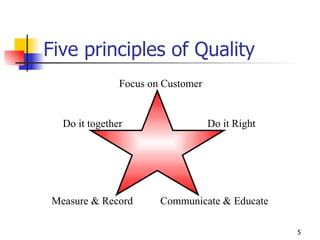
Five principles of Quality Focus on Customer Do it Right Communicate & Educate Measure & Record Do it together
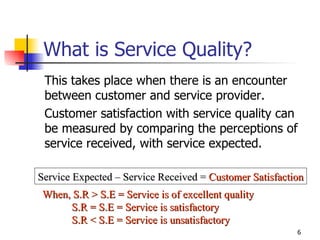
What is Service Quality? This takes place when there is an encounter between customer and service provider.  Customer satisfaction with service quality can be measured by comparing the perceptions of service received, with service expected. Service Expected – Service Received =  Customer Satisfaction When, S.R > S.E = Service is of excellent quality S.R = S.E = Service is satisfactory S.R < S.E = Service is unsatisfactory
Quality is an attitude….. Attitude is what differentiates between excellence and mediocrity. Positive attitude leads to high quality and vice-versa.
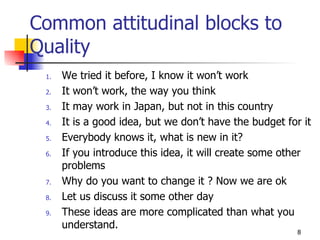
Common attitudinal blocks to Quality We tried it before, I know it won’t work It won’t work, the way you think It may work in Japan, but not in this country It is a good idea, but we don’t have the budget for it Everybody knows it, what is new in it? If you introduce this idea, it will create some other problems Why do you want to change it ? Now we are ok Let us discuss it some other day These ideas are more complicated than what you understand.
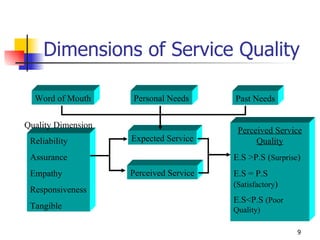
Dimensions of Service Quality Word of Mouth Personal Needs Past Needs Expected Service Perceived Service Reliability Assurance Empathy Responsiveness Tangible Quality Dimension Perceived Service Quality E.S >P.S ( Surprise ) E.S = P.S ( Satisfactory ) E.S<P.S  (Poor Quality)
Reliability  This refers to the ability to perform the promised service independently and accurately. Reliability means, every time the service has to be accomplished on time and in the same manner without errors. E.g. Application of film
Responsiveness This refers to the willingness to help customers to provide prompt service,without keeping the customer waiting for no apparent reasons.  This creates negative perceptions of quality.  In the event of service failure, the ability to recover quickly with professionalism, can create a very positive perception of quality E.g Roller Discs from NEC
Assurance This refers to the courtesy of employees and their ability to convey trust and confidence.  i.e. competence to perform the service, politeness and respect for the customer, effective communication with the customer , and general attitude E.g Efficiency v/s Effectiveness
Empathy This refers to caring and individualizing attention to the customer.  Empathy includes approachability, sense of security and efforts to understand customer needs.
Tangibles This refers to  Physical facilities Equipment Communication material; Condition of physical surroundings The above are the evidence of care and attention given to the workplace by service providers
Service Quality v/s Product Quality Service quality is more difficult for customers to evaluate than product quality Customer does not evaluate service quality solely by outcome of service Customer judge only quality, all other judgment is essentially irrelevant
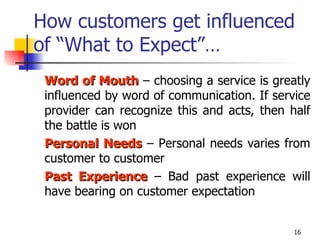
How customers get influenced of “What to Expect”… Word of Mouth  – choosing a service is greatly influenced by word of communication. If service provider can recognize this and acts, then half the battle is won Personal Needs  – Personal needs varies from customer to customer Past Experience  – Bad past experience will have bearing on customer expectation
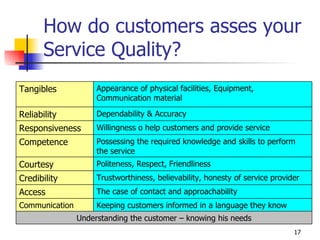
How do customers asses your Service Quality? The case of contact and approachability Access Keeping customers informed in a language they know Communication Politeness, Respect, Friendliness Courtesy Trustworthiness, believability, honesty of service provider Credibility Understanding the customer – knowing his needs Possessing the required knowledge and skills to perform the service Competence Willingness o help customers and provide service Responsiveness Dependability & Accuracy Reliability Appearance of physical facilities, Equipment, Communication material Tangibles
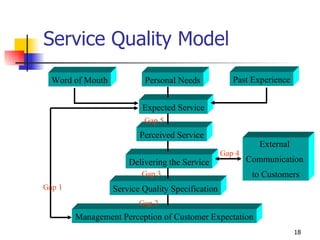
Service Quality Model Word of Mouth Personal Needs Past Experience Expected Service Perceived Service Delivering the Service Service Quality Specification Management Perception of Customer Expectation External  Communication  to Customers Gap 3 Gap 4 Gap 1 Gap 5 Gap 2
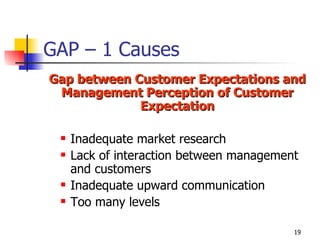
GAP – 1 Causes Gap between Customer Expectations and Management Perception of Customer Expectation Inadequate market research Lack of interaction between management and customers Inadequate upward communication Too many levels
Market Research No MR is done MR is done but not made use of Concentrating on Day to Day Operations In MR Data regarding customer expectations not collected Data regarding customer perceptions not collected Complaint made by customer neglected Even if findings are available-not made use of because of the following reasons Too busy Research are very complex Research is too technical Lack of confidence in research
Inadequate Upward Communication Personal Customer Contact v/s Top Management Inadequate upward communication Upward communication blocked
Too many levels Acts as an impediment to upward communication At various levels information gets distorted
Remedies to close GAP – 1  Collect data regarding expectations and perception of the customers.  Improve upward communication – have a periodical meeting between management and customer contact staff; informal or formal Direct interaction by the top management with customer wherever possible Reduce levels – helps in faster decision making
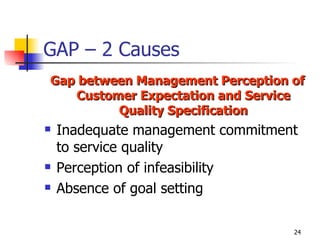
GAP – 2 Causes  Gap between Management Perception of Customer Expectation and Service Quality Specification Inadequate management commitment to service quality Perception of infeasibility Absence of goal setting
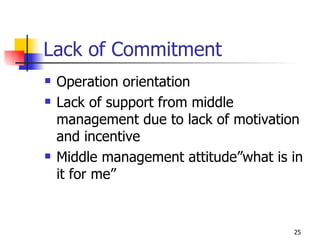
Lack of Commitment Operation orientation Lack of support from middle management due to lack of motivation and incentive Middle management attitude”what is in it for me”
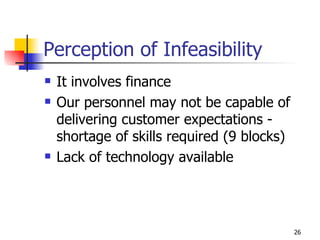
Perception of Infeasibility It involves finance Our personnel may not be capable of delivering customer expectations - shortage of skills required (9 blocks) Lack of technology available
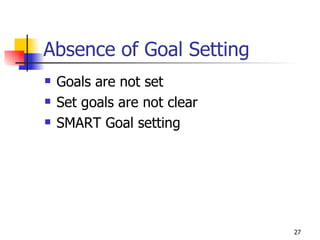
Absence of Goal Setting Goals are not set Set goals are not clear SMART Goal setting
Remedies to close GAP – 2  Mind set: Remove  the mind block – open mindedness; ‘Can Do’ attitude Willingness to – investing money to buy technology;spend time with employees to satisfy customer requirements Middle Management to be involved all the more in Quality programmes Train the employees “ Lack of time concept” should be converted to “enough time” by following the principles of time management
Contd… Absence of goal setting Most goals on quality should be based on : Customer requirement Specific Acceptable to employees Realistic Designed to meet customer specifications Should  not become a pious intention Have a proper feedback system
GAP – 3 Causes Gap between Service Quality Specification and Service Delivery Role ambiguity Role conflict Job fit Inappropriate supervisory control system Lack of perceived control Lack of team work
Role Ambiguity Lack of information from the top Lack of training to perform the job Uncertainty about superiors expectations Method of evaluation by superiors
Role Conflict Conflict between role expectations and perceptions Personal attention requirement from customer vis-a-vis time limit from employee side Management constraints and customer expectations Varied customer demands
Job Fit Making job psychograph v/s individual psychograph Hiring of people qualified for the job Do management spend enough time and resources on hiring the best people who are in direct contact with customer? Skills required for the job v/s existing employee skills
Inappropriate Supervisory Control System Do the employees know “what aspect of their job will be stressed more in performance evaluation?” Are employees evaluated on “how will they interact with customers?” Do employees who make special efforts to serve the customer receive increased financial reward of recognition? Do employees get a word of appreciation for their contribution?
Lack of Perceived Control Are employees given the freedom to make the individual decision to satisfy the customer needs? Are employees required to get approval from another department before delivering the service to the customer? Are they encouraged to learn new ways of servicing the customer better?
Lack of Team Work Do managers and employees contribute a team effort in servicing the customer? Do employees of other departments provide good service to customer contact employees? Are there any competition amongst employees to impress some one at the cost of team work? Do they help each other than pulling each other to reach a goal?
Remedies to close GAP – 3  Improve communication Train the employee in time management Train the employee in prioritizing the task Top management must spend enough time in hiring and selection of employees Hire and use appropriate technology Pushing down decision to lower levels Avoid too many people in decision making Encourage team work – concept of internal customer Job rotation and job training
GAP – 4 Causes Gap between Service Delivery and External Communication to Customer Inadequate horizontal communication Differences in policies and procedures across branches or departments Over promising
Inadequate Horizontal Communication Coordination between Marketing & HR Corporate Advertising & Operations Advertisement & Public Relations In general this refers to the internal communication between departments
Over Promising Time Dimensions Quantity Dimensions When promise do not match delivery, the service quality suffers


Servicequality hs

  • 1.
  • 2.
    Who is acustomer..? A customer is the most important person in our office. A customer is not dependent on us. We are dependent on him. A customer is not an interruption of our work, he is the purpose of it. We are not doing a favor by serving him. He is doing us a favor by giving an opportunity to do so. A customer is not some one to argue. No one has won an argument with a customer. A customer is a person who brings us his wants. It is our job to handle them profitably to him and to ourselves. CUSTOMER IS ALWAYS RIGHT
  • 3.
    Aspects of ServiceQuality Service: it is what is provided by service provider organization E.g. Bank, Insurance , Hospital, Service organizations Quality : it means “what customer wants” (a) within a given time (b) at a price (c) what he/she is willing to pay
  • 4.
    Why Quality ?The drivers of quality are: To Survive Customer is demanding Competition Profitability Strive for excellence
  • 5.
    Five principles ofQuality Focus on Customer Do it Right Communicate & Educate Measure & Record Do it together
  • 6.
    What is ServiceQuality? This takes place when there is an encounter between customer and service provider. Customer satisfaction with service quality can be measured by comparing the perceptions of service received, with service expected. Service Expected – Service Received = Customer Satisfaction When, S.R > S.E = Service is of excellent quality S.R = S.E = Service is satisfactory S.R < S.E = Service is unsatisfactory
  • 7.
    Quality is anattitude….. Attitude is what differentiates between excellence and mediocrity. Positive attitude leads to high quality and vice-versa.
  • 8.
    Common attitudinal blocksto Quality We tried it before, I know it won’t work It won’t work, the way you think It may work in Japan, but not in this country It is a good idea, but we don’t have the budget for it Everybody knows it, what is new in it? If you introduce this idea, it will create some other problems Why do you want to change it ? Now we are ok Let us discuss it some other day These ideas are more complicated than what you understand.
  • 9.
    Dimensions of ServiceQuality Word of Mouth Personal Needs Past Needs Expected Service Perceived Service Reliability Assurance Empathy Responsiveness Tangible Quality Dimension Perceived Service Quality E.S >P.S ( Surprise ) E.S = P.S ( Satisfactory ) E.S<P.S (Poor Quality)
  • 10.
    Reliability Thisrefers to the ability to perform the promised service independently and accurately. Reliability means, every time the service has to be accomplished on time and in the same manner without errors. E.g. Application of film
  • 11.
    Responsiveness This refersto the willingness to help customers to provide prompt service,without keeping the customer waiting for no apparent reasons. This creates negative perceptions of quality. In the event of service failure, the ability to recover quickly with professionalism, can create a very positive perception of quality E.g Roller Discs from NEC
  • 12.
    Assurance This refersto the courtesy of employees and their ability to convey trust and confidence. i.e. competence to perform the service, politeness and respect for the customer, effective communication with the customer , and general attitude E.g Efficiency v/s Effectiveness
  • 13.
    Empathy This refersto caring and individualizing attention to the customer. Empathy includes approachability, sense of security and efforts to understand customer needs.
  • 14.
    Tangibles This refersto Physical facilities Equipment Communication material; Condition of physical surroundings The above are the evidence of care and attention given to the workplace by service providers
  • 15.
    Service Quality v/sProduct Quality Service quality is more difficult for customers to evaluate than product quality Customer does not evaluate service quality solely by outcome of service Customer judge only quality, all other judgment is essentially irrelevant
  • 16.
    How customers getinfluenced of “What to Expect”… Word of Mouth – choosing a service is greatly influenced by word of communication. If service provider can recognize this and acts, then half the battle is won Personal Needs – Personal needs varies from customer to customer Past Experience – Bad past experience will have bearing on customer expectation
  • 17.
    How do customersasses your Service Quality? The case of contact and approachability Access Keeping customers informed in a language they know Communication Politeness, Respect, Friendliness Courtesy Trustworthiness, believability, honesty of service provider Credibility Understanding the customer – knowing his needs Possessing the required knowledge and skills to perform the service Competence Willingness o help customers and provide service Responsiveness Dependability & Accuracy Reliability Appearance of physical facilities, Equipment, Communication material Tangibles
  • 18.
    Service Quality ModelWord of Mouth Personal Needs Past Experience Expected Service Perceived Service Delivering the Service Service Quality Specification Management Perception of Customer Expectation External Communication to Customers Gap 3 Gap 4 Gap 1 Gap 5 Gap 2
  • 19.
    GAP – 1Causes Gap between Customer Expectations and Management Perception of Customer Expectation Inadequate market research Lack of interaction between management and customers Inadequate upward communication Too many levels
  • 20.
    Market Research NoMR is done MR is done but not made use of Concentrating on Day to Day Operations In MR Data regarding customer expectations not collected Data regarding customer perceptions not collected Complaint made by customer neglected Even if findings are available-not made use of because of the following reasons Too busy Research are very complex Research is too technical Lack of confidence in research
  • 21.
    Inadequate Upward CommunicationPersonal Customer Contact v/s Top Management Inadequate upward communication Upward communication blocked
  • 22.
    Too many levelsActs as an impediment to upward communication At various levels information gets distorted
  • 23.
    Remedies to closeGAP – 1 Collect data regarding expectations and perception of the customers. Improve upward communication – have a periodical meeting between management and customer contact staff; informal or formal Direct interaction by the top management with customer wherever possible Reduce levels – helps in faster decision making
  • 24.
    GAP – 2Causes Gap between Management Perception of Customer Expectation and Service Quality Specification Inadequate management commitment to service quality Perception of infeasibility Absence of goal setting
  • 25.
    Lack of CommitmentOperation orientation Lack of support from middle management due to lack of motivation and incentive Middle management attitude”what is in it for me”
  • 26.
    Perception of InfeasibilityIt involves finance Our personnel may not be capable of delivering customer expectations - shortage of skills required (9 blocks) Lack of technology available
  • 27.
    Absence of GoalSetting Goals are not set Set goals are not clear SMART Goal setting
  • 28.
    Remedies to closeGAP – 2 Mind set: Remove the mind block – open mindedness; ‘Can Do’ attitude Willingness to – investing money to buy technology;spend time with employees to satisfy customer requirements Middle Management to be involved all the more in Quality programmes Train the employees “ Lack of time concept” should be converted to “enough time” by following the principles of time management
  • 29.
    Contd… Absence ofgoal setting Most goals on quality should be based on : Customer requirement Specific Acceptable to employees Realistic Designed to meet customer specifications Should not become a pious intention Have a proper feedback system
  • 30.
    GAP – 3Causes Gap between Service Quality Specification and Service Delivery Role ambiguity Role conflict Job fit Inappropriate supervisory control system Lack of perceived control Lack of team work
  • 31.
    Role Ambiguity Lackof information from the top Lack of training to perform the job Uncertainty about superiors expectations Method of evaluation by superiors
  • 32.
    Role Conflict Conflictbetween role expectations and perceptions Personal attention requirement from customer vis-a-vis time limit from employee side Management constraints and customer expectations Varied customer demands
  • 33.
    Job Fit Makingjob psychograph v/s individual psychograph Hiring of people qualified for the job Do management spend enough time and resources on hiring the best people who are in direct contact with customer? Skills required for the job v/s existing employee skills
  • 34.
    Inappropriate Supervisory ControlSystem Do the employees know “what aspect of their job will be stressed more in performance evaluation?” Are employees evaluated on “how will they interact with customers?” Do employees who make special efforts to serve the customer receive increased financial reward of recognition? Do employees get a word of appreciation for their contribution?
  • 35.
    Lack of PerceivedControl Are employees given the freedom to make the individual decision to satisfy the customer needs? Are employees required to get approval from another department before delivering the service to the customer? Are they encouraged to learn new ways of servicing the customer better?
  • 36.
    Lack of TeamWork Do managers and employees contribute a team effort in servicing the customer? Do employees of other departments provide good service to customer contact employees? Are there any competition amongst employees to impress some one at the cost of team work? Do they help each other than pulling each other to reach a goal?
  • 37.
    Remedies to closeGAP – 3 Improve communication Train the employee in time management Train the employee in prioritizing the task Top management must spend enough time in hiring and selection of employees Hire and use appropriate technology Pushing down decision to lower levels Avoid too many people in decision making Encourage team work – concept of internal customer Job rotation and job training
  • 38.
    GAP – 4Causes Gap between Service Delivery and External Communication to Customer Inadequate horizontal communication Differences in policies and procedures across branches or departments Over promising
  • 39.
    Inadequate Horizontal CommunicationCoordination between Marketing & HR Corporate Advertising & Operations Advertisement & Public Relations In general this refers to the internal communication between departments
  • 40.
    Over Promising TimeDimensions Quantity Dimensions When promise do not match delivery, the service quality suffers
  • 41.
  • 42.