CUSTOMER SATISFACTION
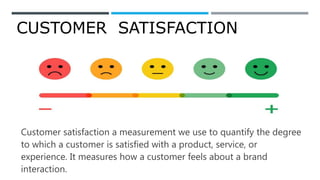
Customer satisfaction a measurement we use to quantify the degree
to which a customer is satisfied with a product, service, or
experience. It measures how a customer feels about a brand
interaction.
CUSTOMER LOYALTY CAN BE SUSTAINED BY
 Customers who consistently pay on or ahead of time .
 Customers who consistently spend over the average amount of your typical customer
spend.
 Customers who refer others.
 Customers who purchase additional items that go beyond typical core offerings (e.g. gift
certificates)
 Repeat customers who have purchased your product/services for a significant amount of
time.
 Maintaining a favorable comparison when compared with competitors.
WHO IS THE CUSTOMER ?
 The customer is the end user or the person who consumes the product or gets benefit from the
services.
HOW TO DESCRIBE YOUR CUSTOMERS?
o ENDORSERS
Endorsers are customers who tell other people about your company.
o BUYERS
A buyer will continue to buy from you, often exclusively, but no longer aggressively endorses your company.
o SATISFIED MUTES
These customers don’t talk to you and you don’t talk to them. If you ask one of them how the business is doing and they
answer, “Fine,” that’s all you know.
o DIS-SATISFIED MUTES
This customer has migrated from the ranks of satisfied mutes, but you don’t know it. That’s because no one is talking to
anyone else.
o GRUMBLES
You know these customers: no matter what happens, you can’t do anything right for them. They’ve experienced too many
negative incidents. In essence, they have become “martyrs.
o COMPLAINERS
Though small in numbers, this type of customer can be deadly. They make a point of telling everyone how badly your
company has treated them. Simply, they are not your friends.
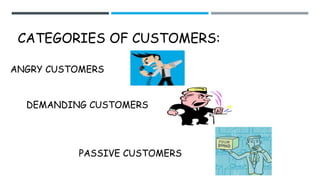
CATEGORIES OF CUSTOMERS:
ANGRY CUSTOMERS
DEMANDING CUSTOMERS
PASSIVE CUSTOMERS
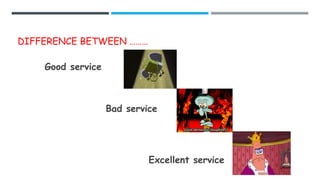
DIFFERENCE BETWEEN ………
Good service
Bad service
Excellent service
GOOD CUSTOMER SERVICE
Good service is when the customer gets treatment that meets his/her expectations.
Customer
Expectation
What Customer
receives
Bad Service is when customer gets treatment which is less than his/her expectations
BAD CUSTOMER SERVICE
Customer
Expectation
What Customer
receives
When the customer gets a little more than what he/she expected, Good Service becomes
Excellent Service
EXCELLENT CUSTOMER SERVICE
Customer
Expectation
What Customer
receives
+
KANO MODEL: (DR.NARIAKI KANO)
Kano model distinguishes between three types of
product or service requirements which influence
customer satisfaction in different ways when met.
1. Basic attributes
2. Performance attributes
3. Excitement attributes
1. BASIC NEEDS – DISSATISFIERS
A dissatisfiers is a product or service characteristics
that the customer takes for granted.
Absence of basic attributes results in extreme
customer dissatisfaction.
Customer complaints are the primary source of
information on existing dissatisfiers in our current
product or service.
2. PERFORMANCE NEEDS – SATISFIERS
A satisfier is something that customer want in their
product or service, and usually ask for it.
Better the performance more will be the customer
satisfaction.
They are easy to measure and they become the
benchmarks used for competitive analysis.
3. EXCITEMENT NEEDS – DELIGHTERS
A delighter is unspoken or unexpected requirement of a
customer and can result into high level of customer
satisfaction.
Delighters are sometimes called exciting quality.
Absence of delighter doesn’t result into customer
dissatisfaction while its presence can help in enhancing
customer satisfaction.
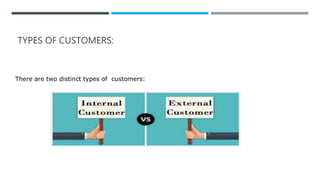
TYPES OF CUSTOMERS:
There are two distinct types of customers:
EXTERNAL CUSTOMERS:
 An external customer can be defined in many ways, such as
 The one who uses the product or services
 The one who purchases the product or services
 The one who influences the sale of the product or service.
AN EXTERNAL CUSTOMERS EXISTS OUTSIDE THE
ORGANIZATION AND GENERALLY FALLS
 into three categories:
 Current customers
 Prospective customers
 Lost customers
INTERNAL CUSTOMERS:
 An internal customer is just as important.
 Every function, whether it be engineering, order processing, or production, has an internal
customer.
 Each receives a products or services and in exchange provide a product or service. Each
person in a process considered a preceding operations.
 Each workers goal is to make sure that the quality meets the expectation of the next
person, and should satisfy the external customer.
CUSTOMER PERCEPTION OF QUALITY:
 One of the basic concept of TQM philosophy is continuous process
improvement.
 This concept implies that there is no acceptable Quality level because the
customer’s needs, values, and expectations are constantly changing and
becoming more demanding.
(ASQ) SURVEY ON END USERS:
 An American Society for Quality (ASQ)
surveys on end users perceptions of important factors that influenced purchases showed
the following ranking:
 Performance
 Features
 Service
 Warranty
 Price
 Reputation
SERVICE ORGANIZATIONS AND CUSTOMER
SATISFACTION
 Difficult but not impossible
 Determine key performance indicators
 Set Targets – SMART goals
 Make teams
 Analyze them on weekly basis Standardize
 Sustain
PERFORMANCE:
 a performance can be well defined by a phrase
 “ FITNESS FOR USE ”
 this phrase indicates that the product and services is
ready for customers use at the time of sale.
FEATURES:
Identifiable features or attributes of a product or
service a product or service are:
 Psychological
 Time oriented
 Contractual
 Ethical
 Technological
Features are secondary characteristics of the P&S.
SERVICES:
This is the customer-value added technique,
However it is intangible but the companies that focus
more on their services always satisfy their customers
and don't give them chance to complaint them for their
product.
WARRANTY:
 The product warranty represents an organization’s public
promise of a quality product backed up by a guarantee of a
customer satisfaction.
 The warranty encourages customers to buy a service by
reducing the risk of the purchase decision, and it generates
more sales from existing customers by enhancing loyalty.
PRICE:
 Today's customer is willing to pay a higher price to obtain the
valuable product.
 In this highly competitive world the definition of the customer is
continuously changing that they can even pay high rice for high
quality product.
REPUTATION:
Total customer satisfaction is based on the entire
experience with the organization, not just the
product.
FEEDBACK:
 Customer feedback must be continually solicited and monitored.
 It is not a one time effort, it is an ongoing and active probing of the customers mind.
 Customer feedback is information provided by clients about whether they are satisfied or
dissatisfied with a product or service and about general experience they had with a
company.
 Their opinion is a resource for improving customer experience and adjusting your actions
to their needs. This information can be collected with different kinds of surveys (prompted
feedback), but you can also find opinions and reviews your clients post online
(unprompted feedback) and collect them using Internet monitoring tools. Both sources are
important to get a full picture of how your clients perceive your brand.
REASONS WHY CUSTOMER FEEDBACK IS IMPORTANT TO YOUR BUSINESS
 Customer feedback helps improve products and services
 Customer feedback helps you measure customer satisfaction
 Collecting customer feedback shows you value their opinions
 Customer feedback helps you create the best customer experience
 Customer feedback helps to improve customer retention
 Customer feedback is a reliable source for information to other consumers
 Customer feedback gives you data that helps taking business decisions
JUST TO STRETCH DISCUSSION …
 FEEDBACK enable organizations to:
 Discover customers dissatisfaction Discover relative priorities of quality
 Compare performance with the competition
 Identify customers need
 Determine opportunities for improvement
WAYS OF COLLECTING FEEDBACK:
 There are the following ways through which feedback can be collected:
 Comment Card
 Customer Questionnaire
 Toll-Free Telephone Numbers
 The Internet
 Employee Feedback
 Mass Communication
COMMENT CARD
 A low cost method of obtaining feed back
from customers involves a comment card
which can be attached to the warranty car
and included with the product at the time of
purchase.
CUSTOMER QUESTIONNAIRE:
 A Customer Questionnaire is a popular
tool for obtaining opinions and
perceptions about an organization and its
product and services.
 Survey may administered by mail or
telephone.
 This survey may ask the customer to
GRADE the organization.
THE INTERNET AND COMPUTERS:
 Some managers are beginning to monitor discussions that take place on the internet to find out what
customers are saying about their product.
 There re even internet sites which takes customers complaint about product and gives grades on
the basis .
EMPLOYEE FEEDBACK:
Employees are often an untapped source of information.
Although customer research reveals what is happening, employee research reveals why
it is happening .
MASS CUSTOMIZATION:
The ultimate in customer satisfaction is giving customers exactly what they want.
Mass customization is a direct result of advances made in manufacturing such as
flexible manufacturing technologies.
SERVICE QUALITY:
 Elements of customer services are:
o Organization
o Customer Care
o Communication
o Front-line people
o Leadership
CUSTOMER RETENTION:
 Customer Retention is most powerful and effective than customer satisfaction.
 Customer Retention represents the activities that produce the necessary customer
satisfaction, that creates customers loyalty, which actually improves the bottom line.
“ACTIVITY”
Good service-give 1 good service that
you encounter.
Bad service-give 1 hugely bad
service that you experience.
Excellent service-give 1 excellent
service that you didn’t expect .
“ACTIVITY”
Good service-give tips on how to improve
good service in to excellent service ..
Bad service-give solutions on how
to solve the bad experience .
Excellent service-set the standards in
able to maintain the expectation of
costumers in experiencing excellent
service.
THANK YOU !!!

Customer satisfaction

  • 1.
    CUSTOMER SATISFACTION Customer satisfactiona measurement we use to quantify the degree to which a customer is satisfied with a product, service, or experience. It measures how a customer feels about a brand interaction.
  • 2.
    CUSTOMER LOYALTY CANBE SUSTAINED BY  Customers who consistently pay on or ahead of time .  Customers who consistently spend over the average amount of your typical customer spend.  Customers who refer others.  Customers who purchase additional items that go beyond typical core offerings (e.g. gift certificates)  Repeat customers who have purchased your product/services for a significant amount of time.  Maintaining a favorable comparison when compared with competitors.
  • 3.
    WHO IS THECUSTOMER ?  The customer is the end user or the person who consumes the product or gets benefit from the services. HOW TO DESCRIBE YOUR CUSTOMERS? o ENDORSERS Endorsers are customers who tell other people about your company. o BUYERS A buyer will continue to buy from you, often exclusively, but no longer aggressively endorses your company. o SATISFIED MUTES These customers don’t talk to you and you don’t talk to them. If you ask one of them how the business is doing and they answer, “Fine,” that’s all you know. o DIS-SATISFIED MUTES This customer has migrated from the ranks of satisfied mutes, but you don’t know it. That’s because no one is talking to anyone else. o GRUMBLES You know these customers: no matter what happens, you can’t do anything right for them. They’ve experienced too many negative incidents. In essence, they have become “martyrs. o COMPLAINERS Though small in numbers, this type of customer can be deadly. They make a point of telling everyone how badly your company has treated them. Simply, they are not your friends.
  • 4.
    CATEGORIES OF CUSTOMERS: ANGRYCUSTOMERS DEMANDING CUSTOMERS PASSIVE CUSTOMERS
  • 5.
    DIFFERENCE BETWEEN ……… Goodservice Bad service Excellent service
  • 6.
    GOOD CUSTOMER SERVICE Goodservice is when the customer gets treatment that meets his/her expectations. Customer Expectation What Customer receives
  • 7.
    Bad Service iswhen customer gets treatment which is less than his/her expectations BAD CUSTOMER SERVICE Customer Expectation What Customer receives
  • 8.
    When the customergets a little more than what he/she expected, Good Service becomes Excellent Service EXCELLENT CUSTOMER SERVICE Customer Expectation What Customer receives +
  • 10.
    KANO MODEL: (DR.NARIAKIKANO) Kano model distinguishes between three types of product or service requirements which influence customer satisfaction in different ways when met. 1. Basic attributes 2. Performance attributes 3. Excitement attributes
  • 12.
    1. BASIC NEEDS– DISSATISFIERS A dissatisfiers is a product or service characteristics that the customer takes for granted. Absence of basic attributes results in extreme customer dissatisfaction. Customer complaints are the primary source of information on existing dissatisfiers in our current product or service.
  • 13.
    2. PERFORMANCE NEEDS– SATISFIERS A satisfier is something that customer want in their product or service, and usually ask for it. Better the performance more will be the customer satisfaction. They are easy to measure and they become the benchmarks used for competitive analysis.
  • 14.
    3. EXCITEMENT NEEDS– DELIGHTERS A delighter is unspoken or unexpected requirement of a customer and can result into high level of customer satisfaction. Delighters are sometimes called exciting quality. Absence of delighter doesn’t result into customer dissatisfaction while its presence can help in enhancing customer satisfaction.
  • 15.
    TYPES OF CUSTOMERS: Thereare two distinct types of customers:
  • 16.
    EXTERNAL CUSTOMERS:  Anexternal customer can be defined in many ways, such as  The one who uses the product or services  The one who purchases the product or services  The one who influences the sale of the product or service.
  • 17.
    AN EXTERNAL CUSTOMERSEXISTS OUTSIDE THE ORGANIZATION AND GENERALLY FALLS  into three categories:  Current customers  Prospective customers  Lost customers
  • 18.
    INTERNAL CUSTOMERS:  Aninternal customer is just as important.  Every function, whether it be engineering, order processing, or production, has an internal customer.  Each receives a products or services and in exchange provide a product or service. Each person in a process considered a preceding operations.  Each workers goal is to make sure that the quality meets the expectation of the next person, and should satisfy the external customer.
  • 19.
    CUSTOMER PERCEPTION OFQUALITY:  One of the basic concept of TQM philosophy is continuous process improvement.  This concept implies that there is no acceptable Quality level because the customer’s needs, values, and expectations are constantly changing and becoming more demanding.
  • 20.
    (ASQ) SURVEY ONEND USERS:  An American Society for Quality (ASQ) surveys on end users perceptions of important factors that influenced purchases showed the following ranking:  Performance  Features  Service  Warranty  Price  Reputation
  • 21.
    SERVICE ORGANIZATIONS ANDCUSTOMER SATISFACTION  Difficult but not impossible  Determine key performance indicators  Set Targets – SMART goals  Make teams  Analyze them on weekly basis Standardize  Sustain
  • 22.
    PERFORMANCE:  a performancecan be well defined by a phrase  “ FITNESS FOR USE ”  this phrase indicates that the product and services is ready for customers use at the time of sale.
  • 23.
    FEATURES: Identifiable features orattributes of a product or service a product or service are:  Psychological  Time oriented  Contractual  Ethical  Technological Features are secondary characteristics of the P&S.
  • 24.
    SERVICES: This is thecustomer-value added technique, However it is intangible but the companies that focus more on their services always satisfy their customers and don't give them chance to complaint them for their product.
  • 25.
    WARRANTY:  The productwarranty represents an organization’s public promise of a quality product backed up by a guarantee of a customer satisfaction.  The warranty encourages customers to buy a service by reducing the risk of the purchase decision, and it generates more sales from existing customers by enhancing loyalty.
  • 26.
    PRICE:  Today's customeris willing to pay a higher price to obtain the valuable product.  In this highly competitive world the definition of the customer is continuously changing that they can even pay high rice for high quality product.
  • 27.
    REPUTATION: Total customer satisfactionis based on the entire experience with the organization, not just the product.
  • 28.
    FEEDBACK:  Customer feedbackmust be continually solicited and monitored.  It is not a one time effort, it is an ongoing and active probing of the customers mind.  Customer feedback is information provided by clients about whether they are satisfied or dissatisfied with a product or service and about general experience they had with a company.  Their opinion is a resource for improving customer experience and adjusting your actions to their needs. This information can be collected with different kinds of surveys (prompted feedback), but you can also find opinions and reviews your clients post online (unprompted feedback) and collect them using Internet monitoring tools. Both sources are important to get a full picture of how your clients perceive your brand.
  • 29.
    REASONS WHY CUSTOMERFEEDBACK IS IMPORTANT TO YOUR BUSINESS  Customer feedback helps improve products and services  Customer feedback helps you measure customer satisfaction  Collecting customer feedback shows you value their opinions  Customer feedback helps you create the best customer experience  Customer feedback helps to improve customer retention  Customer feedback is a reliable source for information to other consumers  Customer feedback gives you data that helps taking business decisions
  • 30.
    JUST TO STRETCHDISCUSSION …  FEEDBACK enable organizations to:  Discover customers dissatisfaction Discover relative priorities of quality  Compare performance with the competition  Identify customers need  Determine opportunities for improvement
  • 31.
    WAYS OF COLLECTINGFEEDBACK:  There are the following ways through which feedback can be collected:  Comment Card  Customer Questionnaire  Toll-Free Telephone Numbers  The Internet  Employee Feedback  Mass Communication
  • 32.
    COMMENT CARD  Alow cost method of obtaining feed back from customers involves a comment card which can be attached to the warranty car and included with the product at the time of purchase.
  • 33.
    CUSTOMER QUESTIONNAIRE:  ACustomer Questionnaire is a popular tool for obtaining opinions and perceptions about an organization and its product and services.  Survey may administered by mail or telephone.  This survey may ask the customer to GRADE the organization.
  • 34.
    THE INTERNET ANDCOMPUTERS:  Some managers are beginning to monitor discussions that take place on the internet to find out what customers are saying about their product.  There re even internet sites which takes customers complaint about product and gives grades on the basis .
  • 35.
    EMPLOYEE FEEDBACK: Employees areoften an untapped source of information. Although customer research reveals what is happening, employee research reveals why it is happening .
  • 36.
    MASS CUSTOMIZATION: The ultimatein customer satisfaction is giving customers exactly what they want. Mass customization is a direct result of advances made in manufacturing such as flexible manufacturing technologies.
  • 37.
    SERVICE QUALITY:  Elementsof customer services are: o Organization o Customer Care o Communication o Front-line people o Leadership
  • 38.
    CUSTOMER RETENTION:  CustomerRetention is most powerful and effective than customer satisfaction.  Customer Retention represents the activities that produce the necessary customer satisfaction, that creates customers loyalty, which actually improves the bottom line.
  • 39.
    “ACTIVITY” Good service-give 1good service that you encounter. Bad service-give 1 hugely bad service that you experience. Excellent service-give 1 excellent service that you didn’t expect .
  • 40.
    “ACTIVITY” Good service-give tipson how to improve good service in to excellent service .. Bad service-give solutions on how to solve the bad experience . Excellent service-set the standards in able to maintain the expectation of costumers in experiencing excellent service.
  • 41.