CUSTOMER
SATISFACTION
MEANING
• It is a measure of how products and services supplied by a
company meet or surpass the customer’s expectations.
• Customer expectation is the needs, wants, and
preconceived ideas of a customer about a product or a
service.
• If customer expectations are met then the customer is
satisfied.
WHO ARE CUSTOMERS
• Internal Customer : are people, departments, units and
groups within an organization served by what we do.
• External Customer : are end users of the organization's
product or services depositors, borrowers, investors, etc.
Why customer satisfaction
• Customer is the boss of the market.
• Customer dictates market trends and direction.
• The organization is dependent on the customer and not the
other way round.
• Customer satisfaction means loyalty towards the organization.
• The satisfied customers will help in bringing the new customers
by the “word of mouth”.
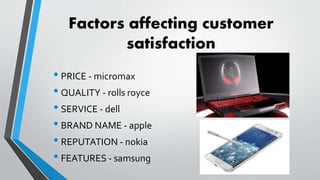
Factors affecting customer
satisfaction
• PRICE - micromax
• QUALITY - rolls royce
• SERVICE - dell
• BRAND NAME - apple
• REPUTATION - nokia
• FEATURES - samsung
LEVELS OF CUSTOMER
SATISFACTION
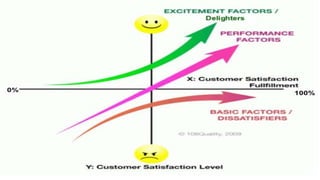
1.Basic Needs (Dissatisfiers)
• A service that the costumer takes for granted. He expects it to be present in the
product.
• Absence of this need will lead to dissatisfaction for the customer but the presence
of it will not lead to any satisfaction as such.
•Performance needs (satisfiers)
• It is a need or want of the customer which he specifically
asks for.
• Better the performance more will be the satisfaction of the
customer.
• These factors becomes the benchmarks in the competitive
market.
•Excitement Needs (delighters)
• A delighter is an unspoken or unexpected requirement of a
customer.
• It leads to very high level of satisfaction or customer delight.
• Absence of delighters does not result in customer
dissatisfaction while its presence will enhance customer
satisfaction.
CUSTOMER SATISFACTION FACTS
• 5% increase in loyalty can increase profits by 25% to 85%.
• Only 4% of unsatisfied customers will complain.
• An unhappy customer tells 9 other people.
• A happy customers tells to about 5 other people.
CUSTOMER SATISFACTION PROCESS
• Step 1: Understanding customer expectations
• Step 2: Promises to customers
• Step 3: Execution
• Step 4: Ongoing dialog with a customer
• Step 5: Customer satisfaction surveys
CUSTOMER RETENTION
• Customer satisfaction should lead to customer loyalty and customer
retention.
• This is the real test and bottom line- when the customer repeatedly comes
back to you for repeat orders and to purchase new products manufactured
by you. (In spite of stiff competition and multiple Suppliers/Sources! )
• Firm orders received or cash payments registered , market share, customer
referrals and customer retention are an indication of your customer success
and penetration in the market.
CUSTOMER FEEDBACK
• Customer feedback must be continually done and
monitored.
It enables an organization to:
• Discover customer’s dissatisfaction
• Discover relative priorities of quality
• Identify customer need
• Determine opportunities for improvement
How to ensure customer
satisfaction
• Surveys
• Customer feedback
• Comparison with alternatives
• Employee feedback
• Internet/blogs
• Toll free numbers
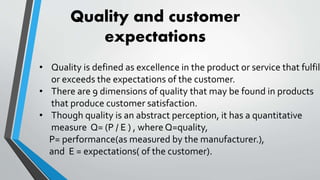
• Quality is defined as excellence in the product or service that fulfil
or exceeds the expectations of the customer.
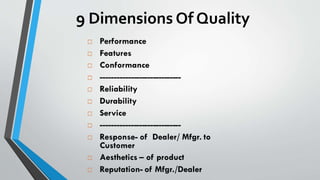
• There are 9 dimensions of quality that may be found in products
that produce customer satisfaction.
• Though quality is an abstract perception, it has a quantitative
measure Q= (P / E ) , where Q=quality,
P= performance(as measured by the manufacturer.),
and E = expectations( of the customer).
Quality and customer
expectations
9 Dimensions Of Quality
Customer satisfaction

Customer satisfaction

  • 1.
  • 2.
    MEANING • It isa measure of how products and services supplied by a company meet or surpass the customer’s expectations. • Customer expectation is the needs, wants, and preconceived ideas of a customer about a product or a service. • If customer expectations are met then the customer is satisfied.
  • 3.
    WHO ARE CUSTOMERS •Internal Customer : are people, departments, units and groups within an organization served by what we do. • External Customer : are end users of the organization's product or services depositors, borrowers, investors, etc.
  • 4.
    Why customer satisfaction •Customer is the boss of the market. • Customer dictates market trends and direction. • The organization is dependent on the customer and not the other way round. • Customer satisfaction means loyalty towards the organization. • The satisfied customers will help in bringing the new customers by the “word of mouth”.
  • 5.
    Factors affecting customer satisfaction •PRICE - micromax • QUALITY - rolls royce • SERVICE - dell • BRAND NAME - apple • REPUTATION - nokia • FEATURES - samsung
  • 8.
    LEVELS OF CUSTOMER SATISFACTION 1.BasicNeeds (Dissatisfiers) • A service that the costumer takes for granted. He expects it to be present in the product. • Absence of this need will lead to dissatisfaction for the customer but the presence of it will not lead to any satisfaction as such.
  • 9.
    •Performance needs (satisfiers) •It is a need or want of the customer which he specifically asks for. • Better the performance more will be the satisfaction of the customer. • These factors becomes the benchmarks in the competitive market.
  • 10.
    •Excitement Needs (delighters) •A delighter is an unspoken or unexpected requirement of a customer. • It leads to very high level of satisfaction or customer delight. • Absence of delighters does not result in customer dissatisfaction while its presence will enhance customer satisfaction.
  • 11.
    CUSTOMER SATISFACTION FACTS •5% increase in loyalty can increase profits by 25% to 85%. • Only 4% of unsatisfied customers will complain. • An unhappy customer tells 9 other people. • A happy customers tells to about 5 other people.
  • 12.
    CUSTOMER SATISFACTION PROCESS •Step 1: Understanding customer expectations • Step 2: Promises to customers • Step 3: Execution • Step 4: Ongoing dialog with a customer • Step 5: Customer satisfaction surveys
  • 13.
    CUSTOMER RETENTION • Customersatisfaction should lead to customer loyalty and customer retention. • This is the real test and bottom line- when the customer repeatedly comes back to you for repeat orders and to purchase new products manufactured by you. (In spite of stiff competition and multiple Suppliers/Sources! ) • Firm orders received or cash payments registered , market share, customer referrals and customer retention are an indication of your customer success and penetration in the market.
  • 14.
    CUSTOMER FEEDBACK • Customerfeedback must be continually done and monitored. It enables an organization to: • Discover customer’s dissatisfaction • Discover relative priorities of quality • Identify customer need • Determine opportunities for improvement
  • 15.
    How to ensurecustomer satisfaction • Surveys • Customer feedback • Comparison with alternatives • Employee feedback • Internet/blogs • Toll free numbers
  • 16.
    • Quality isdefined as excellence in the product or service that fulfil or exceeds the expectations of the customer. • There are 9 dimensions of quality that may be found in products that produce customer satisfaction. • Though quality is an abstract perception, it has a quantitative measure Q= (P / E ) , where Q=quality, P= performance(as measured by the manufacturer.), and E = expectations( of the customer). Quality and customer expectations
  • 17.