Service and Relationship Marketing Module:1 Chapter:1 – Basics of Service Marketing
What are services? The word service originally associated with the  work performed by servants  for their masters. “  the action of serving, helping or benefiting; conduct tending to the welfare or advantage of another” Services are acts, deeds, performance or efforts. The aim of service is to provide solution to the customers problem. Service and Relationship Marketing   Module:1 Chapter:1 – Basics of Service Marketing SRM/M1/SS
Services is an activity  or series of activities  take place by interaction between customer and service employees It’s an economic activity which is consumed at a time it is produced and  provide  added  value in forms of  Convenience, amusement, timeliness , comfort or health SRM/M1/SS
Services Defined… “ Activities, Benefits or Satisfactions  which are offered for sale  or  provided in connection with the sale of goods” American Marketing Association SRM/M1/SS
Services Defined… “ Separately identifiable, intangible activities which provide want satisfaction  when marketed to consumers and/or industrial users  and which are not necessarily tied to the sale of a product or another service” William J. Stanton SRM/M1/SS
Services Defined… “ Any activity or benefit that one party can offer to another that is essentially intangible and does not result in the ownership of anything. Its production may or may not be tied to a physical product” Philip Kotler and Bloom SRM/M1/SS
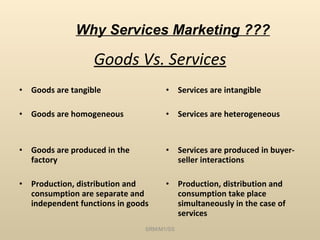
Goods Vs. Services Goods are tangible Goods are homogeneous Goods are produced in the factory Production, distribution and consumption are separate and independent functions in goods Services are intangible Services are heterogeneous Services are produced in buyer-seller interactions Production, distribution and consumption take place simultaneously in the case of services Why Services Marketing ??? SRM/M1/SS
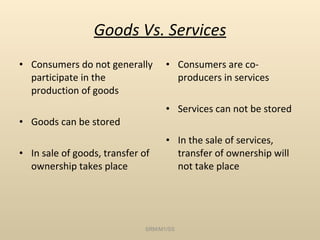
Goods Vs. Services Consumers do not generally participate in the production of goods Goods can be stored In sale of goods, transfer of ownership takes place Consumers are co-producers in services Services can not be stored In the sale of services, transfer of ownership will not take place SRM/M1/SS
Characteristics of Services… Intangibility Inseparability Variability Perishability Customer participation No ownership SRM/M1/SS
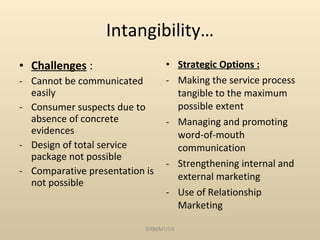
Intangibility… Challenges  : Cannot be communicated easily Consumer suspects due to absence of concrete evidences Design of total service package not possible Comparative presentation is not possible Strategic Options : Making the service process tangible to the maximum possible extent Managing and promoting word-of-mouth communication Strengthening internal and external marketing Use of Relationship Marketing SRM/M1/SS
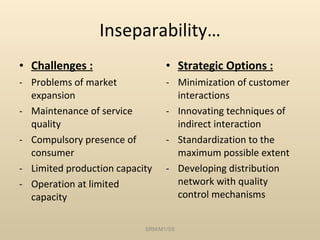
Inseparability… Challenges : Problems of market expansion Maintenance of service quality Compulsory presence of consumer Limited production capacity Operation at limited capacity Strategic Options : Minimization of customer interactions Innovating techniques of indirect interaction Standardization to the maximum possible extent Developing distribution network with quality control mechanisms SRM/M1/SS
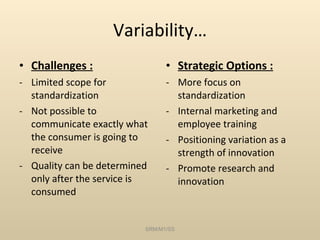
Variability… Challenges : Limited scope for standardization Not possible to communicate exactly what the consumer is going to receive Quality can be determined only after the service is consumed Strategic Options : More focus on standardization Internal marketing and employee training Positioning variation as a strength of innovation Promote research and innovation SRM/M1/SS
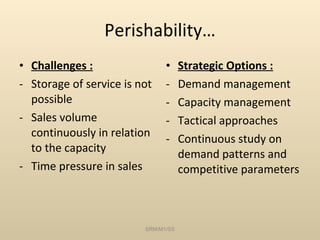
Perishability… Challenges : Storage of service is not possible Sales volume continuously in relation to the capacity Time pressure in sales Strategic Options : Demand management Capacity management Tactical approaches Continuous study on demand patterns and competitive parameters SRM/M1/SS
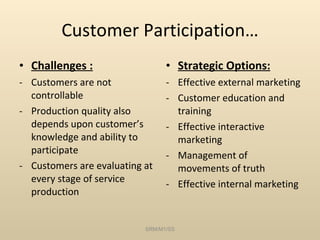
Customer Participation… Challenges : Customers are not controllable Production quality also depends upon customer’s knowledge and ability to participate Customers are evaluating at every stage of service production Strategic Options: Effective external marketing Customer education and training Effective interactive marketing Management of movements of truth Effective internal marketing SRM/M1/SS
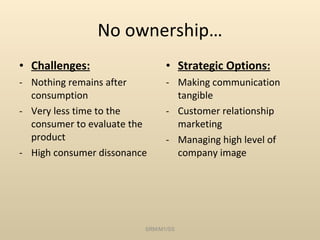
No ownership… Challenges: Nothing remains after consumption Very less time to the consumer to evaluate the product High consumer dissonance Strategic Options: Making communication tangible Customer relationship marketing Managing high level of company image SRM/M1/SS
Sources for service sector growth Innovation -: Push Theory of Innovation -: Pull theory of Innovation Social Trends SRM/M1/SS
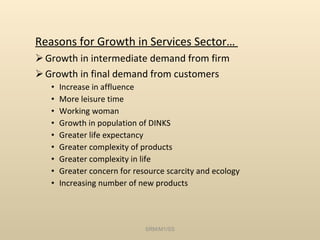
Reasons for Growth in Services Sector…  Growth in intermediate demand from firm Growth in final demand from customers Increase in affluence More leisure time Working woman Growth in population of DINKS Greater life expectancy Greater complexity of products Greater complexity in life Greater concern for resource scarcity and ecology Increasing number of new products SRM/M1/SS
Service Sector in Indian Economy…
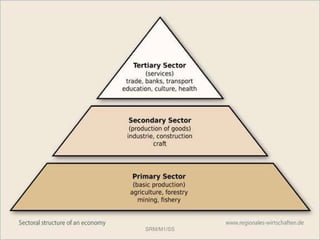
SRM/M1/SS
Reasons for growth of Services in India… Economic Affluence Changing Role of Women Cultural Changes IT Revolution Development of Markets Unbundling Corporations Increasing Consciousness of Health Care Economic Liberalization Migration Export Potential Service Tax SRM/M1/SS
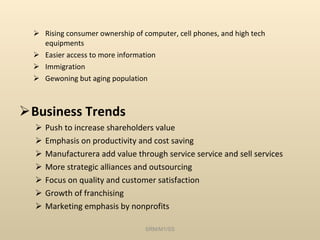
Factors Stimulation the transformation of the Service Economy  Government Policies Change in regulation Privatization New rules to protect customer, employees and the environment New agreements on trade in services Social Changes Rising consumer Expectation More affluence More people short of time Increased desire for buying experience vs things Rising consumer ownership of computer, cell phones, and high tech equipments SRM/M1/SS
Rising consumer ownership of computer, cell phones, and high tech equipments Easier access to more information Immigration Gewoning but aging population Business Trends Push to increase shareholders value Emphasis on productivity and cost saving Manufacturera add value through service service and sell services More strategic alliances and outsourcing Focus on quality and customer satisfaction Growth of franchising Marketing emphasis by nonprofits SRM/M1/SS
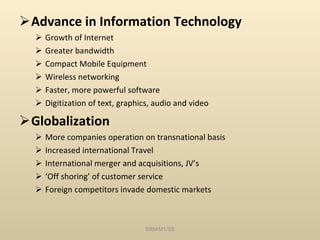
Advance in Information Technology Growth of Internet Greater bandwidth Compact Mobile Equipment Wireless networking Faster, more powerful software Digitization of text, graphics, audio and video Globalization More companies operation on transnational basis Increased international Travel International merger and acquisitions, JV’s ‘ Off shoring’ of customer service Foreign competitors invade domestic markets SRM/M1/SS
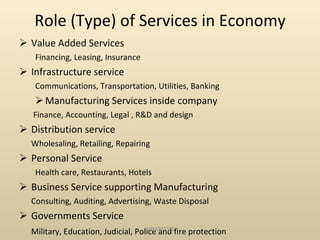
Role (Type) of Services in Economy Value Added Services Financing, Leasing, Insurance Infrastructure service Communications, Transportation, Utilities, Banking Manufacturing Services inside company Finance, Accounting, Legal , R&D and design Distribution service Wholesaling, Retailing, Repairing Personal Service Health care, Restaurants, Hotels Business Service supporting Manufacturing  Consulting, Auditing, Advertising, Waste Disposal Governments Service Military, Education, Judicial, Police and fire protection SRM/M1/SS
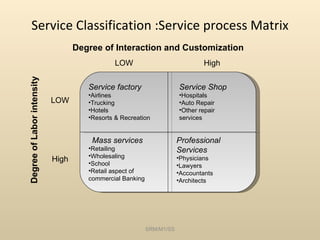
Service Classification :Service process Matrix SRM/M1/SS LOW High LOW High Mass services Retailing Wholesaling School Retail aspect of commercial Banking Service factory Airlines Trucking Hotels Resorts & Recreation Service Shop Hospitals Auto Repair Other repair services Professional Services Physicians Lawyers Accountants Architects Degree of Labor intensity Degree of Interaction and Customization
How to win customer in Service Business(USP’s) Availability How accessible is the service? ( ATM’s  – service beyond the traditional banker’s hours) Convenience (The location of service where customer must travel to that  service-Fast food restaurants) Dependability Hoe reliable is the service? (Airlines- on time departure & arrival performance will build huge trust) Personalization   need for Customization -Are you treated as an individual? SRM/M1/SS
Price The price is viewed as being a surrogate for quality. Quality Quality is judged by both the process of services delivery and the put comes of the service. It is difference between  service   expectation & service experience Reputation Unlike a product, a poor service experience can note exchanged or returned for a different model.  Positive word-of-mouth  is the most effective form of advertising. Safety In  air travel and medicine , the customers are putting their lives in the hands of the service provider Speed How long must I wait for service? For emergency service such as fire or police protection,  response time  is the major criterion of performance . SRM/M1/SS
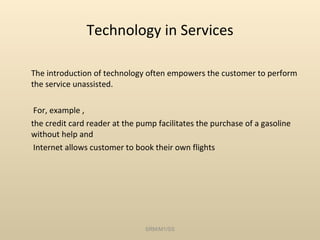
Technology in Services The introduction of technology often empowers the customer to perform the service unassisted.   For, example ,  the credit card reader at the pump facilitates the purchase of a gasoline without help and   Internet allows customer to book their own flights SRM/M1/SS
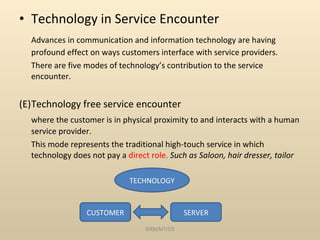
Technology in Service Encounter Advances in communication and information technology are having profound effect on ways customers interface with service providers. There are five modes of technology’s contribution to the service encounter. Technology free service encounter where the customer is in physical proximity to and interacts with a human service provider.  This mode represents the traditional high-touch service in which technology does not pay a  direct role.  Such as Saloon, hair dresser, tailor SRM/M1/SS CUSTOMER SERVER TECHNOLOGY
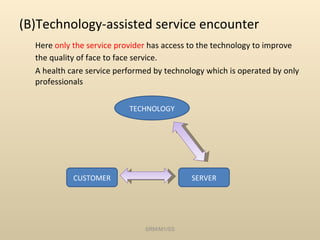
(B)Technology-assisted service encounter Here  only the service provider  has access to the technology to improve the quality of face to face service. A health care service performed by technology which is operated by only professionals SRM/M1/SS CUSTOMER SERVER TECHNOLOGY
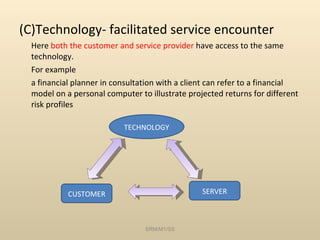
(C)Technology- facilitated service encounter Here  both the customer and service provider  have access to the same technology. For example a financial planner in consultation with a client can refer to a financial model on a personal computer to illustrate projected returns for different risk profiles SRM/M1/SS CUSTOMER SERVER TECHNOLOGY
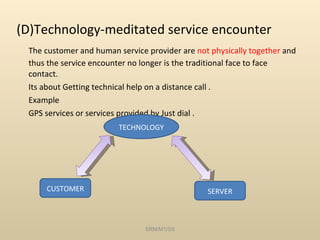
(D)Technology-meditated service encounter The customer and human service provider are  not physically together  and thus the service encounter no longer is the traditional face to face contact.  Its about Getting technical help on a distance call . Example GPS services or services provided by Just dial . SRM/M1/SS CUSTOMER SERVER TECHNOLOGY
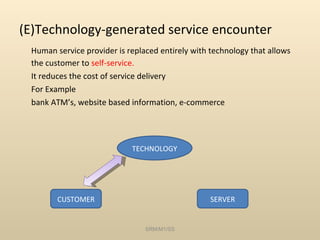
(E)Technology-generated service encounter Human service provider is replaced entirely with technology that allows the customer to  self-service. It reduces the cost of service delivery For Example bank ATM’s, website based information, e-commerce SRM/M1/SS CUSTOMER SERVER TECHNOLOGY
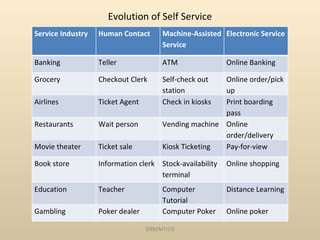
The Emergence of Self Service Elimination of labor costs for nonproductive activity is the principle driver for the service provider. Customer acceptance results from increased opportunity for customization, accuracy, convenience and speed. Cost saving and place & Time  has lead the buisiness to become Self Service by customer him/herself. SRM/M1/SS
Evolution of Self Service SRM/M1/SS Service Industry Human Contact Machine-Assisted Service Electronic Service Banking Teller ATM Online Banking Grocery Checkout Clerk Self-check out station Online order/pick up Airlines Ticket Agent Check in kiosks Print boarding pass Restaurants Wait person Vending machine Online order/delivery Movie theater Ticket sale Kiosk Ticketing Pay-for-view Book store Information clerk Stock-availability terminal Online shopping Education Teacher Computer Tutorial Distance Learning Gambling Poker dealer Computer Poker Online poker
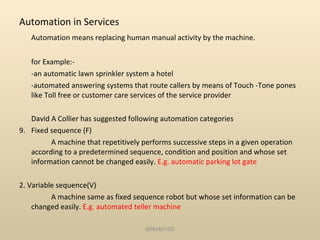
Automation in Services Automation means replacing human manual activity by the machine. for Example:- -an automatic lawn sprinkler system a hotel -automated answering systems that route callers by means of Touch -Tone pones like Toll free or customer care services of the service provider David A Collier has suggested following automation categories Fixed sequence (F) A machine that repetitively performs successive steps in a given operation according to a predetermined sequence, condition and position and whose set information cannot be changed easily.  E.g. automatic parking lot gate 2. Variable sequence(V) A machine same as fixed sequence robot but whose set information can be changed easily.  E.g. automated teller machine SRM/M1/SS
3. Playback(P) A machine that can produce operation from memory that were originally executed under human control.  E.g. telephone answering machine 4. Numerical Controlled(N) A  machine that can perform task according to sequence as command by stored information  tat can be reprogrammed  easily .  E.g. animated character at an amusement park. 5. Intelligent(I) A machine with sensory perception devices, such as visual or tactile  receptors, that  can detect changes  in the work environment or task by itself and has its own decision-making abilities.  E.g. autopilot for a commercial airplane SRM/M1/SS
6. Expert system(E) A computer program that uses an inference engine (e.g. decision rules) and a knowledge base (i.e. information on a particular subject) to diagnose problem ex- maintenance trouble shooting for  elevator repair 7. Totally automated system(T) A system of machine and computers that performs all the physical and intellectual tasks that are required to produce or deliver a service. ex- electronic fund transfer SRM/M1/SS
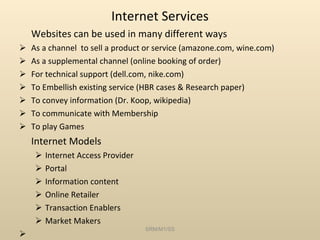
Internet Services Websites can be used in many different ways As a channel  to sell a product or service (amazone.com, wine.com) As a supplemental channel (online booking of order) For technical support (dell.com, nike.com) To Embellish existing service (HBR cases & Research paper) To convey information (Dr. Koop, wikipedia) To communicate with Membership To play Games Internet Models Internet Access Provider  Portal Information content Online Retailer Transaction Enablers Market Makers SRM/M1/SS
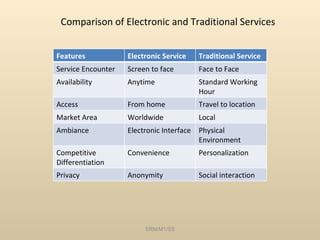
Comparison of Electronic and Traditional Services SRM/M1/SS Features Electronic Service Traditional Service Service Encounter Screen to face Face to Face Availability Anytime Standard Working Hour Access  From home Travel to location Market Area Worldwide Local Ambiance Electronic Interface Physical Environment Competitive Differentiation Convenience Personalization Privacy Anonymity Social interaction
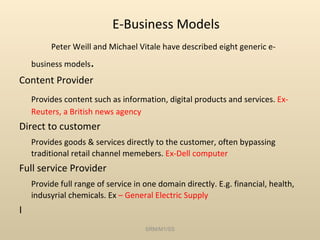
E-Business Models Peter Weill and Michael Vitale have described eight generic e-business models . Content Provider Provides content such as information, digital products and services.  Ex- Reuters, a British news agency Direct to customer Provides goods & services directly to the customer, often bypassing traditional retail channel memebers.  Ex-Dell computer Full service Provider Provide full range of service in one domain directly. E.g. financial, health, indusyrial chemicals. Ex  – General Electric Supply I SRM/M1/SS
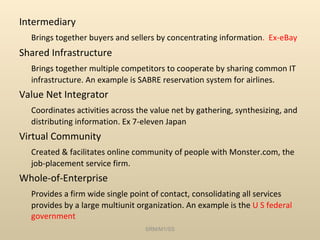
Intermediary Brings together buyers and sellers by concentrating information .  Ex-eBay Shared Infrastructure Brings together multiple competitors to cooperate by sharing common IT infrastructure. An example is SABRE reservation system for airlines. Value Net Integrator Coordinates activities across the value net by gathering, synthesizing, and distributing information. Ex 7-eleven Japan Virtual Community Created & facilitates online community of people with Monster.com, the job-placement service firm. Whole-of-Enterprise Provides a firm wide single point of contact, consolidating all services provides by a large multiunit organization. An example is the  U S federal government SRM/M1/SS
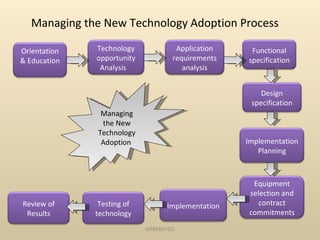
Managing the New Technology Adoption Process SRM/M1/SS Managing the New Technology Adoption  Orientation & Education Technology opportunity Analysis Implementation Equipment selection and contract commitments Implementation Planning Design specification Functional specification Application requirements analysis Testing of technology Review of Results
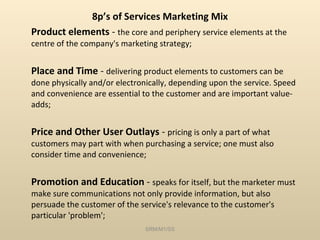
8p’s of Services Marketing Mix Product elements  -  the core and periphery service elements at the centre of the company's marketing strategy; Place and Time  -  delivering product elements to customers can be done physically and/or electronically, depending upon the service. Speed and convenience are essential to the customer and are important value-adds; Price and Other User Outlays  -  pricing is only a part of what customers may part with when purchasing a service; one must also consider time and convenience; Promotion and Education  -  speaks for itself, but the marketer must make sure communications not only provide information, but also persuade the customer of the service's relevance to the customer's particular 'problem'; SRM/M1/SS
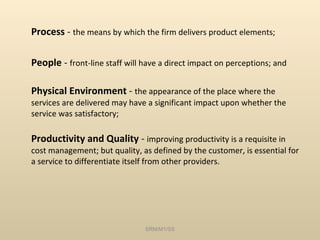
Process  -  the means by which the firm delivers product elements;  People  -  front-line staff will have a direct impact on perceptions; and  Physical Environment  -  the appearance of the place where the services are delivered may have a significant impact upon whether the service was satisfactory; Productivity and Quality  -  improving productivity is a requisite in cost management; but quality, as defined by the customer, is essential for a service to differentiate itself from other providers.  SRM/M1/SS
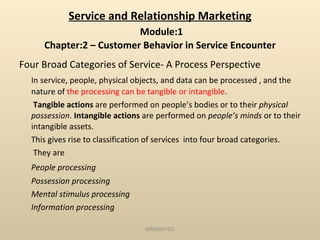
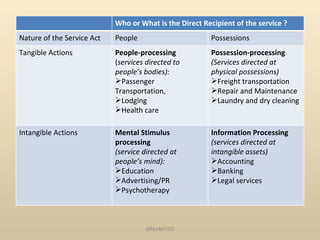
Service and Relationship Marketing   Module:1 Chapter:2 – Customer Behavior in Service Encounter Four Broad Categories of Service- A Process Perspective In service, people, physical objects, and data can be processed , and the nature of  the processing can be tangible or intangible .   Tangible actions  are performed on people’s bodies or to their  physical possession .  Intangible actions  are performed on  people’s minds  or to their intangible assets. This gives rise to classification of services  into four broad categories.   They are People processing Possession processing Mental stimulus processing Information processing SRM/M1/SS
SRM/M1/SS Who or What is the Direct Recipient of the service ? Nature of the Service Act People Possessions Tangible Actions People-processing  ( services directed to people’s bodies): Passenger Transportation,  Lodging Health care Possession-processing  (Services directed at physical possessions) Freight transportation Repair and Maintenance Laundry and dry cleaning Intangible Actions Mental Stimulus processing (service directed at people’s mind): Education Advertising/PR Psychotherapy Information Processing (services directed at intangible assets) Accounting Banking Legal services
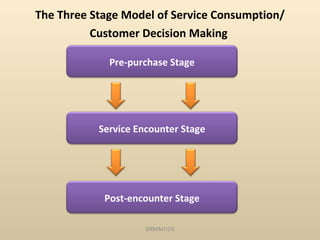
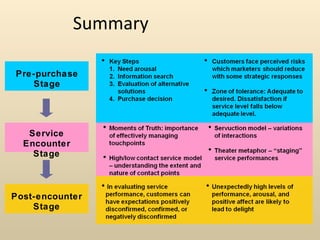
The Three Stage Model of Service Consumption/ Customer Decision Making  SRM/M1/SS Pre-purchase Stage Post-encounter Stage Service Encounter Stage
Pre-purchase Stage
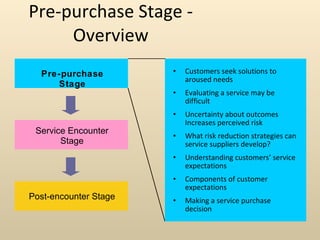
Pre-purchase Stage - Overview Customers seek solutions to aroused needs Evaluating a service may be difficult Uncertainty about outcomes Increases perceived risk What risk reduction strategies can service suppliers develop? Understanding customers’ service expectations Components of customer expectations Making a service purchase decision Pre-purchase Stage Service Encounter Stage Post-encounter Stage
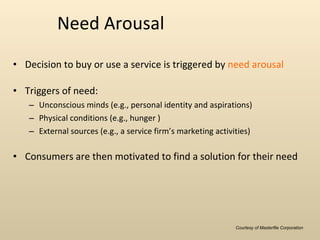
Need Arousal Decision to buy or use a service is triggered by  need arousal Triggers of need: Unconscious minds (e.g., personal identity and aspirations) Physical conditions (e.g., hunger ) External sources (e.g., a service firm’s marketing activities) Consumers are then motivated to find a solution for their need Courtesy of Masterfile Corporation
Information Search Need arousal leads to attempts to find a solution Evoked set  – a set of products and brands that a consumer considers during the decision-making process – that is derived from past experiences or external sources Alternatives then  need to be evaluated  before a final decision is made
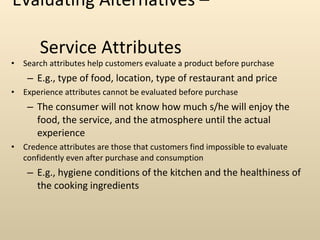
Evaluating Alternatives –  Service Attributes Search attributes help customers evaluate a product before purchase E.g., type of food, location, type of restaurant and price Experience attributes cannot be evaluated before purchase The consumer will not know how much s/he will enjoy the food, the service, and the atmosphere until the actual experience Credence attributes are those that customers find impossible to evaluate confidently even after purchase and consumption E.g., hygiene conditions of the kitchen and the healthiness of the cooking ingredients
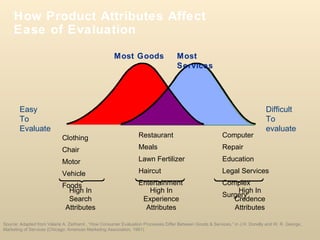
How Product Attributes Affect  Ease of Evaluation Source: Adapted from Valarie A. Zeithaml , “How Consumer Evaluation Processes Differ Between Goods & Services,” in J.H. Donelly and W. R. George, Marketing of Services (Chicago: American Marketing Association, 1981) Most Goods Difficult  To evaluate Easy To Evaluate  Most Services Clothing Chair Motor Vehicle Foods High In Search Attributes Restaurant Meals Lawn Fertilizer Haircut Entertainment High In Experience Attributes Computer Repair Education Legal Services Complex Surgery High In Credence Attributes
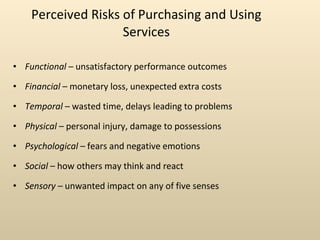
Perceived Risks of Purchasing and Using Services Functional  – unsatisfactory performance outcomes Financial  – monetary loss, unexpected extra costs Temporal  – wasted time, delays leading to problems Physical  – personal injury, damage to possessions Psychological  – fears and negative emotions Social  – how others may think and react Sensory  – unwanted impact on any of five senses
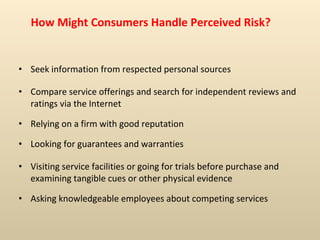
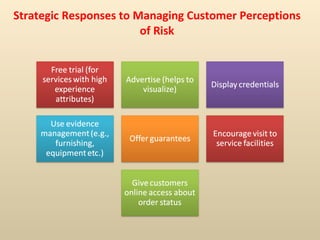
How Might Consumers Handle Perceived Risk? Seek information from respected personal sources Compare service offerings and search for independent reviews and ratings via the Internet Relying on a firm with good reputation Looking for guarantees and warranties Visiting service facilities or going for trials before purchase and examining tangible cues or other physical evidence Asking knowledgeable employees about competing services
Strategic Responses to Managing Customer Perceptions of Risk
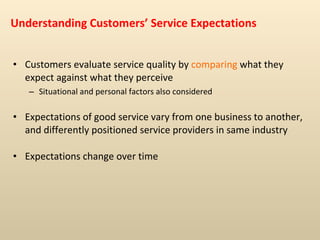
Understanding Customers’ Service Expectations Customers evaluate service quality by  comparing  what they expect against what they perceive  Situational and personal factors also considered Expectations of good service vary from one business to another, and differently positioned service providers in same industry Expectations change over time
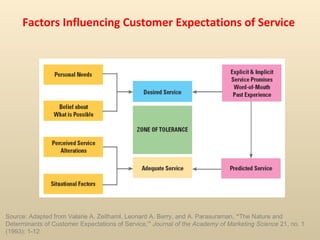
Factors Influencing Customer Expectations of Service Source:  Adapted from Valarie A. Zeithaml, Leonard A. Berry, and A. Parasuraman,  “ The Nature and Determinants of Customer Expectations of Service, ”   Journal of the Academy of Marketing Science  21, no. 1 (1993): 1-12
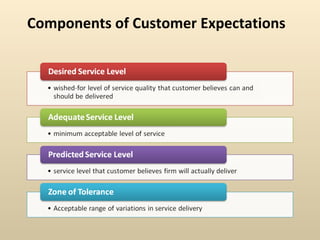
Components of Customer Expectations
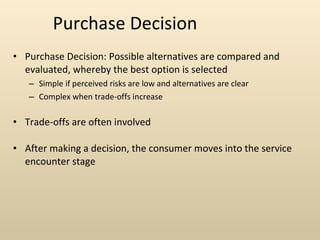
Purchase Decision Purchase Decision: Possible alternatives are compared and evaluated, whereby the best option is selected Simple if perceived risks are low and alternatives are clear Complex when trade-offs increase Trade-offs are often involved After making a decision, the consumer moves into the service encounter stage
Service Encounter Stage
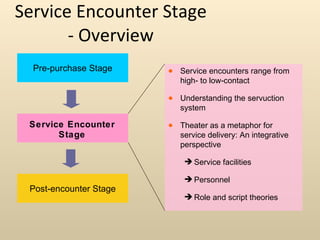
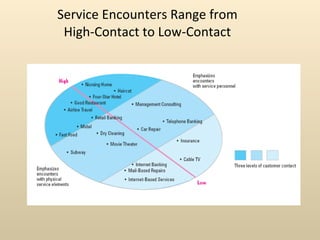
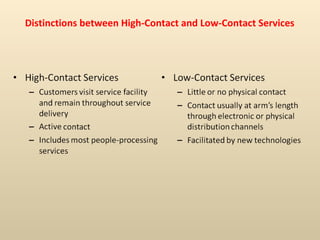
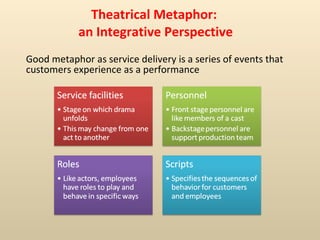
Service Encounter Stage - Overview Pre-purchase Stage Service Encounter Stage Post-encounter Stage Service encounters range from high- to low-contact Understanding the servuction system Theater as a metaphor for service delivery: An integrative perspective Service facilities Personnel Role and script theories
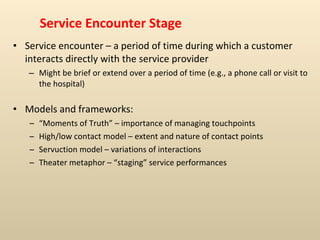
Service Encounter Stage Service encounter – a period of time during which a customer interacts directly with the service provider Might be brief or extend over a period of time (e.g., a phone call or visit to the hospital) Models and frameworks: “ Moments of Truth” – importance of managing touchpoints High/low contact model – extent and nature of contact points Servuction model – variations of interactions Theater metaphor – “staging” service performances
Moments of Truth “ [W]e could say that the perceived quality is realized at the moment of truth, when the  service provider  and the  service customer confront  one another in the arena. At that moment they are very much on their own… It is the skill, the motivation, and the tools employed by the firm’s representative and the expectations and behavior of the client which together will create the service delivery process.” Richard Normann
Service Encounters Range from  High-Contact to Low-Contact
Distinctions between High-Contact and Low-Contact Services
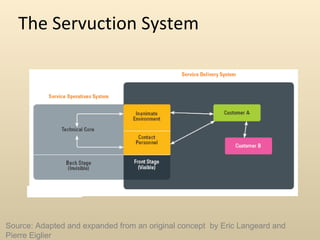
The Servuction System  Source: Adapted and expanded from an original concept  by Eric Langeard and Pierre Eiglier
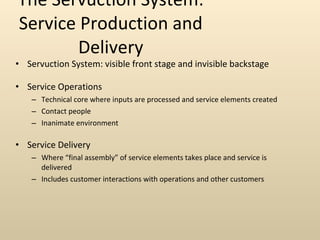
The Servuction System: Service Production and Delivery Servuction System: visible front stage and invisible backstage Service Operations Technical core where inputs are processed and service elements created  Contact people Inanimate environment Service Delivery Where “final assembly” of service elements takes place and service is delivered Includes customer interactions with operations and other customers
Theater as a Metaphor for  Service Delivery William Shakespeare As You Like It
Theatrical Metaphor:  an Integrative Perspective Good metaphor as service delivery is a series of events that customers experience as a performance
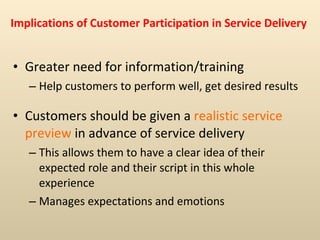
Implications of Customer Participation in Service Delivery Greater need for information/training  Help customers to perform well, get desired results Customers should be given a  realistic service preview  in advance of service delivery This allows them to have a clear idea of their expected role and their script in this whole experience Manages expectations and emotions
Post-Encounter Stage
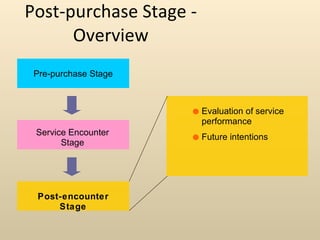
Post-purchase Stage - Overview Pre-purchase Stage Service Encounter Stage Post-encounter Stage Evaluation of service performance Future intentions
Customer Satisfaction with Service Experience Satisfaction:  attitude-like judgment  following a service purchase or series of service interactions Whereby customers have expectations prior to consumption, observe service performance, compare it to expectations Satisfaction judgments are based on this comparison Positive disconfirmation (better)  Confirmation (same)  Negative disconfirmation (worse)
Customer Delight: Going Beyond Satisfaction Research shows that delight is a function of three components Unexpectedly high levels of performance Arousal (e.g., surprise, excitement) Positive affect (e.g., pleasure, joy, or happiness) Strategic links exist between customer satisfaction and corporate performance By creating more value for customers (increased satisfaction), the firm creates more value for the owners
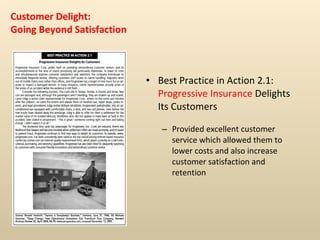
Best Practice in Action 2.1:  Progressive Insurance  Delights Its Customers Provided excellent customer service which allowed them to lower costs and also increase customer satisfaction and retention Customer Delight: Going Beyond Satisfaction
Summary Pre-purchase Stage Service Encounter Stage Post-encounter Stage

Services Marketing

  • 1.
    Service and RelationshipMarketing Module:1 Chapter:1 – Basics of Service Marketing
  • 2.
    What are services?The word service originally associated with the work performed by servants for their masters. “ the action of serving, helping or benefiting; conduct tending to the welfare or advantage of another” Services are acts, deeds, performance or efforts. The aim of service is to provide solution to the customers problem. Service and Relationship Marketing Module:1 Chapter:1 – Basics of Service Marketing SRM/M1/SS
  • 3.
    Services is anactivity or series of activities take place by interaction between customer and service employees It’s an economic activity which is consumed at a time it is produced and provide added value in forms of Convenience, amusement, timeliness , comfort or health SRM/M1/SS
  • 4.
    Services Defined… “Activities, Benefits or Satisfactions which are offered for sale or provided in connection with the sale of goods” American Marketing Association SRM/M1/SS
  • 5.
    Services Defined… “Separately identifiable, intangible activities which provide want satisfaction when marketed to consumers and/or industrial users and which are not necessarily tied to the sale of a product or another service” William J. Stanton SRM/M1/SS
  • 6.
    Services Defined… “Any activity or benefit that one party can offer to another that is essentially intangible and does not result in the ownership of anything. Its production may or may not be tied to a physical product” Philip Kotler and Bloom SRM/M1/SS
  • 7.
    Goods Vs. ServicesGoods are tangible Goods are homogeneous Goods are produced in the factory Production, distribution and consumption are separate and independent functions in goods Services are intangible Services are heterogeneous Services are produced in buyer-seller interactions Production, distribution and consumption take place simultaneously in the case of services Why Services Marketing ??? SRM/M1/SS
  • 8.
    Goods Vs. ServicesConsumers do not generally participate in the production of goods Goods can be stored In sale of goods, transfer of ownership takes place Consumers are co-producers in services Services can not be stored In the sale of services, transfer of ownership will not take place SRM/M1/SS
  • 9.
    Characteristics of Services…Intangibility Inseparability Variability Perishability Customer participation No ownership SRM/M1/SS
  • 10.
    Intangibility… Challenges : Cannot be communicated easily Consumer suspects due to absence of concrete evidences Design of total service package not possible Comparative presentation is not possible Strategic Options : Making the service process tangible to the maximum possible extent Managing and promoting word-of-mouth communication Strengthening internal and external marketing Use of Relationship Marketing SRM/M1/SS
  • 11.
    Inseparability… Challenges :Problems of market expansion Maintenance of service quality Compulsory presence of consumer Limited production capacity Operation at limited capacity Strategic Options : Minimization of customer interactions Innovating techniques of indirect interaction Standardization to the maximum possible extent Developing distribution network with quality control mechanisms SRM/M1/SS
  • 12.
    Variability… Challenges :Limited scope for standardization Not possible to communicate exactly what the consumer is going to receive Quality can be determined only after the service is consumed Strategic Options : More focus on standardization Internal marketing and employee training Positioning variation as a strength of innovation Promote research and innovation SRM/M1/SS
  • 13.
    Perishability… Challenges :Storage of service is not possible Sales volume continuously in relation to the capacity Time pressure in sales Strategic Options : Demand management Capacity management Tactical approaches Continuous study on demand patterns and competitive parameters SRM/M1/SS
  • 14.
    Customer Participation… Challenges: Customers are not controllable Production quality also depends upon customer’s knowledge and ability to participate Customers are evaluating at every stage of service production Strategic Options: Effective external marketing Customer education and training Effective interactive marketing Management of movements of truth Effective internal marketing SRM/M1/SS
  • 15.
    No ownership… Challenges:Nothing remains after consumption Very less time to the consumer to evaluate the product High consumer dissonance Strategic Options: Making communication tangible Customer relationship marketing Managing high level of company image SRM/M1/SS
  • 16.
    Sources for servicesector growth Innovation -: Push Theory of Innovation -: Pull theory of Innovation Social Trends SRM/M1/SS
  • 17.
    Reasons for Growthin Services Sector… Growth in intermediate demand from firm Growth in final demand from customers Increase in affluence More leisure time Working woman Growth in population of DINKS Greater life expectancy Greater complexity of products Greater complexity in life Greater concern for resource scarcity and ecology Increasing number of new products SRM/M1/SS
  • 18.
    Service Sector inIndian Economy…
  • 19.
  • 20.
    Reasons for growthof Services in India… Economic Affluence Changing Role of Women Cultural Changes IT Revolution Development of Markets Unbundling Corporations Increasing Consciousness of Health Care Economic Liberalization Migration Export Potential Service Tax SRM/M1/SS
  • 21.
    Factors Stimulation thetransformation of the Service Economy Government Policies Change in regulation Privatization New rules to protect customer, employees and the environment New agreements on trade in services Social Changes Rising consumer Expectation More affluence More people short of time Increased desire for buying experience vs things Rising consumer ownership of computer, cell phones, and high tech equipments SRM/M1/SS
  • 22.
    Rising consumer ownershipof computer, cell phones, and high tech equipments Easier access to more information Immigration Gewoning but aging population Business Trends Push to increase shareholders value Emphasis on productivity and cost saving Manufacturera add value through service service and sell services More strategic alliances and outsourcing Focus on quality and customer satisfaction Growth of franchising Marketing emphasis by nonprofits SRM/M1/SS
  • 23.
    Advance in InformationTechnology Growth of Internet Greater bandwidth Compact Mobile Equipment Wireless networking Faster, more powerful software Digitization of text, graphics, audio and video Globalization More companies operation on transnational basis Increased international Travel International merger and acquisitions, JV’s ‘ Off shoring’ of customer service Foreign competitors invade domestic markets SRM/M1/SS
  • 24.
    Role (Type) ofServices in Economy Value Added Services Financing, Leasing, Insurance Infrastructure service Communications, Transportation, Utilities, Banking Manufacturing Services inside company Finance, Accounting, Legal , R&D and design Distribution service Wholesaling, Retailing, Repairing Personal Service Health care, Restaurants, Hotels Business Service supporting Manufacturing Consulting, Auditing, Advertising, Waste Disposal Governments Service Military, Education, Judicial, Police and fire protection SRM/M1/SS
  • 25.
    Service Classification :Serviceprocess Matrix SRM/M1/SS LOW High LOW High Mass services Retailing Wholesaling School Retail aspect of commercial Banking Service factory Airlines Trucking Hotels Resorts & Recreation Service Shop Hospitals Auto Repair Other repair services Professional Services Physicians Lawyers Accountants Architects Degree of Labor intensity Degree of Interaction and Customization
  • 26.
    How to wincustomer in Service Business(USP’s) Availability How accessible is the service? ( ATM’s – service beyond the traditional banker’s hours) Convenience (The location of service where customer must travel to that service-Fast food restaurants) Dependability Hoe reliable is the service? (Airlines- on time departure & arrival performance will build huge trust) Personalization need for Customization -Are you treated as an individual? SRM/M1/SS
  • 27.
    Price The priceis viewed as being a surrogate for quality. Quality Quality is judged by both the process of services delivery and the put comes of the service. It is difference between service expectation & service experience Reputation Unlike a product, a poor service experience can note exchanged or returned for a different model. Positive word-of-mouth is the most effective form of advertising. Safety In air travel and medicine , the customers are putting their lives in the hands of the service provider Speed How long must I wait for service? For emergency service such as fire or police protection, response time is the major criterion of performance . SRM/M1/SS
  • 28.
    Technology in ServicesThe introduction of technology often empowers the customer to perform the service unassisted. For, example , the credit card reader at the pump facilitates the purchase of a gasoline without help and Internet allows customer to book their own flights SRM/M1/SS
  • 29.
    Technology in ServiceEncounter Advances in communication and information technology are having profound effect on ways customers interface with service providers. There are five modes of technology’s contribution to the service encounter. Technology free service encounter where the customer is in physical proximity to and interacts with a human service provider. This mode represents the traditional high-touch service in which technology does not pay a direct role. Such as Saloon, hair dresser, tailor SRM/M1/SS CUSTOMER SERVER TECHNOLOGY
  • 30.
    (B)Technology-assisted service encounterHere only the service provider has access to the technology to improve the quality of face to face service. A health care service performed by technology which is operated by only professionals SRM/M1/SS CUSTOMER SERVER TECHNOLOGY
  • 31.
    (C)Technology- facilitated serviceencounter Here both the customer and service provider have access to the same technology. For example a financial planner in consultation with a client can refer to a financial model on a personal computer to illustrate projected returns for different risk profiles SRM/M1/SS CUSTOMER SERVER TECHNOLOGY
  • 32.
    (D)Technology-meditated service encounterThe customer and human service provider are not physically together and thus the service encounter no longer is the traditional face to face contact. Its about Getting technical help on a distance call . Example GPS services or services provided by Just dial . SRM/M1/SS CUSTOMER SERVER TECHNOLOGY
  • 33.
    (E)Technology-generated service encounterHuman service provider is replaced entirely with technology that allows the customer to self-service. It reduces the cost of service delivery For Example bank ATM’s, website based information, e-commerce SRM/M1/SS CUSTOMER SERVER TECHNOLOGY
  • 34.
    The Emergence ofSelf Service Elimination of labor costs for nonproductive activity is the principle driver for the service provider. Customer acceptance results from increased opportunity for customization, accuracy, convenience and speed. Cost saving and place & Time has lead the buisiness to become Self Service by customer him/herself. SRM/M1/SS
  • 35.
    Evolution of SelfService SRM/M1/SS Service Industry Human Contact Machine-Assisted Service Electronic Service Banking Teller ATM Online Banking Grocery Checkout Clerk Self-check out station Online order/pick up Airlines Ticket Agent Check in kiosks Print boarding pass Restaurants Wait person Vending machine Online order/delivery Movie theater Ticket sale Kiosk Ticketing Pay-for-view Book store Information clerk Stock-availability terminal Online shopping Education Teacher Computer Tutorial Distance Learning Gambling Poker dealer Computer Poker Online poker
  • 36.
    Automation in ServicesAutomation means replacing human manual activity by the machine. for Example:- -an automatic lawn sprinkler system a hotel -automated answering systems that route callers by means of Touch -Tone pones like Toll free or customer care services of the service provider David A Collier has suggested following automation categories Fixed sequence (F) A machine that repetitively performs successive steps in a given operation according to a predetermined sequence, condition and position and whose set information cannot be changed easily. E.g. automatic parking lot gate 2. Variable sequence(V) A machine same as fixed sequence robot but whose set information can be changed easily. E.g. automated teller machine SRM/M1/SS
  • 37.
    3. Playback(P) Amachine that can produce operation from memory that were originally executed under human control. E.g. telephone answering machine 4. Numerical Controlled(N) A machine that can perform task according to sequence as command by stored information tat can be reprogrammed easily . E.g. animated character at an amusement park. 5. Intelligent(I) A machine with sensory perception devices, such as visual or tactile receptors, that can detect changes in the work environment or task by itself and has its own decision-making abilities. E.g. autopilot for a commercial airplane SRM/M1/SS
  • 38.
    6. Expert system(E)A computer program that uses an inference engine (e.g. decision rules) and a knowledge base (i.e. information on a particular subject) to diagnose problem ex- maintenance trouble shooting for elevator repair 7. Totally automated system(T) A system of machine and computers that performs all the physical and intellectual tasks that are required to produce or deliver a service. ex- electronic fund transfer SRM/M1/SS
  • 39.
    Internet Services Websitescan be used in many different ways As a channel to sell a product or service (amazone.com, wine.com) As a supplemental channel (online booking of order) For technical support (dell.com, nike.com) To Embellish existing service (HBR cases & Research paper) To convey information (Dr. Koop, wikipedia) To communicate with Membership To play Games Internet Models Internet Access Provider Portal Information content Online Retailer Transaction Enablers Market Makers SRM/M1/SS
  • 40.
    Comparison of Electronicand Traditional Services SRM/M1/SS Features Electronic Service Traditional Service Service Encounter Screen to face Face to Face Availability Anytime Standard Working Hour Access From home Travel to location Market Area Worldwide Local Ambiance Electronic Interface Physical Environment Competitive Differentiation Convenience Personalization Privacy Anonymity Social interaction
  • 41.
    E-Business Models PeterWeill and Michael Vitale have described eight generic e-business models . Content Provider Provides content such as information, digital products and services. Ex- Reuters, a British news agency Direct to customer Provides goods & services directly to the customer, often bypassing traditional retail channel memebers. Ex-Dell computer Full service Provider Provide full range of service in one domain directly. E.g. financial, health, indusyrial chemicals. Ex – General Electric Supply I SRM/M1/SS
  • 42.
    Intermediary Brings togetherbuyers and sellers by concentrating information . Ex-eBay Shared Infrastructure Brings together multiple competitors to cooperate by sharing common IT infrastructure. An example is SABRE reservation system for airlines. Value Net Integrator Coordinates activities across the value net by gathering, synthesizing, and distributing information. Ex 7-eleven Japan Virtual Community Created & facilitates online community of people with Monster.com, the job-placement service firm. Whole-of-Enterprise Provides a firm wide single point of contact, consolidating all services provides by a large multiunit organization. An example is the U S federal government SRM/M1/SS
  • 43.
    Managing the NewTechnology Adoption Process SRM/M1/SS Managing the New Technology Adoption Orientation & Education Technology opportunity Analysis Implementation Equipment selection and contract commitments Implementation Planning Design specification Functional specification Application requirements analysis Testing of technology Review of Results
  • 44.
    8p’s of ServicesMarketing Mix Product elements - the core and periphery service elements at the centre of the company's marketing strategy; Place and Time - delivering product elements to customers can be done physically and/or electronically, depending upon the service. Speed and convenience are essential to the customer and are important value-adds; Price and Other User Outlays - pricing is only a part of what customers may part with when purchasing a service; one must also consider time and convenience; Promotion and Education - speaks for itself, but the marketer must make sure communications not only provide information, but also persuade the customer of the service's relevance to the customer's particular 'problem'; SRM/M1/SS
  • 45.
    Process - the means by which the firm delivers product elements; People - front-line staff will have a direct impact on perceptions; and Physical Environment - the appearance of the place where the services are delivered may have a significant impact upon whether the service was satisfactory; Productivity and Quality - improving productivity is a requisite in cost management; but quality, as defined by the customer, is essential for a service to differentiate itself from other providers. SRM/M1/SS
  • 46.
    Service and RelationshipMarketing Module:1 Chapter:2 – Customer Behavior in Service Encounter Four Broad Categories of Service- A Process Perspective In service, people, physical objects, and data can be processed , and the nature of the processing can be tangible or intangible . Tangible actions are performed on people’s bodies or to their physical possession . Intangible actions are performed on people’s minds or to their intangible assets. This gives rise to classification of services into four broad categories. They are People processing Possession processing Mental stimulus processing Information processing SRM/M1/SS
  • 47.
    SRM/M1/SS Who orWhat is the Direct Recipient of the service ? Nature of the Service Act People Possessions Tangible Actions People-processing ( services directed to people’s bodies): Passenger Transportation, Lodging Health care Possession-processing (Services directed at physical possessions) Freight transportation Repair and Maintenance Laundry and dry cleaning Intangible Actions Mental Stimulus processing (service directed at people’s mind): Education Advertising/PR Psychotherapy Information Processing (services directed at intangible assets) Accounting Banking Legal services
  • 48.
    The Three StageModel of Service Consumption/ Customer Decision Making SRM/M1/SS Pre-purchase Stage Post-encounter Stage Service Encounter Stage
  • 49.
  • 50.
    Pre-purchase Stage -Overview Customers seek solutions to aroused needs Evaluating a service may be difficult Uncertainty about outcomes Increases perceived risk What risk reduction strategies can service suppliers develop? Understanding customers’ service expectations Components of customer expectations Making a service purchase decision Pre-purchase Stage Service Encounter Stage Post-encounter Stage
  • 51.
    Need Arousal Decisionto buy or use a service is triggered by need arousal Triggers of need: Unconscious minds (e.g., personal identity and aspirations) Physical conditions (e.g., hunger ) External sources (e.g., a service firm’s marketing activities) Consumers are then motivated to find a solution for their need Courtesy of Masterfile Corporation
  • 52.
    Information Search Needarousal leads to attempts to find a solution Evoked set – a set of products and brands that a consumer considers during the decision-making process – that is derived from past experiences or external sources Alternatives then need to be evaluated before a final decision is made
  • 53.
    Evaluating Alternatives – Service Attributes Search attributes help customers evaluate a product before purchase E.g., type of food, location, type of restaurant and price Experience attributes cannot be evaluated before purchase The consumer will not know how much s/he will enjoy the food, the service, and the atmosphere until the actual experience Credence attributes are those that customers find impossible to evaluate confidently even after purchase and consumption E.g., hygiene conditions of the kitchen and the healthiness of the cooking ingredients
  • 54.
    How Product AttributesAffect Ease of Evaluation Source: Adapted from Valarie A. Zeithaml , “How Consumer Evaluation Processes Differ Between Goods & Services,” in J.H. Donelly and W. R. George, Marketing of Services (Chicago: American Marketing Association, 1981) Most Goods Difficult To evaluate Easy To Evaluate Most Services Clothing Chair Motor Vehicle Foods High In Search Attributes Restaurant Meals Lawn Fertilizer Haircut Entertainment High In Experience Attributes Computer Repair Education Legal Services Complex Surgery High In Credence Attributes
  • 55.
    Perceived Risks ofPurchasing and Using Services Functional – unsatisfactory performance outcomes Financial – monetary loss, unexpected extra costs Temporal – wasted time, delays leading to problems Physical – personal injury, damage to possessions Psychological – fears and negative emotions Social – how others may think and react Sensory – unwanted impact on any of five senses
  • 56.
    How Might ConsumersHandle Perceived Risk? Seek information from respected personal sources Compare service offerings and search for independent reviews and ratings via the Internet Relying on a firm with good reputation Looking for guarantees and warranties Visiting service facilities or going for trials before purchase and examining tangible cues or other physical evidence Asking knowledgeable employees about competing services
  • 57.
    Strategic Responses toManaging Customer Perceptions of Risk
  • 58.
    Understanding Customers’ ServiceExpectations Customers evaluate service quality by comparing what they expect against what they perceive Situational and personal factors also considered Expectations of good service vary from one business to another, and differently positioned service providers in same industry Expectations change over time
  • 59.
    Factors Influencing CustomerExpectations of Service Source: Adapted from Valarie A. Zeithaml, Leonard A. Berry, and A. Parasuraman, “ The Nature and Determinants of Customer Expectations of Service, ” Journal of the Academy of Marketing Science 21, no. 1 (1993): 1-12
  • 60.
  • 61.
    Purchase Decision PurchaseDecision: Possible alternatives are compared and evaluated, whereby the best option is selected Simple if perceived risks are low and alternatives are clear Complex when trade-offs increase Trade-offs are often involved After making a decision, the consumer moves into the service encounter stage
  • 62.
  • 63.
    Service Encounter Stage- Overview Pre-purchase Stage Service Encounter Stage Post-encounter Stage Service encounters range from high- to low-contact Understanding the servuction system Theater as a metaphor for service delivery: An integrative perspective Service facilities Personnel Role and script theories
  • 64.
    Service Encounter StageService encounter – a period of time during which a customer interacts directly with the service provider Might be brief or extend over a period of time (e.g., a phone call or visit to the hospital) Models and frameworks: “ Moments of Truth” – importance of managing touchpoints High/low contact model – extent and nature of contact points Servuction model – variations of interactions Theater metaphor – “staging” service performances
  • 65.
    Moments of Truth“ [W]e could say that the perceived quality is realized at the moment of truth, when the service provider and the service customer confront one another in the arena. At that moment they are very much on their own… It is the skill, the motivation, and the tools employed by the firm’s representative and the expectations and behavior of the client which together will create the service delivery process.” Richard Normann
  • 66.
    Service Encounters Rangefrom High-Contact to Low-Contact
  • 67.
    Distinctions between High-Contactand Low-Contact Services
  • 68.
    The Servuction System Source: Adapted and expanded from an original concept by Eric Langeard and Pierre Eiglier
  • 69.
    The Servuction System:Service Production and Delivery Servuction System: visible front stage and invisible backstage Service Operations Technical core where inputs are processed and service elements created Contact people Inanimate environment Service Delivery Where “final assembly” of service elements takes place and service is delivered Includes customer interactions with operations and other customers
  • 70.
    Theater as aMetaphor for Service Delivery William Shakespeare As You Like It
  • 71.
    Theatrical Metaphor: an Integrative Perspective Good metaphor as service delivery is a series of events that customers experience as a performance
  • 72.
    Implications of CustomerParticipation in Service Delivery Greater need for information/training Help customers to perform well, get desired results Customers should be given a realistic service preview in advance of service delivery This allows them to have a clear idea of their expected role and their script in this whole experience Manages expectations and emotions
  • 73.
  • 74.
    Post-purchase Stage -Overview Pre-purchase Stage Service Encounter Stage Post-encounter Stage Evaluation of service performance Future intentions
  • 75.
    Customer Satisfaction withService Experience Satisfaction: attitude-like judgment following a service purchase or series of service interactions Whereby customers have expectations prior to consumption, observe service performance, compare it to expectations Satisfaction judgments are based on this comparison Positive disconfirmation (better) Confirmation (same) Negative disconfirmation (worse)
  • 76.
    Customer Delight: GoingBeyond Satisfaction Research shows that delight is a function of three components Unexpectedly high levels of performance Arousal (e.g., surprise, excitement) Positive affect (e.g., pleasure, joy, or happiness) Strategic links exist between customer satisfaction and corporate performance By creating more value for customers (increased satisfaction), the firm creates more value for the owners
  • 77.
    Best Practice inAction 2.1: Progressive Insurance Delights Its Customers Provided excellent customer service which allowed them to lower costs and also increase customer satisfaction and retention Customer Delight: Going Beyond Satisfaction
  • 78.
    Summary Pre-purchase StageService Encounter Stage Post-encounter Stage

Editor's Notes

  • #2 Service and Relationship Marketing
  • #5 Service and Relationship Marketing