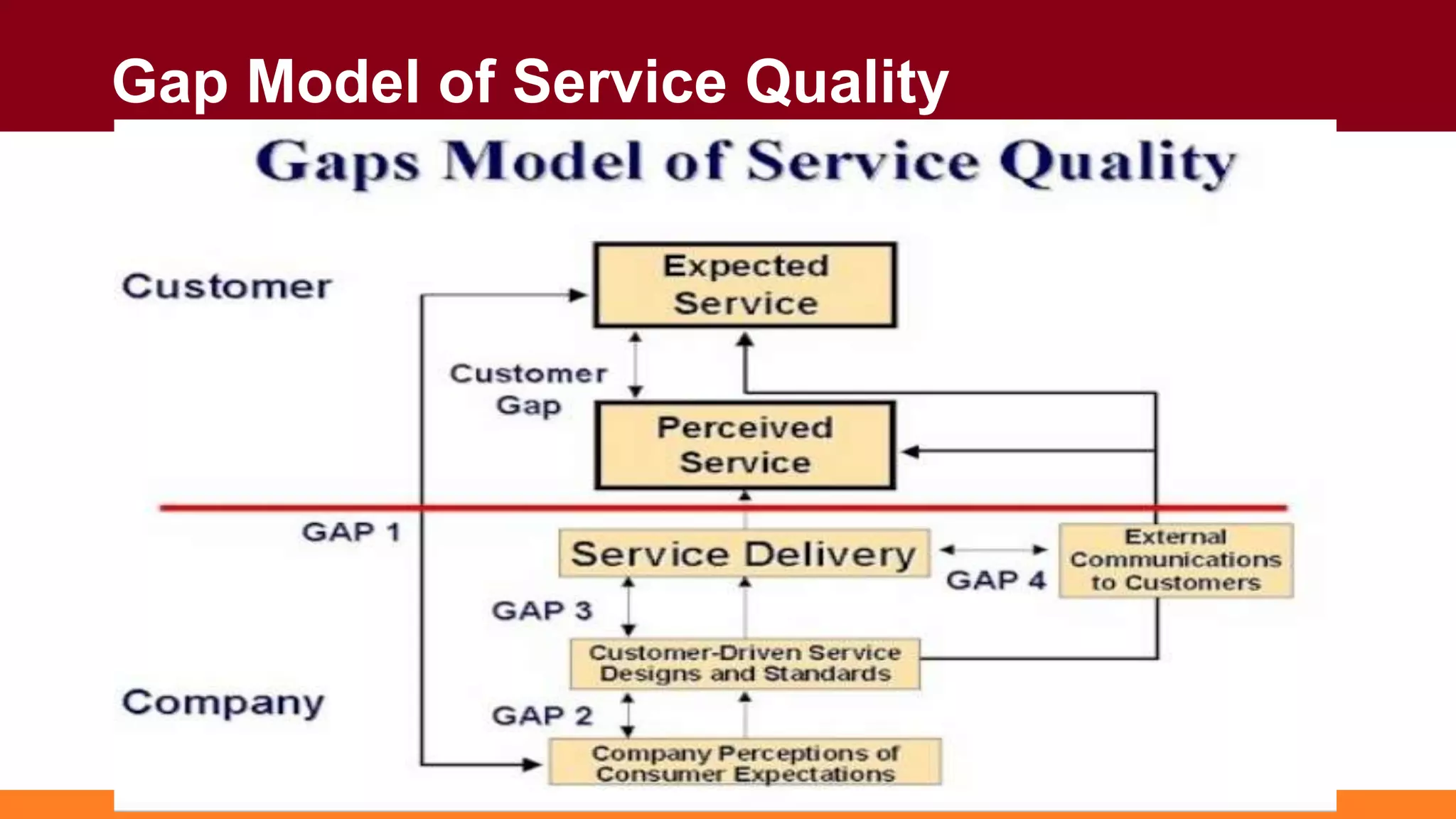
The document discusses service quality and encounter management. It describes the Gap Model of Service Quality, which identifies four gaps that can occur during service delivery: 1) between customer expectations and management perceptions, 2) between customer expectations and service design, 3) between service design and service delivery, and 4) between service delivery and external communications. It also discusses strategies to minimize each gap. The document then covers the SERVQUAL instrument for measuring service quality and the uses of SERVQUAL surveys. Finally, it defines service encounters, explores the importance of encounters, and categorizes types of encounters.
Gap Model ofService Quality
• Gap refers to any deviations
• Gaps are the leakages which takes place during the service
delivery process
A] Customer Gap
• It is the difference between customer expectations and
perceptions Expected Service
Perceived Service
4.
B. Provider Gap
1.The Listening Gap
• It is the difference between customer expectations of service
and company understanding of those expectations
• Reasons
• Inadequate customer research orientation
• Lack of upward communication
• Insufficient relationship focus
• Inadequate service recovery
Customer Expectation
Company Perceptions
Of Customer
Expectations
G
a
p
1
5.
Strategies to ReduceListening Gap
• Environmental scanning and monitoring
• Collect accurate information about customer’s expectation
• Developing a system to acquire continuous information from the
service employees
• Implementing relationship marketing
• Developing a well-defined complaint handling system
• Empowerment of employees
6.
2. Service Designand Standard Gap
• It occurs when service provider fails to design and provide
service as per the standard.
• Difficulty experienced in translating customer expectations
into service quality specifications that employees can
understand and execute.
• Reasons
• Poor Service Design
• Absence of customer driven standards
• Inappropriate physical evidence and service scape
Customer Driven
Designs and Standards
Management
Perceptions of
Customer Expectations
G
a
p
2
7.
Strategies to reduceservice design and standard gap
• Identification of customer preferences
• Clearly designing the service
• Develop service blueprinting
8.
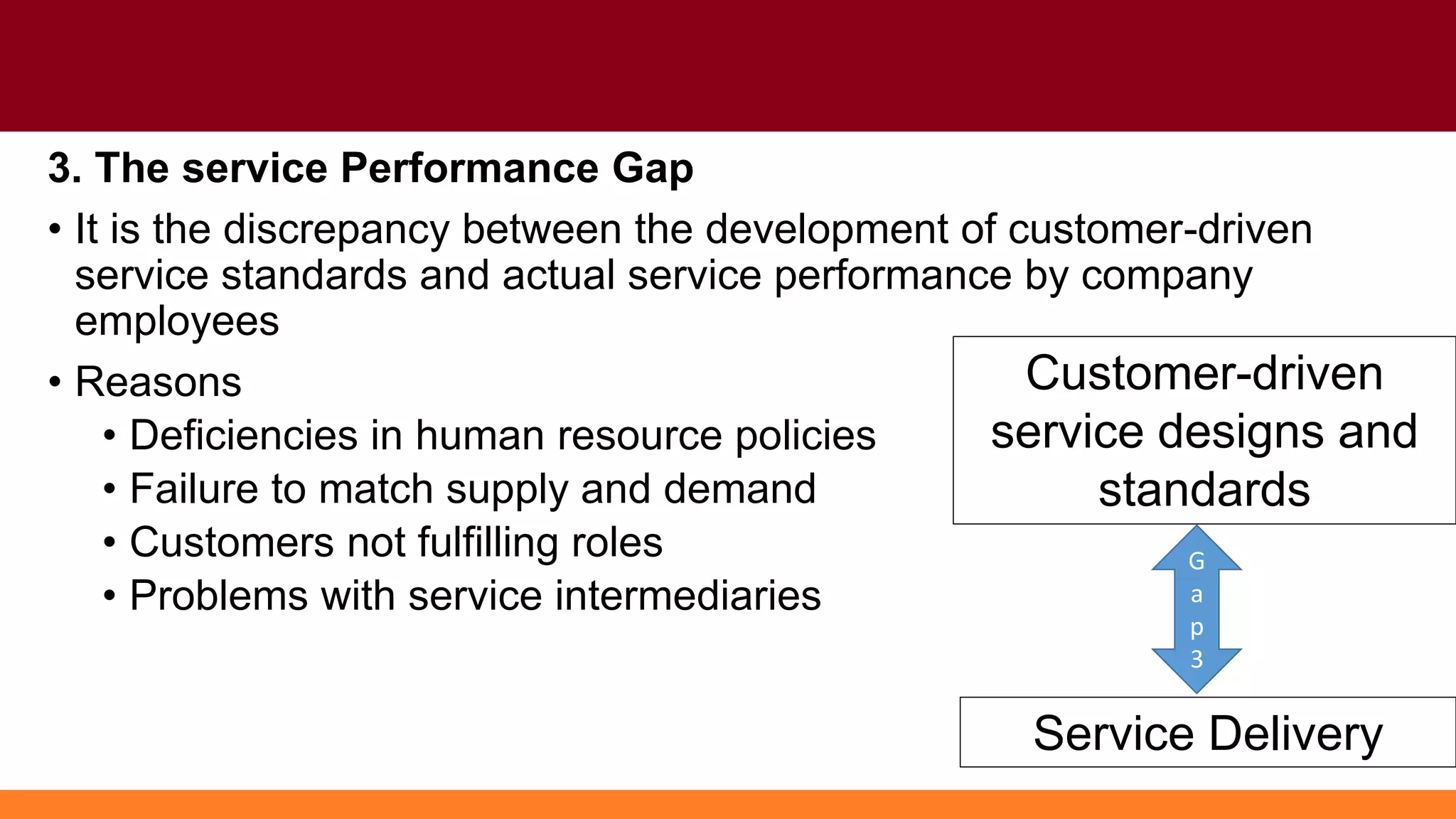
3. The servicePerformance Gap
• It is the discrepancy between the development of customer-driven
service standards and actual service performance by company
employees
• Reasons
• Deficiencies in human resource policies
• Failure to match supply and demand
• Customers not fulfilling roles
• Problems with service intermediaries
Customer-driven
service designs and
standards
Service Delivery
G
a
p
3
9.
Strategies to minimizeservice performance gap
• Select and train the service employees
• Top and middle management’s continuous support to
employees
• Proper management of service environment
• Empowerment of employees
• Focus on internal marketing
10.
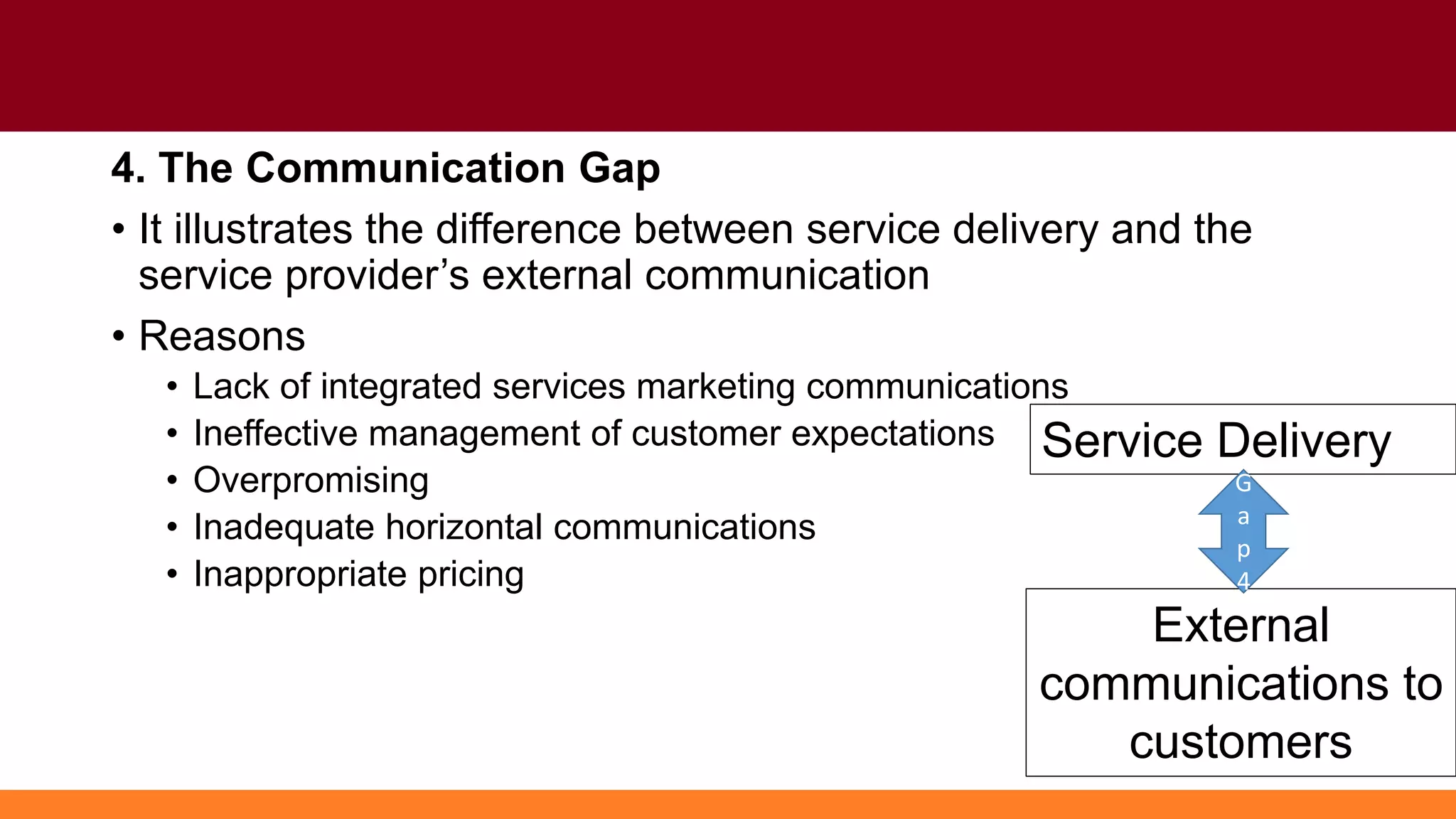
4. The CommunicationGap
• It illustrates the difference between service delivery and the
service provider’s external communication
• Reasons
• Lack of integrated services marketing communications
• Ineffective management of customer expectations
• Overpromising
• Inadequate horizontal communications
• Inappropriate pricing
Service Delivery
External
communications to
customers
G
a
p
4
11.
Strategies to minimizethe communication gap
• Educate customers to receive services
• Manage word-of-mouth
• Train, educate and motivate staffs to involve in service delivery
process
• Integrated service marketing communications
12.
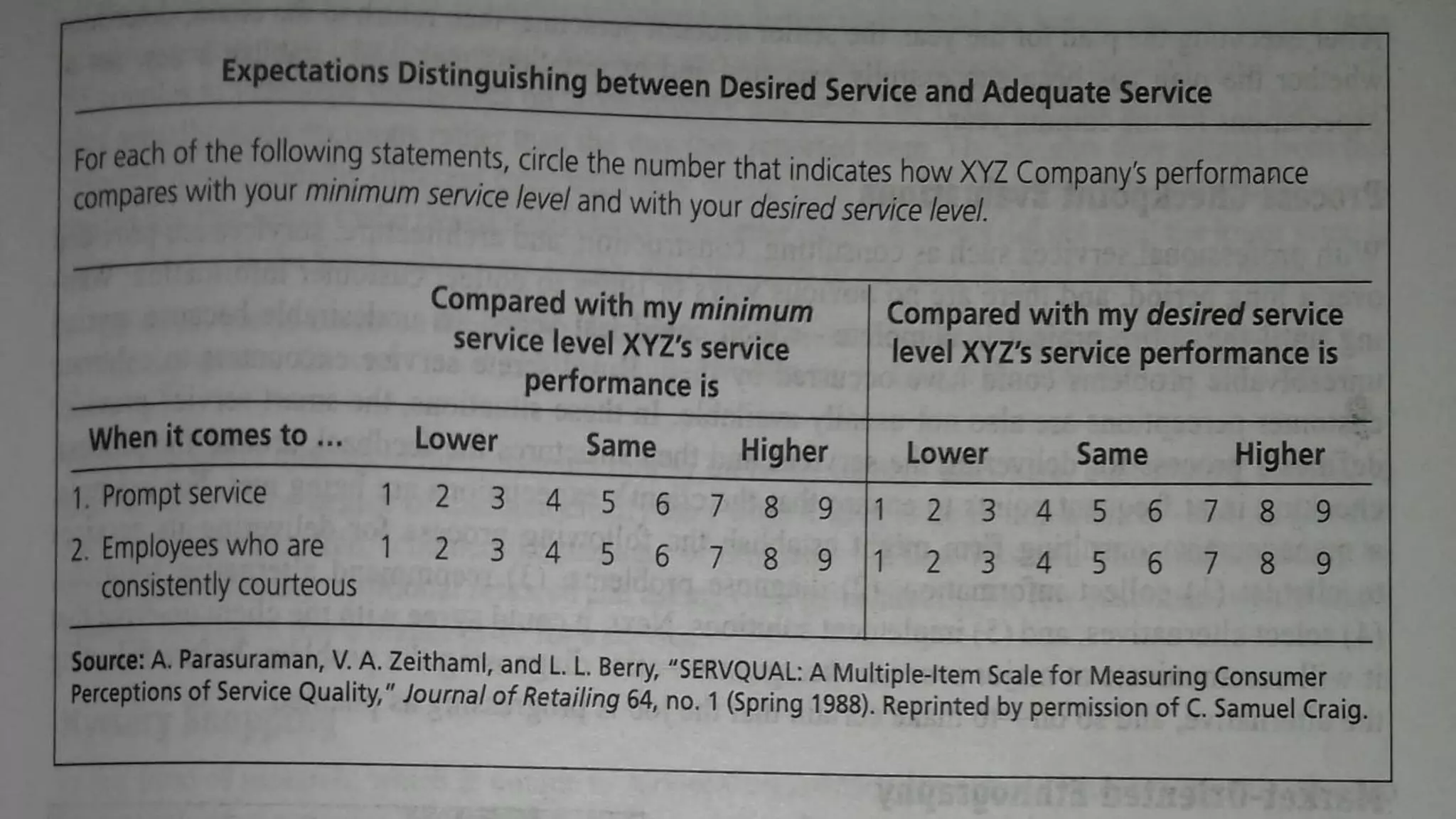
Measurement of ServiceQuality: The
SERVQUAL Instrument
• Simply, SERVQUAL is a questionnaire or a measurement scale
that is designed to measure the quality of service
• SERVQUAL is a multi-dimensional research instrument,
designed to capture consumer expectations and perceptions of
a service along the five dimensions that are believed to
represent service quality
• The scale consists 21 perception items that are distributed
throughout the five service quality dimensions
13.
Uses of SERVQUALSurvey
• To determine the average gap score for each service attributes
• To assess a company’s service quality along each of the five
SERVQUAL dimensions
• To track customers’ expectations and perceptions over time
• To compare a company’s SERVQUAL scores against those of
competitors
• To identify and examine customer segments that differ
significantly in their assessments of a company’s service
performance
17.
Service Encounters (Momentof Truth)
• It is duration of interaction of customers with firms internal
employees and technology
• Service encounters are building blocks for customer
perceptions
• Also called real time marketing
• Service encounters are where promises are kept or broken
• Some services have few encounters where other have many
18.
Importance of Encounters
•Determines the consumption of service
• Multiple encounters are significant in shaping the composite
image of the company
• Determines the retention of customers
19.
Types of ServiceEncounters
Remote encounters
Technology-mediated encounters
Face to face encounters
A. By Zeithaml (2001)
20.
Remote Encounter
• Canoccur without direct human contact
• E.g. ATM system in banks, retail purchasing through internet,
airlines ticketing, etc.
• Tangible evidence of service and the quality of the technical
processes and system become the primary basis for judging
quality
21.
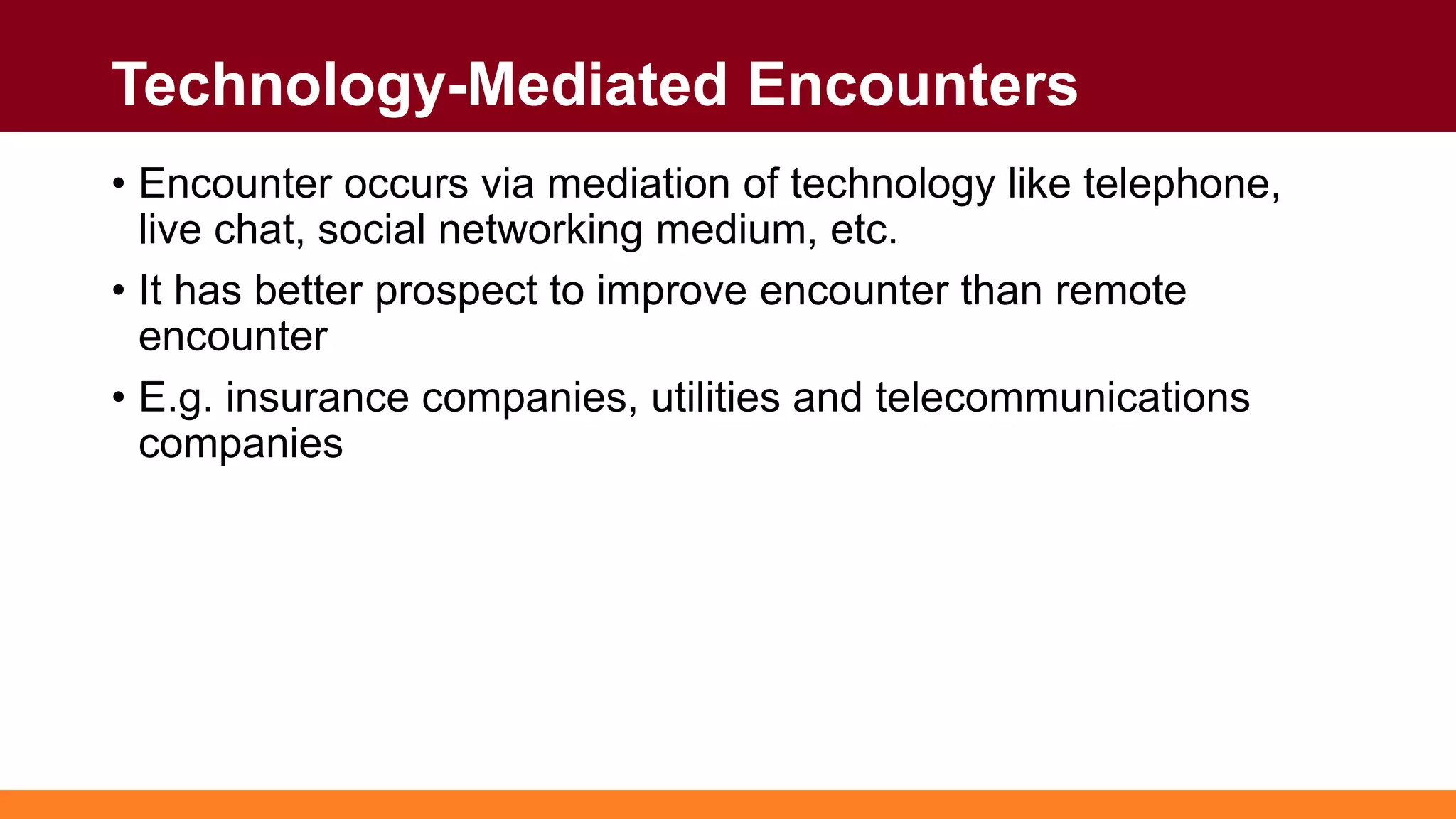
Technology-Mediated Encounters
• Encounteroccurs via mediation of technology like telephone,
live chat, social networking medium, etc.
• It has better prospect to improve encounter than remote
encounter
• E.g. insurance companies, utilities and telecommunications
companies
22.
Face to FaceEncounter
• Occurs in direct personal contact
• Verbal and non-verbal communication play significant role
• E.g. in hospitals with doctors, teaching, Lawer, etc
23.
B. Service Encounterson the Basis of Process
• People Processing
• Customers involve physically
• E.g. trekking, travelling, body building, etc
• Possession Processing
• Services are provided to the assets/possession of customers
• E.g. bicycle servicing, painting a house, laptop maintenance
• Mental Stimulus Processing
• Involves services that interact with peoples mind
• Mental attention of the customer is vital
• E.g. education service, news and information, psychological counseling
24.
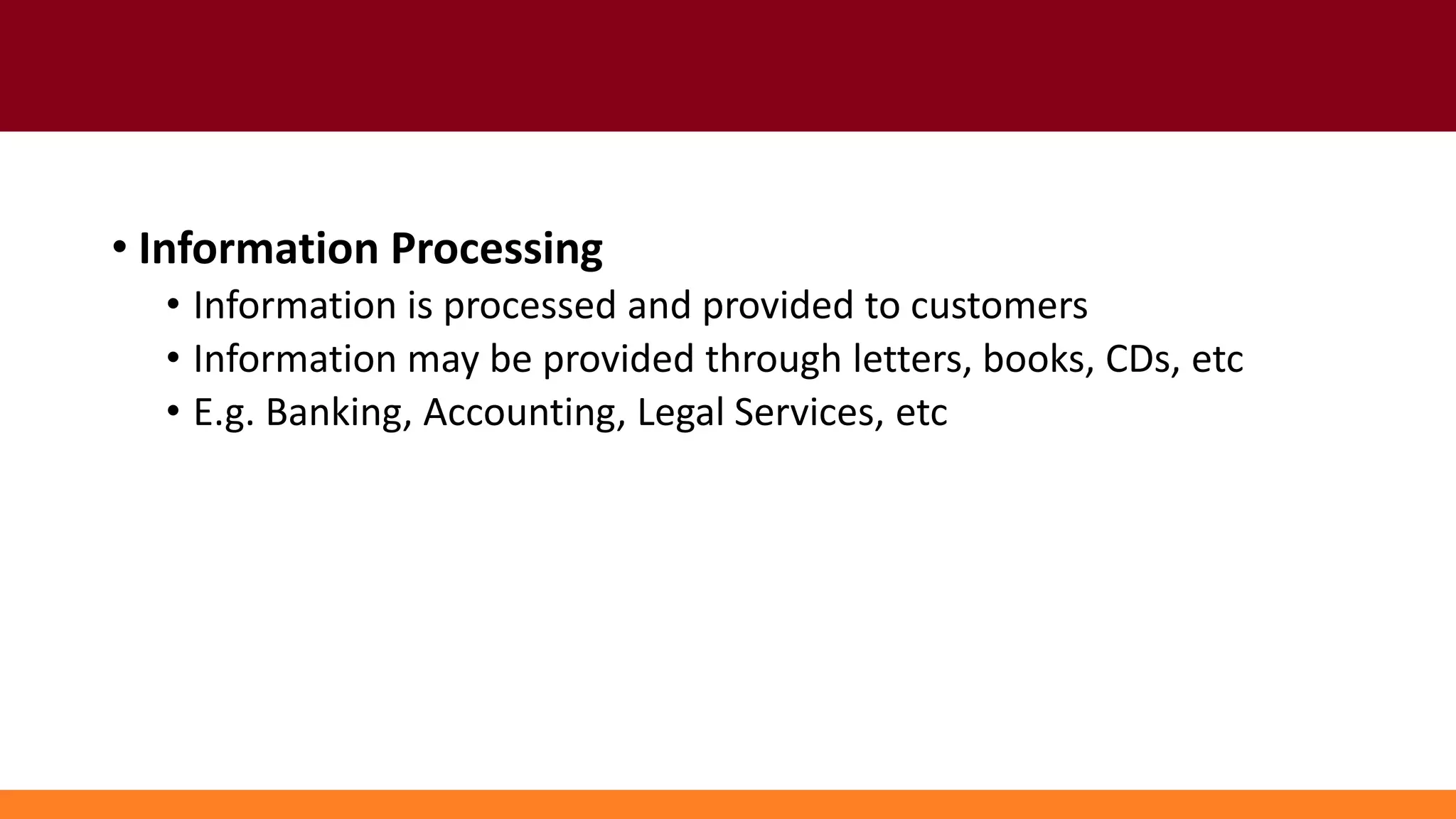
• Information Processing
•Information is processed and provided to customers
• Information may be provided through letters, books, CDs, etc
• E.g. Banking, Accounting, Legal Services, etc
25.
Main Drivers ofService Quality
• People
• Process
• Service Product
![Gap Model of Service Quality
• Gap refers to any deviations
• Gaps are the leakages which takes place during the service
delivery process
A] Customer Gap
• It is the difference between customer expectations and
perceptions Expected Service
Perceived Service](https://image.slidesharecdn.com/servicequalityencountermanagement-180811091329/75/Service-quality-encounter-management-3-2048.jpg)