SERVICE QUALITY
MANAGEMENT
Submitted to
Assistant Professor Jinu Mathew
Submitted by
Jayakrishnan V
Femymol MA
Emmanuel Sebastian
Govind S Unnithan
Dhanuja Pradeep
SERVICE QUALITY MANAGEMENT
• Service quality management encompasses a variety of processes used to assess
the quality of services according to customer expectations. It also includes the
maintentance and long-term monitoring of all of the services offered to
customers, as to track developments in quality and measure the efficiency of
improvement efforts.
• By measuring the size of the gap between expectations and reality, companies
are delivered with actionable suggestions and ideas for targeted improvements,
and profit from the additional benefit of getting to know their target audiences
much better along the way. Moreover, it enables companies to identify and
reduce sources of errors and customer complaints.
BENEFITS OF SERVICE QUALITY MANAGEMENT
What are the benefits of using a Service Quality Management System?
A Service Quality Management System is used to communicate to employees how a company
defines success and what needs to be done to offer and maintain high-quality services, and is
also used as a management technique to motivate employees and influence their behavior and
interactions with customers.
• Implement a centralized Service Quality Management System to monitor service quality
across all company touch points and use the following beneficial features to improve your
organization for good:
• Create and measure your own definition of customer and employee satisfaction, enabling
the custom evaluation of success according to the factors important to you
• Implement a measurement system to capture the exact data you need, saving time and
cutting costs otherwise spent digging through heaps of data
Benefits……
• Receive custom performance reports, such as NPS, satisfaction rankings,
and benchmarks to view business performance from varied perspectives
• Continuously monitor the development of results in collaboration with
entire teams, resulting in closer and more transparent collaboration and
reduced response times
• Use a bonus-malus system based on service performance achievements
and motivate teams and contractors to do an even better job
• Close the gap between customer expectations and service
reality to increase customer satisfaction and build loyalty
DIMENSIONS OF SERVICE QUALITY ENVIRONMENT
The 5 Dimensions Defined
After extensive research, Zeithaml, Parasuraman and Berry found five dimensions
customers use when evaluating service quality. They named their survey instrument SERVQUAL.
The five SERVQUAL dimensions are:
• TANGIBLES-Appearance of physical facilities, equipment, personnel, and communication
materials
• RELIABILITY-Ability to perform the promised service dependably and accurately
• RESPONSIVENESS-Willingness to help customers and provide prompt service
• ASSURANCE-Knowledge and courtesy of employees and their ability to convey trust and
confidence
• EMPATHY-Caring, individualized attention the firm provides its customers
#1 Just Do It
RELIABILITY: Do what you say
you’re going to do when you said
you were going to do it.
Customers want to count on their
providers. They value that
reliability. Don’t providers
yearn to find out what customers
value? This is it.It’s three times
more important to be
reliable than have shiny new
equipment or flashy uniforms.
#2 Do It Now
RESPONSIVENESS: Respond
quickly, promptly, rapidly,
immediately, instantly.
Waiting a day to return a call or
email doesn’t make it. Even if
customers are chronically
slow in getting back to providers,
responsiveness is more than
1/5th of their service quality
assessment.
DIMENSIONS…..
#3 Know What Your Doing
ASSURANCE: Service
providers are expected to be
the experts of the service
they’re delivering. It’s a given.
SERVQUAL research showed
it’s important to communicate
that expertise to customers. If
a service provider is highly
skilled, but customers don’t
see that, their confidence in
that provider will be lower.
And their assessment of that
provider’s service quality will
be lower.
#4 Care about Customers as
much as the Service
EMPATHY: Services can be
performed completely to
specifications. Yet customers
may not feel provider employees
care about them during delivery.
And this hurts customers’
assessments of providers’
service quality.
SERVICE DELIVERY MATTERS
Providers’ service delivery can be as important
as how it was done. Provider employees should
be trained how to interact with customers and
their end-users. Even a brief session during
initial orientation helps. Anything to help them
understand their impact on customers’
assessment of service quality.
#5 Look Sharp
TANGIBLES: Even though this is
the least important dimension,
appearance matters. Just
not as much as the other
dimensions.
Service providers will still want
to make certain their employees
appearance, uniforms,
equipment, and work areas on-
site (closets, service offices, etc.)
look good. The danger is for
providers to make everything
look sharp, and then fall short
on RELIABILITY or
RESPONSIVENESS.
DIMENSIONS……
SERVICE
PERCEPTION
GAP MODEL OF SERVICE QUALITY
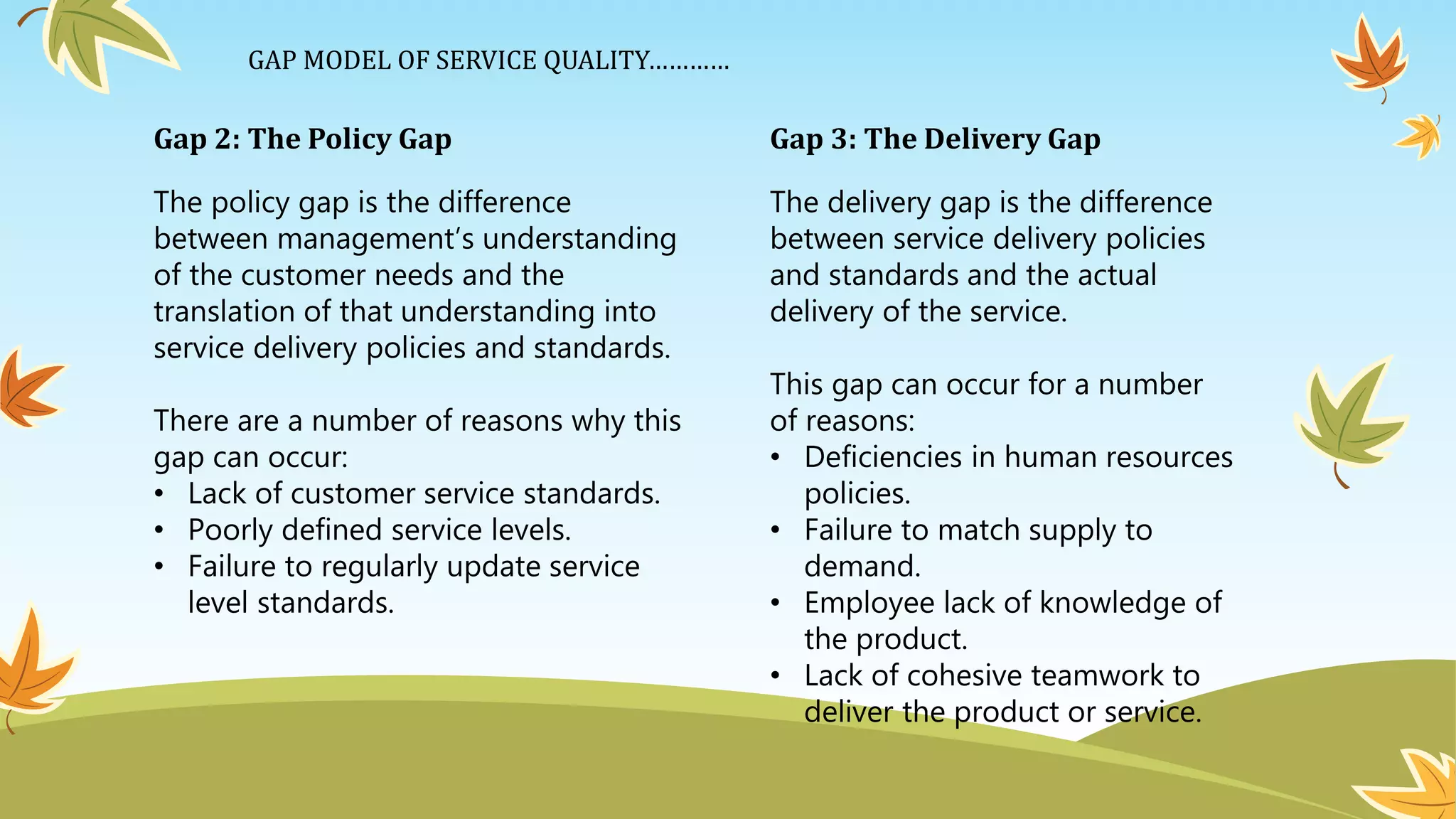
Gap Modelof ServiceQuality
The Gap Model of Service Quality (aka the Customer Service Gap Model or the 5 Gap
Model) is a framework which can help us to understand customer satisfaction.
The model shows the five major satisfaction gaps that organizations must address
when seeking to meet customer expectations. The model was first proposed by A.
Parasuraman, Valarie Zeithaml, and Leonard L. Berry in 1985.
In the Gap Model of Service Quality, customer satisfaction is largely a function of
perception. If the customer perceives that the service meets their expectations then
they will be satisfied. If not, they’ll be dissatisfied. If they are dissatisfied then it will
be because of one of the five customer service “gaps”
Gap 1: Knowledge Gap
The knowledge gap is the difference between
the customer’s expectations of the service and
the company’s provision of that service.
Essentially, this gap arises because
management doesn’t know exactly what
customers expect. There are a number
of reasons this could happen, including:
• Lack of management and customer
interaction.
• Lack of communication between service
employees and management.
• Insufficient market research.
• Insufficient relationship focus.
• Failure to listen to customer complaints.
Gap 2: The Policy Gap
The policy gap is the difference
between management’s understanding
of the customer needs and the
translation of that understanding into
service delivery policies and standards.
There are a number of reasons why this
gap can occur:
• Lack of customer service standards.
• Poorly defined service levels.
• Failure to regularly update service
level standards.
Gap 3: The Delivery Gap
The delivery gap is the difference
between service delivery policies
and standards and the actual
delivery of the service.
This gap can occur for a number
of reasons:
• Deficiencies in human resources
policies.
• Failure to match supply to
demand.
• Employee lack of knowledge of
the product.
• Lack of cohesive teamwork to
deliver the product or service.
GAP MODEL OF SERVICE QUALITY…………
Gap 4: The Communication Gap
The communication gap is the gap between
what gets promised to customers through
advertising and what gets delivered. Again,
there are a number of reasons why this can
happen:
• Overpromising.
• Viewing external communications as
separate to what’s going on internally.
• Insufficient communications between the
operations and advertising teams.
• Communication gaps lead to customer
dissatisfaction. This happens because what
they receive isn’t what they were promised.
In the worst case, it may cause them to turn
to an alternative supplier
Gap 5: The Customer Gap
The customer gap is the difference between
customer expectations and customer
perceptions. This gap occurs because customers
do not always understand what the service has
done for them or they misinterpret the service
quality.
Many organizations can be completely blind to
this gap. This gap can happen because of one of
the other four gaps, or simply because the
customer perceives the quality of the
service incorrectly. In a worst-case scenario, it
could lead to a business losing a large
proportion of their customers
overnight. Although the company thought there
was no gap, the reality was that their customers
were just waiting for someone to fill their
perceived gap.
SERVICE GAP MODEL….
SERVICE QUALITY AUDIT
Quality audit is the process of systematic examination of a quality system carried out by an internal or
external quality auditor or an audit team, in this case ensuring the quality of services. It is an important
part of an organization's quality management system and is a key element in the ISO quality system
standard, ISO 9001.
Quality audits are typically performed at predefined time intervals and ensure that the institution has
clearly defined internal system monitoring procedures linked to effective action. This can help determine
if the organization complies with the defined quality system processes and can involve procedural or
results-based assessment criteria.
Audits are an essential management tool to be used for verifying objective evidence of processes, to
assess how successfully processes have been implemented, for judging the effectiveness of achieving any
defined target levels, to provide evidence concerning reduction and elimination of problem areas. For the
benefit of the organization, quality auditing should not only report non-conformances and corrective
actions, but also highlight areas of good practice. In this way other departments may share information
and amend their working practices as a result, also contributing to continual improvement.
THANK YOU

Service quality management

  • 1.
    SERVICE QUALITY MANAGEMENT Submitted to AssistantProfessor Jinu Mathew Submitted by Jayakrishnan V Femymol MA Emmanuel Sebastian Govind S Unnithan Dhanuja Pradeep
  • 2.
    SERVICE QUALITY MANAGEMENT •Service quality management encompasses a variety of processes used to assess the quality of services according to customer expectations. It also includes the maintentance and long-term monitoring of all of the services offered to customers, as to track developments in quality and measure the efficiency of improvement efforts. • By measuring the size of the gap between expectations and reality, companies are delivered with actionable suggestions and ideas for targeted improvements, and profit from the additional benefit of getting to know their target audiences much better along the way. Moreover, it enables companies to identify and reduce sources of errors and customer complaints.
  • 3.
    BENEFITS OF SERVICEQUALITY MANAGEMENT What are the benefits of using a Service Quality Management System? A Service Quality Management System is used to communicate to employees how a company defines success and what needs to be done to offer and maintain high-quality services, and is also used as a management technique to motivate employees and influence their behavior and interactions with customers. • Implement a centralized Service Quality Management System to monitor service quality across all company touch points and use the following beneficial features to improve your organization for good: • Create and measure your own definition of customer and employee satisfaction, enabling the custom evaluation of success according to the factors important to you • Implement a measurement system to capture the exact data you need, saving time and cutting costs otherwise spent digging through heaps of data
  • 4.
    Benefits…… • Receive customperformance reports, such as NPS, satisfaction rankings, and benchmarks to view business performance from varied perspectives • Continuously monitor the development of results in collaboration with entire teams, resulting in closer and more transparent collaboration and reduced response times • Use a bonus-malus system based on service performance achievements and motivate teams and contractors to do an even better job • Close the gap between customer expectations and service reality to increase customer satisfaction and build loyalty
  • 5.
    DIMENSIONS OF SERVICEQUALITY ENVIRONMENT The 5 Dimensions Defined After extensive research, Zeithaml, Parasuraman and Berry found five dimensions customers use when evaluating service quality. They named their survey instrument SERVQUAL. The five SERVQUAL dimensions are: • TANGIBLES-Appearance of physical facilities, equipment, personnel, and communication materials • RELIABILITY-Ability to perform the promised service dependably and accurately • RESPONSIVENESS-Willingness to help customers and provide prompt service • ASSURANCE-Knowledge and courtesy of employees and their ability to convey trust and confidence • EMPATHY-Caring, individualized attention the firm provides its customers
  • 6.
    #1 Just DoIt RELIABILITY: Do what you say you’re going to do when you said you were going to do it. Customers want to count on their providers. They value that reliability. Don’t providers yearn to find out what customers value? This is it.It’s three times more important to be reliable than have shiny new equipment or flashy uniforms. #2 Do It Now RESPONSIVENESS: Respond quickly, promptly, rapidly, immediately, instantly. Waiting a day to return a call or email doesn’t make it. Even if customers are chronically slow in getting back to providers, responsiveness is more than 1/5th of their service quality assessment. DIMENSIONS…..
  • 7.
    #3 Know WhatYour Doing ASSURANCE: Service providers are expected to be the experts of the service they’re delivering. It’s a given. SERVQUAL research showed it’s important to communicate that expertise to customers. If a service provider is highly skilled, but customers don’t see that, their confidence in that provider will be lower. And their assessment of that provider’s service quality will be lower. #4 Care about Customers as much as the Service EMPATHY: Services can be performed completely to specifications. Yet customers may not feel provider employees care about them during delivery. And this hurts customers’ assessments of providers’ service quality. SERVICE DELIVERY MATTERS Providers’ service delivery can be as important as how it was done. Provider employees should be trained how to interact with customers and their end-users. Even a brief session during initial orientation helps. Anything to help them understand their impact on customers’ assessment of service quality. #5 Look Sharp TANGIBLES: Even though this is the least important dimension, appearance matters. Just not as much as the other dimensions. Service providers will still want to make certain their employees appearance, uniforms, equipment, and work areas on- site (closets, service offices, etc.) look good. The danger is for providers to make everything look sharp, and then fall short on RELIABILITY or RESPONSIVENESS. DIMENSIONS……
  • 8.
  • 9.
    Gap Modelof ServiceQuality TheGap Model of Service Quality (aka the Customer Service Gap Model or the 5 Gap Model) is a framework which can help us to understand customer satisfaction. The model shows the five major satisfaction gaps that organizations must address when seeking to meet customer expectations. The model was first proposed by A. Parasuraman, Valarie Zeithaml, and Leonard L. Berry in 1985. In the Gap Model of Service Quality, customer satisfaction is largely a function of perception. If the customer perceives that the service meets their expectations then they will be satisfied. If not, they’ll be dissatisfied. If they are dissatisfied then it will be because of one of the five customer service “gaps”
  • 10.
    Gap 1: KnowledgeGap The knowledge gap is the difference between the customer’s expectations of the service and the company’s provision of that service. Essentially, this gap arises because management doesn’t know exactly what customers expect. There are a number of reasons this could happen, including: • Lack of management and customer interaction. • Lack of communication between service employees and management. • Insufficient market research. • Insufficient relationship focus. • Failure to listen to customer complaints.
  • 11.
    Gap 2: ThePolicy Gap The policy gap is the difference between management’s understanding of the customer needs and the translation of that understanding into service delivery policies and standards. There are a number of reasons why this gap can occur: • Lack of customer service standards. • Poorly defined service levels. • Failure to regularly update service level standards. Gap 3: The Delivery Gap The delivery gap is the difference between service delivery policies and standards and the actual delivery of the service. This gap can occur for a number of reasons: • Deficiencies in human resources policies. • Failure to match supply to demand. • Employee lack of knowledge of the product. • Lack of cohesive teamwork to deliver the product or service. GAP MODEL OF SERVICE QUALITY…………
  • 12.
    Gap 4: TheCommunication Gap The communication gap is the gap between what gets promised to customers through advertising and what gets delivered. Again, there are a number of reasons why this can happen: • Overpromising. • Viewing external communications as separate to what’s going on internally. • Insufficient communications between the operations and advertising teams. • Communication gaps lead to customer dissatisfaction. This happens because what they receive isn’t what they were promised. In the worst case, it may cause them to turn to an alternative supplier Gap 5: The Customer Gap The customer gap is the difference between customer expectations and customer perceptions. This gap occurs because customers do not always understand what the service has done for them or they misinterpret the service quality. Many organizations can be completely blind to this gap. This gap can happen because of one of the other four gaps, or simply because the customer perceives the quality of the service incorrectly. In a worst-case scenario, it could lead to a business losing a large proportion of their customers overnight. Although the company thought there was no gap, the reality was that their customers were just waiting for someone to fill their perceived gap. SERVICE GAP MODEL….
  • 13.
    SERVICE QUALITY AUDIT Qualityaudit is the process of systematic examination of a quality system carried out by an internal or external quality auditor or an audit team, in this case ensuring the quality of services. It is an important part of an organization's quality management system and is a key element in the ISO quality system standard, ISO 9001. Quality audits are typically performed at predefined time intervals and ensure that the institution has clearly defined internal system monitoring procedures linked to effective action. This can help determine if the organization complies with the defined quality system processes and can involve procedural or results-based assessment criteria. Audits are an essential management tool to be used for verifying objective evidence of processes, to assess how successfully processes have been implemented, for judging the effectiveness of achieving any defined target levels, to provide evidence concerning reduction and elimination of problem areas. For the benefit of the organization, quality auditing should not only report non-conformances and corrective actions, but also highlight areas of good practice. In this way other departments may share information and amend their working practices as a result, also contributing to continual improvement.
  • 14.