Lesson 1 integration as the inverse of differentiation
This document provides an introduction to integration, which is the inverse process of differentiation. It discusses the basic notation and concepts of integration, such as taking the integral of a function to find its anti-derivative and adding a constant C. Examples are provided of integrating common functions and determining the constant value based on initial conditions. Questions and answers about integration techniques are also presented.
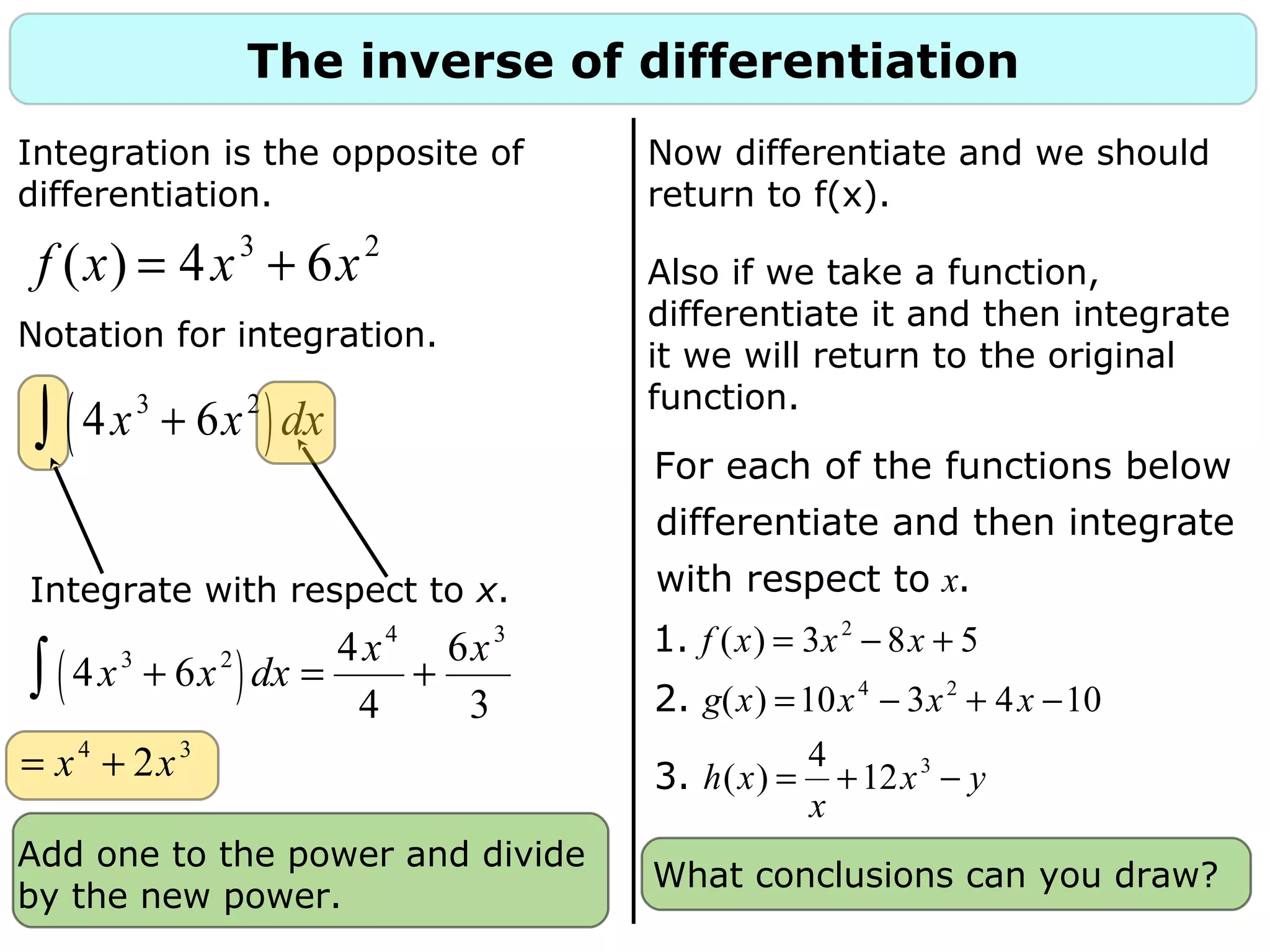
The inverse ofdifferentiation
f (x) = 4x3
+ 6x2
Notation for integration.
Integration is the opposite of
differentiation.
4x3
+ 6x2
( )dx∫
Integrate with respect to x.
4x3
+ 6x2
( )dx∫ =
4x4
4
+
6x3
3
= x4
+ 2x3
Add one to the power and divide
by the new power.
Now differentiate and we should
return to f(x).
Also if we take a function,
differentiate it and then integrate
it we will return to the original
function.
For each of the functions below
differentiate and then integrate
with respect to x.
1. f (x) = 3x2
− 8x + 5
2. g(x) =10x4
− 3x2
+ 4x −10
3. h(x) =
4
x
+12x3
− y
What conclusions can you draw?
3.
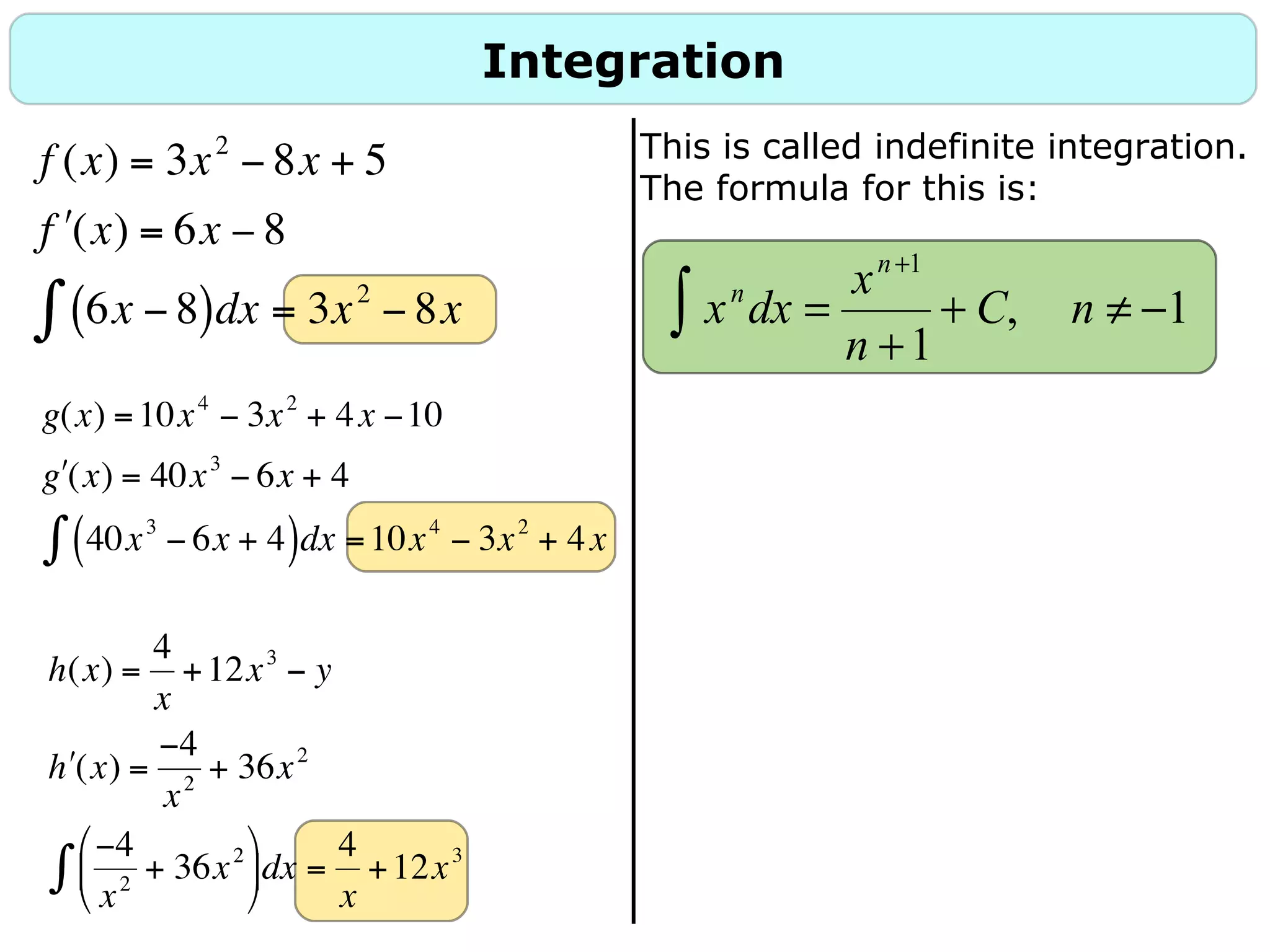
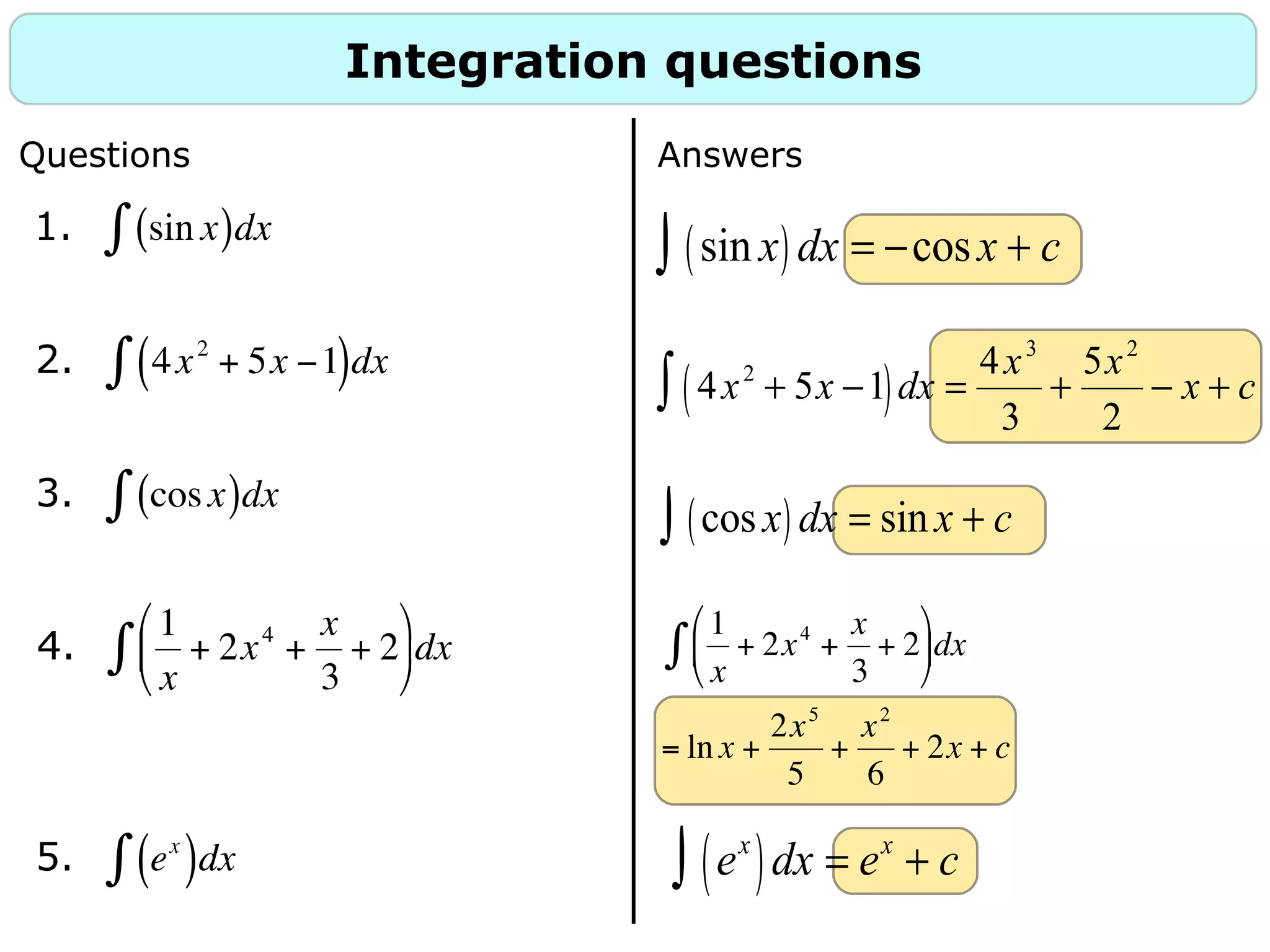
Integration
This is calledindefinite integration.
The formula for this is:
xn
dx =
xn+1
n +1
+ C, n ≠ −1∫
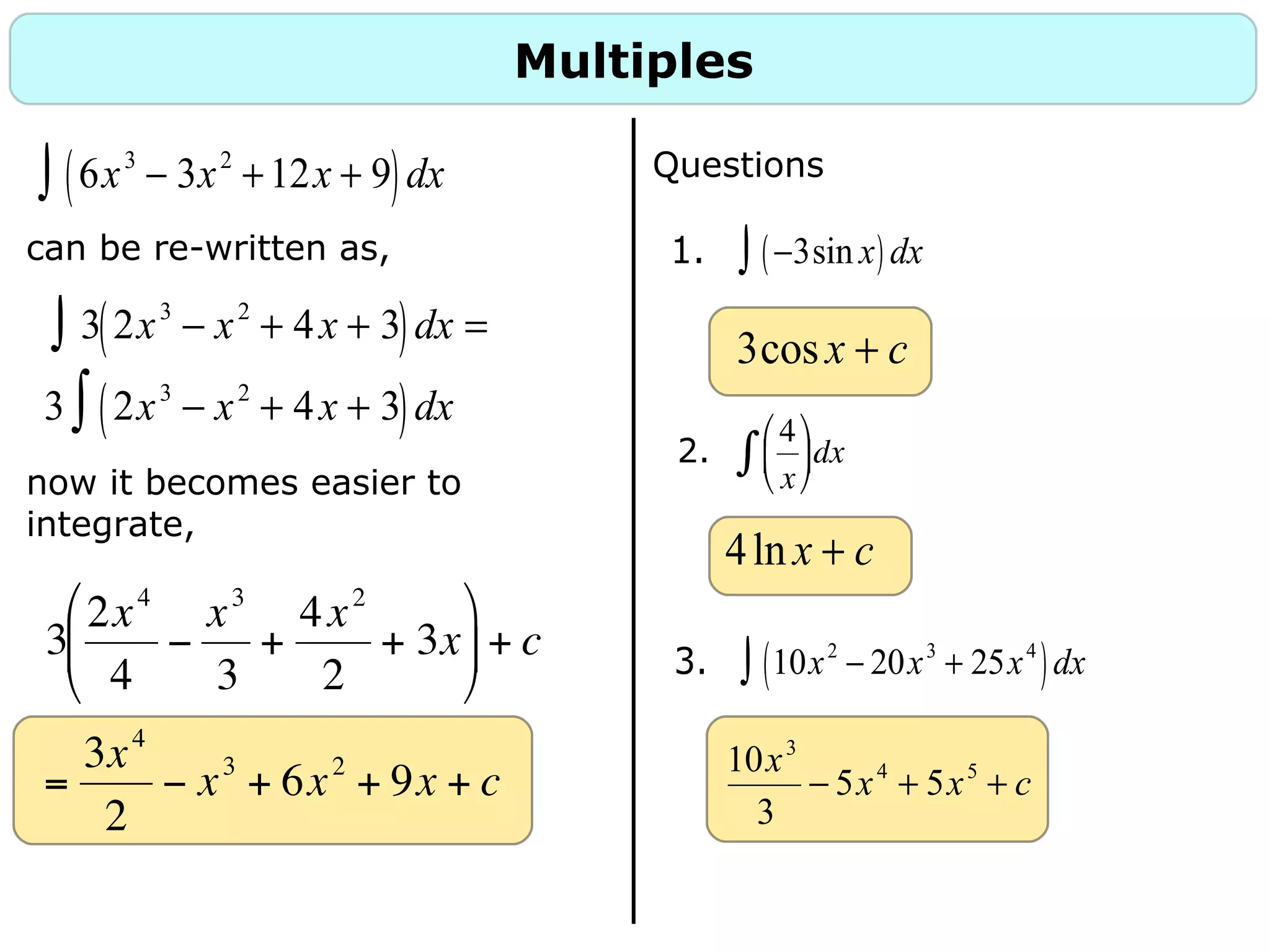
Multiples
6x3
− 3x2
+12x +9( )dx∫
can be re-written as,
now it becomes easier to
integrate,
3 2x3
− x2
+ 4x + 3( )dx =∫
3 2x3
− x2
+ 4x + 3( )dx∫
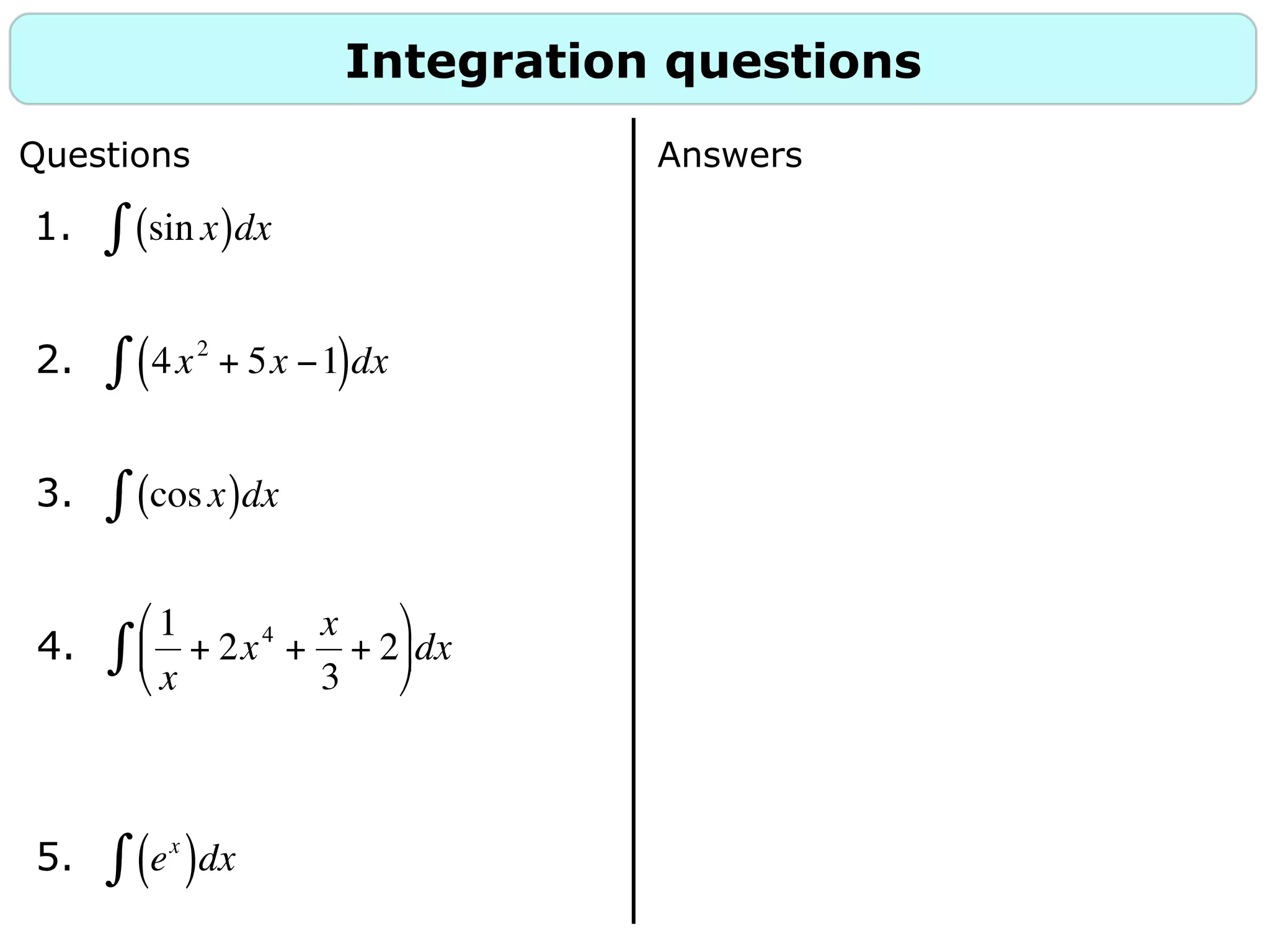
Questions
1. −3sin x( )dx∫
3. 10x2
− 20x3
+ 25x4
( )dx∫
3cosx + c
4ln x + c
10x3
3
− 5x4
+ 5x5
+ c
7.
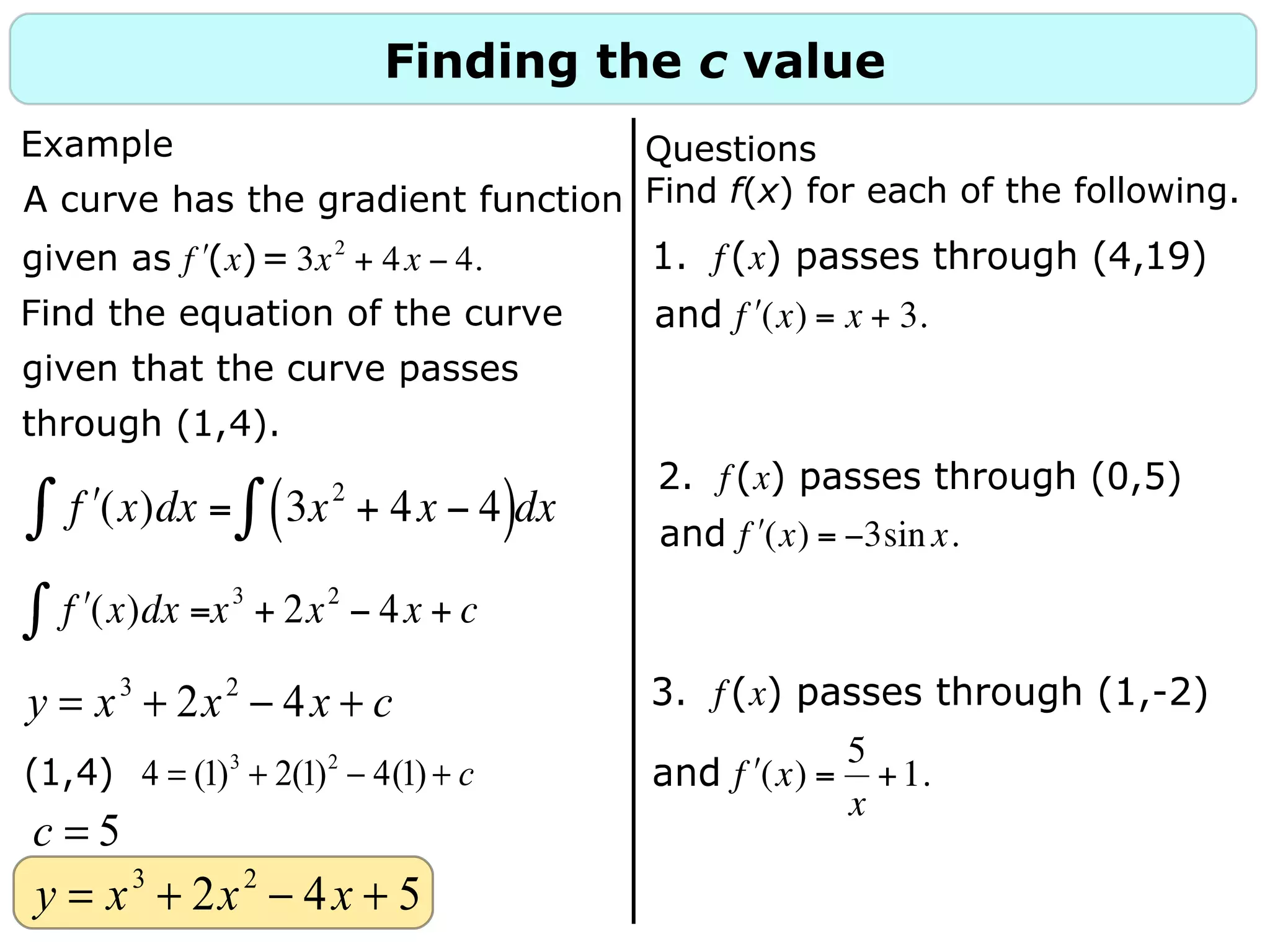
Finding the cvalue
y = x3
+ 2x2
− 4x + c
(1,4) 4 = (1)3
+ 2(1)2
− 4(1) + c
c = 5
y = x3
+ 2x2
− 4x + 5
Questions
Find f(x) for each of the following.
8.
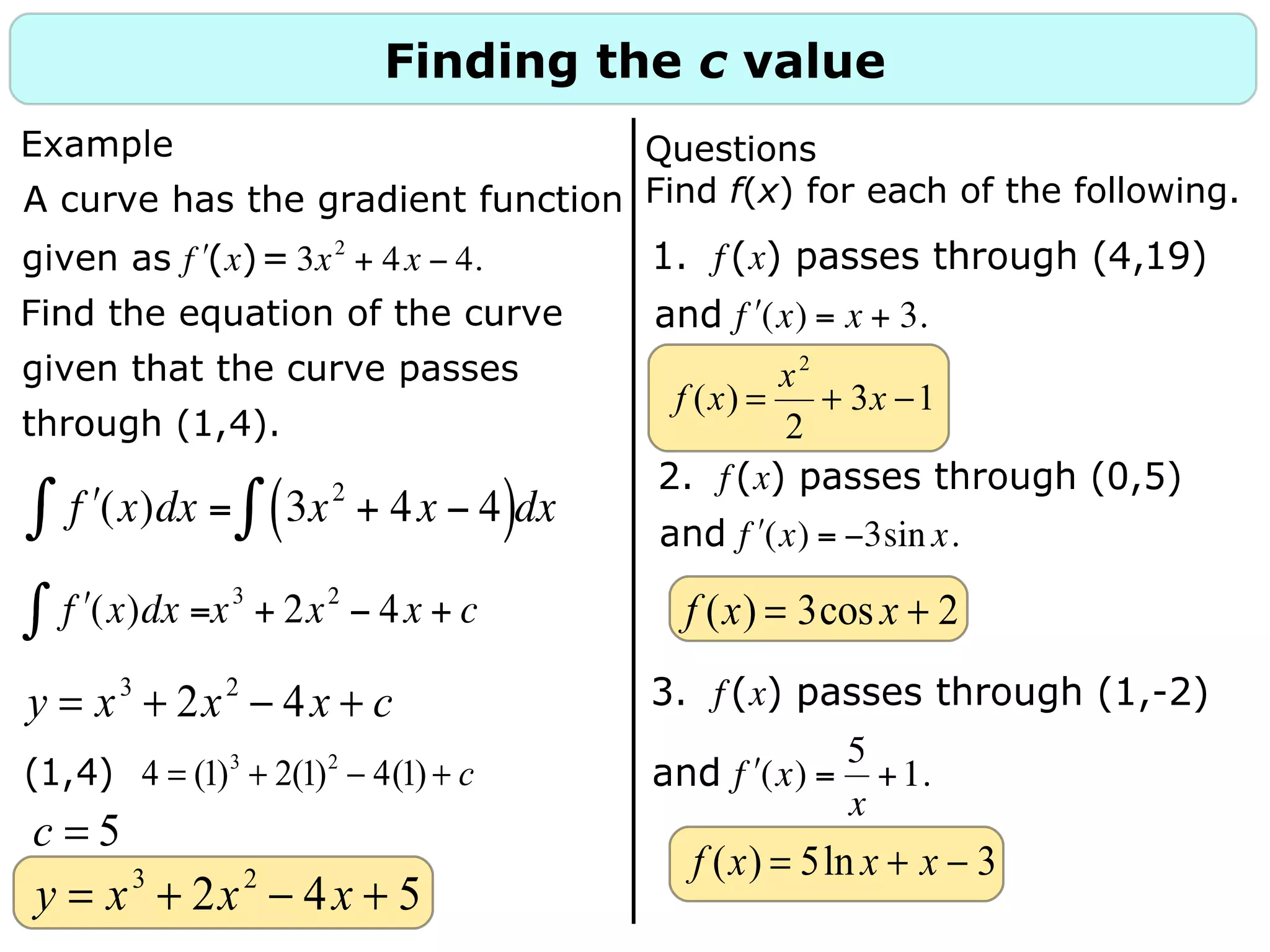
Finding the cvalue
y = x3
+ 2x2
− 4x + c
(1,4) 4 = (1)3
+ 2(1)2
− 4(1) + c
c = 5
y = x3
+ 2x2
− 4x + 5
Questions
Find f(x) for each of the following.
f (x) =
x2
2
+ 3x −1
f (x) = 3cos x + 2
f (x) = 5ln x + x − 3