-K.Anitha M.Sc., M.Phil.,
-A.Sujatha M.Sc., M.Phil.,PGDCA
Department of Mathematics ( SF )
V.V.Vanniaperumal College for Women,
Virudhunagar.
Complex Analysis
( 15UMTC62)
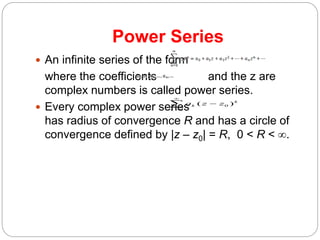
Power Series
 An infinite series of the form
where the coefficients and the z are
complex numbers is called power series.
 Every complex power series
has radius of convergence R and has a circle of
convergence defined by |z – z0| = R, 0 < R < .
0
0
( )k
k
k
a z z



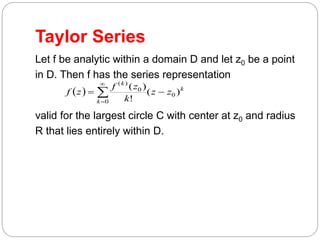
Taylor Series
Let f be analytic within a domain D and let z0 be a point
in D. Then f has the series representation
valid for the largest circle C with center at z0 and radius
R that lies entirely within D.
  k
k
k
zz
k
zf
zf )(
!
)(
0
0
0
)(
 


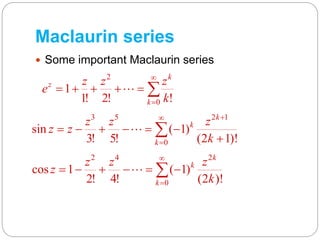
Maclaurin series
 Some important Maclaurin series




0
2
!!2!1
1
k
k
z
k
zzz
e 






0
1253
)!12(
)1(
!5!3
sin
k
k
k
k
zzz
zz 




0
242
)!2(
)1(
!4!2
1cos
k
k
k
k
zzz
z 
Laurent ‘s Series
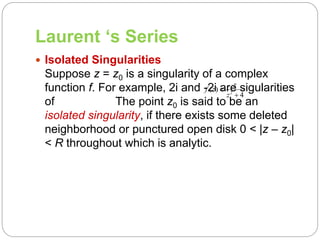
 Isolated Singularities
Suppose z = z0 is a singularity of a complex
function f. For example, 2i and -2i are sigularities
of The point z0 is said to be an
isolated singularity, if there exists some deleted
neighborhood or punctured open disk 0 < |z – z0|
< R throughout which is analytic.
2
( )
4
z
f z
z


Laurent’s Series
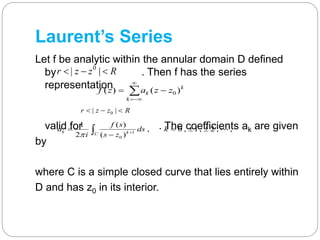
Let f be analytic within the annular domain D defined
by . Then f has the series
representation
valid for . The coefficients ak are given
by
where C is a simple closed curve that lies entirely within
D and has z0 in its interior.
Rzzr  || 0




k
k
k zzazf )()( 0
Rzzr  || 0
1
0
1 ( )
, 0 , 1, 2 , ,
2 ( )
k kC
f s
a ds k
i s z 
   

Example
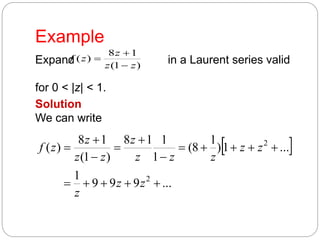
Expand in a Laurent series valid
for 0 < |z| < 1.
Solution
We can write
)1(
18
)(
zz
z
zf



 
...999
1
...1)
1
8(
1
118
)1(
18
)(
2
2








zz
z
zz
zzz
z
zz
z
zf
Zeros and Poles
 Introduction
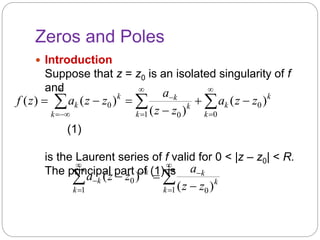
Suppose that z = z0 is an isolated singularity of f
and
(1)
is the Laurent series of f valid for 0 < |z – z0| < R.
The principal part of (1) is
 










1 0
0
0
0 )(
)(
)()(
k k
k
kk
k
k
k
k zza
zz
a
zzazf










1 01
0
)(
)(
k
k
k
k
k
k
zz
a
zza
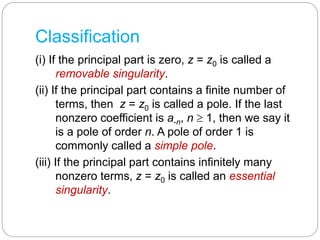
Classification
(i) If the principal part is zero, z = z0 is called a
removable singularity.
(ii) If the principal part contains a finite number of
terms, then z = z0 is called a pole. If the last
nonzero coefficient is a-n, n  1, then we say it
is a pole of order n. A pole of order 1 is
commonly called a simple pole.
(iii) If the principal part contains infinitely many
nonzero terms, z = z0 is called an essential
singularity.
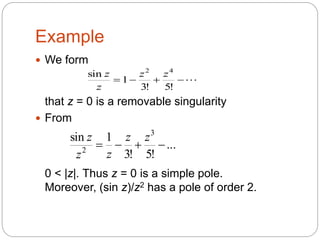
Example
 We form
that z = 0 is a removable singularity
 From
0 < |z|. Thus z = 0 is a simple pole.
Moreover, (sin z)/z2 has a pole of order 2.

!5!3
1
sin 42
zz
z
z
...
!5!3
1sin 3
2

zz
zz
z
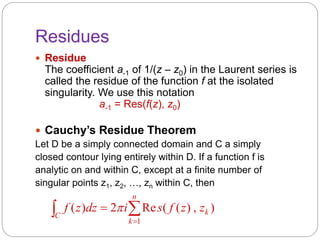
Residues
 Residue
The coefficient a-1 of 1/(z – z0) in the Laurent series is
called the residue of the function f at the isolated
singularity. We use this notation
a-1 = Res(f(z), z0)
 Cauchy’s Residue Theorem
Let D be a simply connected domain and C a simply
closed contour lying entirely within D. If a function f is
analytic on and within C, except at a finite number of
singular points z1, z2, …, zn within C, then
 

n
k
kC
zzfsidzzf
1
),)((Re2)( 

Complex analysis

  • 1.
    -K.Anitha M.Sc., M.Phil., -A.SujathaM.Sc., M.Phil.,PGDCA Department of Mathematics ( SF ) V.V.Vanniaperumal College for Women, Virudhunagar. Complex Analysis ( 15UMTC62)
  • 2.
    Power Series  Aninfinite series of the form where the coefficients and the z are complex numbers is called power series.  Every complex power series has radius of convergence R and has a circle of convergence defined by |z – z0| = R, 0 < R < . 0 0 ( )k k k a z z   
  • 3.
    Taylor Series Let fbe analytic within a domain D and let z0 be a point in D. Then f has the series representation valid for the largest circle C with center at z0 and radius R that lies entirely within D.   k k k zz k zf zf )( ! )( 0 0 0 )(    
  • 4.
    Maclaurin series  Someimportant Maclaurin series     0 2 !!2!1 1 k k z k zzz e        0 1253 )!12( )1( !5!3 sin k k k k zzz zz      0 242 )!2( )1( !4!2 1cos k k k k zzz z 
  • 5.
    Laurent ‘s Series Isolated Singularities Suppose z = z0 is a singularity of a complex function f. For example, 2i and -2i are sigularities of The point z0 is said to be an isolated singularity, if there exists some deleted neighborhood or punctured open disk 0 < |z – z0| < R throughout which is analytic. 2 ( ) 4 z f z z  
  • 6.
    Laurent’s Series Let fbe analytic within the annular domain D defined by . Then f has the series representation valid for . The coefficients ak are given by where C is a simple closed curve that lies entirely within D and has z0 in its interior. Rzzr  || 0     k k k zzazf )()( 0 Rzzr  || 0 1 0 1 ( ) , 0 , 1, 2 , , 2 ( ) k kC f s a ds k i s z      
  • 7.
    Example Expand in aLaurent series valid for 0 < |z| < 1. Solution We can write )1( 18 )( zz z zf      ...999 1 ...1) 1 8( 1 118 )1( 18 )( 2 2         zz z zz zzz z zz z zf
  • 8.
    Zeros and Poles Introduction Suppose that z = z0 is an isolated singularity of f and (1) is the Laurent series of f valid for 0 < |z – z0| < R. The principal part of (1) is             1 0 0 0 0 )( )( )()( k k k kk k k k k zza zz a zzazf           1 01 0 )( )( k k k k k k zz a zza
  • 9.
    Classification (i) If theprincipal part is zero, z = z0 is called a removable singularity. (ii) If the principal part contains a finite number of terms, then z = z0 is called a pole. If the last nonzero coefficient is a-n, n  1, then we say it is a pole of order n. A pole of order 1 is commonly called a simple pole. (iii) If the principal part contains infinitely many nonzero terms, z = z0 is called an essential singularity.
  • 10.
    Example  We form thatz = 0 is a removable singularity  From 0 < |z|. Thus z = 0 is a simple pole. Moreover, (sin z)/z2 has a pole of order 2.  !5!3 1 sin 42 zz z z ... !5!3 1sin 3 2  zz zz z
  • 11.
    Residues  Residue The coefficienta-1 of 1/(z – z0) in the Laurent series is called the residue of the function f at the isolated singularity. We use this notation a-1 = Res(f(z), z0)  Cauchy’s Residue Theorem Let D be a simply connected domain and C a simply closed contour lying entirely within D. If a function f is analytic on and within C, except at a finite number of singular points z1, z2, …, zn within C, then    n k kC zzfsidzzf 1 ),)((Re2)( 