Sequences and Series
Ms.E.Niraimathi
Assistant Professor in Mathematics
Sri Sarada Niketan College of Science For Women,Karur
Introduction
Sequence and series are the basic topics in Arithmetic. An
itemized collection of elements in which repetitions of any
sort are allowed is known as a sequence, whereas a series
is the sum of all elements. An arithmetic progression is
one of the common examples of sequence and series.
Injective and surjective
•The function is injective, or one-to-one, if each element of the
codomain is mapped to by at most one element of the domain, or
equivalently, if distinct elements of the domain map to distinct
elements in the co domain. An injective function is also called
an injection.
•The function is surjective, or onto, if each element of the co
domain is mapped to by at least one element of the domain. That is,
the image and the co domain of the function are equal. A surjective
function is a surjection.
 The function is bijective (one-to-one and onto, one-to-one
correspondence, or invertible) if each element of the
codomain is mapped to by exactly one element of the domain.
That is, the function is both injective and surjective. A
bijective function is also called a bijection.That is, combining
the definitions of injective and surjective.
Bounded sequence
A sequence an is a bounded sequence if it is bounded above and
bounded below. If a sequence is not bounded, it is an unbounded
sequence. For example, the sequence 1/n is bounded above because
1/n≤1 for all positive integers n. It is also bounded below because
1/n≥0 for all positive integers n.
Monotonic sequences
Monotone Sequences. Definition : We say that a sequence (xn) is
increasing if xn ≤ xn+1 for all n and strictly increasing if xn < xn+1
for all n. Similarly, we define decreasing and strictly decreasing
sequences. Sequences which are either increasing or decreasing are
called monotone.
Theorem
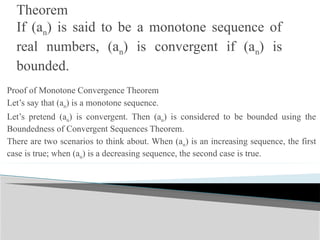
If (an) is said to be a monotone sequence of
real numbers, (an) is convergent if (an) is
bounded.
Proof of Monotone Convergence Theorem
Let’s say that (an) is a monotone sequence.
Let’s pretend (an) is convergent. Then (an) is considered to be bounded using the
Boundedness of Convergent Sequences Theorem.
There are two scenarios to think about. When (an) is an increasing sequence, the first
case is true; when (an) is a decreasing sequence, the second case is true.
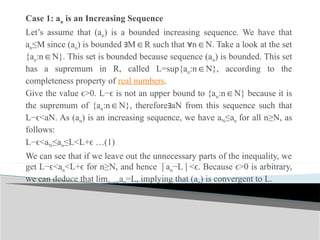
Case 1: an is an Increasing Sequence
Let’s assume that (an) is a bounded increasing sequence. We have that
an≤M since (an) is bounded M R such that n N. Take a look at the set
∃ ∈ ∀ ∈
{an:n N}. This set is bounded because sequence (a
∈ n) is bounded. This set
has a supremum in R, called L=sup{an:n N}, according to the
∈
completeness property of real numbers.
Give the value >0. L− is not an upper bound to {a
ϵ ϵ n:n N} because it is
∈
the supremum of {an:n N}, therefore aN from this sequence such that
∈ ∃
L− <aN. As (a
ϵ n) is an increasing sequence, we have aN≤an for all n≥N, as
follows:
L− <a
ϵ N≤an≤L<L+ …(1)
ϵ
We can see that if we leave out the unnecessary parts of the inequality, we
get L− <a
ϵ n<L+ for n≥N, and hence a
ϵ ∣ n−L < . Because >0 is arbitrary,
∣ ϵ ϵ
we can deduce that limn→∞an=L, implying that (an) is convergent to L.
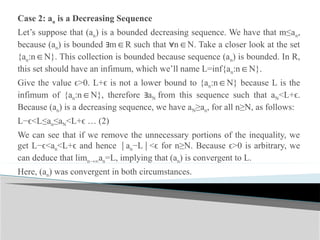
Case 2: an is a Decreasing Sequence
Let’s suppose that (an) is a bounded decreasing sequence. We have that m≤an,
because (an) is bounded m R such that n N. Take a closer look at the set
∃ ∈ ∀ ∈
{an:n N}. This collection is bounded because sequence (a
∈ n) is bounded. In R,
this set should have an infimum, which we’ll name L=inf{an:n N}.
∈
Give the value >0. L+ is not a lower bound to {a
ϵ ϵ n:n N} because L is the
∈
infimum of {an:n N}, therefore a
∈ ∃ N from this sequence such that aN<L+ .
ϵ
Because (an) is a decreasing sequence, we have aN≥an, for all n≥N, as follows:
L− <L≤a
ϵ n≤aN<L+ … (2)
ϵ
We can see that if we remove the unnecessary portions of the inequality, we
get L− <a
ϵ n<L+ and hence a
ϵ ∣ n−L < for n≥N. Because >0 is arbitrary, we
∣ ϵ ϵ
can deduce that limn→∞an=L, implying that (an) is convergent to L.
Here, (an) was convergent in both circumstances.
 It’s worth noting that the Monotone Convergence
Theorem only holds if the sequence (an) is bounded and
eventually monotone (i.e., increasing or decreasing). As
a result, (an) is convergent if the sequence (an) is
bounded and N N is such that n≥N is either
∃ ∈ ∀
an≤an+1 or an≥an+1.
Convergent sequence
A sequence converges when it keeps getting closer and
closer to a certain value. Example: 1/n. The terms of
1/n are: 1, 1/2, 1/3, 1/4, 1/5 and so on, And that
sequence converges to 0, because the terms get closer
and closer to 0. (Also called "Convergent Sequence")
Divergent Sequence
A sequence a0,a1,a2,... R is convergent when there is some a R such
∈ ∈
that an→a as n→∞.
If a sequence is not convergent, then it is called divergent.
The sequence an=n is divergent. an→∞ as n→∞
The sequence an=(−1)n is divergent - it alternates between ±1, so has no limit.
We can formally define convergence as follows:
The sequence a0,a1,a2,... is convergent with limit a R if:
∈
∀ε>0 N Z: n≥N,|an−a|<ε
∃ ∈ ∀
So a sequence a0,a1,a2,... is divergent if:
∀a R ε>0: N Z, n≥N:|an−a|≥ε
∈ ∃ ∀ ∈ ∃
That is a0,a1,a2,... fails to converge to any a R
∈
Algebra of limits
1. Limit of sum of two functions is the sum of the limits of the function.
x→a lim​
[f(x)+g(x)]=x→a lim​
f(x)+x→a lim​
g(x)
2.Limit of difference of two functions is difference of the limits of the function.
x→al im​
[f(x)−g(x)]=x→a lim​
f(x)−x→a lim​
g(x)
3. Limit of product of two functions is product of the limits of the function.
x→a lim​
[f(x) g(x)]=x→a lim​
f(x) x→a lim​
g(x)
⋅ ⋅
4. Limit of quotient of two functions is quotient of the limits of the function. (if
denominator is non zero).
x→a lim​
g(x)f(x)​
=x→a lim​
g(x)x→a lim​
f(x)​
Behavior of monotonic functions
Theorems:
1) Let {an} be a sequence of real numbers. The
following hold: If {an} is increasing and bounded
above, then it is convergent. If {an} is decreasing
and bounded below, then it is convergent.
Theorem 2.1: Suppose xn → x and yn → y. Then 1.
Proof:
xn + yn → x + y
xnyn → xy
xn yn → x y
if y = 0 and
yn = 0 for all n.
Suppose that (xn),(yn) and (zn) are sequences such that xn ≤
yn ≤ zn for all n and that xn → x0 and zn → x0. Then yn → x0.
Proof: Let > 0 be given.
ɛ
Since xn → x0 and zn → x0,
there exist N1 and N2 such that xn (x0 − , x0 + ɛ
) for all n ≥ N1
ɛ ɛ
and
zn (x0 − , x0 + ) for all n ≥ N2.
∈ ɛ ɛ
Choose N = max{N1, N2}.
Then, since xn ≤ yn ≤ zn, we have yn (x0 − , x0 + ) for all n
∈ ɛ ɛ
≥ N. This proves that yn → x0.
Some theorems on limits
Theorem: Every convergent sequence is a bounded sequence,
that is the set {xn : n N} is bounded
∈
Proof:
Suppose a sequence (xn) converges to x.
Then, for = 1, there exist N such that |xn − x| ≤ 1 for all n ≥ N.
ɛ
This implies |xn| ≤ |x| + 1 for all n ≥ N.
If we let M = max{|x1|, |x2|, . . . , |xN−1|},
then |xn| ≤ M + |x| + 1 for all n.
Hence (xn) is a bounded sequence.
Theorem:Suppose (xn) is a bounded and increasing
sequence. Then the least upper bound of the set {xn : n N}
∈
is the limit of (xn).
Proof:
Suppose sup n xn = M. Then for given > 0, there exists n0
ɛ
such that M − ≤ xn0 . Since (xn) is increasing, we have xn0
ɛ
≤ xn for all n ≥ n0. This implies that M − ≤ xn ≤ M ≤ M +
ɛ ɛ
for all n ≥ n0. That is xn → M. For decreasing sequences we
have the following result and its proof is similar.
Theorem: Suppose (xn) is a bounded and decreasing
sequence. Then the greatest lower bound of the set {xn : n ∈
N} is the limit of (xn).
Examples:
1. Let x1 = √ 2 and xn = √ 2 + xn−1 for n > 1. Then use
induction to see that 0 ≤ xn ≤ 2 and (xn) is increasing.
Therefore, by previous result (xn) converges. Suppose
xn → λ. Then λ = √ 2 + λ. This implies that λ = 2.
2. 2. Let x1 = 8 and xn+1 = 1 2 xn + 2. Note that xn+1 xn <
1. Hence the sequence is decreasing. Since xn > 0, the
sequence is bounded below. Therefore (xn) converges.
Suppose xn → λ. Then λ = λ 2 + 2. Therefore, λ = 2.
Cauchy sequencse:
A sequence {an}is called a Cauchy sequence if for any given ϵ
> 0, there exists N N such that n, m ≥ N = |an − am| <
∈ ⇒ . |
ϵ
an − L| < 2
ϵ ∀ n ≥ N. Thus if n, m ≥ N, we have |an − am|≤|an
− L| + |am − L| < 2 + 2 = .
ϵ ϵ ϵ
Series
As sequence and series are related concepts. Suppose a1, a2, a3, …, an is a sequence
such that the expression a1 + a2 + a3 +,…+ an is called the series associated with the
given sequence. The series is finite or infinite, according to whether the given
sequence is finite or infinite. Series are often represented in compact form, called
sigma notation, using the Greek letter sigma, ∑ to indicate the summation
involved.
Thus, the series a1 + a2 + a3 + … + an is abbreviated.
Infinite series
Cauchy’s general principle of convergence
Comparison test theorem
Test of convergence
Cauchy’s first limit theorem
If a sequence {an} converges to k, then the sequence {xn} also converges to k.
Where, xn=(a1+a2+a3+……+an)/n …………..(1)
show that limn→∞(1 + 1/22+1/32+…..+1/n2)/n = 0
Comparing to eq.(1),
Xn=(1 + 1/22+1/32+…..+1/n2)/n
Here an = 1/n2
limn→∞(1/n2) = 0
hence according to Cauchy's first theorem,
This implies, {an=1/n2} converges to 0, and then so {xn} also converges to 0.
Hence, limn→∞(1+1/22+1/32+…..+1/n2)/n = 0
DAlemberts ratio test
Cauchy’s root test
Alternating Series
An alternating series is any series, ∑an for which the
series terms can be written in one of the following two
forms.
an=(−1)nbn
bn≥0
an=(−1)n+1
bnbn≥0
Absolute convergence
Thank you

Sequences and Series and basic concepts

  • 1.
    Sequences and Series Ms.E.Niraimathi AssistantProfessor in Mathematics Sri Sarada Niketan College of Science For Women,Karur
  • 2.
    Introduction Sequence and seriesare the basic topics in Arithmetic. An itemized collection of elements in which repetitions of any sort are allowed is known as a sequence, whereas a series is the sum of all elements. An arithmetic progression is one of the common examples of sequence and series.
  • 3.
  • 4.
    •The function isinjective, or one-to-one, if each element of the codomain is mapped to by at most one element of the domain, or equivalently, if distinct elements of the domain map to distinct elements in the co domain. An injective function is also called an injection. •The function is surjective, or onto, if each element of the co domain is mapped to by at least one element of the domain. That is, the image and the co domain of the function are equal. A surjective function is a surjection.
  • 5.
     The functionis bijective (one-to-one and onto, one-to-one correspondence, or invertible) if each element of the codomain is mapped to by exactly one element of the domain. That is, the function is both injective and surjective. A bijective function is also called a bijection.That is, combining the definitions of injective and surjective.
  • 6.
    Bounded sequence A sequencean is a bounded sequence if it is bounded above and bounded below. If a sequence is not bounded, it is an unbounded sequence. For example, the sequence 1/n is bounded above because 1/n≤1 for all positive integers n. It is also bounded below because 1/n≥0 for all positive integers n.
  • 8.
    Monotonic sequences Monotone Sequences.Definition : We say that a sequence (xn) is increasing if xn ≤ xn+1 for all n and strictly increasing if xn < xn+1 for all n. Similarly, we define decreasing and strictly decreasing sequences. Sequences which are either increasing or decreasing are called monotone.
  • 9.
    Theorem If (an) issaid to be a monotone sequence of real numbers, (an) is convergent if (an) is bounded. Proof of Monotone Convergence Theorem Let’s say that (an) is a monotone sequence. Let’s pretend (an) is convergent. Then (an) is considered to be bounded using the Boundedness of Convergent Sequences Theorem. There are two scenarios to think about. When (an) is an increasing sequence, the first case is true; when (an) is a decreasing sequence, the second case is true.
  • 10.
    Case 1: anis an Increasing Sequence Let’s assume that (an) is a bounded increasing sequence. We have that an≤M since (an) is bounded M R such that n N. Take a look at the set ∃ ∈ ∀ ∈ {an:n N}. This set is bounded because sequence (a ∈ n) is bounded. This set has a supremum in R, called L=sup{an:n N}, according to the ∈ completeness property of real numbers. Give the value >0. L− is not an upper bound to {a ϵ ϵ n:n N} because it is ∈ the supremum of {an:n N}, therefore aN from this sequence such that ∈ ∃ L− <aN. As (a ϵ n) is an increasing sequence, we have aN≤an for all n≥N, as follows: L− <a ϵ N≤an≤L<L+ …(1) ϵ We can see that if we leave out the unnecessary parts of the inequality, we get L− <a ϵ n<L+ for n≥N, and hence a ϵ ∣ n−L < . Because >0 is arbitrary, ∣ ϵ ϵ we can deduce that limn→∞an=L, implying that (an) is convergent to L.
  • 11.
    Case 2: anis a Decreasing Sequence Let’s suppose that (an) is a bounded decreasing sequence. We have that m≤an, because (an) is bounded m R such that n N. Take a closer look at the set ∃ ∈ ∀ ∈ {an:n N}. This collection is bounded because sequence (a ∈ n) is bounded. In R, this set should have an infimum, which we’ll name L=inf{an:n N}. ∈ Give the value >0. L+ is not a lower bound to {a ϵ ϵ n:n N} because L is the ∈ infimum of {an:n N}, therefore a ∈ ∃ N from this sequence such that aN<L+ . ϵ Because (an) is a decreasing sequence, we have aN≥an, for all n≥N, as follows: L− <L≤a ϵ n≤aN<L+ … (2) ϵ We can see that if we remove the unnecessary portions of the inequality, we get L− <a ϵ n<L+ and hence a ϵ ∣ n−L < for n≥N. Because >0 is arbitrary, we ∣ ϵ ϵ can deduce that limn→∞an=L, implying that (an) is convergent to L. Here, (an) was convergent in both circumstances.
  • 12.
     It’s worthnoting that the Monotone Convergence Theorem only holds if the sequence (an) is bounded and eventually monotone (i.e., increasing or decreasing). As a result, (an) is convergent if the sequence (an) is bounded and N N is such that n≥N is either ∃ ∈ ∀ an≤an+1 or an≥an+1.
  • 13.
    Convergent sequence A sequenceconverges when it keeps getting closer and closer to a certain value. Example: 1/n. The terms of 1/n are: 1, 1/2, 1/3, 1/4, 1/5 and so on, And that sequence converges to 0, because the terms get closer and closer to 0. (Also called "Convergent Sequence")
  • 14.
    Divergent Sequence A sequencea0,a1,a2,... R is convergent when there is some a R such ∈ ∈ that an→a as n→∞. If a sequence is not convergent, then it is called divergent. The sequence an=n is divergent. an→∞ as n→∞ The sequence an=(−1)n is divergent - it alternates between ±1, so has no limit. We can formally define convergence as follows: The sequence a0,a1,a2,... is convergent with limit a R if: ∈ ∀ε>0 N Z: n≥N,|an−a|<ε ∃ ∈ ∀ So a sequence a0,a1,a2,... is divergent if: ∀a R ε>0: N Z, n≥N:|an−a|≥ε ∈ ∃ ∀ ∈ ∃ That is a0,a1,a2,... fails to converge to any a R ∈
  • 15.
    Algebra of limits 1.Limit of sum of two functions is the sum of the limits of the function. x→a lim​ [f(x)+g(x)]=x→a lim​ f(x)+x→a lim​ g(x) 2.Limit of difference of two functions is difference of the limits of the function. x→al im​ [f(x)−g(x)]=x→a lim​ f(x)−x→a lim​ g(x) 3. Limit of product of two functions is product of the limits of the function. x→a lim​ [f(x) g(x)]=x→a lim​ f(x) x→a lim​ g(x) ⋅ ⋅ 4. Limit of quotient of two functions is quotient of the limits of the function. (if denominator is non zero). x→a lim​ g(x)f(x)​ =x→a lim​ g(x)x→a lim​ f(x)​
  • 16.
    Behavior of monotonicfunctions Theorems: 1) Let {an} be a sequence of real numbers. The following hold: If {an} is increasing and bounded above, then it is convergent. If {an} is decreasing and bounded below, then it is convergent.
  • 17.
    Theorem 2.1: Supposexn → x and yn → y. Then 1. Proof: xn + yn → x + y xnyn → xy xn yn → x y if y = 0 and yn = 0 for all n.
  • 18.
    Suppose that (xn),(yn)and (zn) are sequences such that xn ≤ yn ≤ zn for all n and that xn → x0 and zn → x0. Then yn → x0. Proof: Let > 0 be given. ɛ Since xn → x0 and zn → x0, there exist N1 and N2 such that xn (x0 − , x0 + ɛ ) for all n ≥ N1 ɛ ɛ and zn (x0 − , x0 + ) for all n ≥ N2. ∈ ɛ ɛ Choose N = max{N1, N2}. Then, since xn ≤ yn ≤ zn, we have yn (x0 − , x0 + ) for all n ∈ ɛ ɛ ≥ N. This proves that yn → x0.
  • 19.
    Some theorems onlimits Theorem: Every convergent sequence is a bounded sequence, that is the set {xn : n N} is bounded ∈ Proof: Suppose a sequence (xn) converges to x. Then, for = 1, there exist N such that |xn − x| ≤ 1 for all n ≥ N. ɛ This implies |xn| ≤ |x| + 1 for all n ≥ N. If we let M = max{|x1|, |x2|, . . . , |xN−1|}, then |xn| ≤ M + |x| + 1 for all n. Hence (xn) is a bounded sequence.
  • 20.
    Theorem:Suppose (xn) isa bounded and increasing sequence. Then the least upper bound of the set {xn : n N} ∈ is the limit of (xn). Proof: Suppose sup n xn = M. Then for given > 0, there exists n0 ɛ such that M − ≤ xn0 . Since (xn) is increasing, we have xn0 ɛ ≤ xn for all n ≥ n0. This implies that M − ≤ xn ≤ M ≤ M + ɛ ɛ for all n ≥ n0. That is xn → M. For decreasing sequences we have the following result and its proof is similar.
  • 21.
    Theorem: Suppose (xn)is a bounded and decreasing sequence. Then the greatest lower bound of the set {xn : n ∈ N} is the limit of (xn).
  • 22.
    Examples: 1. Let x1= √ 2 and xn = √ 2 + xn−1 for n > 1. Then use induction to see that 0 ≤ xn ≤ 2 and (xn) is increasing. Therefore, by previous result (xn) converges. Suppose xn → λ. Then λ = √ 2 + λ. This implies that λ = 2. 2. 2. Let x1 = 8 and xn+1 = 1 2 xn + 2. Note that xn+1 xn < 1. Hence the sequence is decreasing. Since xn > 0, the sequence is bounded below. Therefore (xn) converges. Suppose xn → λ. Then λ = λ 2 + 2. Therefore, λ = 2.
  • 23.
    Cauchy sequencse: A sequence{an}is called a Cauchy sequence if for any given ϵ > 0, there exists N N such that n, m ≥ N = |an − am| < ∈ ⇒ . | ϵ an − L| < 2 ϵ ∀ n ≥ N. Thus if n, m ≥ N, we have |an − am|≤|an − L| + |am − L| < 2 + 2 = . ϵ ϵ ϵ
  • 24.
    Series As sequence andseries are related concepts. Suppose a1, a2, a3, …, an is a sequence such that the expression a1 + a2 + a3 +,…+ an is called the series associated with the given sequence. The series is finite or infinite, according to whether the given sequence is finite or infinite. Series are often represented in compact form, called sigma notation, using the Greek letter sigma, ∑ to indicate the summation involved. Thus, the series a1 + a2 + a3 + … + an is abbreviated.
  • 25.
  • 26.
  • 27.
  • 28.
  • 29.
    Cauchy’s first limittheorem If a sequence {an} converges to k, then the sequence {xn} also converges to k. Where, xn=(a1+a2+a3+……+an)/n …………..(1) show that limn→∞(1 + 1/22+1/32+…..+1/n2)/n = 0 Comparing to eq.(1), Xn=(1 + 1/22+1/32+…..+1/n2)/n Here an = 1/n2 limn→∞(1/n2) = 0 hence according to Cauchy's first theorem, This implies, {an=1/n2} converges to 0, and then so {xn} also converges to 0. Hence, limn→∞(1+1/22+1/32+…..+1/n2)/n = 0
  • 30.
  • 31.
  • 32.
    Alternating Series An alternatingseries is any series, ∑an for which the series terms can be written in one of the following two forms. an=(−1)nbn bn≥0 an=(−1)n+1 bnbn≥0
  • 33.
  • 34.