Mathematics
Presentation
Name: PRITAM MANDAL
Department: Computer Science & Engineering
Year: 2nd
Semester: 3rd
Roll no: 28100121048
Reg. no: 212810100110054
Sequences and
Series
2
TOPIC:
SEQUENCE
S
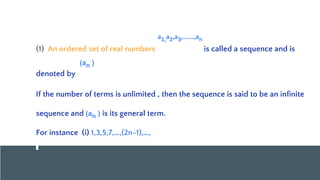
(1) An ordered set of real numbers is called a sequence and is
denoted by
If the number of terms is unlimited , then the sequence is said to be an infinite
sequence and (an ) is its general term.
For instance (i) 1,3,5,7,…,(2n-1),…,
3
a1,a2,a3,…...,an
(an )
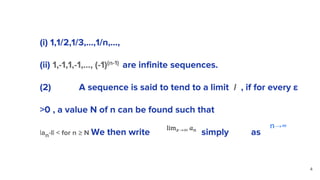
(i) 1,1/2,1/3,…,1/n,...,
(ii) 1,-1,1,-1,…, (-1)(n-1) are infinite sequences.
(2) Limit. A sequence is said to tend to a limit l , if for every ε
>0 , a value N of n can be found such that
|an-l| < for n ≥ N We then write or simply as
4
n→∞
(4) Bounded sequence: A sequence ( an ) is said to be bounded ,if there exists a
number k such that for every n.
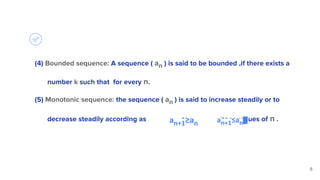
(5) Monotonic sequence: the sequence ( an ) is said to increase steadily or to
decrease steadily according as or for all values of n .
5
an+1≥an an+1≤an
“
Both increasing and decreasing sequences are called monotonic sequences.
A monotonic sequence always tends to a limit , finite or infinite.
Thus, a sequence which is monotonic and bounded is convergent.
6
SERIE
S
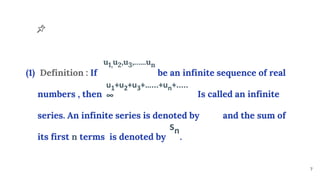
(1) Definition : If be an infinite sequence of real
numbers , then Is called an infinite
series. An infinite series is denoted by and the sum of
its first n terms is denoted by .
7
u1,u2,u3,…...un
u1+u2+u3+…...+un+.....
∞
sn
8
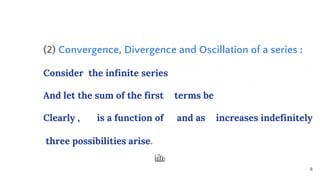
(2) Convergence, Divergence and Oscillation of a series :
Consider the infinite series
And let the sum of the first n terms be
Clearly , is a function of n and as n increases indefinitely
three possibilities arise.
sn
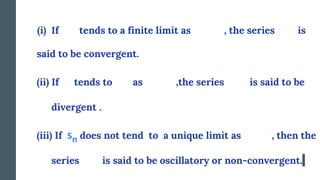
(i) If tends to a finite limit as , the series is
said to be convergent.
(ii) If sn tends to as ,the series is said to be
divergent .
(iii) If sn does not tend to a unique limit as , then the
series is said to be oscillatory or non-convergent.
sn
For your patience.
Thank You!
10

math.pptx

  • 1.
    Mathematics Presentation Name: PRITAM MANDAL Department:Computer Science & Engineering Year: 2nd Semester: 3rd Roll no: 28100121048 Reg. no: 212810100110054
  • 2.
  • 3.
    SEQUENCE S (1) An orderedset of real numbers is called a sequence and is denoted by If the number of terms is unlimited , then the sequence is said to be an infinite sequence and (an ) is its general term. For instance (i) 1,3,5,7,…,(2n-1),…, 3 a1,a2,a3,…...,an (an )
  • 4.
    (i) 1,1/2,1/3,…,1/n,..., (ii) 1,-1,1,-1,…,(-1)(n-1) are infinite sequences. (2) Limit. A sequence is said to tend to a limit l , if for every ε >0 , a value N of n can be found such that |an-l| < for n ≥ N We then write or simply as 4 n→∞
  • 5.
    (4) Bounded sequence:A sequence ( an ) is said to be bounded ,if there exists a number k such that for every n. (5) Monotonic sequence: the sequence ( an ) is said to increase steadily or to decrease steadily according as or for all values of n . 5 an+1≥an an+1≤an
  • 6.
    “ Both increasing anddecreasing sequences are called monotonic sequences. A monotonic sequence always tends to a limit , finite or infinite. Thus, a sequence which is monotonic and bounded is convergent. 6
  • 7.
    SERIE S (1) Definition :If be an infinite sequence of real numbers , then Is called an infinite series. An infinite series is denoted by and the sum of its first n terms is denoted by . 7 u1,u2,u3,…...un u1+u2+u3+…...+un+..... ∞ sn
  • 8.
    8 (2) Convergence, Divergenceand Oscillation of a series : Consider the infinite series And let the sum of the first n terms be Clearly , is a function of n and as n increases indefinitely three possibilities arise. sn
  • 9.
    (i) If tendsto a finite limit as , the series is said to be convergent. (ii) If sn tends to as ,the series is said to be divergent . (iii) If sn does not tend to a unique limit as , then the series is said to be oscillatory or non-convergent. sn
  • 10.