Septoplasty
Dr. Nirajan Khadka
First year Resident
ENT-HNS, PoAHS
Moderator: Asso. Prof Dr. Akash Mani Bhandari
Introduction
“Septoplasty” takes its meaning from the Greek term that means “to reshape or mold
the septum”
An operation designed to replace a deviated nasal septum in the midposition by
dividing almost all its attachments and leaving the quadrilateral cartilages attached
to a flap of mucosa to preserve its viability
• Techniques used today are still geared toward septal resection, but more emphasis
has been placed on preservation, realignment, or a combination of the two
• Most standard procedures today recognize mucosal preservation as a primary
goal and make use of a submucous cartilaginous and bony approach
• In most cases of septal deviation, the septal L-strut is involved
• Septoplasty techniques are needed to address these problems and the approach
should provide access to the L-strut.
Septal surgery history
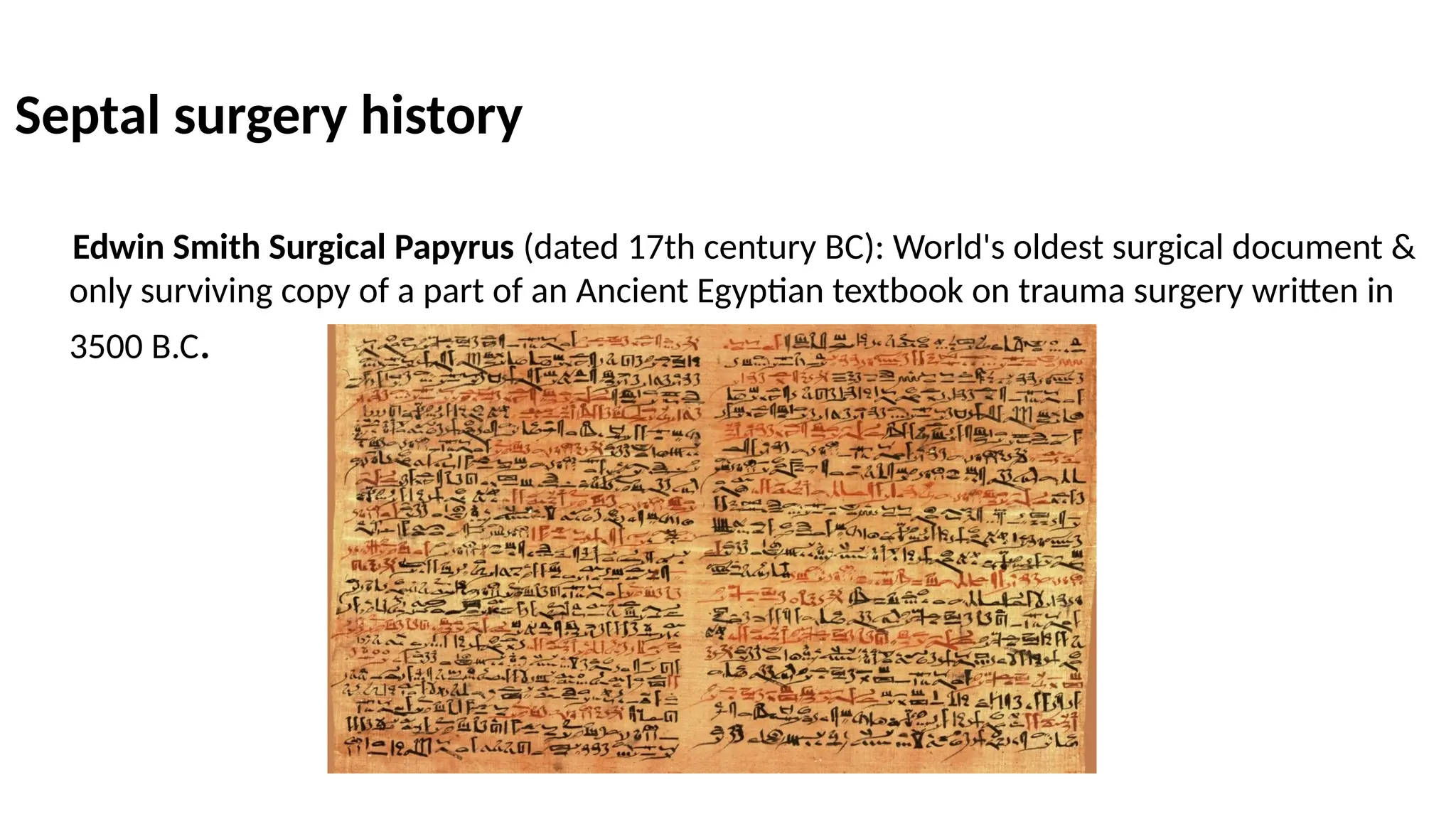
Edwin Smith Surgical Papyrus (dated 17th century BC): World's oldest surgical document &
only surviving copy of a part of an Ancient Egyptian textbook on trauma surgery written in
3500 B.C.
Quelmaltz proposed daily digital pressure to correct a deviated septum in 18th
Century
In 1875 Adams proposed closed reduction and splinting for treatment of a deviated
septum
While the physiological role of the nasal septum remained poorly understood during
the 19th
Century, surgeons emphasized on excising obstructing segments of the
septum in an attempt to relieve nasal obstruction
In 1890 Krieg described a technique of mucosal resection in which the deflected
cartilaginous segment, along with overlying mucosa, was removed in its entirety
Patients suffered nasal whistling, crusting, epistaxis, worsening nasal obstructions
from turbulent airflow, saddle nose
Later Kreig concluded mucosal preservation and removal of only deviated septal
Cartilage could decrease complications
Bosworth sawed off deviated septal spurs, sacrificing ipsilateral mucosa while
Maintaining the contralateral mucosa
1899- Asch purposed a full cruciate incision through the cartiliginous septum to
“ destroy the resiliency” of the cartilage while preserving mucosa
• Bosworth operation (late 19th century): deviated part of septum amputated along
with mucosa
• Asch (1899): full thickness cruciate incisions on septal cartilage
• Freer (1902): SMR of total septal cartilage
• Killian (1904): SMR with preservation of dorsal & caudal portion of septal cartilage
• Metzenbaum (1929): Swinging door technique for caudal septal dislocation
• Peer (1937): Removal of caudal septum & replacement after its alteration
• Cottle (1948) : Maxilla-Premaxilla septoplasty
• The nasal airway is composed of two nasal cavities, each with a medial and a lateral
wall as well as a floor
• Medial nasal wall: This is mainly formed by the nasal septum which in itself is
composed of bony, cartilaginous and membranous parts. The columella forms the
most caudal part of the medial wall
• Lateral nasal wall: This is formed by the turbinates,fibrofatty tissue and cartilages
(sesamoid cartilages,accessory cartilages, upper lateral cartilage and the
lateral crus of the lower lateral cartilage)
• Nasal floor: This wall is formed by the floor of the nasal cavity and the nasal
vestibule sill.
Nasal septum
The nasal septum has both functional and aesthetic significance
Main support structure of the external nose
Divides the nose into 2 cavities; regulates airflow through the nose and supports the
mucosal lining of the nasal cavities
Parts of Nasal Septum
1. Columellar septum:
It is covered on either side by skin.
Contains medial crura of lower lateral cartilages,
Joined together with fibrous tissue
2. Membranous Septum:
-Lies between the columella and the caudal border
of septal cartilages and consists double layer of skin
-No bony and cartilaginous support
3. Septum Proper
It is covered with mucous membrane and consists of osteocartilginous framework
Perpendicular plate of ethmoid, the vomer and a large quadrilateral septal cartilage,
which is wedged between vomer and ethmoid plate
Other bones, includes Crest of nasal bone, nasal spine of frontal bone, rostrum of
sphenoid, crests of palatine and maxilla and the anterior nasal spine of maxilla
A projection of the septal cartilage
called the sphenoidal process or septal
tail extends posteriorly between the vomer
and perpendicular plate of the ethmoid
The sepal tail can serve as an additional
source of cartilage to harvest especially
during revision rhinoplasty
The inferior attachment sits within the nasal
crest of the maxilla and is bound by loose
connective tissue creating a pseudoarthrosis
The joint allows mobility of the septal cartilage
base during flexon thereby reducing the risk of fracture
or dislocation with trauma
Embryology of Nasal Septum
Begins during 4th
weeks of gestation
The nasal septum develops as a downgrowth from merged medial nasal processes and
the nasofrontal process and thus defines right and left nasal cavities
During 9th
week: The nasal septum and the palatine processes begin to fuse anteriorly
Fusion is completed posteriorly by 12th
week
During the late embryonic period, the epithelium invaginates on each side of the
nasal
septum; forming diverticula known as the vomeronasal organs
A vomeronasal cartilages develops ventral to each diverticulum; the vomeronasal
cartilages are usually the only adult remnants
The perpendicular plates of the ethmoid and the nasal bones donot completely
ossify until puberty
Indications of Septoplasty
1. Deviated septum causing nasal obstruction on one or both sides.
2. As a part of septorhinoplasty for cosmetic reasons.
3. Recurrent epistaxis usually from the spur.
4. Sinusitis due to septal deviation.
5. Septal deviation making contact with lateral nasal wall and causing headaches.
6. For approach to middle meatus or frontal recess in endoscopic sinus surgery when
deviated septum obstructs the view and access to these areas.
7. Access to endoscopic dacryocystorhinostomy operation in some cases.
8. As an approach to pituitary fossa (trans-septal transsphenoidal approach).
9. Septal deviation causing sleep apnoea or hypopnoea syndrome.
CONTRAINDICATIONS
1. Acute nasal or sinus infection.
2. Untreated diabetes.
3. Hypertension.
4. Bleeding diathesis
Some special tests to consider before septoplasty
.1. Acoustic Rhinometry
The sound waves are delivered to nasal cavity and the reflected sound waves are
measured(rhinogram) which include calculation of minimal cross-sectional area of
nose and nasal cavity resistance
The first and second dips in rhinogram are caused due to
nasal valve and anterior tips of turbinates(inferior and
middle) respectively
2. Rhinomanometry or rhinometry
This computerized electronic technique measures transnasal pressure and resultant
nasal airflow
Initially, water columns and mechanical devices were used in rhinomanometry
More than 3 cm H20/L/s combined bilateral resistance of adult nose at rest indicates
nasal obstruction
The surgical field
The surgical field must be optimized
Hemostasis is maintained by:
1. Working with the anesthesist to reduce cardiac output if done under GA
2. Positioning the patient with the head raised about 30 degrees to reduce
dependent vasocongestion
3. Placement of neuropatties containing 1:1000 epinephrine
Local Anaesthesia infiltration
- 1% Xylocaine with 1:100,000 epinephrine is used with a maximum suggested dose
of 4 to 7 mg/kg
- Injection is performed with either a 27- or
30- gauge needle
- Due to hydro dissection correct dissection plane
can be identified
- The injection is started at the caudal end of the septum,
and secondary injection are performed more posteriorly,
until the mucosa is well blanched, or until maximum volume
based on patient weight is met
- Forceful injection is avoided to prevent retrograde
vascular communication
- The contralateral membrane should also be injected
- Waiting at least 10 minutes ensures maximum vasoconstriction
TYPES OF SEPTAL INCISIONS IN SEPTOPLASTY
1. Killian’s: In the nasal mucosa, cephalic to the caudal end of the septum
2. Transfixion: Through and through incision, close to but caudal to caudal end of the
septum.
3. Hemitransfixion: Same as the transfixion incision but on one side.
4. Horizontal on the spur: For endoscopic spurectomy
The incision and Approach
Insert the nasal speculum into the nose and gently
retract the slightly opened speculum revealing
the caudal septal cartilage
No 15 blade is then used to incise mucosa down to
and through the perichondrium on the concave side
Open rhinoplasty approach
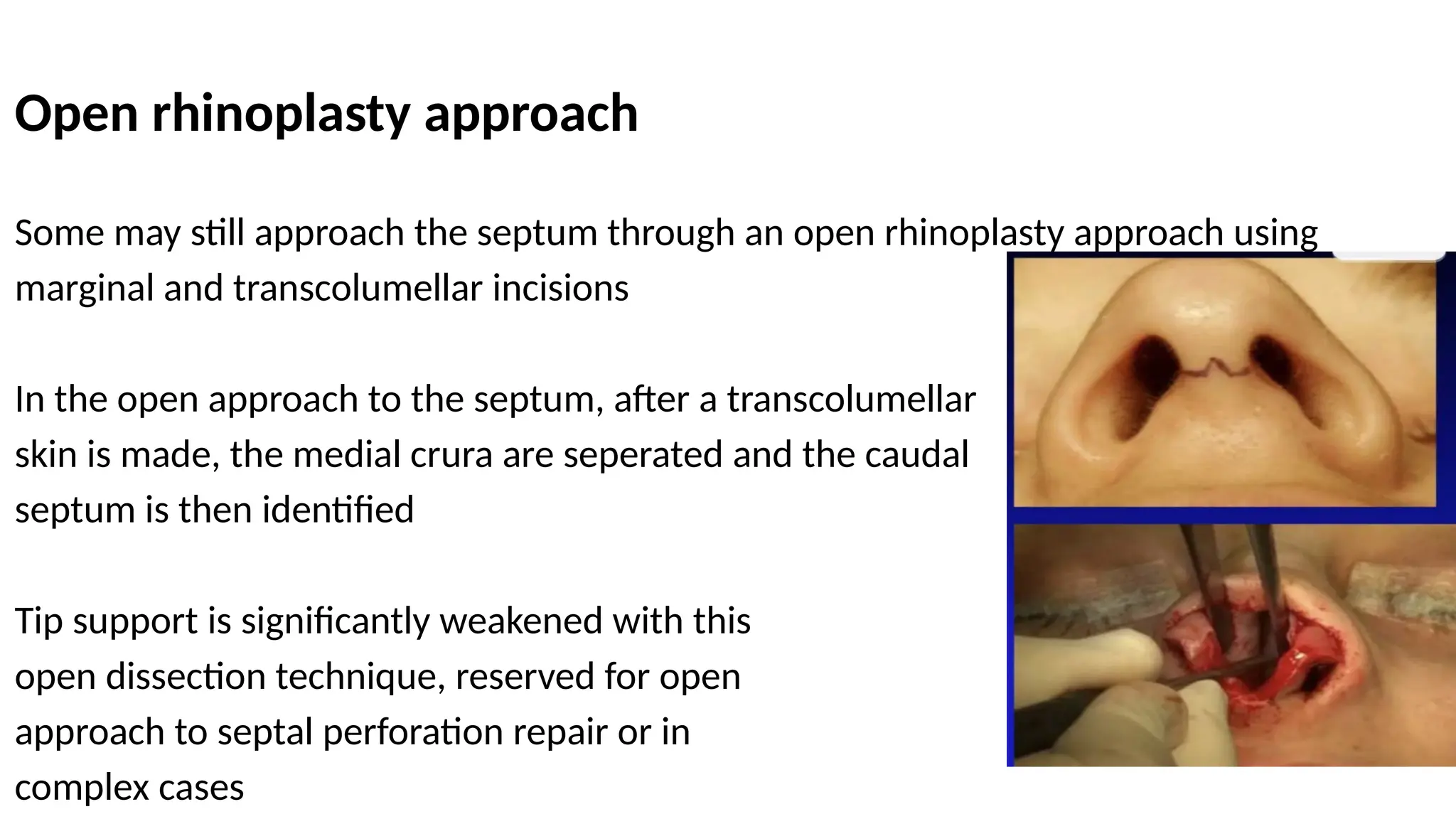
Some may still approach the septum through an open rhinoplasty approach using
marginal and transcolumellar incisions
In the open approach to the septum, after a transcolumellar
skin is made, the medial crura are seperated and the caudal
septum is then identified
Tip support is significantly weakened with this
open dissection technique, reserved for open
approach to septal perforation repair or in
complex cases
Plane identification and mucoperichondrial flap elevation
Identification of the proper plane- achieved by scoring the area to find the desired
plane
The Cottle elevator with its two dissecting faces- one shaped like a sharpened spade,
the other more flat and dull is used to raise the envelope under direct vision
The sharper, spadelike end is used first to begin the dissection in the
submucoperichondrial plane
After the dissection is started, the flat and dull end efficiently elevates
the envelope in an atraumatic fashion
Elevate the envelope with a wide front to ensure the best visibility and
to decrease the risk of mucosal tearing
Longer speculum is used as the dissection proceeds posteriorly.
When the bony osteocartiliginous junction is reached, this junction
is disarticulated to gain access to the opposite side of the bony septum
The mucosal flap is raised carefully from the opposite side of the bony
septum
Disarticulation of the quadrilateral cartilage from the maxillary crest
Septum moved to midline
Often a sliver of bone or cartilage needs to be removed
The 1 cm of bony-cartilginous junction at the L- strut is left undisturbed if possible
Managing the spur
Raising the flap over a septal spur can be challenging
The Mucoperichondrial flap is raised over the quadrilateral
cartilage and the bony septum; this constitutes the anterior channel
over the spur
Then another subperiosteal tunnel is raised posterior to the septal
spur which constitutes the posterior channel
Connecting the two tunnels directly helps to avoid mucosal flaps
The dissection may be eased with the use of the sharper spade
end of the cottle elevator
The risk of membrane fenestration is greatest in the area of a spur
To mobilize the bony deviation or spur, becker septal scissor are used to make cuts
in the bony septum above and below the deviated septal segment or spur
To prevent cribiform plate injury, the superior bony septum is never manipulated
without first performing a superior septal incison or cut
Even then, any posterior septal removal is done within one rotational plane
Removal of the freed segment with a nonbiting forceps completes
the resection using wide-mouthed Watson-Williams forceps
SEPTOPLASTY TECHNIQUES
• CUTTING TECHNIQUES
• GRAFTING TECHNIQUES
• SUTURING TECHNIQUES
• RELOCATING TECHNIQUES
CUTTING TECHNIQUES
• Scoring→ septal cartilage→ concave →straight→eliminating deviation
• Under-scoring & over-scoring →unsatisfactory results
• S -shaped→ scoring in both concave sides
• Caudal septal deviation-swinging door technique
Grafting technique
• Both septal cartilage & septal bone
• Harvesting → perpendicular plate of ethmoid →thinned → graft→ perforated
→splinted concave side of the septum
• Suture →secure the graft to the septum
Suturing technique
• Mattress suture can be used
• Septum is first scored→ pliable→ shaped kept in shape→ fine
sutures
• Entrance & exit sutures are placed on convex side
Relocating technique
• These techniques are used when the septum is dislocated off the midline and it
only requires reinsertion onto the maxillary crest
• The septum needs to be secured in its midline position
• Achieved by suturing the septum either onto the periosteum of the anterior nasal
spine or to the actual bone by drilling a hole onto it.
• Fine absorbable or non-absorbable sutures can be used for this purpose
• Often a deviated caudal septum can be improved by door-stop technique
SPECIAL SEPTOPLASTY CONSIDERATIONS
1. Endoscopic septoplasty
• Used to improve visualization particularly of more cephalic septal deformities
• Allows minimal access dissection to reach isolated deviated parts of the septum
(more relevant in revision cases).
• Endoscopic septoplasty can be used concomitantly along with sinus surgery
• It is also an effective teaching tool
Extracorporeal septoplasty
• In cases of a severely fractured and deformed septum
• In this method, the septum (both cartilaginous and the bony segment) is excised in
one piece as intact as possible
• This requires detachment of the cartilaginous septum from upper lateral cartilages
and its attachment to the maxillary crest posteriorly
• The septum is then measured and a template is made to represent the new
septum.
1. Re-orientation:
The new L-strut is harvested from a straight section of the excised septum and it is reinserted in place
2. Reconstruction:
The septum is reconstructed by a variety of techniques and then reinserted in its
place
In cases of fractured septum, the fracture line is cut through or weakened to straighten the septum and
then the septum is splinted against a graft
In cases where the septum is broken into many pieces, the segments of septum are splinted against a
sheet of thinned down perpendicular plate of ethmoid or a PDS sheet (like a jigsaw puzzle)
A fine absorbable or non-absorbable suture (e.g. 5x0 PDSR) is used to secure the pieces of septum to
the ethmoid bone graft or the PDS sheet.
Paediatric septoplasty
• There remains controversy about the optimal age and extent of septal surgery in
the paediatric population
• Studies have demonstrated that septal surgery performed in children as young as 6
years old provides long-term satisfactory outcomes
• The most important aspect of surgery is to resect the cartilage conservatively and
to avoid disrupting the endochondral ossification plates if possible
• Excision should be kept to minimum and any excised segment should be reinserted
after remodelling
Postoperative care
A light nasal pack is placed to prevent large clot accumulation
Tight Packs are avoided as there is tendency to adhere to mucosa, cause pain, and
create bleeding when removed
After the nasal packs are removed, a thrice-daily regimen of saline flushing of the nose
is initiated
Gentle suctioning on postoperative days 5 through day 7 and continued local care for
at least 2 to 3 weeks allows for adequate healing
Gentle nose blowing is permitted after the third week, and sternous exercise is
discouraged for a total of 5 weeks
Complications of septoplasty
Persistence in the subjective complaint of nasal obstruction(Most common)
Sepal hematoma
Septal perforations
Nasal shape change
Synechiae
Excessive bleeding
CSF rhinorrhea
Wound infection
Septal Abscess
Toxic shock syndrome
Sensory changes- Anosmia or dental anaesthesia
SUBMUCOSAL RESECTION
In this technique, the L-strut is not addressed
Generally done in adults
Consists of elevating mucoperichondrial and mucoperiosteal flap on either side of the
septum, removing the deflected parts of bony and cartiliginous septum and then
repositioning the flaps
Indications
1. Deviated nasal septum (DNS) causing symptoms of nasal obstruction and recurrent
headaches.
2. DNS causing obstruction to ventilation of paranasal sinuses and middle ear, resulting
in recurrent sinusitis and otitis media.
3. Recurrent epistaxis from septal spur.
4. As a part of septorhinoplasty for cosmetic correction of external nasal deformities.
5. As a preliminary step in hypophysectomy (trans-septal trans-sphenoidal approach)
or vidian neurectomy(trans-septal approach)
CONTRAINDICATIONS
1. Patients below 17 years of age. In such cases, a conservative surgery (septoplasty)
should be done.
2. Acute episode of respiratory infection.
3. Bleeding diathesis.
4. Untreated diabetes or hypertension
SMR Steps
Infiltration: Subperichondrial infiltration with 2% xylocaine with adrenaline
Incision: Killian’s incision- curvilinear incision 2-3 mm behind the anterior end of septal
cartilage
Elevation of flaps
Incision of the cartilage
Elevation of opposite mucoperichondrial and mucoperisoteal flap
Removal of cartilage and bone
Cartilage can be removed with ballinger swivel knife or Luc’s forceps
Bony spur removed using gouze and hammer
Preserve a strip of 1 cm wide cartilage along the dorsal and caudal borders(L-
struts)
Nasal Packing
References
• Scott-Brown's Otorhinolaryngology and Head and Neck Surgery, Eighth
Edition
• Scott-Brown's Otorhinolaryngology and Head and Neck Surgery, Seventh
Edition
• Cummings otorhinolarngology Head and Neck Surgery
• Disease of ear nose throat and head and neck surgery Dhingra 7th
edition
Next presentation
Topic: Neck Dissection
Presenter: Dr Satish Kumar Ray
Friday
Thank You!!!

Septoplasty ENT & HEAD NECK SURGERY.pptx

  • 1.
    Septoplasty Dr. Nirajan Khadka Firstyear Resident ENT-HNS, PoAHS Moderator: Asso. Prof Dr. Akash Mani Bhandari
  • 2.
    Introduction “Septoplasty” takes itsmeaning from the Greek term that means “to reshape or mold the septum” An operation designed to replace a deviated nasal septum in the midposition by dividing almost all its attachments and leaving the quadrilateral cartilages attached to a flap of mucosa to preserve its viability
  • 3.
    • Techniques usedtoday are still geared toward septal resection, but more emphasis has been placed on preservation, realignment, or a combination of the two • Most standard procedures today recognize mucosal preservation as a primary goal and make use of a submucous cartilaginous and bony approach • In most cases of septal deviation, the septal L-strut is involved • Septoplasty techniques are needed to address these problems and the approach should provide access to the L-strut.
  • 4.
    Septal surgery history EdwinSmith Surgical Papyrus (dated 17th century BC): World's oldest surgical document & only surviving copy of a part of an Ancient Egyptian textbook on trauma surgery written in 3500 B.C.
  • 5.
    Quelmaltz proposed dailydigital pressure to correct a deviated septum in 18th Century In 1875 Adams proposed closed reduction and splinting for treatment of a deviated septum While the physiological role of the nasal septum remained poorly understood during the 19th Century, surgeons emphasized on excising obstructing segments of the septum in an attempt to relieve nasal obstruction
  • 6.
    In 1890 Kriegdescribed a technique of mucosal resection in which the deflected cartilaginous segment, along with overlying mucosa, was removed in its entirety Patients suffered nasal whistling, crusting, epistaxis, worsening nasal obstructions from turbulent airflow, saddle nose Later Kreig concluded mucosal preservation and removal of only deviated septal Cartilage could decrease complications Bosworth sawed off deviated septal spurs, sacrificing ipsilateral mucosa while Maintaining the contralateral mucosa
  • 7.
    1899- Asch purposeda full cruciate incision through the cartiliginous septum to “ destroy the resiliency” of the cartilage while preserving mucosa • Bosworth operation (late 19th century): deviated part of septum amputated along with mucosa • Asch (1899): full thickness cruciate incisions on septal cartilage • Freer (1902): SMR of total septal cartilage • Killian (1904): SMR with preservation of dorsal & caudal portion of septal cartilage • Metzenbaum (1929): Swinging door technique for caudal septal dislocation • Peer (1937): Removal of caudal septum & replacement after its alteration • Cottle (1948) : Maxilla-Premaxilla septoplasty
  • 8.
    • The nasalairway is composed of two nasal cavities, each with a medial and a lateral wall as well as a floor • Medial nasal wall: This is mainly formed by the nasal septum which in itself is composed of bony, cartilaginous and membranous parts. The columella forms the most caudal part of the medial wall • Lateral nasal wall: This is formed by the turbinates,fibrofatty tissue and cartilages (sesamoid cartilages,accessory cartilages, upper lateral cartilage and the lateral crus of the lower lateral cartilage) • Nasal floor: This wall is formed by the floor of the nasal cavity and the nasal vestibule sill.
  • 9.
    Nasal septum The nasalseptum has both functional and aesthetic significance Main support structure of the external nose Divides the nose into 2 cavities; regulates airflow through the nose and supports the mucosal lining of the nasal cavities
  • 10.
    Parts of NasalSeptum 1. Columellar septum: It is covered on either side by skin. Contains medial crura of lower lateral cartilages, Joined together with fibrous tissue 2. Membranous Septum: -Lies between the columella and the caudal border of septal cartilages and consists double layer of skin -No bony and cartilaginous support
  • 11.
    3. Septum Proper Itis covered with mucous membrane and consists of osteocartilginous framework Perpendicular plate of ethmoid, the vomer and a large quadrilateral septal cartilage, which is wedged between vomer and ethmoid plate Other bones, includes Crest of nasal bone, nasal spine of frontal bone, rostrum of sphenoid, crests of palatine and maxilla and the anterior nasal spine of maxilla
  • 12.
    A projection ofthe septal cartilage called the sphenoidal process or septal tail extends posteriorly between the vomer and perpendicular plate of the ethmoid The sepal tail can serve as an additional source of cartilage to harvest especially during revision rhinoplasty The inferior attachment sits within the nasal crest of the maxilla and is bound by loose connective tissue creating a pseudoarthrosis The joint allows mobility of the septal cartilage base during flexon thereby reducing the risk of fracture or dislocation with trauma
  • 13.
    Embryology of NasalSeptum Begins during 4th weeks of gestation The nasal septum develops as a downgrowth from merged medial nasal processes and the nasofrontal process and thus defines right and left nasal cavities During 9th week: The nasal septum and the palatine processes begin to fuse anteriorly Fusion is completed posteriorly by 12th week During the late embryonic period, the epithelium invaginates on each side of the nasal septum; forming diverticula known as the vomeronasal organs
  • 14.
    A vomeronasal cartilagesdevelops ventral to each diverticulum; the vomeronasal cartilages are usually the only adult remnants The perpendicular plates of the ethmoid and the nasal bones donot completely ossify until puberty
  • 15.
    Indications of Septoplasty 1.Deviated septum causing nasal obstruction on one or both sides. 2. As a part of septorhinoplasty for cosmetic reasons. 3. Recurrent epistaxis usually from the spur. 4. Sinusitis due to septal deviation. 5. Septal deviation making contact with lateral nasal wall and causing headaches. 6. For approach to middle meatus or frontal recess in endoscopic sinus surgery when deviated septum obstructs the view and access to these areas. 7. Access to endoscopic dacryocystorhinostomy operation in some cases. 8. As an approach to pituitary fossa (trans-septal transsphenoidal approach). 9. Septal deviation causing sleep apnoea or hypopnoea syndrome.
  • 16.
    CONTRAINDICATIONS 1. Acute nasalor sinus infection. 2. Untreated diabetes. 3. Hypertension. 4. Bleeding diathesis
  • 17.
    Some special teststo consider before septoplasty .1. Acoustic Rhinometry The sound waves are delivered to nasal cavity and the reflected sound waves are measured(rhinogram) which include calculation of minimal cross-sectional area of nose and nasal cavity resistance The first and second dips in rhinogram are caused due to nasal valve and anterior tips of turbinates(inferior and middle) respectively
  • 18.
    2. Rhinomanometry orrhinometry This computerized electronic technique measures transnasal pressure and resultant nasal airflow Initially, water columns and mechanical devices were used in rhinomanometry More than 3 cm H20/L/s combined bilateral resistance of adult nose at rest indicates nasal obstruction
  • 19.
    The surgical field Thesurgical field must be optimized Hemostasis is maintained by: 1. Working with the anesthesist to reduce cardiac output if done under GA 2. Positioning the patient with the head raised about 30 degrees to reduce dependent vasocongestion 3. Placement of neuropatties containing 1:1000 epinephrine
  • 20.
    Local Anaesthesia infiltration -1% Xylocaine with 1:100,000 epinephrine is used with a maximum suggested dose of 4 to 7 mg/kg - Injection is performed with either a 27- or 30- gauge needle - Due to hydro dissection correct dissection plane can be identified - The injection is started at the caudal end of the septum, and secondary injection are performed more posteriorly, until the mucosa is well blanched, or until maximum volume based on patient weight is met - Forceful injection is avoided to prevent retrograde vascular communication - The contralateral membrane should also be injected - Waiting at least 10 minutes ensures maximum vasoconstriction
  • 21.
    TYPES OF SEPTALINCISIONS IN SEPTOPLASTY 1. Killian’s: In the nasal mucosa, cephalic to the caudal end of the septum 2. Transfixion: Through and through incision, close to but caudal to caudal end of the septum. 3. Hemitransfixion: Same as the transfixion incision but on one side. 4. Horizontal on the spur: For endoscopic spurectomy
  • 22.
    The incision andApproach Insert the nasal speculum into the nose and gently retract the slightly opened speculum revealing the caudal septal cartilage No 15 blade is then used to incise mucosa down to and through the perichondrium on the concave side
  • 23.
    Open rhinoplasty approach Somemay still approach the septum through an open rhinoplasty approach using marginal and transcolumellar incisions In the open approach to the septum, after a transcolumellar skin is made, the medial crura are seperated and the caudal septum is then identified Tip support is significantly weakened with this open dissection technique, reserved for open approach to septal perforation repair or in complex cases
  • 24.
    Plane identification andmucoperichondrial flap elevation Identification of the proper plane- achieved by scoring the area to find the desired plane The Cottle elevator with its two dissecting faces- one shaped like a sharpened spade, the other more flat and dull is used to raise the envelope under direct vision The sharper, spadelike end is used first to begin the dissection in the submucoperichondrial plane
  • 25.
    After the dissectionis started, the flat and dull end efficiently elevates the envelope in an atraumatic fashion Elevate the envelope with a wide front to ensure the best visibility and to decrease the risk of mucosal tearing Longer speculum is used as the dissection proceeds posteriorly.
  • 26.
    When the bonyosteocartiliginous junction is reached, this junction is disarticulated to gain access to the opposite side of the bony septum The mucosal flap is raised carefully from the opposite side of the bony septum Disarticulation of the quadrilateral cartilage from the maxillary crest Septum moved to midline Often a sliver of bone or cartilage needs to be removed The 1 cm of bony-cartilginous junction at the L- strut is left undisturbed if possible
  • 27.
    Managing the spur Raisingthe flap over a septal spur can be challenging The Mucoperichondrial flap is raised over the quadrilateral cartilage and the bony septum; this constitutes the anterior channel over the spur Then another subperiosteal tunnel is raised posterior to the septal spur which constitutes the posterior channel Connecting the two tunnels directly helps to avoid mucosal flaps The dissection may be eased with the use of the sharper spade end of the cottle elevator
  • 28.
    The risk ofmembrane fenestration is greatest in the area of a spur To mobilize the bony deviation or spur, becker septal scissor are used to make cuts in the bony septum above and below the deviated septal segment or spur To prevent cribiform plate injury, the superior bony septum is never manipulated without first performing a superior septal incison or cut Even then, any posterior septal removal is done within one rotational plane
  • 29.
    Removal of thefreed segment with a nonbiting forceps completes the resection using wide-mouthed Watson-Williams forceps
  • 30.
    SEPTOPLASTY TECHNIQUES • CUTTINGTECHNIQUES • GRAFTING TECHNIQUES • SUTURING TECHNIQUES • RELOCATING TECHNIQUES
  • 31.
    CUTTING TECHNIQUES • Scoring→septal cartilage→ concave →straight→eliminating deviation • Under-scoring & over-scoring →unsatisfactory results • S -shaped→ scoring in both concave sides • Caudal septal deviation-swinging door technique
  • 32.
    Grafting technique • Bothseptal cartilage & septal bone • Harvesting → perpendicular plate of ethmoid →thinned → graft→ perforated →splinted concave side of the septum • Suture →secure the graft to the septum
  • 33.
    Suturing technique • Mattresssuture can be used • Septum is first scored→ pliable→ shaped kept in shape→ fine sutures • Entrance & exit sutures are placed on convex side
  • 34.
    Relocating technique • Thesetechniques are used when the septum is dislocated off the midline and it only requires reinsertion onto the maxillary crest • The septum needs to be secured in its midline position • Achieved by suturing the septum either onto the periosteum of the anterior nasal spine or to the actual bone by drilling a hole onto it. • Fine absorbable or non-absorbable sutures can be used for this purpose • Often a deviated caudal septum can be improved by door-stop technique
  • 35.
    SPECIAL SEPTOPLASTY CONSIDERATIONS 1.Endoscopic septoplasty • Used to improve visualization particularly of more cephalic septal deformities • Allows minimal access dissection to reach isolated deviated parts of the septum (more relevant in revision cases). • Endoscopic septoplasty can be used concomitantly along with sinus surgery • It is also an effective teaching tool
  • 36.
    Extracorporeal septoplasty • Incases of a severely fractured and deformed septum • In this method, the septum (both cartilaginous and the bony segment) is excised in one piece as intact as possible • This requires detachment of the cartilaginous septum from upper lateral cartilages and its attachment to the maxillary crest posteriorly • The septum is then measured and a template is made to represent the new septum.
  • 37.
    1. Re-orientation: The newL-strut is harvested from a straight section of the excised septum and it is reinserted in place 2. Reconstruction: The septum is reconstructed by a variety of techniques and then reinserted in its place In cases of fractured septum, the fracture line is cut through or weakened to straighten the septum and then the septum is splinted against a graft In cases where the septum is broken into many pieces, the segments of septum are splinted against a sheet of thinned down perpendicular plate of ethmoid or a PDS sheet (like a jigsaw puzzle) A fine absorbable or non-absorbable suture (e.g. 5x0 PDSR) is used to secure the pieces of septum to the ethmoid bone graft or the PDS sheet.
  • 38.
    Paediatric septoplasty • Thereremains controversy about the optimal age and extent of septal surgery in the paediatric population • Studies have demonstrated that septal surgery performed in children as young as 6 years old provides long-term satisfactory outcomes • The most important aspect of surgery is to resect the cartilage conservatively and to avoid disrupting the endochondral ossification plates if possible • Excision should be kept to minimum and any excised segment should be reinserted after remodelling
  • 39.
    Postoperative care A lightnasal pack is placed to prevent large clot accumulation Tight Packs are avoided as there is tendency to adhere to mucosa, cause pain, and create bleeding when removed After the nasal packs are removed, a thrice-daily regimen of saline flushing of the nose is initiated Gentle suctioning on postoperative days 5 through day 7 and continued local care for at least 2 to 3 weeks allows for adequate healing Gentle nose blowing is permitted after the third week, and sternous exercise is discouraged for a total of 5 weeks
  • 40.
    Complications of septoplasty Persistencein the subjective complaint of nasal obstruction(Most common) Sepal hematoma Septal perforations Nasal shape change Synechiae Excessive bleeding CSF rhinorrhea Wound infection Septal Abscess Toxic shock syndrome Sensory changes- Anosmia or dental anaesthesia
  • 41.
    SUBMUCOSAL RESECTION In thistechnique, the L-strut is not addressed Generally done in adults Consists of elevating mucoperichondrial and mucoperiosteal flap on either side of the septum, removing the deflected parts of bony and cartiliginous septum and then repositioning the flaps
  • 42.
    Indications 1. Deviated nasalseptum (DNS) causing symptoms of nasal obstruction and recurrent headaches. 2. DNS causing obstruction to ventilation of paranasal sinuses and middle ear, resulting in recurrent sinusitis and otitis media. 3. Recurrent epistaxis from septal spur. 4. As a part of septorhinoplasty for cosmetic correction of external nasal deformities. 5. As a preliminary step in hypophysectomy (trans-septal trans-sphenoidal approach) or vidian neurectomy(trans-septal approach)
  • 43.
    CONTRAINDICATIONS 1. Patients below17 years of age. In such cases, a conservative surgery (septoplasty) should be done. 2. Acute episode of respiratory infection. 3. Bleeding diathesis. 4. Untreated diabetes or hypertension
  • 44.
    SMR Steps Infiltration: Subperichondrialinfiltration with 2% xylocaine with adrenaline Incision: Killian’s incision- curvilinear incision 2-3 mm behind the anterior end of septal cartilage Elevation of flaps Incision of the cartilage Elevation of opposite mucoperichondrial and mucoperisoteal flap
  • 45.
    Removal of cartilageand bone Cartilage can be removed with ballinger swivel knife or Luc’s forceps Bony spur removed using gouze and hammer Preserve a strip of 1 cm wide cartilage along the dorsal and caudal borders(L- struts) Nasal Packing
  • 46.
    References • Scott-Brown's Otorhinolaryngologyand Head and Neck Surgery, Eighth Edition • Scott-Brown's Otorhinolaryngology and Head and Neck Surgery, Seventh Edition • Cummings otorhinolarngology Head and Neck Surgery • Disease of ear nose throat and head and neck surgery Dhingra 7th edition
  • 47.
    Next presentation Topic: NeckDissection Presenter: Dr Satish Kumar Ray Friday
  • 48.

Editor's Notes

  • #3 L- strut: a segment of the dorsal and caudal septal cartilage of at last 1cm in width