VESTIBULAR EVOKED MYOGENIC
POTENTIALS
ITS INDICATIONS & CURRENT STATUS
VESTIBULAR EVOKED
MYOGENIC POTENTIALS
• An otolith(saccule)-mediated short - latency
reflex recorded from averaged
sternocleidomastoid electromyography in
response to clicks or tonebursts.
• Increasingly used in the evaluation of patients
with vertigo
• Conventional vestibular assessment - evaluation of
horizontal semicircular canal
• VEMP – evaluation of saccule, inferior vestibular nerve
& vestibulocollic pathway
• VEMP is a polysynaptic response & helps in the
assessment of lower brainstem function, unlike the caloric
tests & ABR which assess the upper brainstem
• Saccule and saccular nerves have the lowest
threshold to response to acoustic stimuli – basis
of VEMP test
• This sound sensitivity is thought to be a remnant
from the saccule’s use as an organ of hearing in
lower animals
HISTORY OF VEMP
• Sound-evoked vestibular responses in
humans were described by Tullio (1929) &
Von Békésy (1935)
• Townsend et al.noticed the true origin of
these potentials was the saccule
• Colebatch and Halmagyi first recorded
VEMPs (1992)
• Kovach reintroduced VEMP (1994)
• Clinically used since 1992
VEMP - INDICATIONS
• Indicated in the diagnosis of peripheral and central
vestibulopathies
• Differentiation of labyrinthine from retro labyrinthine
lesions
• Used to monitor the efficacy of intratympanic
gentamycin treatment
• Can be used in intraoperative, neurophysiological
monitoring
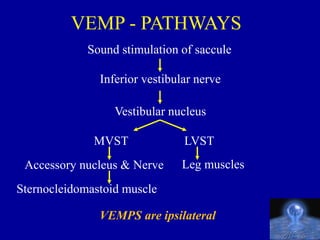
VEMP - PATHWAYS
Sound stimulation of saccule
Inferior vestibular nerve
Vestibular nucleus
MVST
Accessory nucleus & Nerve
Sternocleidomastoid muscle
LVST
Leg muscles
VEMPS are ipsilateral
VEMP methods
• Click evoked VEMP – most reproducible,
symmetric, and technically easy to perform.
• Air- and bone-conducted short tone bursts
• Bone conduction VEMP
• Galvanic VEMP
• Forehead taps
EQUIPMENT
• Evoked response computer
• Sound generator
• Surface electrodes to pick up neck muscle
activation
VEMP - technique
• Subjects are instructed to tense the muscle during
runs of acoustic stimulation, relax between runs
• Inserts are preferable to headphones
• The response is ipsilateral, hence bilateral stimuli
and bilateral recording is done
• Loud clicks (0.1 msec) or tone bursts (typically 95-
100 dB nHL or louder) are repetitively presented to
each ear in turn at 200 msec intervals (5/second)
• Optimum frequency: 500 - 1000 Hz
• 3 repetitions on each side
• Myogenic potentials are amplified, bandpass
filtered (5-1K Hz), and averaged for at least 100
presentations
• The response evoked in the neck EMG is averaged
and presented as a VEMP
• VEMP is recorded in the first 30 ms after the
stimulus
• The latency, amplitude, and threshold for the p13-
n23 wave is measured
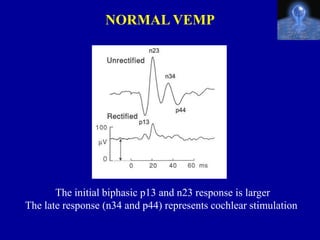
NORMAL VEMP
NORMAL VEMP
The initial biphasic p13 and n23 response is larger
The late response (n34 and p44) represents cochlear stimulation.
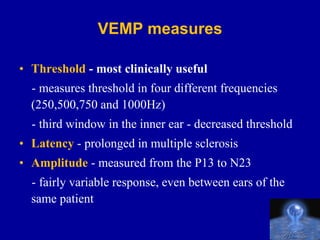
VEMP measures
• Threshold - most clinically useful
- measures threshold in four different frequencies
(250,500,750 and 1000Hz)
- third window in the inner ear - decreased threshold
• Latency - prolonged in multiple sclerosis
• Amplitude - measured from the P13 to N23
- fairly variable response, even between ears of the
same patient
ABNORMAL VEMP
• Asymmetry is calculated by Amplitude
Asymetric ratio
• If the ratio is more than 33% then asymmetry
exsists
• Absent (no reproducible wave, or P1 latency
outside of norms)
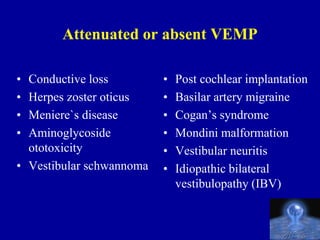
Attenuated or absent VEMP
• Conductive loss
• Herpes zoster oticus
• Meniere`s disease
• Aminoglycoside
ototoxicity
• Vestibular schwannoma
• Post cochlear implantation
• Basilar artery migraine
• Cogan’s syndrome
• Mondini malformation
• Vestibular neuritis
• Idiopathic bilateral
vestibulopathy (IBV)
Conductive hearing loss
Left ear
(Absent VEMP)
Right ear
(Normal VEMP)
BILATERAL AMINOGLYCOSIDE OTOTOXICITY
Rt Lt
LEFT ACOUSTIC NEUROMA
Rt Lt
VEMP - Meniere’s disease
Lt Rt
• VEMP amplitudes can be increased in early
Meniere's disease
• Absent VEMPs in advanced disease may represent
collapse of the saccule
• Altered VEMP after administering glycerol
Meniere’s disease
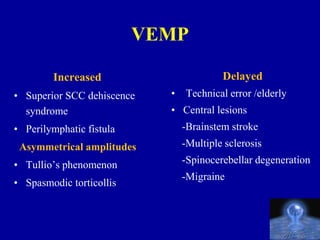
VEMP
Increased
• Superior SCC dehiscence
syndrome
• Perilymphatic fistula
Asymmetrical amplitudes
• Tullio’s phenomenon
• Spasmodic torticollis
Delayed
• Technical error /elderly
• Central lesions
-Brainstem stroke
-Multiple sclerosis
-Spinocerebellar degeneration
-Migraine
LEFT SUPERIOR SEMICIRCULAR DEHISCENCE
Rt
Lt
VEMP - ADVANTAGES
• Specific vestibular sensory system (saccule) is assessed
• Retained in patients with profound SNHL
• Used in infants (latencies are shorter)
• Highly sensitive in the early diagnosis of retrocochlear
lesions
• Robust, reproducible screening test of otolith function
• Minimal test time
• Easy to obtain & interpret
• Non-invasive, bedside test
• Does not cause discomfort
LIMITATIONS
• Conductive hearing loss obliterates VEMP's - an absent
VEMP does not mean absent saccule function
• A person with a present VEMP and conductive hearing
loss may have Superior semicircular canal dehiscence
CONCLUSION
• VEMP is a sound - evoked muscle reflex, or sonomotor
response that can be recorded using evoked potential
techniques by acoustical stimulation of the saccule
• VEMP has become an important investigative modality
in the evaluation of patients with balance disorders
VEMP

VEMP

  • 1.
    VESTIBULAR EVOKED MYOGENIC POTENTIALS ITSINDICATIONS & CURRENT STATUS
  • 2.
    VESTIBULAR EVOKED MYOGENIC POTENTIALS •An otolith(saccule)-mediated short - latency reflex recorded from averaged sternocleidomastoid electromyography in response to clicks or tonebursts. • Increasingly used in the evaluation of patients with vertigo
  • 3.
    • Conventional vestibularassessment - evaluation of horizontal semicircular canal • VEMP – evaluation of saccule, inferior vestibular nerve & vestibulocollic pathway • VEMP is a polysynaptic response & helps in the assessment of lower brainstem function, unlike the caloric tests & ABR which assess the upper brainstem
  • 4.
    • Saccule andsaccular nerves have the lowest threshold to response to acoustic stimuli – basis of VEMP test • This sound sensitivity is thought to be a remnant from the saccule’s use as an organ of hearing in lower animals
  • 5.
    HISTORY OF VEMP •Sound-evoked vestibular responses in humans were described by Tullio (1929) & Von Békésy (1935) • Townsend et al.noticed the true origin of these potentials was the saccule • Colebatch and Halmagyi first recorded VEMPs (1992) • Kovach reintroduced VEMP (1994) • Clinically used since 1992
  • 6.
    VEMP - INDICATIONS •Indicated in the diagnosis of peripheral and central vestibulopathies • Differentiation of labyrinthine from retro labyrinthine lesions • Used to monitor the efficacy of intratympanic gentamycin treatment • Can be used in intraoperative, neurophysiological monitoring
  • 7.
    VEMP - PATHWAYS Soundstimulation of saccule Inferior vestibular nerve Vestibular nucleus MVST Accessory nucleus & Nerve Sternocleidomastoid muscle LVST Leg muscles VEMPS are ipsilateral
  • 8.
    VEMP methods • Clickevoked VEMP – most reproducible, symmetric, and technically easy to perform. • Air- and bone-conducted short tone bursts • Bone conduction VEMP • Galvanic VEMP • Forehead taps
  • 9.
    EQUIPMENT • Evoked responsecomputer • Sound generator • Surface electrodes to pick up neck muscle activation
  • 10.
  • 11.
    • Subjects areinstructed to tense the muscle during runs of acoustic stimulation, relax between runs • Inserts are preferable to headphones • The response is ipsilateral, hence bilateral stimuli and bilateral recording is done • Loud clicks (0.1 msec) or tone bursts (typically 95- 100 dB nHL or louder) are repetitively presented to each ear in turn at 200 msec intervals (5/second) • Optimum frequency: 500 - 1000 Hz • 3 repetitions on each side
  • 12.
    • Myogenic potentialsare amplified, bandpass filtered (5-1K Hz), and averaged for at least 100 presentations • The response evoked in the neck EMG is averaged and presented as a VEMP • VEMP is recorded in the first 30 ms after the stimulus • The latency, amplitude, and threshold for the p13- n23 wave is measured
  • 13.
  • 14.
    NORMAL VEMP The initialbiphasic p13 and n23 response is larger The late response (n34 and p44) represents cochlear stimulation.
  • 15.
    VEMP measures • Threshold- most clinically useful - measures threshold in four different frequencies (250,500,750 and 1000Hz) - third window in the inner ear - decreased threshold • Latency - prolonged in multiple sclerosis • Amplitude - measured from the P13 to N23 - fairly variable response, even between ears of the same patient
  • 16.
    ABNORMAL VEMP • Asymmetryis calculated by Amplitude Asymetric ratio • If the ratio is more than 33% then asymmetry exsists • Absent (no reproducible wave, or P1 latency outside of norms)
  • 17.
    Attenuated or absentVEMP • Conductive loss • Herpes zoster oticus • Meniere`s disease • Aminoglycoside ototoxicity • Vestibular schwannoma • Post cochlear implantation • Basilar artery migraine • Cogan’s syndrome • Mondini malformation • Vestibular neuritis • Idiopathic bilateral vestibulopathy (IBV)
  • 18.
    Conductive hearing loss Leftear (Absent VEMP) Right ear (Normal VEMP)
  • 19.
  • 20.
  • 21.
    VEMP - Meniere’sdisease Lt Rt
  • 22.
    • VEMP amplitudescan be increased in early Meniere's disease • Absent VEMPs in advanced disease may represent collapse of the saccule • Altered VEMP after administering glycerol Meniere’s disease
  • 23.
    VEMP Increased • Superior SCCdehiscence syndrome • Perilymphatic fistula Asymmetrical amplitudes • Tullio’s phenomenon • Spasmodic torticollis Delayed • Technical error /elderly • Central lesions -Brainstem stroke -Multiple sclerosis -Spinocerebellar degeneration -Migraine
  • 24.
  • 25.
    VEMP - ADVANTAGES •Specific vestibular sensory system (saccule) is assessed • Retained in patients with profound SNHL • Used in infants (latencies are shorter) • Highly sensitive in the early diagnosis of retrocochlear lesions • Robust, reproducible screening test of otolith function • Minimal test time • Easy to obtain & interpret • Non-invasive, bedside test • Does not cause discomfort
  • 26.
    LIMITATIONS • Conductive hearingloss obliterates VEMP's - an absent VEMP does not mean absent saccule function • A person with a present VEMP and conductive hearing loss may have Superior semicircular canal dehiscence
  • 27.
    CONCLUSION • VEMP isa sound - evoked muscle reflex, or sonomotor response that can be recorded using evoked potential techniques by acoustical stimulation of the saccule • VEMP has become an important investigative modality in the evaluation of patients with balance disorders