DNS TREATMENT
BY
DR.M.V.HARIKA M.S IN ENT
Submucous Resection (SMR) Operation: It is generally done in adults under local anaesthesia. It
consists of elevating the mucoperichondrial and mucoperiosteal flaps on either side of the septal
framework by a single incision made on one side of the septum, removing the deflected parts of the
bony and cartilaginous septum, and then repositioning the flaps (see section on Operative Surgery for
details).
Septoplasty: It is a conservative approach to septal surgery. In this operation, much of the septal
framework is retained. Only the most deviated parts are removed. Rest of the septal framework is
corrected and repositioned by plastic means. Mucoperichondrial/periosteal flap is generally raised only
on one side of the septum, retaining the attachment and blood supply on the other. Septoplasty has
now almost replaced SMR operation.Septal surgery is usually done after the age of 17 so as not to
interfere with the growth of nasal skeleton. However, if a child has severe septal deviation causing
marked nasal obstruction, conservative septal surgery ( septoplasty) can be performed to provide a
good airway.
SEPTAL HAEMATOMA
AETIOLOGY: It is collection of blood under the perichondrium or periosteum of the nasal
septum. It often results from nasal trauma or septal surgery. In bleeding disorders, it may
occur spontaneously.
CLINICAL FEATURES : Bilateral nasal obstruction is the commonest presenting symptom.
This may be associated with frontal headache and a sense of pressure over the nasal
bridge. Examination reveals smooth rounded swelling of the septum in both the nasal
fossae.Palpation may show the mass to be soft and fluctuant.
TREATMENT : Small haematomas can be aspirated with a wide bore sterile needle. Larger
haematomas are incised and drained by a small anteroposterior incision parallel to the nasal floor.
Excision of a small piece of mucosa from the edge of incision gives better drainage. Following
drainage, nose is packed on both sides to prevent reaccumulation. Systemic antibiotics should be
given to prevent septal abscess.
COMPLICATIONS: Septal haematoma, if not drained, may organize into fibrous tissue leading to a
permanently thickened septum. If secondary infection supervenes, it results in septal abscess with
necrosis of cartilage and depression of nasal dorsum.
SEPTAL ABSCESS
AETIOLOGY: Mostly, it results from secondary infection of septal
haematoma. Occasionally, it follows furuncle of the nose or upper lip. It
may also follow acute infection such as typhoid or measles.
CLINICAL FEATURES: There is severe bilateral nasal obstruction with pain
and tenderness over the bridge of nose. Patient may also complain of fever
with chills and frontal headache. Skin over the nose may be red and
swollen. Internal examination of nose reveals smooth bilateral swelling of
the nasal septum . Fluctuation can be elicited in this swelling. Septal
mucosa is often congested. Submandibular lymph nodes may also be
enlarged and tender.
TREATMENT: Abscess should be drained as early as possible. Incision is made in the
most dependent part of the abscess and a piece of septal mucosa excised. Pus
and necrosed pieces of cartilage are removed by suction. Incision may require to
be reopened daily for 2–3 days to drain any pus or to remove any necrosed pieces
of cartilage. Systemic antibiotics are started as soon as diagnosis has been made
and continued at least for a period of 10 days.
COMPLICATIONS : Necrosis of septal cartilage often results in depression of the
cartilaginous dorsum in the supratip area and may require augmentation
rhinoplasty 2–3 months later. Necrosis of septal flaps may lead to septal perforation.
Meningitis and cavernous sinus thrombosis following septal abscess, though rare
these days, can be serious complications.
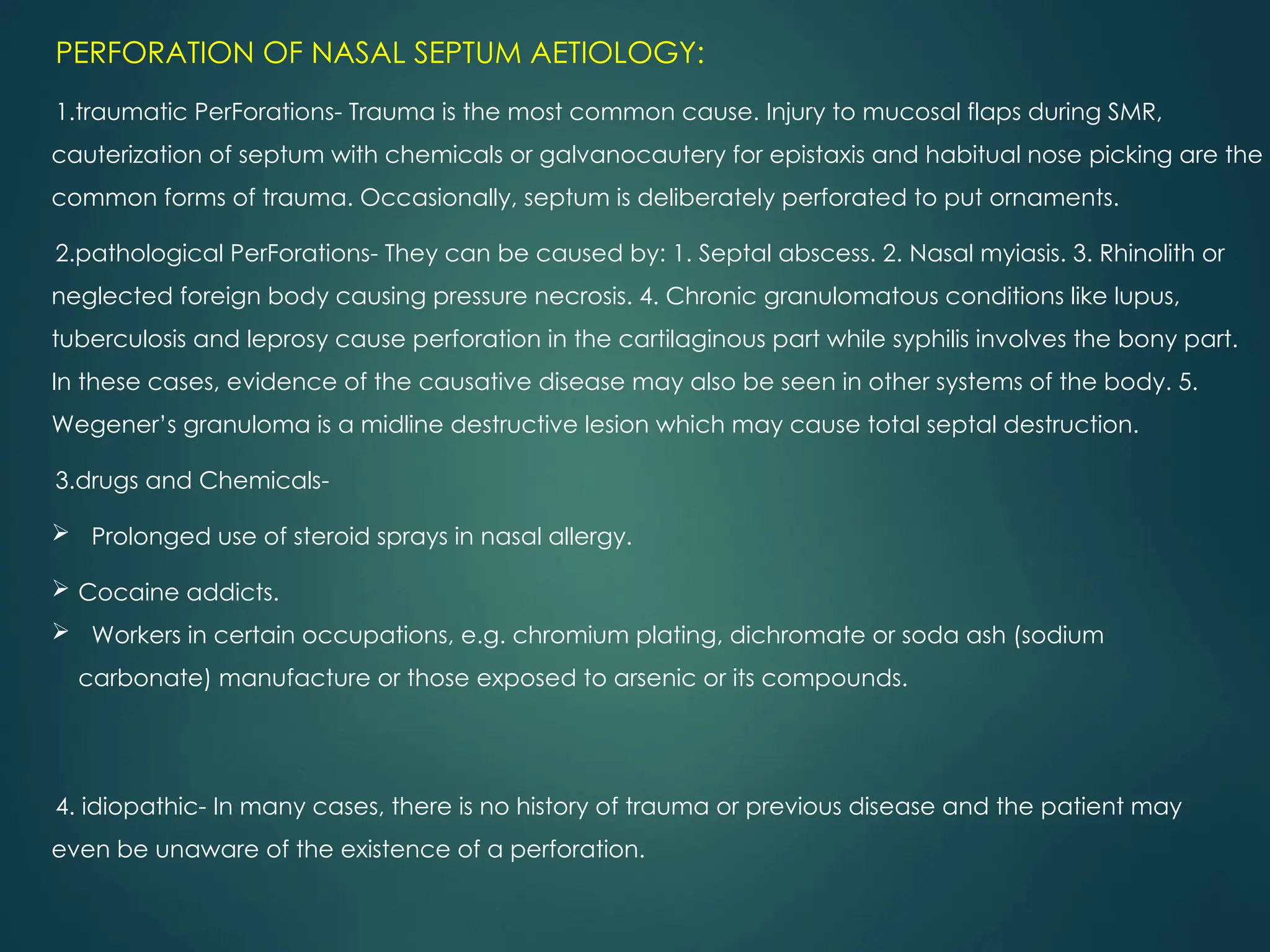
PERFORATION OF NASAL SEPTUM AETIOLOGY:
1.traumatic PerForations- Trauma is the most common cause. Injury to mucosal flaps during SMR,
cauterization of septum with chemicals or galvanocautery for epistaxis and habitual nose picking are the
common forms of trauma. Occasionally, septum is deliberately perforated to put ornaments.
2.pathological PerForations- They can be caused by: 1. Septal abscess. 2. Nasal myiasis. 3. Rhinolith or
neglected foreign body causing pressure necrosis. 4. Chronic granulomatous conditions like lupus,
tuberculosis and leprosy cause perforation in the cartilaginous part while syphilis involves the bony part.
In these cases, evidence of the causative disease may also be seen in other systems of the body. 5.
Wegener’s granuloma is a midline destructive lesion which may cause total septal destruction.
3.drugs and Chemicals-
 Prolonged use of steroid sprays in nasal allergy.
 Cocaine addicts.
 Workers in certain occupations, e.g. chromium plating, dichromate or soda ash (sodium
carbonate) manufacture or those exposed to arsenic or its compounds.
4. idiopathic- In many cases, there is no history of trauma or previous disease and the patient may
even be unaware of the existence of a perforation.
CLINICAL FEATURES: Small anterior perforations cause whistling sound
during inspiration or expiration. Larger perforations develop crusts which
obstruct the nose or cause severe epistaxis when removed.
TREATMENT: An attempt should always be made to find out the cause
before treatment of perforation. This may require biopsy from the
granulations or biopsy of the edge of the perforation. Inactive small
perforations can be surgically closed by plastic flaps. Larger perforations
are difficult to close. Their treatment is aimed to keep the nose crust-free
by alkaline nasal douches and application of a bland ointment.
Sometimes, a thin silastic button can be worn to get relief from the
symptoms .
Submucous Resectionof Nasal Septum (SMR Operation)
INDICATIONS
Deviated nasal septum (DNS) causing symptoms of na- sal obstruction and recurrent
headaches.
DNS causing obstruction to ventilation of paranasal sinuses and middle ear,
resulting in recurrent sinusitis and otitis media.
Recurrent epistaxis from septal spur.
As a part of septorhinoplasty for cosmetic correction of external nasal
deformities.
As a preliminary step in hypophysectomy (trans-sep- tal trans-sphenoidal approach)
or vidian neurectomy (trans-septal approach).
CONTRAINDICATIONS
Patients below 17 years of age. In such cases, a con- servative surgery (septoplasty)
should be done.
Acute episode of respiratory infection.
Bleeding diathesis.
Untreated diabetes or hypertension.
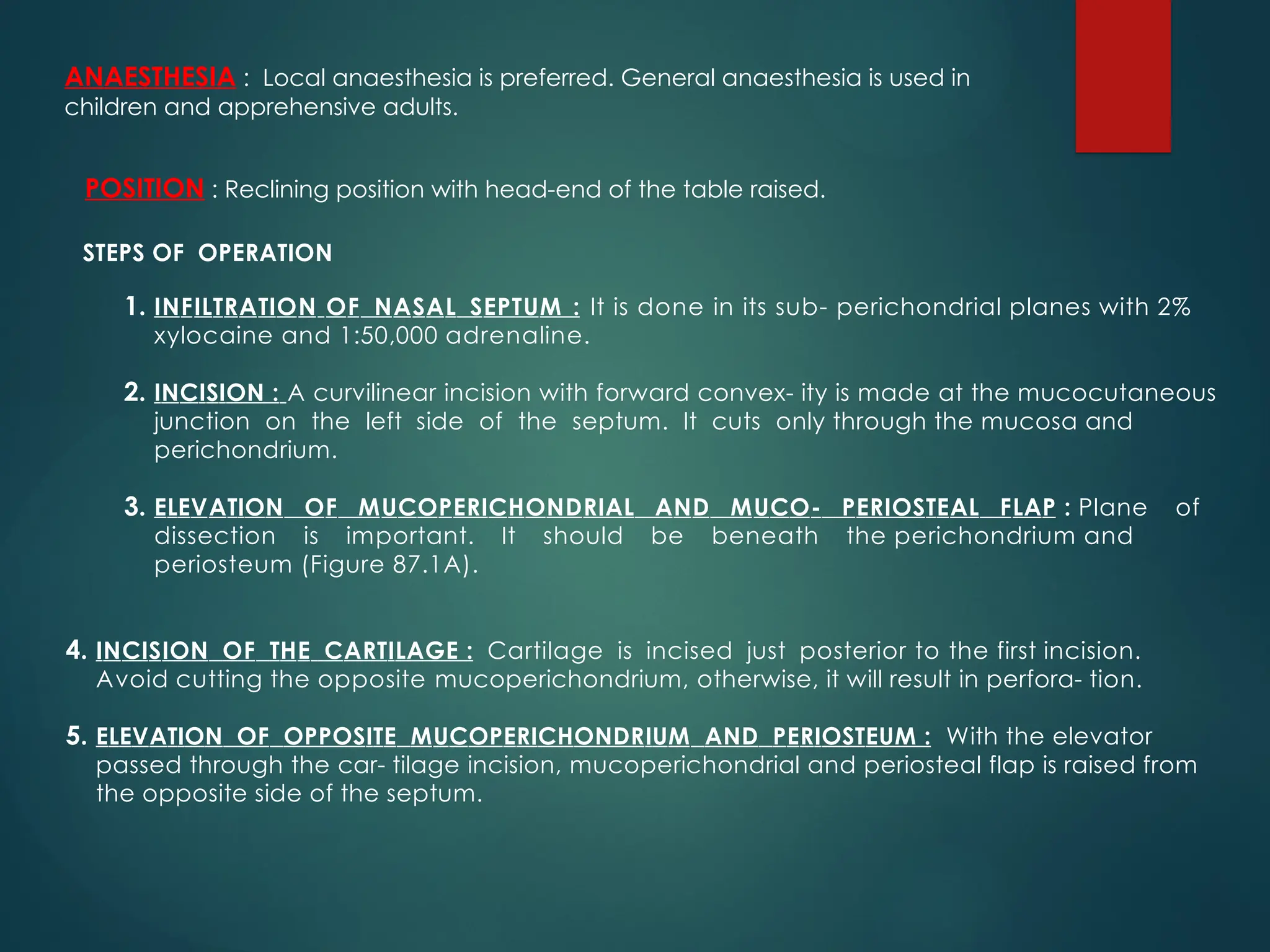
ANAESTHESIA : Local anaesthesia is preferred. General anaesthesia is used in
children and apprehensive adults.
POSITION : Reclining position with head-end of the table raised.
STEPS OF OPERATION
1. INFILTRATION OF NASAL SEPTUM : It is done in its sub- perichondrial planes with 2%
xylocaine and 1:50,000 adrenaline.
2. INCISION : A curvilinear incision with forward convex- ity is made at the mucocutaneous
junction on the left side of the septum. It cuts only through the mucosa and
perichondrium.
3. ELEVATION OF MUCOPERICHONDRIAL AND MUCO- PERIOSTEAL FLAP : Plane of
dissection is important. It should be beneath the perichondrium and
periosteum (Figure 87.1A).
4. INCISION OF THE CARTILAGE : Cartilage is incised just posterior to the first incision.
Avoid cutting the opposite mucoperichondrium, otherwise, it will result in perfora- tion.
5. ELEVATION OF OPPOSITE MUCOPERICHONDRIUM AND PERIOSTEUM : With the elevator
passed through the car- tilage incision, mucoperichondrial and periosteal flap is raised from
the opposite side of the septum.
6. REMOVAL OF CARTILAGE AND BONE : Now working between the two
flaps, cartilage and bone are removed. Cartilage can be removed
with Ballenger swivel knife and bone with Luc’s forceps. Bony spur or ridge
can be re- moved with gouge and hammer. Preserve a strip of car- tilage
about 1 cm wide along the dorsal and caudal bor- der of the septum to
prevent collapse of the bridge of the nose or retraction of columella
(Figure 87.2).
7. STITCHING : One or two catgut or silk stitches are ap- plied in the initial
mucoperichondrial incision.
8. PACKING : A ribbon gauze, smeared with an antibiotic ointment or liquid
paraffin, is packed on each side of the nasal cavity to prevent collection of
blood between the flaps. Nasal dressing is applied.
POSTOPERATIVECARE
1.Patient is placed in semi-sitting position to prevent oozing of blood. Outer
nasal dressing is changed if soaked in blood.
2.A soft diet should be taken in the first two postopera- tive days to
minimize active mastication which causes bleeding.
3.Pain, if any, should be controlled with analgesics.
4.Antibiotic cover is given for 5–6 days.
5.Nasal packs are gently removed after 24 h and there- after, decongestant
nasal drops and steam inhalations are given daily for 5–6 days.
6.Silk stitch, if any, is removed on 5th or 6th day.
7.Patient should avoid trauma to the nose for several days.
COMPLICATIONS
1.Bleeding : It may require repacking, if severe.
2.Septal haematoma. :Evacuate the haematoma and give intranasal packing on both
sides of septum for equal pressure.
3.Septal abscess. This can follow infection of septal hae- matoma.
4.Perforation. When tears occur on opposing sides of the mucous membrane.
5.Depression of bridge. Usually occurs in supratip area due to too much removal of
cartilage along the dorsal border.
6.Retraction of columella. Often seen when caudal strip of cartilage is not preserved.
7.Persistence of deviation. It usually occurs due to inadequate surgery and may
require revision operation.
8.Flapping of nasal septum. Rarely seen, when too much of septal framework has been
removed. Septum, which now consists of two mucoperichondrial flaps, moves to the
right or left with respiration.
9.Toxic shock syndrome. It is rare after septal surgery. It can follow staphylococcal
(sometimes streptococcal) infection and is characterized by nausea, vomiting,
purulent secretions, hypotension and rash. It should be diagnosed early. It is treated
by removal of packing, hydrating the patient, maintaining blood pressure and
administering proper antibiotics.
PRESENT STATUS
These days SMR operation has been replaced by septoplasty. As much of the
cartilage or bone as possible should be retained. Sometimes straight pieces of bone
or cartilage can be put back between the mucosal flaps. Only indication for SMR is when
cartilage or bone from the septum is required for a graft.
Submucous resection of nasal
septum. (A) Incision and elevation
of flap on the left. (B) Elevation of
flap on the right after incis- ing the
septal cartilage. (C) Closing the
incision.
SMR operation. It is necessary to
preserve dorsal and caudal struts
of cartilage to avoid supratip
depression or columellar
recession, respectively.
Septoplasty is a conservative approach to septal surgery; as much of the septal framework as
possible is retained. Mucoperichondrial/periosteal flap is generally raised only on one side. This
operation has almost replaced the SMR operation.
INDICATIONS
1.Deviated septum causing nasal obstruction on one or both sides.
2.As a part of septorhinoplasty for cosmetic reasons.
3.Recurrent epistaxis usually from the spur.
4.Sinusitis due to septal deviation.
5.Septal deviation making contact with lateral nasal wall and causing headaches.
6.For approach to middle meatus or frontal recess in endoscopic sinus surgery when deviated septum
obstructs the view and access to these areas.
7.Access to endoscopic dacryocystorhinostomy operation in some cases.
8.As an approach to pituitary fossa (trans-septal transsphenoidal approach).
9.Septal deviation causing sleep apnoea or hypopnoea syndrome.
CONTRAINDICATIONS
10.Acute nasal or sinus infection.
11.Untreated diabetes.
12.Hypertension.
13.Bleeding diathesis.
septoplasty
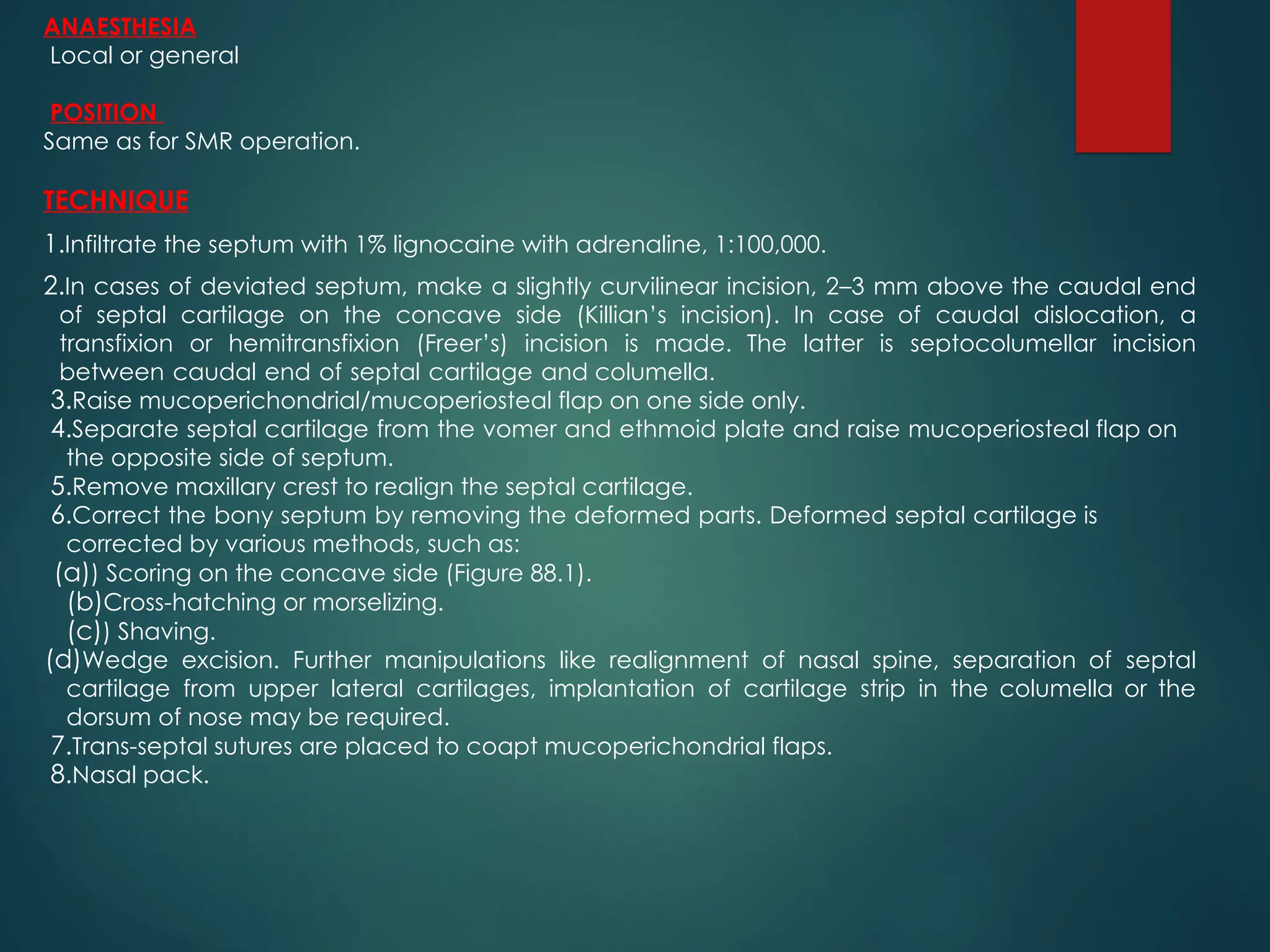
ANAESTHESIA
Local or general
POSITION
Same as for SMR operation.
TECHNIQUE
1.Infiltrate the septum with 1% lignocaine with adrenaline, 1:100,000.
2.In cases of deviated septum, make a slightly curvilinear incision, 2–3 mm above the caudal end
of septal cartilage on the concave side (Killian’s incision). In case of caudal dislocation, a
transfixion or hemitransfixion (Freer’s) incision is made. The latter is septocolumellar incision
between caudal end of septal cartilage and columella.
3.Raise mucoperichondrial/mucoperiosteal flap on one side only.
4.Separate septal cartilage from the vomer and ethmoid plate and raise mucoperiosteal flap on
the opposite side of septum.
5.Remove maxillary crest to realign the septal cartilage.
6.Correct the bony septum by removing the deformed parts. Deformed septal cartilage is
corrected by various methods, such as:
(a)) Scoring on the concave side (Figure 88.1).
(b)Cross-hatching or morselizing.
(c)) Shaving.
(d)Wedge excision. Further manipulations like realignment of nasal spine, separation of septal
cartilage from upper lateral cartilages, implantation of cartilage strip in the columella or the
dorsum of nose may be required.
7.Trans-septal sutures are placed to coapt mucoperichondrial flaps.
8.Nasal pack.
POSTOPERATIVE CARE
1.Septal surgery is a daycare surgery and the patient can go home after he fully
recovers from effects of sedation with no postoperative nausea or bleeding. Patients with
obstructive sleep apnoea should better be observed overnight.
2.Avoid strenuous exercise as it may cause bleeding.
3.Pack, if kept is removed the next day and patient be instructed not to blow the nose or sneeze
hard. Secretions can be drawn backwards into the throat by snorting rather than blowing the
nose.
4.Saline spray or steam inhalation are encouraged after pack removal.
5.Xylo- or oxymetazoline drops are used if nose becomes stuffy.
6.Nasal splints, if used, are removed on fourth to eighth day and gentle suction of nose is
done.
7.Patient should avoid trauma to nose, wipe the nose gently and in no case push the nose from
one side to another.
POSTOPERATIVE COMPLICATIONS
Same as in SMR operation.
8.Bleeding.
9.Septal haematoma and abscess.
10.Septal perforation.
11.Supratip depression.
12.Saddle nose deformity.
6.Columellar retraction.
7.Persistence of septal deviation, or external nasal deformity.
8.Cerebrospinal fluid rhinorrhoea rarely occurs if the perpendicular plate of ethmoid is avulsed.
9.Toxic shock syndrome.
Septal cartilage is straightened by scoring the
cartilage on the concave side to remove
interlocked cartilage stresses (A), or by shav-
ing the convex side of cartilage (B). Dislocated
septal cartilage can be replaced in the
maxillary groove or on the anterior nasal spine
by excision of the cartilage along the floor of
nose and fixing it with a suture (C).
TYPES OF SEPTAL INCISIONS IN SEPTOPLASTY
1. Killian’s: In the nasal mucosa, cephalic to the caudal end of the septum
(Figure 88.2).
2. Transfixion: Through and through incision, close to but caudal to caudal
end of the septum.
3. Hemitransfixion: Same as the transfixion incision but on one side
4. Horizontal on the spur: For endoscopic spurectomy
Septal incisions. (A) Killian’s incision.
(B) Hemitransfixion incision.
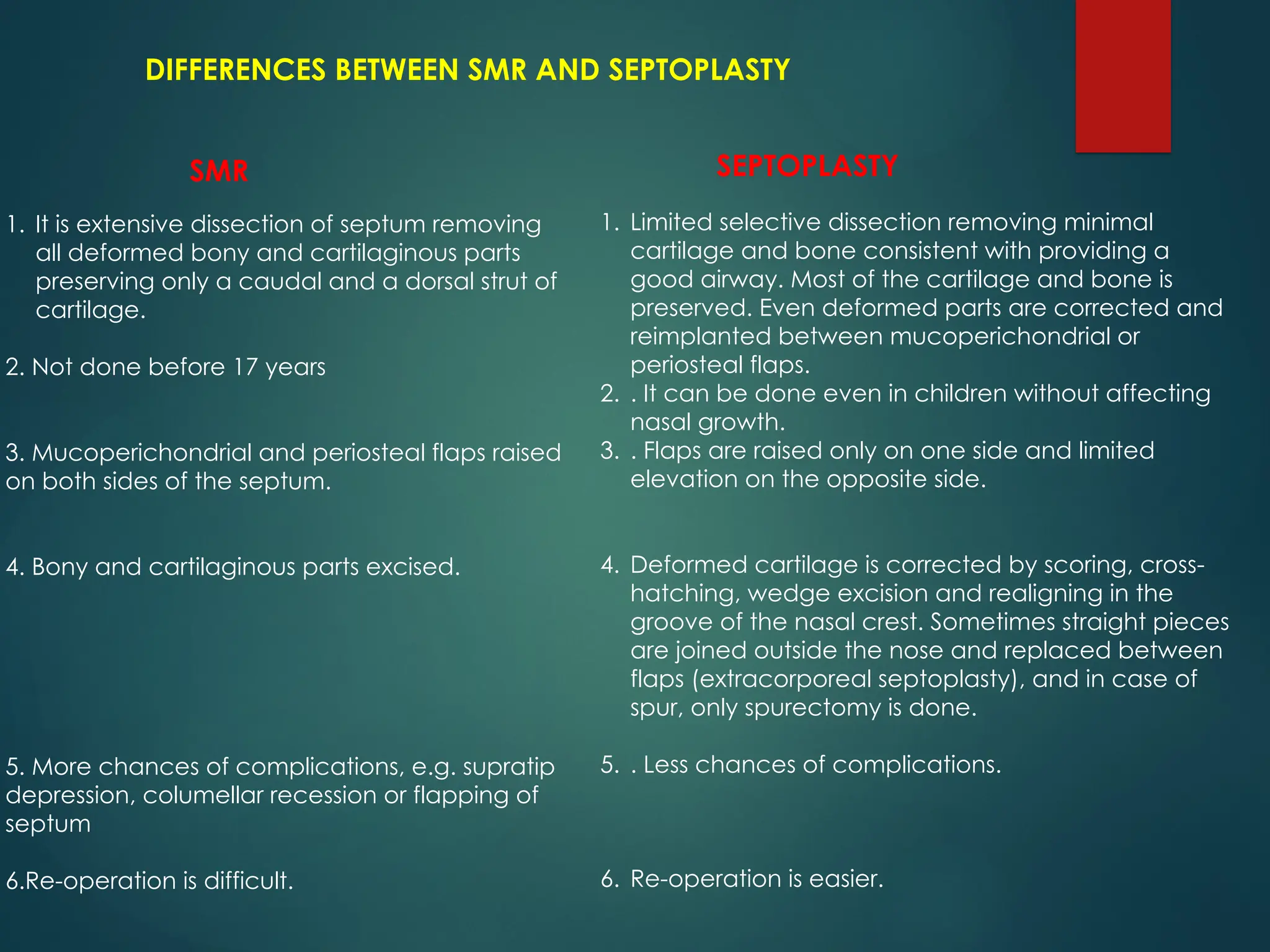
1. It is extensive dissection of septum removing
all deformed bony and cartilaginous parts
preserving only a caudal and a dorsal strut of
cartilage.
2. Not done before 17 years
3. Mucoperichondrial and periosteal flaps raised
on both sides of the septum.
4. Bony and cartilaginous parts excised.
5. More chances of complications, e.g. supratip
depression, columellar recession or flapping of
septum
6.Re-operation is difficult.
1. Limited selective dissection removing minimal
cartilage and bone consistent with providing a
good airway. Most of the cartilage and bone is
preserved. Even deformed parts are corrected and
reimplanted between mucoperichondrial or
periosteal flaps.
2. . It can be done even in children without affecting
nasal growth.
3. . Flaps are raised only on one side and limited
elevation on the opposite side.
4. Deformed cartilage is corrected by scoring, cross-
hatching, wedge excision and realigning in the
groove of the nasal crest. Sometimes straight pieces
are joined outside the nose and replaced between
flaps (extracorporeal septoplasty), and in case of
spur, only spurectomy is done.
5. . Less chances of complications.
6. Re-operation is easier.
DIFFERENCES BETWEEN SMR AND SEPTOPLASTY
SMR SEPTOPLASTY
ANY QUERIES ?
THANK YOU

DNS TREATMENT AND ITS MANAGEMENT TECHNIQUES

  • 1.
  • 2.
    Submucous Resection (SMR)Operation: It is generally done in adults under local anaesthesia. It consists of elevating the mucoperichondrial and mucoperiosteal flaps on either side of the septal framework by a single incision made on one side of the septum, removing the deflected parts of the bony and cartilaginous septum, and then repositioning the flaps (see section on Operative Surgery for details). Septoplasty: It is a conservative approach to septal surgery. In this operation, much of the septal framework is retained. Only the most deviated parts are removed. Rest of the septal framework is corrected and repositioned by plastic means. Mucoperichondrial/periosteal flap is generally raised only on one side of the septum, retaining the attachment and blood supply on the other. Septoplasty has now almost replaced SMR operation.Septal surgery is usually done after the age of 17 so as not to interfere with the growth of nasal skeleton. However, if a child has severe septal deviation causing marked nasal obstruction, conservative septal surgery ( septoplasty) can be performed to provide a good airway.
  • 3.
    SEPTAL HAEMATOMA AETIOLOGY: Itis collection of blood under the perichondrium or periosteum of the nasal septum. It often results from nasal trauma or septal surgery. In bleeding disorders, it may occur spontaneously. CLINICAL FEATURES : Bilateral nasal obstruction is the commonest presenting symptom. This may be associated with frontal headache and a sense of pressure over the nasal bridge. Examination reveals smooth rounded swelling of the septum in both the nasal fossae.Palpation may show the mass to be soft and fluctuant. TREATMENT : Small haematomas can be aspirated with a wide bore sterile needle. Larger haematomas are incised and drained by a small anteroposterior incision parallel to the nasal floor. Excision of a small piece of mucosa from the edge of incision gives better drainage. Following drainage, nose is packed on both sides to prevent reaccumulation. Systemic antibiotics should be given to prevent septal abscess. COMPLICATIONS: Septal haematoma, if not drained, may organize into fibrous tissue leading to a permanently thickened septum. If secondary infection supervenes, it results in septal abscess with necrosis of cartilage and depression of nasal dorsum.
  • 4.
    SEPTAL ABSCESS AETIOLOGY: Mostly,it results from secondary infection of septal haematoma. Occasionally, it follows furuncle of the nose or upper lip. It may also follow acute infection such as typhoid or measles. CLINICAL FEATURES: There is severe bilateral nasal obstruction with pain and tenderness over the bridge of nose. Patient may also complain of fever with chills and frontal headache. Skin over the nose may be red and swollen. Internal examination of nose reveals smooth bilateral swelling of the nasal septum . Fluctuation can be elicited in this swelling. Septal mucosa is often congested. Submandibular lymph nodes may also be enlarged and tender.
  • 5.
    TREATMENT: Abscess shouldbe drained as early as possible. Incision is made in the most dependent part of the abscess and a piece of septal mucosa excised. Pus and necrosed pieces of cartilage are removed by suction. Incision may require to be reopened daily for 2–3 days to drain any pus or to remove any necrosed pieces of cartilage. Systemic antibiotics are started as soon as diagnosis has been made and continued at least for a period of 10 days. COMPLICATIONS : Necrosis of septal cartilage often results in depression of the cartilaginous dorsum in the supratip area and may require augmentation rhinoplasty 2–3 months later. Necrosis of septal flaps may lead to septal perforation. Meningitis and cavernous sinus thrombosis following septal abscess, though rare these days, can be serious complications.
  • 6.
    PERFORATION OF NASALSEPTUM AETIOLOGY: 1.traumatic PerForations- Trauma is the most common cause. Injury to mucosal flaps during SMR, cauterization of septum with chemicals or galvanocautery for epistaxis and habitual nose picking are the common forms of trauma. Occasionally, septum is deliberately perforated to put ornaments. 2.pathological PerForations- They can be caused by: 1. Septal abscess. 2. Nasal myiasis. 3. Rhinolith or neglected foreign body causing pressure necrosis. 4. Chronic granulomatous conditions like lupus, tuberculosis and leprosy cause perforation in the cartilaginous part while syphilis involves the bony part. In these cases, evidence of the causative disease may also be seen in other systems of the body. 5. Wegener’s granuloma is a midline destructive lesion which may cause total septal destruction. 3.drugs and Chemicals-  Prolonged use of steroid sprays in nasal allergy.  Cocaine addicts.  Workers in certain occupations, e.g. chromium plating, dichromate or soda ash (sodium carbonate) manufacture or those exposed to arsenic or its compounds. 4. idiopathic- In many cases, there is no history of trauma or previous disease and the patient may even be unaware of the existence of a perforation.
  • 7.
    CLINICAL FEATURES: Smallanterior perforations cause whistling sound during inspiration or expiration. Larger perforations develop crusts which obstruct the nose or cause severe epistaxis when removed. TREATMENT: An attempt should always be made to find out the cause before treatment of perforation. This may require biopsy from the granulations or biopsy of the edge of the perforation. Inactive small perforations can be surgically closed by plastic flaps. Larger perforations are difficult to close. Their treatment is aimed to keep the nose crust-free by alkaline nasal douches and application of a bland ointment. Sometimes, a thin silastic button can be worn to get relief from the symptoms .
  • 8.
    Submucous Resectionof NasalSeptum (SMR Operation) INDICATIONS Deviated nasal septum (DNS) causing symptoms of na- sal obstruction and recurrent headaches. DNS causing obstruction to ventilation of paranasal sinuses and middle ear, resulting in recurrent sinusitis and otitis media. Recurrent epistaxis from septal spur. As a part of septorhinoplasty for cosmetic correction of external nasal deformities. As a preliminary step in hypophysectomy (trans-sep- tal trans-sphenoidal approach) or vidian neurectomy (trans-septal approach). CONTRAINDICATIONS Patients below 17 years of age. In such cases, a con- servative surgery (septoplasty) should be done. Acute episode of respiratory infection. Bleeding diathesis. Untreated diabetes or hypertension.
  • 9.
    ANAESTHESIA : Localanaesthesia is preferred. General anaesthesia is used in children and apprehensive adults. POSITION : Reclining position with head-end of the table raised. STEPS OF OPERATION 1. INFILTRATION OF NASAL SEPTUM : It is done in its sub- perichondrial planes with 2% xylocaine and 1:50,000 adrenaline. 2. INCISION : A curvilinear incision with forward convex- ity is made at the mucocutaneous junction on the left side of the septum. It cuts only through the mucosa and perichondrium. 3. ELEVATION OF MUCOPERICHONDRIAL AND MUCO- PERIOSTEAL FLAP : Plane of dissection is important. It should be beneath the perichondrium and periosteum (Figure 87.1A). 4. INCISION OF THE CARTILAGE : Cartilage is incised just posterior to the first incision. Avoid cutting the opposite mucoperichondrium, otherwise, it will result in perfora- tion. 5. ELEVATION OF OPPOSITE MUCOPERICHONDRIUM AND PERIOSTEUM : With the elevator passed through the car- tilage incision, mucoperichondrial and periosteal flap is raised from the opposite side of the septum.
  • 10.
    6. REMOVAL OFCARTILAGE AND BONE : Now working between the two flaps, cartilage and bone are removed. Cartilage can be removed with Ballenger swivel knife and bone with Luc’s forceps. Bony spur or ridge can be re- moved with gouge and hammer. Preserve a strip of car- tilage about 1 cm wide along the dorsal and caudal bor- der of the septum to prevent collapse of the bridge of the nose or retraction of columella (Figure 87.2). 7. STITCHING : One or two catgut or silk stitches are ap- plied in the initial mucoperichondrial incision. 8. PACKING : A ribbon gauze, smeared with an antibiotic ointment or liquid paraffin, is packed on each side of the nasal cavity to prevent collection of blood between the flaps. Nasal dressing is applied. POSTOPERATIVECARE 1.Patient is placed in semi-sitting position to prevent oozing of blood. Outer nasal dressing is changed if soaked in blood. 2.A soft diet should be taken in the first two postopera- tive days to minimize active mastication which causes bleeding. 3.Pain, if any, should be controlled with analgesics. 4.Antibiotic cover is given for 5–6 days. 5.Nasal packs are gently removed after 24 h and there- after, decongestant nasal drops and steam inhalations are given daily for 5–6 days. 6.Silk stitch, if any, is removed on 5th or 6th day. 7.Patient should avoid trauma to the nose for several days.
  • 11.
    COMPLICATIONS 1.Bleeding : Itmay require repacking, if severe. 2.Septal haematoma. :Evacuate the haematoma and give intranasal packing on both sides of septum for equal pressure. 3.Septal abscess. This can follow infection of septal hae- matoma. 4.Perforation. When tears occur on opposing sides of the mucous membrane. 5.Depression of bridge. Usually occurs in supratip area due to too much removal of cartilage along the dorsal border. 6.Retraction of columella. Often seen when caudal strip of cartilage is not preserved. 7.Persistence of deviation. It usually occurs due to inadequate surgery and may require revision operation. 8.Flapping of nasal septum. Rarely seen, when too much of septal framework has been removed. Septum, which now consists of two mucoperichondrial flaps, moves to the right or left with respiration. 9.Toxic shock syndrome. It is rare after septal surgery. It can follow staphylococcal (sometimes streptococcal) infection and is characterized by nausea, vomiting, purulent secretions, hypotension and rash. It should be diagnosed early. It is treated by removal of packing, hydrating the patient, maintaining blood pressure and administering proper antibiotics. PRESENT STATUS These days SMR operation has been replaced by septoplasty. As much of the cartilage or bone as possible should be retained. Sometimes straight pieces of bone or cartilage can be put back between the mucosal flaps. Only indication for SMR is when cartilage or bone from the septum is required for a graft.
  • 12.
    Submucous resection ofnasal septum. (A) Incision and elevation of flap on the left. (B) Elevation of flap on the right after incis- ing the septal cartilage. (C) Closing the incision. SMR operation. It is necessary to preserve dorsal and caudal struts of cartilage to avoid supratip depression or columellar recession, respectively.
  • 13.
    Septoplasty is aconservative approach to septal surgery; as much of the septal framework as possible is retained. Mucoperichondrial/periosteal flap is generally raised only on one side. This operation has almost replaced the SMR operation. INDICATIONS 1.Deviated septum causing nasal obstruction on one or both sides. 2.As a part of septorhinoplasty for cosmetic reasons. 3.Recurrent epistaxis usually from the spur. 4.Sinusitis due to septal deviation. 5.Septal deviation making contact with lateral nasal wall and causing headaches. 6.For approach to middle meatus or frontal recess in endoscopic sinus surgery when deviated septum obstructs the view and access to these areas. 7.Access to endoscopic dacryocystorhinostomy operation in some cases. 8.As an approach to pituitary fossa (trans-septal transsphenoidal approach). 9.Septal deviation causing sleep apnoea or hypopnoea syndrome. CONTRAINDICATIONS 10.Acute nasal or sinus infection. 11.Untreated diabetes. 12.Hypertension. 13.Bleeding diathesis. septoplasty
  • 14.
    ANAESTHESIA Local or general POSITION Sameas for SMR operation. TECHNIQUE 1.Infiltrate the septum with 1% lignocaine with adrenaline, 1:100,000. 2.In cases of deviated septum, make a slightly curvilinear incision, 2–3 mm above the caudal end of septal cartilage on the concave side (Killian’s incision). In case of caudal dislocation, a transfixion or hemitransfixion (Freer’s) incision is made. The latter is septocolumellar incision between caudal end of septal cartilage and columella. 3.Raise mucoperichondrial/mucoperiosteal flap on one side only. 4.Separate septal cartilage from the vomer and ethmoid plate and raise mucoperiosteal flap on the opposite side of septum. 5.Remove maxillary crest to realign the septal cartilage. 6.Correct the bony septum by removing the deformed parts. Deformed septal cartilage is corrected by various methods, such as: (a)) Scoring on the concave side (Figure 88.1). (b)Cross-hatching or morselizing. (c)) Shaving. (d)Wedge excision. Further manipulations like realignment of nasal spine, separation of septal cartilage from upper lateral cartilages, implantation of cartilage strip in the columella or the dorsum of nose may be required. 7.Trans-septal sutures are placed to coapt mucoperichondrial flaps. 8.Nasal pack.
  • 15.
    POSTOPERATIVE CARE 1.Septal surgeryis a daycare surgery and the patient can go home after he fully recovers from effects of sedation with no postoperative nausea or bleeding. Patients with obstructive sleep apnoea should better be observed overnight. 2.Avoid strenuous exercise as it may cause bleeding. 3.Pack, if kept is removed the next day and patient be instructed not to blow the nose or sneeze hard. Secretions can be drawn backwards into the throat by snorting rather than blowing the nose. 4.Saline spray or steam inhalation are encouraged after pack removal. 5.Xylo- or oxymetazoline drops are used if nose becomes stuffy. 6.Nasal splints, if used, are removed on fourth to eighth day and gentle suction of nose is done. 7.Patient should avoid trauma to nose, wipe the nose gently and in no case push the nose from one side to another. POSTOPERATIVE COMPLICATIONS Same as in SMR operation. 8.Bleeding. 9.Septal haematoma and abscess. 10.Septal perforation. 11.Supratip depression. 12.Saddle nose deformity. 6.Columellar retraction. 7.Persistence of septal deviation, or external nasal deformity. 8.Cerebrospinal fluid rhinorrhoea rarely occurs if the perpendicular plate of ethmoid is avulsed. 9.Toxic shock syndrome.
  • 16.
    Septal cartilage isstraightened by scoring the cartilage on the concave side to remove interlocked cartilage stresses (A), or by shav- ing the convex side of cartilage (B). Dislocated septal cartilage can be replaced in the maxillary groove or on the anterior nasal spine by excision of the cartilage along the floor of nose and fixing it with a suture (C).
  • 17.
    TYPES OF SEPTALINCISIONS IN SEPTOPLASTY 1. Killian’s: In the nasal mucosa, cephalic to the caudal end of the septum (Figure 88.2). 2. Transfixion: Through and through incision, close to but caudal to caudal end of the septum. 3. Hemitransfixion: Same as the transfixion incision but on one side 4. Horizontal on the spur: For endoscopic spurectomy Septal incisions. (A) Killian’s incision. (B) Hemitransfixion incision.
  • 18.
    1. It isextensive dissection of septum removing all deformed bony and cartilaginous parts preserving only a caudal and a dorsal strut of cartilage. 2. Not done before 17 years 3. Mucoperichondrial and periosteal flaps raised on both sides of the septum. 4. Bony and cartilaginous parts excised. 5. More chances of complications, e.g. supratip depression, columellar recession or flapping of septum 6.Re-operation is difficult. 1. Limited selective dissection removing minimal cartilage and bone consistent with providing a good airway. Most of the cartilage and bone is preserved. Even deformed parts are corrected and reimplanted between mucoperichondrial or periosteal flaps. 2. . It can be done even in children without affecting nasal growth. 3. . Flaps are raised only on one side and limited elevation on the opposite side. 4. Deformed cartilage is corrected by scoring, cross- hatching, wedge excision and realigning in the groove of the nasal crest. Sometimes straight pieces are joined outside the nose and replaced between flaps (extracorporeal septoplasty), and in case of spur, only spurectomy is done. 5. . Less chances of complications. 6. Re-operation is easier. DIFFERENCES BETWEEN SMR AND SEPTOPLASTY SMR SEPTOPLASTY
  • 19.
  • 20.