Dr.VINOD. M. K
GMC,Amritsar
References
1.Glasscock Shambaugh 6th edi.
2.Scott-Brown 7th edi.
 Middle ear implants represent a type of
hearing aid that has a potentially widespread
application to patients with mild to severe
hearing loss.
 The main impetus to develop these devices
has come from patient dissatisfaction with
conventional amplification aids relating to
 performance
 the sound quality, occlusion effects and
 acoustic feedback,comfort
 social stigma and cosmetic implications.
 Wax blocking the receiver
 recurrent otitis externa .
 Implantable acoustic/mechanical hearing
devices differ from conventional hearing aids
in that they are partially or totally implanted
and directly couple acoustic energy to the
ossicular chain or cochlea.
 In exchange for the added surgical risks and
costs associated with implantation, they offer
several potential advantages over
conventional hearing aids, including
 increased gain and dynamic range,
 reduced feedback,
 Reduced maintenance,
 improved appearance,
 freedom from ear canal occlusion.
Wilska is credited with being the first to
use electromagnetic induction to stimulate
the middle ear.
Implantable middle ear hearing devices
differ from conventional aids in how they
impart sound vibration to the ossicular
chain.
convert the electric signal movement of
an actuator coupled to the ossicular chain.
Two basic types of transducers that have
been incorporated into the middle ear
implantable hearing devices:
ELECTROMAGNETIC and
PIEZOELECTRIC.
 Electromagnetic transducers generate a
magnetic field using a wire coil carrying a
current that encodes the microphone output.
 This magnetic field induces motion of a
nearby magnet, which can either be separate
from the coil and attached alone to the
ossicles or
 integrated with the coil to become a vibrating
compound mass affixed to the ossicles
Piezoelectric devices move ossicles using
a piezoelectric crystal that bends or
lengthens in time with changes in a signal
voltage applied across it.
Piezoelectric ossicular actuators generally
yield greater power and less distortion than
electromagnetic devices.
but they are typically larger and require
precise placement to ensure proper
compressive force between the actuator
and the ossicle it contacts.
 Partially implanted devices consist of an
external processor comprising a microphone,
speech processor, battery, and a transmitter
coil that transcutaneously conveys signals
and power to the internal device.
 This approach facilitates replacement of
batteries, service and upgrade of processors,
and minimization of internal device size, but
requires patient acceptance of an external
processor.
 fully implantable systems house all of
components within the implanted portion of
the device, including the battery pack and a
microphone.
 This frees the patient from wearing a visible
external processor,
 but it increases the size and complexity of the
implanted components,
-mandates surgical procedures for battery
replacement each ~5 years,
-and complicates design and placement of
the microphone.
Vibrant sound bridge- partially implantable
Middle ear transducer(MET)- partially
implantable
Carina- totally implantable
Esteen hearing implant- totally implantable
was the first semiimplantable middle ear
hearing device available in Europe (1998)
and the United States (2000).
The device employs a "vibrating ossicular
reconstruction prosthesis" (VORP)
electromagnetic transducer
 It is a magnet/coil combination typically
attached to the long process of the incus
and connected via a thin signal wire to an
implanted receiver/amplifier.
 The external processor houses a microphone
and standard zinc battery; it is held in place
behind the ear by a permanent magnet
 The internal device typically is implanted
using a standard transmastoid, facial recess
approach to the middle ear.
 The internal receiver is placed in a bony
trough in the retrosigmoid bone several
centimeters behind the ear, similar to
placement of a cochlear implant processor.
 The VORP is crimped into the long process of
the incus
 A prospective, single-subject, repeated-
measures multicenter study of 53 adult
subjects with moderate to severe SNHL
measured
 unaided hearing before and after
implantation,functional gain, speech
recognition, acoustic feedback, occlusion,
patient self-assessment, and device
preference in direct comparison between the
Vibrant Soundbridge™ and appropriately fit
acoustic hearing aids.
 Statistically significant improvement was
observed in functional gain at all frequencies
tested from 250 to 8,000 KHz, patient
satisfaction,performance, occlusion,
feedback, and device preference
 Greater than 10 dB improvement in
functional gain was observed in 2,4, and 6
kHz.
 24% of subjects performed significantly better
with the implanted device and 14% performed
significantly worse.
As of2008, over 2,500 patients have been
implanted with the device worldwide over
more than a decade.
The proportion of patients who said they
would repeat the procedure (72%) and -
40% said they would consider binaural
implantation.
The most common side effects were
persistent aural fullness (27%) and
persistent taste alteration (8%).
A 2005 summary from the device
manufacturer on 1000 Vibrant
Soundbridge™ implant cases described a
0.3% device failure rate since 1999.
a 5% incidence of revision surgery due to
inadequate performance.
1% rate of skin-flap necrosis also noted.
The Vibrant Soundbridge™ is suitable for
patients with
hearing loss of up to 70 dB PTA
and is US FDA-approved for patients with
moderate to severe SNHL, adequate aided
speech discrimination, and medical
contraindication or intolerance of a
conventional hearing aid
The Otologics Middle ear transducer
(MET™) is an electromagnetic middle ear
hearing aid.
The original, semi-implantable MET has
been replaced by the fully implantable
Carina currently in clinical trials.
MET/Carina mechanism moves the incus
using a linear actuator rigidly connected to
the edges of a limited mastoidectomy
cavity.
offers the potential to exert greater force
on the incus than the floating mass
approach;
however, this comes at the expense of
greater complexity in the implantation
procedure!
 must achieve precise positioning to
ensure optimal compressive loading of the
rod/incus junction
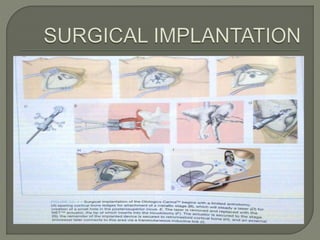
 Via a postauricular incision, a well is drilled to
house the implant body and then a limited
mastoidectomy is performed to expose the
incus body and malleus head.
 A laser is used to make a small pit in the
posterosuperior incus body,
 then the linear actuator is maneuvered into
the mounting system and its position is finely
adjusted until its rod indents the incus pit with
optimal compression force.
 The receiver capsule and transducer
electronics are placed in the well, and the
microphone is positioned subperiosteal at an
intact region of mastoid cortex.
Mean functional gain averaged across
0.5/1/2/4 kHz (for the 160 subjects tested
at 2 to 12 months postoperatively) was 28
dB.
Speech recognition and subjective hearing
scores for the 77-subject cohort were not
significantly different b/W the conventional
aid and MET.
As a fully implanted device reliant on a
rechargeable battery with a ~5-yr life, the
Carina must be exposed via surgery for
replacement of the battery every -5 years
is a fully implantable piezoelectric device.
One especially notable design feature of the
Esteem is its use of the tympanic membrane
and malleus as a microphone diaphragm;
a piezoelectric sensor transduces malleus
motion into a signal voltage, which is
amplified and used to drive a second
piezoelectric actuator in contact with the
incus and/or stapes.
implantation of the Esteem requires partial
removal of the incus to prevent feedback
from actuator to sensor.
This ensures a maximal CHL in the event
of device failure or removal, unless a
subsequent ossiculoplasty is performed.
• Power is provided by a nonrechargeable lithium-ion
battery designed to last 5 years between
replacements
The Esteem is designed for patients with
moderate to severe hearing loss.
Indications include age ^18 years, mild to
severe (35 to 85 dB) SNHL between 0.5
and 4 kHz in the implanted ear, a healthy
ear with normal pneumatization and
adequate space for device implantation on
CT, normal tympanometry, and speech
discrimination ^60%.
Overall, the results so far available for
middle ear implantable devices appear
encouraging and without major
complications
and have provided valuable information as
implant design improves.
at present it is only the Vibrant
Soundbridge that is in worldwide use with
viable support and favourable longterm
results.
Middle ear implants

Middle ear implants

  • 1.
    Dr.VINOD. M. K GMC,Amritsar References 1.GlasscockShambaugh 6th edi. 2.Scott-Brown 7th edi.
  • 2.
     Middle earimplants represent a type of hearing aid that has a potentially widespread application to patients with mild to severe hearing loss.  The main impetus to develop these devices has come from patient dissatisfaction with conventional amplification aids relating to  performance  the sound quality, occlusion effects and  acoustic feedback,comfort  social stigma and cosmetic implications.  Wax blocking the receiver  recurrent otitis externa .
  • 3.
     Implantable acoustic/mechanicalhearing devices differ from conventional hearing aids in that they are partially or totally implanted and directly couple acoustic energy to the ossicular chain or cochlea.  In exchange for the added surgical risks and costs associated with implantation, they offer several potential advantages over conventional hearing aids, including  increased gain and dynamic range,  reduced feedback,  Reduced maintenance,  improved appearance,  freedom from ear canal occlusion.
  • 4.
    Wilska is creditedwith being the first to use electromagnetic induction to stimulate the middle ear. Implantable middle ear hearing devices differ from conventional aids in how they impart sound vibration to the ossicular chain. convert the electric signal movement of an actuator coupled to the ossicular chain.
  • 5.
    Two basic typesof transducers that have been incorporated into the middle ear implantable hearing devices: ELECTROMAGNETIC and PIEZOELECTRIC.
  • 6.
     Electromagnetic transducersgenerate a magnetic field using a wire coil carrying a current that encodes the microphone output.  This magnetic field induces motion of a nearby magnet, which can either be separate from the coil and attached alone to the ossicles or  integrated with the coil to become a vibrating compound mass affixed to the ossicles
  • 7.
    Piezoelectric devices moveossicles using a piezoelectric crystal that bends or lengthens in time with changes in a signal voltage applied across it. Piezoelectric ossicular actuators generally yield greater power and less distortion than electromagnetic devices. but they are typically larger and require precise placement to ensure proper compressive force between the actuator and the ossicle it contacts.
  • 8.
     Partially implanteddevices consist of an external processor comprising a microphone, speech processor, battery, and a transmitter coil that transcutaneously conveys signals and power to the internal device.  This approach facilitates replacement of batteries, service and upgrade of processors, and minimization of internal device size, but requires patient acceptance of an external processor.
  • 9.
     fully implantablesystems house all of components within the implanted portion of the device, including the battery pack and a microphone.  This frees the patient from wearing a visible external processor,  but it increases the size and complexity of the implanted components, -mandates surgical procedures for battery replacement each ~5 years, -and complicates design and placement of the microphone.
  • 10.
    Vibrant sound bridge-partially implantable Middle ear transducer(MET)- partially implantable Carina- totally implantable Esteen hearing implant- totally implantable
  • 11.
    was the firstsemiimplantable middle ear hearing device available in Europe (1998) and the United States (2000). The device employs a "vibrating ossicular reconstruction prosthesis" (VORP) electromagnetic transducer  It is a magnet/coil combination typically attached to the long process of the incus and connected via a thin signal wire to an implanted receiver/amplifier.
  • 12.
     The externalprocessor houses a microphone and standard zinc battery; it is held in place behind the ear by a permanent magnet  The internal device typically is implanted using a standard transmastoid, facial recess approach to the middle ear.  The internal receiver is placed in a bony trough in the retrosigmoid bone several centimeters behind the ear, similar to placement of a cochlear implant processor.  The VORP is crimped into the long process of the incus
  • 14.
     A prospective,single-subject, repeated- measures multicenter study of 53 adult subjects with moderate to severe SNHL measured  unaided hearing before and after implantation,functional gain, speech recognition, acoustic feedback, occlusion, patient self-assessment, and device preference in direct comparison between the Vibrant Soundbridge™ and appropriately fit acoustic hearing aids.
  • 15.
     Statistically significantimprovement was observed in functional gain at all frequencies tested from 250 to 8,000 KHz, patient satisfaction,performance, occlusion, feedback, and device preference  Greater than 10 dB improvement in functional gain was observed in 2,4, and 6 kHz.  24% of subjects performed significantly better with the implanted device and 14% performed significantly worse.
  • 16.
    As of2008, over2,500 patients have been implanted with the device worldwide over more than a decade. The proportion of patients who said they would repeat the procedure (72%) and - 40% said they would consider binaural implantation. The most common side effects were persistent aural fullness (27%) and persistent taste alteration (8%).
  • 17.
    A 2005 summaryfrom the device manufacturer on 1000 Vibrant Soundbridge™ implant cases described a 0.3% device failure rate since 1999. a 5% incidence of revision surgery due to inadequate performance. 1% rate of skin-flap necrosis also noted.
  • 18.
    The Vibrant Soundbridge™is suitable for patients with hearing loss of up to 70 dB PTA and is US FDA-approved for patients with moderate to severe SNHL, adequate aided speech discrimination, and medical contraindication or intolerance of a conventional hearing aid
  • 19.
    The Otologics Middleear transducer (MET™) is an electromagnetic middle ear hearing aid. The original, semi-implantable MET has been replaced by the fully implantable Carina currently in clinical trials. MET/Carina mechanism moves the incus using a linear actuator rigidly connected to the edges of a limited mastoidectomy cavity.
  • 21.
    offers the potentialto exert greater force on the incus than the floating mass approach; however, this comes at the expense of greater complexity in the implantation procedure!  must achieve precise positioning to ensure optimal compressive loading of the rod/incus junction
  • 22.
     Via apostauricular incision, a well is drilled to house the implant body and then a limited mastoidectomy is performed to expose the incus body and malleus head.  A laser is used to make a small pit in the posterosuperior incus body,  then the linear actuator is maneuvered into the mounting system and its position is finely adjusted until its rod indents the incus pit with optimal compression force.  The receiver capsule and transducer electronics are placed in the well, and the microphone is positioned subperiosteal at an intact region of mastoid cortex.
  • 24.
    Mean functional gainaveraged across 0.5/1/2/4 kHz (for the 160 subjects tested at 2 to 12 months postoperatively) was 28 dB. Speech recognition and subjective hearing scores for the 77-subject cohort were not significantly different b/W the conventional aid and MET. As a fully implanted device reliant on a rechargeable battery with a ~5-yr life, the Carina must be exposed via surgery for replacement of the battery every -5 years
  • 25.
    is a fullyimplantable piezoelectric device. One especially notable design feature of the Esteem is its use of the tympanic membrane and malleus as a microphone diaphragm; a piezoelectric sensor transduces malleus motion into a signal voltage, which is amplified and used to drive a second piezoelectric actuator in contact with the incus and/or stapes.
  • 26.
    implantation of theEsteem requires partial removal of the incus to prevent feedback from actuator to sensor. This ensures a maximal CHL in the event of device failure or removal, unless a subsequent ossiculoplasty is performed. • Power is provided by a nonrechargeable lithium-ion battery designed to last 5 years between replacements
  • 28.
    The Esteem isdesigned for patients with moderate to severe hearing loss. Indications include age ^18 years, mild to severe (35 to 85 dB) SNHL between 0.5 and 4 kHz in the implanted ear, a healthy ear with normal pneumatization and adequate space for device implantation on CT, normal tympanometry, and speech discrimination ^60%.
  • 29.
    Overall, the resultsso far available for middle ear implantable devices appear encouraging and without major complications and have provided valuable information as implant design improves. at present it is only the Vibrant Soundbridge that is in worldwide use with viable support and favourable longterm results.