
This presentation will cover 3 topics: 
Misplaced modifiers 
 Dangling modifiers 
 Parallel Structures
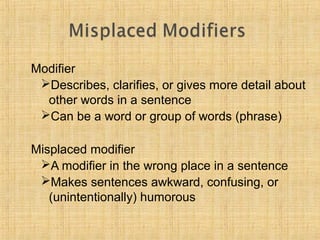
Modifier 
Describes, clarifies, or gives more detail about 
other words in a sentence 
Can be a word or group of words (phrase) 
Misplaced modifier 
A modifier in the wrong place in a sentence 
Makes sentences awkward, confusing, or 
(unintentionally) humorous
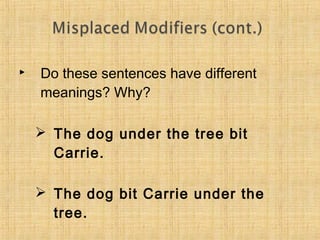
 Do these sentences have different 
meanings? Why? 
 The dog under the tree bit 
Carrie. 
 The dog bit Carrie under the 
tree.
How can you correct this sentence? 
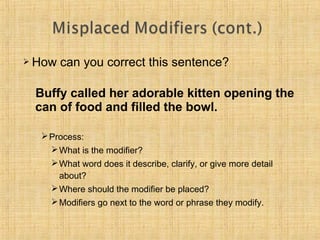
Buffy called her adorable kitten opening the 
can of food and filled the bowl. 
Process: 
What is the modifier? 
What word does it describe, clarify, or give more detail 
about? 
Where should the modifier be placed? 
Modifiers go next to the word or phrase they modify.
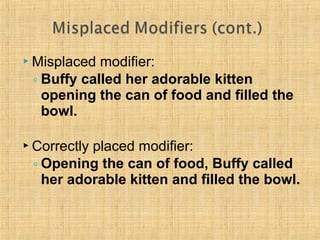
Misplaced modifier: 
◦ Buffy called her adorable kitten 
opening the can of food and filled the 
bowl. 
 Correctly placed modifier: 
◦ Opening the can of food, Buffy called 
her adorable kitten and filled the bowl.
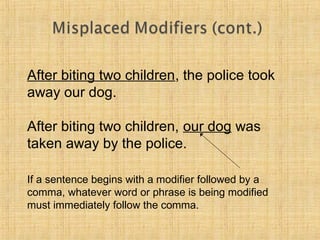
After biting two children, the police took 
away our dog. 
After biting two children, our dog was 
taken away by the police. 
If a sentence begins with a modifier followed by a 
comma, whatever word or phrase is being modified 
must immediately follow the comma.
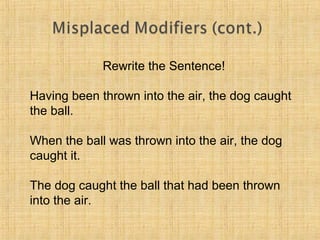
Rewrite the Sentence! 
Having been thrown into the air, the dog caught 
the ball. 
When the ball was thrown into the air, the dog 
caught it. 
The dog caught the ball that had been thrown 
into the air.
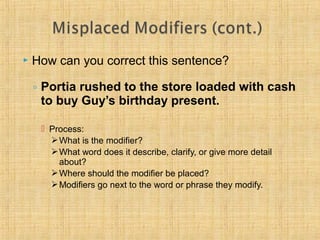
 How can you correct this sentence? 
◦ Portia rushed to the store loaded with cash 
to buy Guy’s birthday present. 
 Process: 
What is the modifier? 
What word does it describe, clarify, or give more detail 
about? 
Where should the modifier be placed? 
Modifiers go next to the word or phrase they modify.
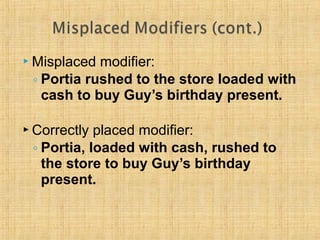
Misplaced modifier: 
◦ Portia rushed to the store loaded with 
cash to buy Guy’s birthday present. 
 Correctly placed modifier: 
◦ Portia, loaded with cash, rushed to 
the store to buy Guy’s birthday 
present.
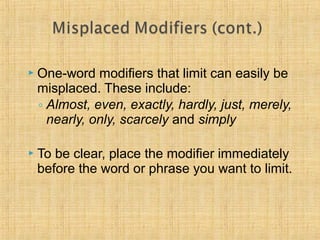
 One-word modifiers that limit can easily be 
misplaced. These include: 
◦ Almost, even, exactly, hardly, just, merely, 
nearly, only, scarcely and simply 
 To be clear, place the modifier immediately 
before the word or phrase you want to limit.
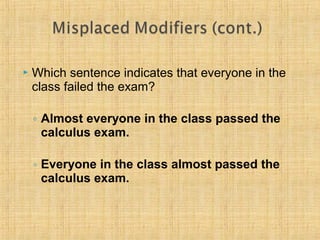
 Which sentence indicates that everyone in the 
class failed the exam? 
◦ Almost everyone in the class passed the 
calculus exam. 
◦ Everyone in the class almost passed the 
calculus exam.
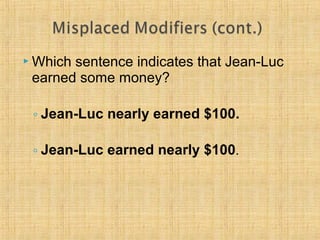
 Which sentence indicates that Jean-Luc 
earned some money? 
◦ Jean-Luc nearly earned $100. 
◦ Jean-Luc earned nearly $100.
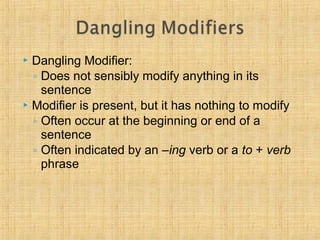
 Dangling Modifier: 
◦ Does not sensibly modify anything in its 
sentence 
 Modifier is present, but it has nothing to modify 
◦ Often occur at the beginning or end of a 
sentence 
◦ Often indicated by an –ing verb or a to + verb 
phrase
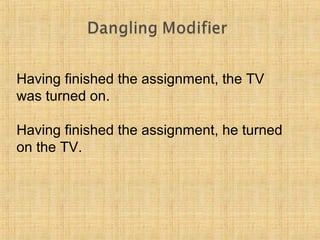
Having finished the assignment, the TV 
was turned on. 
Having finished the assignment, he turned 
on the TV.
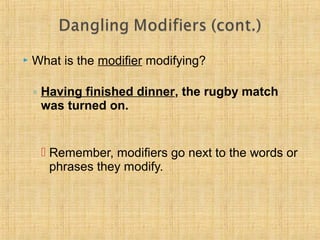
 What is the modifier modifying? 
◦ Having finished dinner, the rugby match 
was turned on. 
 Remember, modifiers go next to the words or 
phrases they modify.
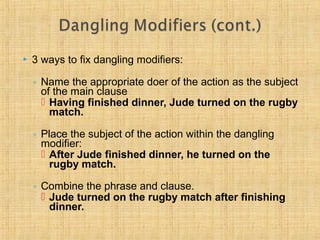
 3 ways to fix dangling modifiers: 
◦ Name the appropriate doer of the action as the subject 
of the main clause 
 Having finished dinner, Jude turned on the rugby 
match. 
◦ Place the subject of the action within the dangling 
modifier: 
 After Jude finished dinner, he turned on the 
rugby match. 
◦ Combine the phrase and clause. 
 Jude turned on the rugby match after finishing 
dinner.
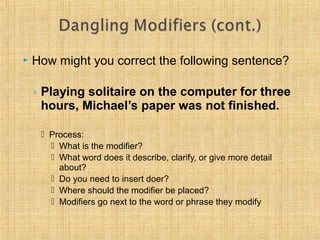
 How might you correct the following sentence? 
◦ Playing solitaire on the computer for three 
hours, Michael’s paper was not finished. 
 Process: 
 What is the modifier? 
 What word does it describe, clarify, or give more detail 
about? 
 Do you need to insert doer? 
 Where should the modifier be placed? 
 Modifiers go next to the word or phrase they modify
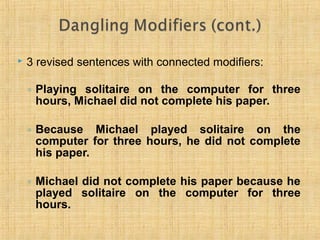
 3 revised sentences with connected modifiers: 
◦ Playing solitaire on the computer for three 
hours, Michael did not complete his paper. 
◦ Because Michael played solitaire on the 
computer for three hours, he did not complete 
his paper. 
◦ Michael did not complete his paper because he 
played solitaire on the computer for three 
hours.
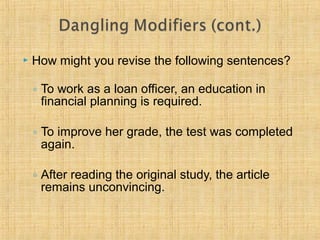
 How might you revise the following sentences? 
◦ To work as a loan officer, an education in 
financial planning is required. 
◦ To improve her grade, the test was completed 
again. 
◦ After reading the original study, the article 
remains unconvincing.
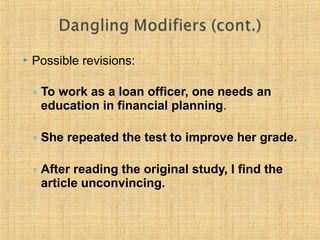
 Possible revisions: 
◦ To work as a loan officer, one needs an 
education in financial planning. 
◦ She repeated the test to improve her grade. 
◦ After reading the original study, I find the 
article unconvincing.
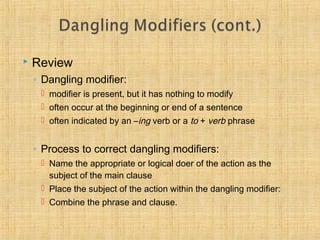
 Review 
◦ Dangling modifier: 
 modifier is present, but it has nothing to modify 
 often occur at the beginning or end of a sentence 
 often indicated by an –ing verb or a to + verb phrase 
◦ Process to correct dangling modifiers: 
 Name the appropriate or logical doer of the action as the 
subject of the main clause 
 Place the subject of the action within the dangling modifier: 
 Combine the phrase and clause.
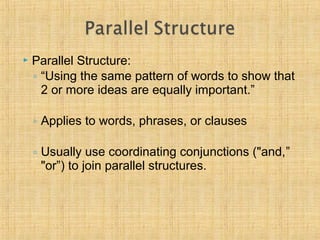
 Parallel Structure: 
◦ “Using the same pattern of words to show that 
2 or more ideas are equally important.” 
◦ Applies to words, phrases, or clauses 
◦ Usually use coordinating conjunctions ("and,” 
"or”) to join parallel structures.
 With the -ing form (gerund) of verbs: 
◦ Parallel: Mary likes hiking, swimming, and 
bicycling. 
 With infinitive verb phrases: 
◦ Parallel: Mary likes to hike, to swim, and to ride a 
bicycle. 
Or 
◦ Mary likes to hike, swim, and ride a bicycle. 
Note: Use "to" before all the verbs in a sentence or 
only before the first one—don’t mix.
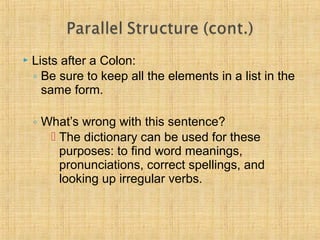
 Lists after a Colon: 
◦ Be sure to keep all the elements in a list in the 
same form. 
◦ What’s wrong with this sentence? 
 The dictionary can be used for these 
purposes: to find word meanings, 
pronunciations, correct spellings, and 
looking up irregular verbs.
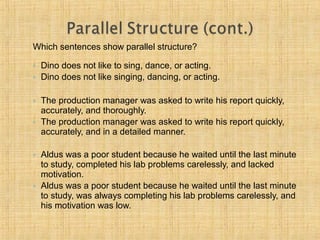
Which sentences show parallel structure? 
◦ Dino does not like to sing, dance, or acting. 
◦ Dino does not like singing, dancing, or acting. 
◦ The production manager was asked to write his report quickly, 
accurately, and thoroughly. 
◦ The production manager was asked to write his report quickly, 
accurately, and in a detailed manner. 
◦ Aldus was a poor student because he waited until the last minute 
to study, completed his lab problems carelessly, and lacked 
motivation. 
◦ Aldus was a poor student because he waited until the last minute 
to study, was always completing his lab problems carelessly, and 
his motivation was low.
Thank you.

Sentence clarity

  • 2.
    This presentation willcover 3 topics: Misplaced modifiers  Dangling modifiers  Parallel Structures
  • 3.
    Modifier Describes, clarifies,or gives more detail about other words in a sentence Can be a word or group of words (phrase) Misplaced modifier A modifier in the wrong place in a sentence Makes sentences awkward, confusing, or (unintentionally) humorous
  • 4.
     Do thesesentences have different meanings? Why?  The dog under the tree bit Carrie.  The dog bit Carrie under the tree.
  • 6.
    How can youcorrect this sentence? Buffy called her adorable kitten opening the can of food and filled the bowl. Process: What is the modifier? What word does it describe, clarify, or give more detail about? Where should the modifier be placed? Modifiers go next to the word or phrase they modify.
  • 7.
    Misplaced modifier: ◦Buffy called her adorable kitten opening the can of food and filled the bowl.  Correctly placed modifier: ◦ Opening the can of food, Buffy called her adorable kitten and filled the bowl.
  • 8.
    After biting twochildren, the police took away our dog. After biting two children, our dog was taken away by the police. If a sentence begins with a modifier followed by a comma, whatever word or phrase is being modified must immediately follow the comma.
  • 9.
    Rewrite the Sentence! Having been thrown into the air, the dog caught the ball. When the ball was thrown into the air, the dog caught it. The dog caught the ball that had been thrown into the air.
  • 10.
     How canyou correct this sentence? ◦ Portia rushed to the store loaded with cash to buy Guy’s birthday present.  Process: What is the modifier? What word does it describe, clarify, or give more detail about? Where should the modifier be placed? Modifiers go next to the word or phrase they modify.
  • 11.
    Misplaced modifier: ◦Portia rushed to the store loaded with cash to buy Guy’s birthday present.  Correctly placed modifier: ◦ Portia, loaded with cash, rushed to the store to buy Guy’s birthday present.
  • 12.
     One-word modifiersthat limit can easily be misplaced. These include: ◦ Almost, even, exactly, hardly, just, merely, nearly, only, scarcely and simply  To be clear, place the modifier immediately before the word or phrase you want to limit.
  • 13.
     Which sentenceindicates that everyone in the class failed the exam? ◦ Almost everyone in the class passed the calculus exam. ◦ Everyone in the class almost passed the calculus exam.
  • 14.
     Which sentenceindicates that Jean-Luc earned some money? ◦ Jean-Luc nearly earned $100. ◦ Jean-Luc earned nearly $100.
  • 15.
     Dangling Modifier: ◦ Does not sensibly modify anything in its sentence  Modifier is present, but it has nothing to modify ◦ Often occur at the beginning or end of a sentence ◦ Often indicated by an –ing verb or a to + verb phrase
  • 16.
    Having finished theassignment, the TV was turned on. Having finished the assignment, he turned on the TV.
  • 17.
     What isthe modifier modifying? ◦ Having finished dinner, the rugby match was turned on.  Remember, modifiers go next to the words or phrases they modify.
  • 18.
     3 waysto fix dangling modifiers: ◦ Name the appropriate doer of the action as the subject of the main clause  Having finished dinner, Jude turned on the rugby match. ◦ Place the subject of the action within the dangling modifier:  After Jude finished dinner, he turned on the rugby match. ◦ Combine the phrase and clause.  Jude turned on the rugby match after finishing dinner.
  • 19.
     How mightyou correct the following sentence? ◦ Playing solitaire on the computer for three hours, Michael’s paper was not finished.  Process:  What is the modifier?  What word does it describe, clarify, or give more detail about?  Do you need to insert doer?  Where should the modifier be placed?  Modifiers go next to the word or phrase they modify
  • 20.
     3 revisedsentences with connected modifiers: ◦ Playing solitaire on the computer for three hours, Michael did not complete his paper. ◦ Because Michael played solitaire on the computer for three hours, he did not complete his paper. ◦ Michael did not complete his paper because he played solitaire on the computer for three hours.
  • 21.
     How mightyou revise the following sentences? ◦ To work as a loan officer, an education in financial planning is required. ◦ To improve her grade, the test was completed again. ◦ After reading the original study, the article remains unconvincing.
  • 22.
     Possible revisions: ◦ To work as a loan officer, one needs an education in financial planning. ◦ She repeated the test to improve her grade. ◦ After reading the original study, I find the article unconvincing.
  • 23.
     Review ◦Dangling modifier:  modifier is present, but it has nothing to modify  often occur at the beginning or end of a sentence  often indicated by an –ing verb or a to + verb phrase ◦ Process to correct dangling modifiers:  Name the appropriate or logical doer of the action as the subject of the main clause  Place the subject of the action within the dangling modifier:  Combine the phrase and clause.
  • 24.
     Parallel Structure: ◦ “Using the same pattern of words to show that 2 or more ideas are equally important.” ◦ Applies to words, phrases, or clauses ◦ Usually use coordinating conjunctions ("and,” "or”) to join parallel structures.
  • 25.
     With the-ing form (gerund) of verbs: ◦ Parallel: Mary likes hiking, swimming, and bicycling.  With infinitive verb phrases: ◦ Parallel: Mary likes to hike, to swim, and to ride a bicycle. Or ◦ Mary likes to hike, swim, and ride a bicycle. Note: Use "to" before all the verbs in a sentence or only before the first one—don’t mix.
  • 26.
     Lists aftera Colon: ◦ Be sure to keep all the elements in a list in the same form. ◦ What’s wrong with this sentence?  The dictionary can be used for these purposes: to find word meanings, pronunciations, correct spellings, and looking up irregular verbs.
  • 27.
    Which sentences showparallel structure? ◦ Dino does not like to sing, dance, or acting. ◦ Dino does not like singing, dancing, or acting. ◦ The production manager was asked to write his report quickly, accurately, and thoroughly. ◦ The production manager was asked to write his report quickly, accurately, and in a detailed manner. ◦ Aldus was a poor student because he waited until the last minute to study, completed his lab problems carelessly, and lacked motivation. ◦ Aldus was a poor student because he waited until the last minute to study, was always completing his lab problems carelessly, and his motivation was low.
  • 28.

Editor's Notes

  • #2 Rationale: This slide establishes three clarity concerns that will be covered in this presentation. Click mouse to advance slide.
  • #3 Rationale: This slide establishes three clarity concerns that will be covered in this presentation. Click mouse to advance slide.
  • #4 Rationale: The formal definitions of modifiers and misplaced modifiers are explained in this slide. Click mouse to advance slide.
  • #5 Rationale: The examples in this slide illustrate the importance of the modification phrase or word group. The facilitator may ask students to explain the difference in meaning between the two sentences. The first sentence explains, “That dog under that tree bit Carrie”--the dog is presently located under the tree. The second sentence indicates that the act of biting Carrie occurred under the tree. Depending on the placement of the modification phrase, “under the tree,” the meaning of a sentence can change dramatically. While this is a simple example to illustrate the importance of modifying phrases, the facilitator may invite students to imagine the confusion misplaced modifiers can cause in directions, legal documents, or business letters. The facilitator may also invite students to think of other sentences where misplaced modifiers create confusion or ambiguity. Click mouse to advance slide.
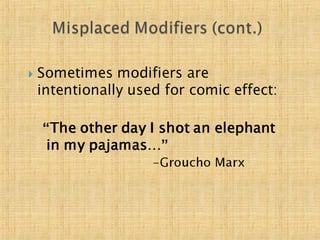
  • #6 Example: Occasionally, misplaced modifiers can be used for comic effect, as in this famous example from the comedian Groucho Marx. The facilitator may note that “in my pajamas” is the modifying phrase in this example. Click mouse to advance slide.
  • #7 Activity: The facilitator may ask participants to point out the problem with the first sentence—the kitten is opening the can of tuna. Unless the kitten has opposable thumbs, this is an unlikely scenario. The participant may then ask what the modifying phrase is here—”opening the can of tuna.” This phrase needs to be as close as possible to what it modifies—in this case, Buffy. This slide also offers a process that students can use to help correct misplaced modifiers. The facilitator may wish to work through this process on this example with students or have them work in small groups. Click mouse to advance slide.
  • #8 Rationale: This slide shows the example sentence and offers one option for correction. Another correct option is, “Buffy, opening the can of tuna, called her adorable kitten and filled the food bowl.” A series of verb phrases would also be correct: “Buffy opened the can of tuna, called her adorable kitten, and filled the food bowl.” Click mouse to advance slide.
  • #11 Activity: Again, the facilitator may ask participants to define the problem with the first sentence: the store is loaded with cash. The facilitator may wish to have students work through this example in small groups. The next slide will present a corrected version of the sentence. Click mouse to advance slide.
  • #12 Rationale: The slide shows the example sentence and offers one option for correction. The modifying phrase, “loaded with cash,” needs to be placed as close as possible to what it modifies--Portia. The slide offers one correct option; another is “Loaded with cash, Portia rushed to the store to buy Guy’s birthday gift.” Click mouse to advance slide.
  • #13 Key Concepts: Not all modification problems are in the form of a phrase. These eight words can also cause confusion within sentences when they are placed next to words that they are not meant to modify. Click mouse to advance slide.
  • #14 Activity: The facilitator may ask students (individually or in small groups) to consider the meaning of each sentence and answer the slide’s final question. The second sentence indicates that everyone in the class failed the exam because “almost” modifies the verb “passed.” Everyone “almost passed”--they came close to passing but did not make the grade. In the first sentence, “almost” modifies “everyone.” ”Almost everyone” passed--most people passed, but a few did not. Click mouse to advance slide.
  • #15 Activity: Again, the facilitator may ask participants (individually or in small groups) to answer the slide’s final question. In the second sentence, “nearly” modifies “$100.” Therefore, “John earned nearly $100”--not quite $100, but perhaps $98. In the first sentence, “nearly” modifies the verb “earned.” “John nearly earned” the money, but he failed to earn it. Click mouse to advance slide.
  • #16 Key Concepts: This slide offers a formal description of dangling modifiers. Click mouse to advance slide.
  • #18 Activity: The facilitator may ask students (individually or in small groups) what the underlined modifier describes. It should described the person who finished eating and turned on the television, but this person is absent. This sentence contains a dangling modifier--it sounds like the rugby game just finished dinner. Click mouse to advance slide.
  • #19 Key Concepts: There are several ways to repair sentences with dangling modifiers. This slide shows three ways to correct the sentence from the preceding slide. The first way should be a review of the previous principle of misplaced modifiers—the modifier phrase “having finished dinner” must be right next to Jude. Click mouse to advance slide.
  • #20 Activity: The facilitator may choose to have participants describe the problem with the sentence—Michael’s paper has played solitaire for three hours--and offer suggestions for correction, using the process presented. The next slide presents 3 corrected options. Click mouse to advance slide.
  • #21 Rationale: The first option corrects the sentence by placing Michael, the doer of the action, as the subject of the sentence. The second option corrects the sentence by placing “Michael” within the modification phrase. The third option corrects the sentence by eliminating the introductory clause and making it a subordinate clause at the end of the sentence. Click mouse to advance slide.
  • #22 Activity: The facilitator may again have participants (individually or in small groups) identify the error within each sentence. The next slide presents corrected versions of these sentences. Click mouse to advance slide.
  • #23 Rationale: This slide presents one possible revision for each sentence. The facilitator should stress that there are other options, discussing these with students briefly. The problem in the first sentence is the lack of a subject—a person who will work as a loan officer. It is corrected here by inserting the pronoun “one.” The problem in the second sentence is the similar to the first—the agent (person doing the action in the verbs) is missing. To correct it, the sentence is rewritten in the active voice (it was passive) with “she” as the subject/agent. Again, the third sentence is missing a subject, and this example problems “I.” Click mouse to advance slide.
  • #24 Rationale: This slide reviews the definition of dangling modifiers and a process students can use to correct them. Click mouse to advance slide.
  • #25 Key Concepts: This slide offers a formal description of parallel structure. Click mouse to advance slide.
  • #26 Key Concepts: This slide offers illustrates two common types of parallel constructions with forms of verbs. Click mouse to advance slide.
  • #27 Key Concepts and Activity: This slide presents an important point about parallelisms after colons. The facilitator may ask participants to identify the problem with the example sentence. The problem is with the final phrase—it introduces a new verb structure. One way to revise this sentence for parallel structure: “The dictionary can be used for these purposes: to find word meanings, pronunciations, correct spellings, and irregular verbs.” Click mouse to advance slide.
  • #28 Activity: The facilitator may ask students (individually or in small groups) to identify the sentences (out of the three pairs of sentences) that show parallel structure in the way they list the three words or phrases. In the first pair of sentences, the second sentence is parallel: “singing, dancing, acting” are all –ing forms of the verbs. The first sentence starts off with infinitives (to + verb) but ends with a gerund (-ing form) In the second pair of sentences, the first sentence is parallel: “quickly, accurately, thoroughly” are all adverbs ending in –ly. The second sentence begins with adverbs but ends in a prepositional phrase (“in a detailed manner”). In the third pair of sentences, the first sentence is parallel: there are three verbs phrases in the past tense form. The second sentence mixes verb forms. Click mouse to advance slide.