More Structural Issues
                   Split Infinitives
               Dangling Modifiers
                       Parallelism
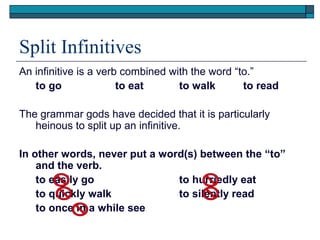
Split Infinitives
An infinitive is a verb combined with the word “to.”
   to go               to eat      to walk       to read

The grammar gods have decided that it is particularly
   heinous to split up an infinitive.

In other words, never put a word(s) between the “to”
    and the verb.
    to easily go               to hurriedly eat
    to quickly walk            to silently read
    to once in a while see
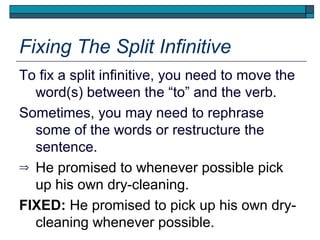
Fixing The Split Infinitive
To fix a split infinitive, you need to move the
  word(s) between the “to” and the verb.
Sometimes, you may need to rephrase
  some of the words or restructure the
  sentence.
⇒ He promised to whenever possible pick
  up his own dry-cleaning.
FIXED: He promised to pick up his own dry-
  cleaning whenever possible.
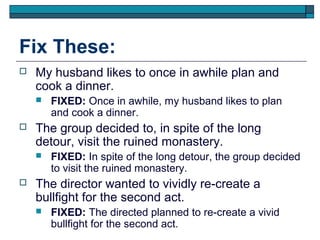
Fix These:
   My husband likes to once in awhile plan and
    cook a dinner.
       FIXED: Once in awhile, my husband likes to plan
        and cook a dinner.
   The group decided to, in spite of the long
    detour, visit the ruined monastery.
       FIXED: In spite of the long detour, the group decided
        to visit the ruined monastery.
   The director wanted to vividly re-create a
    bullfight for the second act.
       FIXED: The directed planned to re-create a vivid
        bullfight for the second act.
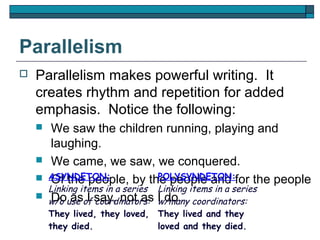
Parallelism
   Parallelism makes powerful writing. It
    creates rhythm and repetition for added
    emphasis. Notice the following:
        We saw the children running, playing and
         laughing.
        We came, we saw, we conquered.
       ASYNDETON:                POLYSYNDETON:
         Of the people, by the people and for the people
        Linking items in a series Linking items in a series
        w/o use of say, not as I do. coordinators:
         Do as I coordinators: w/many
    
        They lived, they loved, They lived and they
        they died.              loved and they died.
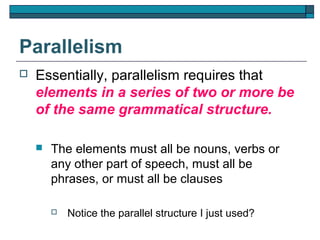
Parallelism
   Essentially, parallelism requires that
    elements in a series of two or more be
    of the same grammatical structure.

       The elements must all be nouns, verbs or
        any other part of speech, must all be
        phrases, or must all be clauses

           Notice the parallel structure I just used?
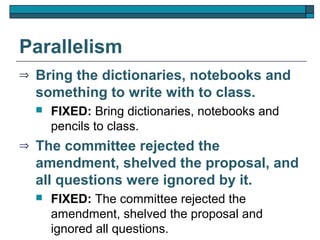
Parallelism
⇒   Bring the dictionaries, notebooks and
    something to write with to class.
       FIXED: Bring dictionaries, notebooks and
        pencils to class.
⇒   The committee rejected the
    amendment, shelved the proposal, and
    all questions were ignored by it.
       FIXED: The committee rejected the
        amendment, shelved the proposal and
        ignored all questions.
Parallelism
   What do the rich know about disease,
    those who are hungry, and being
    poor?
       FIXED: What do the rich know about
        disease, hunger, and poverty?

   Do you see how parallelism creates a
    balanced, flowing sentence that truly
    makes a point?
Parallelism
   Roger stared at the audience with his
    mouth dry and his face was a blank.

       FIXED: Roger stared at the audience with his
        mouth dry and with his face blank.
DANGLING MODIFIERS
   These are the most difficult modifiers to
    recognize and to fix.
   The dangling modifier usually occurs as an
    introductory phrase or clause. The subject
    of the sentence must be the logical doer of
    the phrase or clause.
⇒   Flying over the Alps, the view was
    breathtaking.
        •   In this sentence, the “flying over the Alps” logically modifies
            the view.
        •   We also know, logically, that a “view” can’t fly.
        o   Therefore, this introductory phrase “flying over the Alps”
            dangles—it just isn’t logically attached to anything.
DANGLING MODIFIERS
   To fix a dangling modifier, you MUST re-write the
    sentence. Moving the modifier simply makes it dangle
    in a different part of the sentence.

⇒   Flying over the Alps, the view was breathtaking.
⇒   The view was breathtaking flying over the Alps.

   FIXED: As we flew over the Alps, our view was
    breathtaking.
             •   We is the logical doer.
DANGLING MODIFIERS
⇒   Joe’s face turned beet red when
    offering Betty a ride.
             •   In this sentence, “face” is the subject.
             •   Logically, can a “face” offer a ride?


       FIXED: After he offered Betty a ride, Joe’s
        face turned beet red.
DANGLING MODIFIERS

⇒   To be eligible for the contest, a
    subscription must be sent in.
           •   In this sentence, “subscription” is the subject.
           •   Logically, can a “subscription” be eligible for a contest?


       FIXED: If you want to be eligible for the
        contest, you must send in a subscription.
DANGLING MODIFIERS
   TO FIX THE DANGLING MODIFIER
       Usually add a person to the introductory clause.
       Make that person become the new subject of the
        sentence.

⇒   To be assured of a good cake, fresh
    ingredients must be used.
           •   In this sentence, “ingredients” is the subject.
           •   Logically, can “ingredients” want to be assured of a good
               cake?
       FIXED: If you want to be assured of a good cake,
        you must use fresh ingredients.
DANGLING MODIFIERS
⇒   Having walked three miles, the cabin was a
    welcome sight.
           •   In this sentence, “cabin” is the subject.
           •   Logically, can a “cabin” walk three miles?
       FIXED: After Bill walked three miles, he thought the
        cabin was a welcome sight.

⇒   To get home quickly, the dirt road offered a
    shortcut.
           •   In this sentence, “road” is the subject.
           •   Logically, can a “road” want to get home quickly?
       FIXED: We took the dirt road shortcut because it
        offered us a way to get home quickly.

More structural issues

  • 1.
    More Structural Issues Split Infinitives Dangling Modifiers Parallelism
  • 2.
    Split Infinitives An infinitiveis a verb combined with the word “to.” to go to eat to walk to read The grammar gods have decided that it is particularly heinous to split up an infinitive. In other words, never put a word(s) between the “to” and the verb. to easily go to hurriedly eat to quickly walk to silently read to once in a while see
  • 3.
    Fixing The SplitInfinitive To fix a split infinitive, you need to move the word(s) between the “to” and the verb. Sometimes, you may need to rephrase some of the words or restructure the sentence. ⇒ He promised to whenever possible pick up his own dry-cleaning. FIXED: He promised to pick up his own dry- cleaning whenever possible.
  • 4.
    Fix These:  My husband likes to once in awhile plan and cook a dinner.  FIXED: Once in awhile, my husband likes to plan and cook a dinner.  The group decided to, in spite of the long detour, visit the ruined monastery.  FIXED: In spite of the long detour, the group decided to visit the ruined monastery.  The director wanted to vividly re-create a bullfight for the second act.  FIXED: The directed planned to re-create a vivid bullfight for the second act.
  • 5.
    Parallelism  Parallelism makes powerful writing. It creates rhythm and repetition for added emphasis. Notice the following:  We saw the children running, playing and laughing.  We came, we saw, we conquered.  ASYNDETON: POLYSYNDETON: Of the people, by the people and for the people Linking items in a series Linking items in a series w/o use of say, not as I do. coordinators: Do as I coordinators: w/many  They lived, they loved, They lived and they they died. loved and they died.
  • 6.
    Parallelism  Essentially, parallelism requires that elements in a series of two or more be of the same grammatical structure.  The elements must all be nouns, verbs or any other part of speech, must all be phrases, or must all be clauses  Notice the parallel structure I just used?
  • 7.
    Parallelism ⇒ Bring the dictionaries, notebooks and something to write with to class.  FIXED: Bring dictionaries, notebooks and pencils to class. ⇒ The committee rejected the amendment, shelved the proposal, and all questions were ignored by it.  FIXED: The committee rejected the amendment, shelved the proposal and ignored all questions.
  • 8.
    Parallelism  What do the rich know about disease, those who are hungry, and being poor?  FIXED: What do the rich know about disease, hunger, and poverty?  Do you see how parallelism creates a balanced, flowing sentence that truly makes a point?
  • 9.
    Parallelism  Roger stared at the audience with his mouth dry and his face was a blank.  FIXED: Roger stared at the audience with his mouth dry and with his face blank.
  • 10.
    DANGLING MODIFIERS  These are the most difficult modifiers to recognize and to fix.  The dangling modifier usually occurs as an introductory phrase or clause. The subject of the sentence must be the logical doer of the phrase or clause. ⇒ Flying over the Alps, the view was breathtaking. • In this sentence, the “flying over the Alps” logically modifies the view. • We also know, logically, that a “view” can’t fly. o Therefore, this introductory phrase “flying over the Alps” dangles—it just isn’t logically attached to anything.
  • 11.
    DANGLING MODIFIERS  To fix a dangling modifier, you MUST re-write the sentence. Moving the modifier simply makes it dangle in a different part of the sentence. ⇒ Flying over the Alps, the view was breathtaking. ⇒ The view was breathtaking flying over the Alps.  FIXED: As we flew over the Alps, our view was breathtaking. • We is the logical doer.
  • 12.
    DANGLING MODIFIERS ⇒ Joe’s face turned beet red when offering Betty a ride. • In this sentence, “face” is the subject. • Logically, can a “face” offer a ride?  FIXED: After he offered Betty a ride, Joe’s face turned beet red.
  • 13.
    DANGLING MODIFIERS ⇒ To be eligible for the contest, a subscription must be sent in. • In this sentence, “subscription” is the subject. • Logically, can a “subscription” be eligible for a contest?  FIXED: If you want to be eligible for the contest, you must send in a subscription.
  • 14.
    DANGLING MODIFIERS  TO FIX THE DANGLING MODIFIER  Usually add a person to the introductory clause.  Make that person become the new subject of the sentence. ⇒ To be assured of a good cake, fresh ingredients must be used. • In this sentence, “ingredients” is the subject. • Logically, can “ingredients” want to be assured of a good cake?  FIXED: If you want to be assured of a good cake, you must use fresh ingredients.
  • 15.
    DANGLING MODIFIERS ⇒ Having walked three miles, the cabin was a welcome sight. • In this sentence, “cabin” is the subject. • Logically, can a “cabin” walk three miles?  FIXED: After Bill walked three miles, he thought the cabin was a welcome sight. ⇒ To get home quickly, the dirt road offered a shortcut. • In this sentence, “road” is the subject. • Logically, can a “road” want to get home quickly?  FIXED: We took the dirt road shortcut because it offered us a way to get home quickly.