Pronoun Reference
Review Pronoun--Word substituted for noun Antecedent--Word the pronoun is replacing Examples: Darla (antecedent)- She (pronoun) Shoe (antecedent)-It (pronoun) Cups (antecedent)-Those (pronoun)
Pronoun Reference It needs to be VERY CLEAR what antecedent the pronoun is referring to.  If the antecedent is not clear, the reader can become confused.
Confusing Pronoun Reference Situations to Avoid
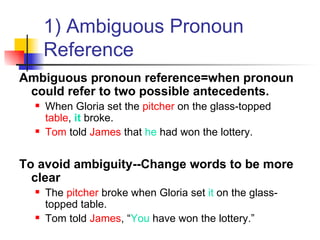
1) Ambiguous Pronoun Reference Ambiguous pronoun reference=when pronoun could refer to two possible antecedents. When Gloria set the  pitcher  on the glass-topped  table ,  it  broke. Tom  told  James  that  he  had won the lottery. To avoid ambiguity--Change words to be more clear The  pitcher  broke when Gloria set  it  on the glass-topped table. Tom told  James , “ You  have won the lottery.”
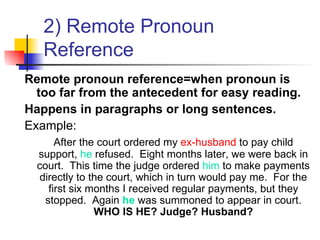
2) Remote Pronoun Reference Remote pronoun reference=when pronoun is too far from the antecedent for easy reading. Happens in paragraphs or long sentences. Example: After the court ordered my  ex-husband  to pay child support,  he  refused.  Eight months later, we were back in court.  This time the judge ordered  him  to make payments directly to the court, which in turn would pay me.  For the first six months I received regular payments, but they stopped.  Again  he  was summoned to appear in court. WHO IS HE? Judge? Husband?
3) Broad Use of THIS, THAT, WHICH and IT When using  this ,  that ,  which  or  it  make sure they refer to specific antecedents.  This avoids confusion. Example: Horatio and Claudette always forgot to complete their English homework,  which  accounts for their low grades. What does  which  refer to?  Not clear!  Use a fact instead. Horatio and Claudette always forgot to complete their English homework,  their forgetfulness  accounts for their low grades.
4) Implied Antecedents Implied antecedent=word that pronoun refers to that is not actually in the sentence John put a bullet in his gun and shot  it . What is  it ?  Not clear!  John put a bullet in his gun and shot  the gun . AVOID IMPLIED ANTECEDENTS
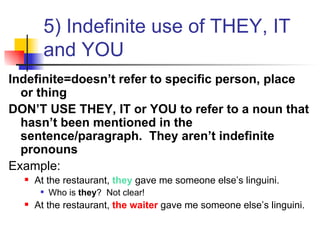
5) Indefinite use of THEY, IT and YOU Indefinite=doesn’t refer to specific person, place or thing DON’T USE THEY, IT or YOU to refer to a noun that hasn’t been mentioned in the sentence/paragraph.  They aren’t indefinite pronouns Example: At the restaurant,  they  gave me someone else’s linguini. Who is  they ?  Not clear!  At the restaurant,  the waiter  gave me someone else’s linguini.
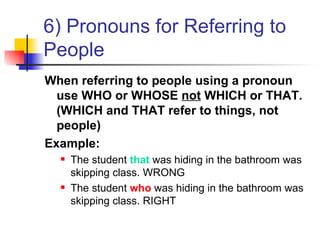
6) Pronouns for Referring to People When referring to people using a pronoun use WHO or WHOSE   not  WHICH or THAT. (WHICH and THAT refer to things, not people) Example: The student  that  was hiding in the bathroom was skipping class. WRONG The student  who  was hiding in the bathroom was skipping class. RIGHT

Pronoun reference powerpoint

  • 1.
  • 2.
    Review Pronoun--Word substitutedfor noun Antecedent--Word the pronoun is replacing Examples: Darla (antecedent)- She (pronoun) Shoe (antecedent)-It (pronoun) Cups (antecedent)-Those (pronoun)
  • 3.
    Pronoun Reference Itneeds to be VERY CLEAR what antecedent the pronoun is referring to. If the antecedent is not clear, the reader can become confused.
  • 4.
    Confusing Pronoun ReferenceSituations to Avoid
  • 5.
    1) Ambiguous PronounReference Ambiguous pronoun reference=when pronoun could refer to two possible antecedents. When Gloria set the pitcher on the glass-topped table , it broke. Tom told James that he had won the lottery. To avoid ambiguity--Change words to be more clear The pitcher broke when Gloria set it on the glass-topped table. Tom told James , “ You have won the lottery.”
  • 6.
    2) Remote PronounReference Remote pronoun reference=when pronoun is too far from the antecedent for easy reading. Happens in paragraphs or long sentences. Example: After the court ordered my ex-husband to pay child support, he refused. Eight months later, we were back in court. This time the judge ordered him to make payments directly to the court, which in turn would pay me. For the first six months I received regular payments, but they stopped. Again he was summoned to appear in court. WHO IS HE? Judge? Husband?
  • 7.
    3) Broad Useof THIS, THAT, WHICH and IT When using this , that , which or it make sure they refer to specific antecedents. This avoids confusion. Example: Horatio and Claudette always forgot to complete their English homework, which accounts for their low grades. What does which refer to? Not clear! Use a fact instead. Horatio and Claudette always forgot to complete their English homework, their forgetfulness accounts for their low grades.
  • 8.
    4) Implied AntecedentsImplied antecedent=word that pronoun refers to that is not actually in the sentence John put a bullet in his gun and shot it . What is it ? Not clear! John put a bullet in his gun and shot the gun . AVOID IMPLIED ANTECEDENTS
  • 9.
    5) Indefinite useof THEY, IT and YOU Indefinite=doesn’t refer to specific person, place or thing DON’T USE THEY, IT or YOU to refer to a noun that hasn’t been mentioned in the sentence/paragraph. They aren’t indefinite pronouns Example: At the restaurant, they gave me someone else’s linguini. Who is they ? Not clear! At the restaurant, the waiter gave me someone else’s linguini.
  • 10.
    6) Pronouns forReferring to People When referring to people using a pronoun use WHO or WHOSE not WHICH or THAT. (WHICH and THAT refer to things, not people) Example: The student that was hiding in the bathroom was skipping class. WRONG The student who was hiding in the bathroom was skipping class. RIGHT