 voice 
 Active voice 
Passive voice 
Sentence Structures 
Passive of imperative sentences 
 Forms of passive verbs 
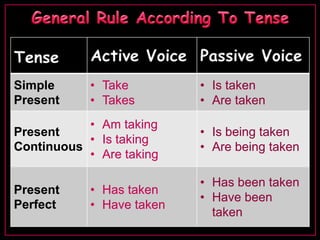
General Rule According To Tense 
Examples 
 Activity 
 Review
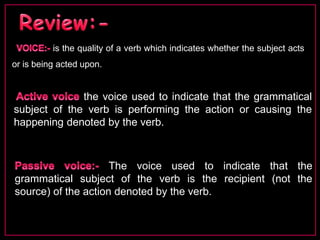
Voice is the quality of a verb which indicates 
whether the subject acts or is being acted upon. 
 Active voice 
 Passive voice
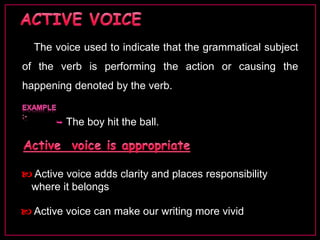
The voice used to indicate that the grammatical subject 
of the verb is performing the action or causing the 
happening denoted by the verb. 
 The boy hit the ball. 
 Active voice adds clarity and places responsibility 
where it belongs 
 Active voice can make our writing more vivid
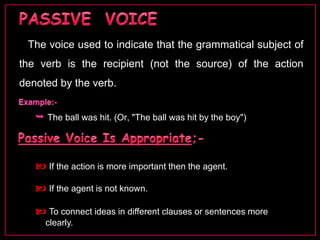
The voice used to indicate that the grammatical subject of 
the verb is the recipient (not the source) of the action 
denoted by the verb. 
 The ball was hit. (Or, "The ball was hit by the boy") 
 If the action is more important then the agent. 
 If the agent is not known. 
 To connect ideas in different clauses or sentences more 
clearly.
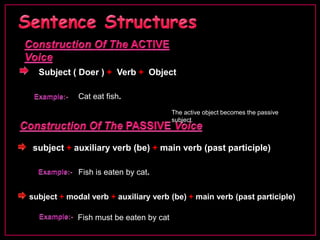
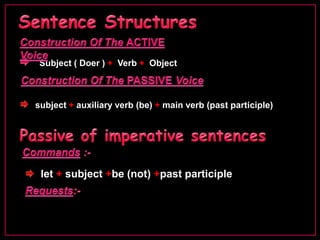
Subject ( Doer ) + Verb + Object 
Cat eat fish. 
The active object becomes the passive 
subject. 
subject + auxiliary verb (be) + main verb (past participle) 
Fish is eaten by cat. 
subject + modal verb + auxiliary verb (be) + main verb (past participle) 
Fish must be eaten by cat.
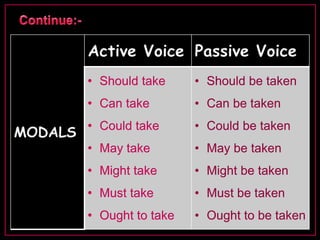
MODALS 
Active Voice Passive Voice 
• Should take 
• Can take 
• Could take 
• May take 
• Might take 
• Must take 
• Ought to take 
• Should be taken 
• Can be taken 
• Could be taken 
• May be taken 
• Might be taken 
• Must be taken 
• Ought to be taken
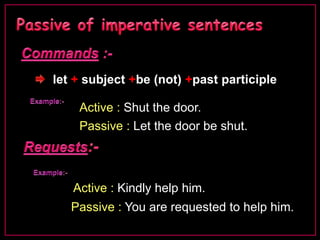
let + subject +be (not) +past participle 
Active : Shut the door. 
Passive : Let the door be shut. 
Active : Kindly help him. 
Passive : You are requested to help him.
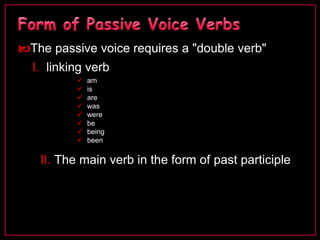
The passive voice requires a "double verb" 
I. linking verb 
 am 
 is 
 are 
 was 
 were 
 be 
 being 
 been 
II. The main verb in the form of past participle
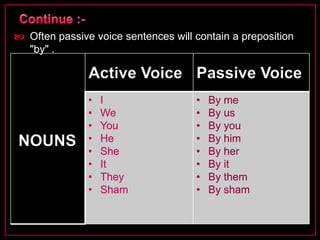
 Often passive voice sentences will contain a preposition 
NOUNS 
Active Voice Passive Voice 
• I 
• We 
• You 
• He 
• She 
• It 
• They 
• Sham 
• By me 
• By us 
• By you 
• By him 
• By her 
• By it 
• By them 
• By sham 
"by" .
Tense Active Voice Passive Voice 
Simple 
Present 
• Take 
• Takes 
• Is taken 
• Are taken 
Present 
Continuous 
• Am taking 
• Is taking 
• Are taking 
• Is being taken 
• Are being taken 
Present 
Perfect 
• Has taken 
• Have taken 
• Has been taken 
• Have been 
taken
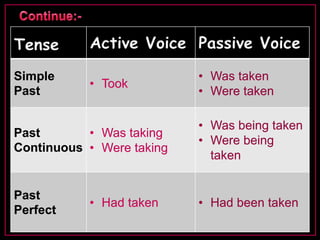
Tense Active Voice Passive Voice 
Simple 
Past 
• Took 
• Was taken 
• Were taken 
Past 
Continuous 
• Was taking 
• Were taking 
• Was being taken 
• Were being 
taken 
Past 
Perfect 
• Had taken • Had been taken
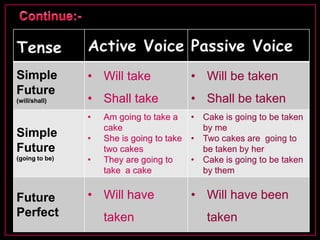
Tense Active Voice Passive Voice 
Simple 
Future 
(will/shall) 
• Will take 
• Shall take 
• Will be taken 
• Shall be taken 
Simple 
Future 
(going to be) 
• Am going to take a 
cake 
• She is going to take 
two cakes 
• They are going to 
take a cake 
• Cake is going to be taken 
by me 
• Two cakes are going to 
be taken by her 
• Cake is going to be taken 
by them 
Future 
Perfect 
• Will have 
taken 
• Will have been 
taken
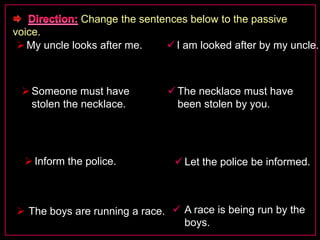
Change the sentences below to the passive 
voice. 
My uncle looks after me.  I am looked after by my uncle. 
Someone must have 
stolen the necklace. 
 The necklace must have 
been stolen by you. 
 Inform the police.  Let the police be informed. 
 The boys are running a race.  A race is being run by the 
boys.
is the quality of a verb which indicates whether the subject acts 
or is being acted upon. 
the voice used to indicate that the grammatical 
subject of the verb is performing the action or causing the 
happening denoted by the verb. 
The voice used to indicate that the 
grammatical subject of the verb is the recipient (not the 
source) of the action denoted by the verb.
Subject ( Doer ) + Verb + Object 
subject + auxiliary verb (be) + main verb (past participle) 
let + subject +be (not) +past participle
 Simple Present 
 Present Continuous 
 Present Perfect 
 Simple past 
 Past Continuous 
 Past Perfect 
 Simple Future 
 Future perfect
 http://www.towson.edu/ows/index.htm (Towson university) 
 http://forum.jamali4u.com/index.php ( a forum) 
 http://staff.jccc.net/pmcqueen/tips/voice.htm 
 Essential English Grammar (book)
.

Active voice and passive voice

  • 2.
     voice Active voice Passive voice Sentence Structures Passive of imperative sentences  Forms of passive verbs General Rule According To Tense Examples  Activity  Review
  • 3.
    Voice is thequality of a verb which indicates whether the subject acts or is being acted upon.  Active voice  Passive voice
  • 4.
    The voice usedto indicate that the grammatical subject of the verb is performing the action or causing the happening denoted by the verb.  The boy hit the ball.  Active voice adds clarity and places responsibility where it belongs  Active voice can make our writing more vivid
  • 5.
    The voice usedto indicate that the grammatical subject of the verb is the recipient (not the source) of the action denoted by the verb.  The ball was hit. (Or, "The ball was hit by the boy")  If the action is more important then the agent.  If the agent is not known.  To connect ideas in different clauses or sentences more clearly.
  • 6.
    Subject ( Doer) + Verb + Object Cat eat fish. The active object becomes the passive subject. subject + auxiliary verb (be) + main verb (past participle) Fish is eaten by cat. subject + modal verb + auxiliary verb (be) + main verb (past participle) Fish must be eaten by cat.
  • 7.
    MODALS Active VoicePassive Voice • Should take • Can take • Could take • May take • Might take • Must take • Ought to take • Should be taken • Can be taken • Could be taken • May be taken • Might be taken • Must be taken • Ought to be taken
  • 8.
    let + subject+be (not) +past participle Active : Shut the door. Passive : Let the door be shut. Active : Kindly help him. Passive : You are requested to help him.
  • 9.
    The passive voicerequires a "double verb" I. linking verb  am  is  are  was  were  be  being  been II. The main verb in the form of past participle
  • 10.
     Often passivevoice sentences will contain a preposition NOUNS Active Voice Passive Voice • I • We • You • He • She • It • They • Sham • By me • By us • By you • By him • By her • By it • By them • By sham "by" .
  • 11.
    Tense Active VoicePassive Voice Simple Present • Take • Takes • Is taken • Are taken Present Continuous • Am taking • Is taking • Are taking • Is being taken • Are being taken Present Perfect • Has taken • Have taken • Has been taken • Have been taken
  • 12.
    Tense Active VoicePassive Voice Simple Past • Took • Was taken • Were taken Past Continuous • Was taking • Were taking • Was being taken • Were being taken Past Perfect • Had taken • Had been taken
  • 13.
    Tense Active VoicePassive Voice Simple Future (will/shall) • Will take • Shall take • Will be taken • Shall be taken Simple Future (going to be) • Am going to take a cake • She is going to take two cakes • They are going to take a cake • Cake is going to be taken by me • Two cakes are going to be taken by her • Cake is going to be taken by them Future Perfect • Will have taken • Will have been taken
  • 16.
    Change the sentencesbelow to the passive voice. My uncle looks after me.  I am looked after by my uncle. Someone must have stolen the necklace.  The necklace must have been stolen by you.  Inform the police.  Let the police be informed.  The boys are running a race.  A race is being run by the boys.
  • 17.
    is the qualityof a verb which indicates whether the subject acts or is being acted upon. the voice used to indicate that the grammatical subject of the verb is performing the action or causing the happening denoted by the verb. The voice used to indicate that the grammatical subject of the verb is the recipient (not the source) of the action denoted by the verb.
  • 18.
    Subject ( Doer) + Verb + Object subject + auxiliary verb (be) + main verb (past participle) let + subject +be (not) +past participle
  • 19.
     Simple Present  Present Continuous  Present Perfect  Simple past  Past Continuous  Past Perfect  Simple Future  Future perfect
  • 20.
     http://www.towson.edu/ows/index.htm (Towsonuniversity)  http://forum.jamali4u.com/index.php ( a forum)  http://staff.jccc.net/pmcqueen/tips/voice.htm  Essential English Grammar (book)
  • 22.

Editor's Notes

  • #4 1,relation between the participants in a narrated event (subject, object) and the event itself. 2,There are two special forms for verbs called voice:
  • #5 we might ask ourselves, what is it that does the hitting? The answer is the subject, boy. That subject is actively performing the verb; it is actively "doing" the verb hit to a direct object (the ball). This virtuous sentence is in active voice.
  • #6 we might ask ourselves what is the subject? (ball.) What is the subject doing? (nothing.) The subject is not hitting anything else. So who exactly is doing the verb to hit? It is not clear unless we stick a prepositional phrase "by the boy" on the end of the sentence. The subject is passively sitting, doing nothing, while some outside agent performs the action (hitting). Since the subject of the sentence is passive grammatically, this wicked sentence in is passive voice.
  • #7  Only verbs that arPassive Voice: The subject of the sentence is now being acted upon. The actor moves to the end of the sentence with by or drops off altogether if it is unimportant or unknown. The verb must include a form of be, followed by a past participle (normally an -ed ending). e followed by an object can be used in the passive. Sometimes a modal verb can be used before the auxiliary verb:
  • #9 In these sentences the action does not pass to the object. The advice remains limited to the subject only.
  • #11 You may have to use an appropriate preposition like ‘by’ before the passive object whenever it is mentioned