INFINITE and NON-
INFINITE CLAUSES
Jessie Tindoy and Mariz Gomonit Report
WHAT IS CLAUSE?
A clause is a group of words that contains a
subject and a verb that have a relationship.
Finite clauses are those clauses containing a
subject and finite verb (marked for tense,
person, and number). There are three main
types of finite dependent clauses: that-
clauses, adverbial clauses, and wh-clauses.
Wh-clauses may also be independent.
Finite clause
● We use that as a conjunction to
link a verb, adjective or noun
with the following clause.
THAT-CLAUSE
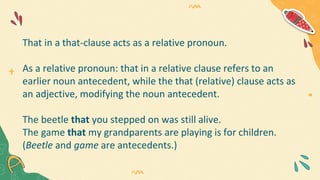
That in a that-clause acts as a relative pronoun.
As a relative pronoun: that in a relative clause refers to an
earlier noun antecedent, while the that (relative) clause acts as
an adjective, modifying the noun antecedent.
The beetle that you stepped on was still alive.
The game that my grandparents are playing is for children.
(Beetle and game are antecedents.)
That is not a relative pronoun when it does not refer to a noun antecedent.
The entire that-clause is a noun that usually follows the main verb.
> He believed that his new business would become one of the biggest in the
world.
> We discovered that there was no truth in the rumor.
(In both these sentences, that is not the subject of the clause, and because it is
not the subject, it can be removed from the sentence.)
> He believed his new business would become one of the biggest in the world.
> We discovered there was no truth in the rumor.
That-clause as subject of a sentence.
That she could use his car tonight was the promise he gave to her.
That the children could fight for so long surprised the adults.
That-clause as object of a sentence.
Mom said that we could play in the rain.
She wished that she could sail to the Antarctic.
Verb + that-clause
Verbs commonly followed by that include reporting verbs
(say, tell, admit, etc.) and mental process verbs (believe,
think, know, hope, etc.):
> They said that four million workers stayed at home to
protest against the tax.
> The survey indicated that 28 per cent would prefer to buy a
house through a building society than through a bank.
> He knew that something bad had happened.
> Do you think that they forgot to pay or that they stole it?
Adjective + that-clause
We use be + adjective + that-clause to express opinions and
feelings. Some adjectives commonly used in this way are sure,
certain, right, important, afraid, pleased, sorry, surprised,
worried. We can omit that with no change in meaning:
> It’s important (that) we look at the problem in more detail.
> I’m sure (that) you’ll know a lot of people there.
> They were afraid (that) we were going to be late.
Noun + that-clause
We use a noun + that-clause to express opinions and feelings,
often about certainty and possibility. We also use that with
reporting nouns. Some nouns commonly used in this way are
belief, fact, hope, idea, possibility, suggestion, statement,
claim, comment, argument:
> He is also having intensive treatment in the hope that he
will be able to train on Friday.
> Dutch police are investigating the possibility that a bomb
was planted on the jet.
That-clause as restrictive relative clause.
The that-clause is also a restrictive relative clause introduced
by the relative pronoun that. The restrictive relative clause
gives important information.
The ringmaster that the lion killed was buried yesterday.
(Without the restrictive relative clause that the lion killed, the
only information we have is the ringmaster was buried
yesterday. We don’t know how he died.)
It reminded her of the hospital that she used to work.
(Without the restrictive relative clause, the question remains
as to what reminded her of the hospital.)
What is an adverbial clause?
An adverbial clause, sometimes referred to as an adverb
clause, is a group of words that, together, functions as an
adverb. This means that the clause describes or modifies a
verb, adjective, or another adverb. Unlike other types of
clauses, an adverbial clause is always a dependent clause.
This means that it cannot stand on its own as an
independent sentence.
Adverbial clauses make sentences richer by providing additional
context and description that standard adverbs cannot. See how
adverbial clauses and adverbs compare in these examples:
He bakes cakes weekly.
He bakes cakes before he leaves for work every Sunday.
Eagerly, my brother agreed to the business proposal.
As dollar signs flashed in his eyes, my brother agreed to the
business proposal.
Types of adverbial clauses
Adverbial clauses of manner
An adverbial clause of manner describes how
the action described in the sentence’s main clause
is taking place or previously took place. Here are a
few examples:
> She addressed the crowd as she had practiced in
the mirror.
> They designed the new product the way
innovators problem-solve around design flaws.
Adverbial clauses of place
Adverbial clauses of place describe where the
action in a sentence’s main clause takes place. See
how they work in these examples:
> My son told me another fight broke out where he
eats lunch at school.
> They drove beyond where the city ends.
Adverbial clauses of condition
With an adverbial clause of condition, you can
communicate the conditions related to the verb,
adverb, or adjective in the sentence’s main clause.
These examples demonstrate a few ways to use
adverbial clauses of condition:
> We’ll be sitting in the conference room until they
tell us to leave.
> Whether my husband likes it or not, we’ll be
celebrating Thanksgiving at my parents’ house.
Adverbial clauses of reason
Adverbial clauses of reason tell us the reason for
the action being taken in the sentence’s main
clause. These clauses generally use subordinating
conjunctions like because, unless, and since. Here
are a few examples of sentences that include
adverbial clauses of reason:
> We adopted these two cats because they are a
bonded pair.
> He’s amazing at billiards since he spent his youth
working in a pool hall.
Adverbial clauses of time
Adverbial clauses of time communicate
when the action in a sentence takes place:
> Before she got home, she called and
ordered a pizza.
> They assembled, dressed, and marched
out as the band played.
Adverbial clauses of purpose
Like adverbial clauses of reason, adverbial clauses of
purpose frequently involve subordinating conjunctions.
These two kinds of clauses can look similar, but they have one
key difference: While adverbial clauses of reason give the
reason why something is happening, adverbial clauses of
purpose explain the reason to take a specific action. Here are
a few examples:
> We studied all night so we would pass the exam.
> So that they could ease the traffic flow, the event organizers
split the group into three cohorts.
Adverbial clauses of comparison
Adverbial clauses of comparison are clauses that
communicate how the subject of the dependent clause
compares to the subject in the main clause. There are two
types of adverbial clauses of comparison: adverbial clauses of
comparison of degree and adverbial clauses of comparison of
manner. Here are a few examples of adverbial clauses of
comparison of degree:
> Felix is as good at video games as he is good at
weightlifting.
> We expected the afternoon class to perform better on the
test than the morning class did.
Adverbial clause of concession
In an adverbial clause of concession, the
writer acknowledges or admits a factor that
modifies the main clause. Take a look at these
adverbial clauses of concession:
> Despite how I had good intentions, the interaction
went horribly wrong.
> The department head hired the first person they
interviewed, though twenty people applied for the
job.
WHAT IS WH-clauses?
In English grammar, a "wh"-clause is a
subordinate clause that's introduced by one
of the wh-words (what, who, which, when,
where, why, how). Wh-clauses can function
as subjects, objects, or complements.
Questions
Who, what, which, whose, when, where, and why are used
to begin questions. Who and what are followed by the
main verb when they are the subject of the sentence.
EXAMPLES:
What caused this problem? Who knows about it?
Like which, when, where, and why, they are
followed by an auxiliary verb when they are not
the subject.
EXAMPLES: Who did you see at the party? Where
did you find the bag? When can I get it from you?
Whose must be followed by a noun. Which is
followed by a noun when it is used as an
adjective.
EXAMPLE: Whose or which car did you come in
tonight?
Relative clauses
These relative pronouns are used after a noun to identify it or give more information about
it. There is usually no punctuation mark before the relative clause if it is telling us which
person or thing is meant, but there are commas before and after the clause if it tells us more
about something already mentioned.
Finite-and-Non-finite-Clauses.pdf

Finite-and-Non-finite-Clauses.pdf

  • 1.
    INFINITE and NON- INFINITECLAUSES Jessie Tindoy and Mariz Gomonit Report
  • 2.
    WHAT IS CLAUSE? Aclause is a group of words that contains a subject and a verb that have a relationship.
  • 4.
    Finite clauses arethose clauses containing a subject and finite verb (marked for tense, person, and number). There are three main types of finite dependent clauses: that- clauses, adverbial clauses, and wh-clauses. Wh-clauses may also be independent. Finite clause
  • 5.
    ● We usethat as a conjunction to link a verb, adjective or noun with the following clause. THAT-CLAUSE
  • 6.
    That in athat-clause acts as a relative pronoun. As a relative pronoun: that in a relative clause refers to an earlier noun antecedent, while the that (relative) clause acts as an adjective, modifying the noun antecedent. The beetle that you stepped on was still alive. The game that my grandparents are playing is for children. (Beetle and game are antecedents.)
  • 7.
    That is nota relative pronoun when it does not refer to a noun antecedent. The entire that-clause is a noun that usually follows the main verb. > He believed that his new business would become one of the biggest in the world. > We discovered that there was no truth in the rumor. (In both these sentences, that is not the subject of the clause, and because it is not the subject, it can be removed from the sentence.) > He believed his new business would become one of the biggest in the world. > We discovered there was no truth in the rumor.
  • 8.
    That-clause as subjectof a sentence. That she could use his car tonight was the promise he gave to her. That the children could fight for so long surprised the adults. That-clause as object of a sentence. Mom said that we could play in the rain. She wished that she could sail to the Antarctic.
  • 9.
    Verb + that-clause Verbscommonly followed by that include reporting verbs (say, tell, admit, etc.) and mental process verbs (believe, think, know, hope, etc.): > They said that four million workers stayed at home to protest against the tax. > The survey indicated that 28 per cent would prefer to buy a house through a building society than through a bank. > He knew that something bad had happened. > Do you think that they forgot to pay or that they stole it?
  • 10.
    Adjective + that-clause Weuse be + adjective + that-clause to express opinions and feelings. Some adjectives commonly used in this way are sure, certain, right, important, afraid, pleased, sorry, surprised, worried. We can omit that with no change in meaning: > It’s important (that) we look at the problem in more detail. > I’m sure (that) you’ll know a lot of people there. > They were afraid (that) we were going to be late.
  • 11.
    Noun + that-clause Weuse a noun + that-clause to express opinions and feelings, often about certainty and possibility. We also use that with reporting nouns. Some nouns commonly used in this way are belief, fact, hope, idea, possibility, suggestion, statement, claim, comment, argument: > He is also having intensive treatment in the hope that he will be able to train on Friday. > Dutch police are investigating the possibility that a bomb was planted on the jet.
  • 12.
    That-clause as restrictiverelative clause. The that-clause is also a restrictive relative clause introduced by the relative pronoun that. The restrictive relative clause gives important information. The ringmaster that the lion killed was buried yesterday. (Without the restrictive relative clause that the lion killed, the only information we have is the ringmaster was buried yesterday. We don’t know how he died.) It reminded her of the hospital that she used to work. (Without the restrictive relative clause, the question remains as to what reminded her of the hospital.)
  • 13.
    What is anadverbial clause? An adverbial clause, sometimes referred to as an adverb clause, is a group of words that, together, functions as an adverb. This means that the clause describes or modifies a verb, adjective, or another adverb. Unlike other types of clauses, an adverbial clause is always a dependent clause. This means that it cannot stand on its own as an independent sentence.
  • 14.
    Adverbial clauses makesentences richer by providing additional context and description that standard adverbs cannot. See how adverbial clauses and adverbs compare in these examples: He bakes cakes weekly. He bakes cakes before he leaves for work every Sunday. Eagerly, my brother agreed to the business proposal. As dollar signs flashed in his eyes, my brother agreed to the business proposal.
  • 15.
  • 16.
    Adverbial clauses ofmanner An adverbial clause of manner describes how the action described in the sentence’s main clause is taking place or previously took place. Here are a few examples: > She addressed the crowd as she had practiced in the mirror. > They designed the new product the way innovators problem-solve around design flaws.
  • 17.
    Adverbial clauses ofplace Adverbial clauses of place describe where the action in a sentence’s main clause takes place. See how they work in these examples: > My son told me another fight broke out where he eats lunch at school. > They drove beyond where the city ends.
  • 18.
    Adverbial clauses ofcondition With an adverbial clause of condition, you can communicate the conditions related to the verb, adverb, or adjective in the sentence’s main clause. These examples demonstrate a few ways to use adverbial clauses of condition: > We’ll be sitting in the conference room until they tell us to leave. > Whether my husband likes it or not, we’ll be celebrating Thanksgiving at my parents’ house.
  • 19.
    Adverbial clauses ofreason Adverbial clauses of reason tell us the reason for the action being taken in the sentence’s main clause. These clauses generally use subordinating conjunctions like because, unless, and since. Here are a few examples of sentences that include adverbial clauses of reason: > We adopted these two cats because they are a bonded pair. > He’s amazing at billiards since he spent his youth working in a pool hall.
  • 20.
    Adverbial clauses oftime Adverbial clauses of time communicate when the action in a sentence takes place: > Before she got home, she called and ordered a pizza. > They assembled, dressed, and marched out as the band played.
  • 21.
    Adverbial clauses ofpurpose Like adverbial clauses of reason, adverbial clauses of purpose frequently involve subordinating conjunctions. These two kinds of clauses can look similar, but they have one key difference: While adverbial clauses of reason give the reason why something is happening, adverbial clauses of purpose explain the reason to take a specific action. Here are a few examples: > We studied all night so we would pass the exam. > So that they could ease the traffic flow, the event organizers split the group into three cohorts.
  • 22.
    Adverbial clauses ofcomparison Adverbial clauses of comparison are clauses that communicate how the subject of the dependent clause compares to the subject in the main clause. There are two types of adverbial clauses of comparison: adverbial clauses of comparison of degree and adverbial clauses of comparison of manner. Here are a few examples of adverbial clauses of comparison of degree: > Felix is as good at video games as he is good at weightlifting. > We expected the afternoon class to perform better on the test than the morning class did.
  • 23.
    Adverbial clause ofconcession In an adverbial clause of concession, the writer acknowledges or admits a factor that modifies the main clause. Take a look at these adverbial clauses of concession: > Despite how I had good intentions, the interaction went horribly wrong. > The department head hired the first person they interviewed, though twenty people applied for the job.
  • 24.
    WHAT IS WH-clauses? InEnglish grammar, a "wh"-clause is a subordinate clause that's introduced by one of the wh-words (what, who, which, when, where, why, how). Wh-clauses can function as subjects, objects, or complements.
  • 25.
    Questions Who, what, which,whose, when, where, and why are used to begin questions. Who and what are followed by the main verb when they are the subject of the sentence. EXAMPLES: What caused this problem? Who knows about it?
  • 26.
    Like which, when,where, and why, they are followed by an auxiliary verb when they are not the subject. EXAMPLES: Who did you see at the party? Where did you find the bag? When can I get it from you?
  • 27.
    Whose must befollowed by a noun. Which is followed by a noun when it is used as an adjective. EXAMPLE: Whose or which car did you come in tonight?
  • 28.
    Relative clauses These relativepronouns are used after a noun to identify it or give more information about it. There is usually no punctuation mark before the relative clause if it is telling us which person or thing is meant, but there are commas before and after the clause if it tells us more about something already mentioned.