Modifiers
Modifiers
Modifiers are words, phrases, or clauses
that provide description in sentences.
Modifiers allow writers to take the picture
that they have in their heads and transfer it
accurately to the heads of their readers.
Modifiers….
It can be a WORD, A PHRASE or A
CLAUSE
Word: E.g. Cool and intelligent, Ken is the
class hero.
Phrase: The moment Michael saw the ghost,
the hair on his hands stood up. (Shows
where..) Be very careful with prepositional
phrases.
Clause: The girl, whom you spoke to a
minute ago, is dead!
Modifiers paint a better picture
Essentially, modifiers breathe life into
sentences. Take a look at this "dead"
sentence: Stephen dropped his fork.
Poor Stephen, who just wanted a quick
meal to get through his three-hour biology
lab, accidentally dropped his fork on the
cafeteria floor, gasping with disgust as a
tarantula wiggled out of his cheese omelet,
a sight requiring a year of therapy before
Stephen could eat eggs again.
Importance of Modifiers
Modifiers can be adjectives, adjective clauses, adverbs, adverb clauses,
absolute phrases, infinitive phrases, participle phrases, and
prepositional phrases. The sentence above contains at least one example of
each:
Adjective = poor.
Adjective clause = who just wanted a quick meal.
Adverb = quickly.
Adverb clause = as a tarantula wiggled out of his cheese omelet.
Absolute phrase = a sight requiring a year of therapy before Stephen
could eat eggs again.
Infinitive phrase = to get through his three-hour biology lab.
Participle phrase = gasping with disgust.
Prepositional phrase = on the cafeteria floor
Without modifiers, sentences would be no fun to read. Carefully chosen,
well-placed modifiers allow you to depict situations with as much
accuracy.
Misplaced Modifiers
A misplaced modifier is a word, phrase, or
clause that is improperly separated from the
word it modifies / describes.
Because of the separation, sentences with
this error often sound awkward, ridiculous,
or confusing. Furthermore, they can be
downright illogical.
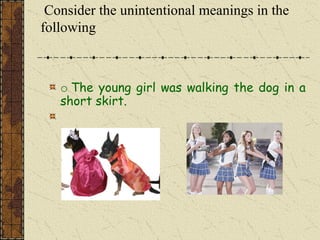
Consider the unintentional meanings in the
following
o The young girl was walking the dog in a
short skirt.
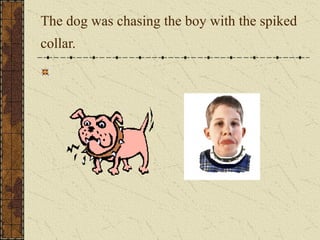
The dog was chasing the boy with the spiked
collar.
You can see what's wrong. The dog isn't
"in a short skirt" and the boy doesn't have
a "spiked collar." Because the modifier is
misplaced, we have to think for a minute
before we get the intended meaning.
The young girl in a short skirt was
walking the dog.
The dog with the spiked collar was
chasing the boy
Misplaced Modifiers
Hence, misplace modifiers are words that
because of awkward placements, do not
describe what the writer intended them to
describe. So to avoid them, place modifying
words as close as possible to what they
describe. Be very careful with:
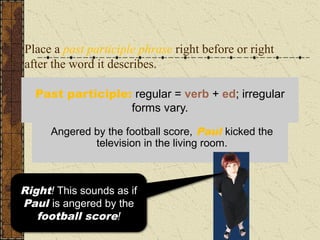
Place a past participle phrase right before or right
after the word it describes.
In the living room, Paul kicked the television
angered by the football score.
Angered by the football score, Paul kicked the
television in the living room.
Past participle: regular = verb + ed; irregular
forms vary.
This sounds as if the
television is angered
by the football score!
Right! This sounds as if
Paul is angered by the
football score!
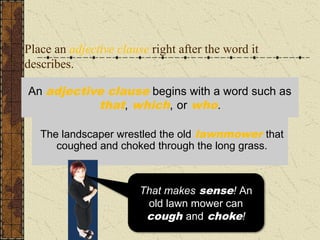
Place an adjective clause right after the word it
describes.
The landscaper wrestled the old lawnmower
through the long grass that coughed and choked.
The landscaper wrestled the old lawnmower that
coughed and choked through the long grass.
An adjective clause begins with a word such as
that, which, or who.
I don’t know about you,
but I have never heard
grass cough and
choke!
That makes sense! An
old lawn mower can
cough and choke!
Try and Correct this misplaced
modifiers ^^
1. The patient talked about his childhood on the
psychiatrist’s couch.
2. The crowd watched the tennis player with swiveling
heads.
3. Vonnie put 4 hamburgers on the counter which she was
cooking for dinner.
4. Steve carefully hung the new suit that he would wear to
his first job interview in the bedroom closet.
5. Anne ripped the shirt on a car door that she made in
sewing class.
6. The newscaster spoke softly into a microphone wearing a
bulletproof vest.
You also need to watch the placement of modifiers such as
almost, even, hardly, nearly, often, and only. A couple of
examples should be enough:
1. Big Dog almost ran around the
yard twenty times.
2. He nearly ate a whole box of
treats.
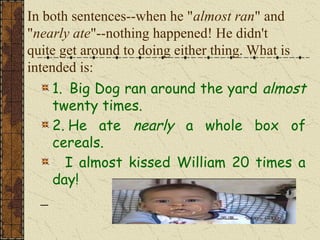
In both sentences--when he "almost ran" and
"nearly ate"--nothing happened! He didn't
quite get around to doing either thing. What is
intended is:
1. Big Dog ran around the yard almost
twenty times.
2. He ate nearly a whole box of
cereals.
I almost kissed William 20 times a
day!
Hmm….
1. I nearly napped for 20 minutes during the
biology lecture.
2. I napped for nearly 20 minutes during the
biology lecture.
3. Only Nadia reads that book.
4. Nadia only reads that book.
5. Nadia reads only that book.
Dangling Modifiers
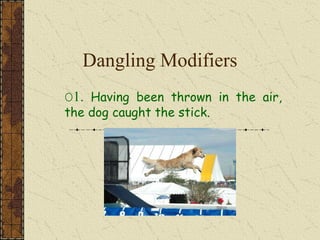
O1. Having been thrown in the air,
the dog caught the stick.
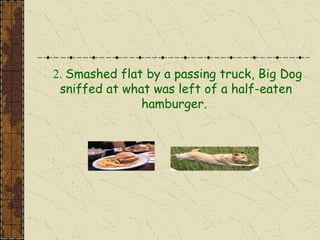
2. Smashed flat by a passing truck, Big Dog
sniffed at what was left of a half-eaten
hamburger.
the writer has unintentionally said
something that he (or she) didn't intend.
The dog wasn't "thrown in the air," and Big
Dog wasn't "smashed flat."
We can work out what is actually meant.
But a reader shouldn't have to work things
out.
So how do you get rid of these? Do the following:
1. Check for modifying phrases at the
beginning of your sentences.
2. If you find one, underline the first
noun that follows it. (That's the one that is
being modified.)
3. Make sure the modifier and noun go
together logically. If they don't, chances
are you have a dangling modifier.
4. Rewrite the sentence.
oWhen the stick was thrown in the air, the
dog caught it. (Here, the modifying phrase
has become a dependent clause. The
meaning is clear.)
o Big Dog sniffed at what was left of a
half-eaten burger that had been smashed
by a passing truck. (Again, the phrase has
been rewritten as a clause.)
Shaving in front of the steamy mirror, the
razor nicked Ed’s Chin.
Correct:
Shaving in front of the steamy mirror, Ed
nicked his chin with the razor.
While Ed was shaving in front of the
steamy mirror, he nicked his chin with the
razor.
While turning over the bacon, hot grease
splashed on my arm.
CORRECTION:
While I was turning over the bacon, hot
grease splashed on my arm.
While turning over the bacon, I was
splashed by hot grease.
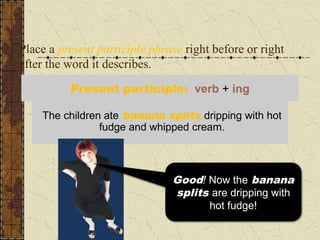
Place a present participle phrase right before or right
after the word it describes.
Dripping with hot fudge and whipped cream, the
children ate banana splits.
The children ate banana splits dripping with hot
fudge and whipped cream.
Present participle: verb + ing
Well, that sounds as if the
children are dripping
with the hot fudge!
Good! Now the banana
splits are dripping with
hot fudge!
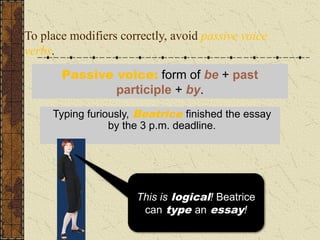
To place modifiers correctly, avoid passive voice
verbs.
Typing furiously, the essay was finished by
Beatrice just before the 3 p.m. deadline.
Typing furiously, Beatrice finished the essay
by the 3 p.m. deadline.
Passive voice: form of be + past
participle + by.
I wish my essays typed
themselves! But that’s
just not logical!
This is logical! Beatrice
can type an essay!
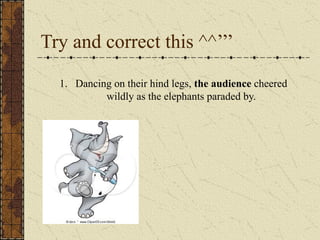
Try and correct this ^^’’’
1. Dancing on their hind legs, the audience cheered
wildly as the elephants paraded by.
THE END…NOW YOUR
SENTENCES WILL
NEVER HAVE
UNINTENDED
MEANINGS

modifiers.pptx everything one should know about modifiers

  • 1.
  • 2.
    Modifiers Modifiers are words,phrases, or clauses that provide description in sentences. Modifiers allow writers to take the picture that they have in their heads and transfer it accurately to the heads of their readers.
  • 3.
    Modifiers…. It can bea WORD, A PHRASE or A CLAUSE Word: E.g. Cool and intelligent, Ken is the class hero. Phrase: The moment Michael saw the ghost, the hair on his hands stood up. (Shows where..) Be very careful with prepositional phrases. Clause: The girl, whom you spoke to a minute ago, is dead!
  • 4.
    Modifiers paint abetter picture Essentially, modifiers breathe life into sentences. Take a look at this "dead" sentence: Stephen dropped his fork. Poor Stephen, who just wanted a quick meal to get through his three-hour biology lab, accidentally dropped his fork on the cafeteria floor, gasping with disgust as a tarantula wiggled out of his cheese omelet, a sight requiring a year of therapy before Stephen could eat eggs again.
  • 5.
    Importance of Modifiers Modifierscan be adjectives, adjective clauses, adverbs, adverb clauses, absolute phrases, infinitive phrases, participle phrases, and prepositional phrases. The sentence above contains at least one example of each: Adjective = poor. Adjective clause = who just wanted a quick meal. Adverb = quickly. Adverb clause = as a tarantula wiggled out of his cheese omelet. Absolute phrase = a sight requiring a year of therapy before Stephen could eat eggs again. Infinitive phrase = to get through his three-hour biology lab. Participle phrase = gasping with disgust. Prepositional phrase = on the cafeteria floor Without modifiers, sentences would be no fun to read. Carefully chosen, well-placed modifiers allow you to depict situations with as much accuracy.
  • 6.
    Misplaced Modifiers A misplacedmodifier is a word, phrase, or clause that is improperly separated from the word it modifies / describes. Because of the separation, sentences with this error often sound awkward, ridiculous, or confusing. Furthermore, they can be downright illogical.
  • 7.
    Consider the unintentionalmeanings in the following o The young girl was walking the dog in a short skirt.
  • 8.
    The dog waschasing the boy with the spiked collar.
  • 9.
    You can seewhat's wrong. The dog isn't "in a short skirt" and the boy doesn't have a "spiked collar." Because the modifier is misplaced, we have to think for a minute before we get the intended meaning.
  • 10.
    The young girlin a short skirt was walking the dog. The dog with the spiked collar was chasing the boy
  • 11.
    Misplaced Modifiers Hence, misplacemodifiers are words that because of awkward placements, do not describe what the writer intended them to describe. So to avoid them, place modifying words as close as possible to what they describe. Be very careful with:
  • 12.
    Place a pastparticiple phrase right before or right after the word it describes. In the living room, Paul kicked the television angered by the football score. Angered by the football score, Paul kicked the television in the living room. Past participle: regular = verb + ed; irregular forms vary. This sounds as if the television is angered by the football score! Right! This sounds as if Paul is angered by the football score!
  • 13.
    Place an adjectiveclause right after the word it describes. The landscaper wrestled the old lawnmower through the long grass that coughed and choked. The landscaper wrestled the old lawnmower that coughed and choked through the long grass. An adjective clause begins with a word such as that, which, or who. I don’t know about you, but I have never heard grass cough and choke! That makes sense! An old lawn mower can cough and choke!
  • 14.
    Try and Correctthis misplaced modifiers ^^ 1. The patient talked about his childhood on the psychiatrist’s couch. 2. The crowd watched the tennis player with swiveling heads. 3. Vonnie put 4 hamburgers on the counter which she was cooking for dinner. 4. Steve carefully hung the new suit that he would wear to his first job interview in the bedroom closet. 5. Anne ripped the shirt on a car door that she made in sewing class. 6. The newscaster spoke softly into a microphone wearing a bulletproof vest.
  • 15.
    You also needto watch the placement of modifiers such as almost, even, hardly, nearly, often, and only. A couple of examples should be enough: 1. Big Dog almost ran around the yard twenty times. 2. He nearly ate a whole box of treats.
  • 16.
    In both sentences--whenhe "almost ran" and "nearly ate"--nothing happened! He didn't quite get around to doing either thing. What is intended is: 1. Big Dog ran around the yard almost twenty times. 2. He ate nearly a whole box of cereals. I almost kissed William 20 times a day!
  • 17.
    Hmm…. 1. I nearlynapped for 20 minutes during the biology lecture. 2. I napped for nearly 20 minutes during the biology lecture. 3. Only Nadia reads that book. 4. Nadia only reads that book. 5. Nadia reads only that book.
  • 18.
    Dangling Modifiers O1. Havingbeen thrown in the air, the dog caught the stick.
  • 19.
    2. Smashed flatby a passing truck, Big Dog sniffed at what was left of a half-eaten hamburger.
  • 20.
    the writer hasunintentionally said something that he (or she) didn't intend. The dog wasn't "thrown in the air," and Big Dog wasn't "smashed flat." We can work out what is actually meant. But a reader shouldn't have to work things out.
  • 21.
    So how doyou get rid of these? Do the following: 1. Check for modifying phrases at the beginning of your sentences. 2. If you find one, underline the first noun that follows it. (That's the one that is being modified.) 3. Make sure the modifier and noun go together logically. If they don't, chances are you have a dangling modifier. 4. Rewrite the sentence.
  • 22.
    oWhen the stickwas thrown in the air, the dog caught it. (Here, the modifying phrase has become a dependent clause. The meaning is clear.) o Big Dog sniffed at what was left of a half-eaten burger that had been smashed by a passing truck. (Again, the phrase has been rewritten as a clause.)
  • 23.
    Shaving in frontof the steamy mirror, the razor nicked Ed’s Chin. Correct: Shaving in front of the steamy mirror, Ed nicked his chin with the razor. While Ed was shaving in front of the steamy mirror, he nicked his chin with the razor.
  • 24.
    While turning overthe bacon, hot grease splashed on my arm. CORRECTION: While I was turning over the bacon, hot grease splashed on my arm. While turning over the bacon, I was splashed by hot grease.
  • 25.
    Place a presentparticiple phrase right before or right after the word it describes. Dripping with hot fudge and whipped cream, the children ate banana splits. The children ate banana splits dripping with hot fudge and whipped cream. Present participle: verb + ing Well, that sounds as if the children are dripping with the hot fudge! Good! Now the banana splits are dripping with hot fudge!
  • 26.
    To place modifierscorrectly, avoid passive voice verbs. Typing furiously, the essay was finished by Beatrice just before the 3 p.m. deadline. Typing furiously, Beatrice finished the essay by the 3 p.m. deadline. Passive voice: form of be + past participle + by. I wish my essays typed themselves! But that’s just not logical! This is logical! Beatrice can type an essay!
  • 27.
    Try and correctthis ^^’’’ 1. Dancing on their hind legs, the audience cheered wildly as the elephants paraded by.
  • 28.
    THE END…NOW YOUR SENTENCESWILL NEVER HAVE UNINTENDED MEANINGS