My oh my, my oh my…
Ch. 22: Revising for Sentence Variety
What is sentence variety??

 It is the different ways you begin, put together, and
  structure sentences to help them flow and transition
  better.


 It spices things up by:
    Combining long and short sentences
    Using questions, commands, and exclamations
    Beginning with adverbs or prepositional phrases
    Joining ideas with compound predicates, -ing modifiers,
     past participial modifiers, appositives, and relative clauses
    Helping to avoid misplaced or confusing modifiers
 It helps writers use each sentence/paragraph effectively.
Combining long and short
sentences…
 If sentences are too short, they create a choppy feel in
  the paper.
    Ex. I walked to school. It was nice. I am happy. I made it
     on time.


 If sentence are too long, they can create a heavy, drawn
  out feeling in the paper.
    Ex: I walked to school because its only five minutes from
     my house and because I like to walk. Also, it is a great
     source of exercise because it keeps me in shape and
     healthy as well as makes me happy.
So…

 Mixing long and short sentences together:
     Will help to transition your sentences and paragraphs
      smoothly.
     Will help your sentences be engaging.


 Ex: I walk to school everyday because I live only five
  minutes from it, and walking relaxes me. It is really
  nice. Also, walking is a great source of exercise. Plus, I
  love it.
Statements…


 Statements—declaratives—are the most commonly used
  in sentences.
    End with a period
    Ex: The woman was wearing a satin, full length dress.
Using a question, a command, or
an exclamation…
 Can draw attention to specific areas of the paper,
  making important information stand out.


 Shows the points you are going to prove/answer


 Gives added emphasis to points and important
  information.


 Provides direction to the readers


 Should only be used when they are beneficial and help
  to influence and to strengthen the main topic.
Questions…

 Are also referred to as rhetorical—you are not looking for
  the readers to answer the question but are showing
  them what you are about to answer in the paper.


    Ex: How can one stop hunger in the world?
    So, what is to be done?


 Use of questions in papers is dependent on the
  professor.


 Cannot be carelessly thrown about but must be used
  effectively.
Commands…

 Are also referred to as imperatives—you are telling the
  reader to DO something and are giving them direction.


    Ex: Action should be taken.
    Ex: Don’t pretend it isn’t happening.
    Speak from the heart.


 Are used frequently in papers.
 Need to be used purposefully.
Exclamations…


 Are also referred to as emphasis—you are trying to
  express strong emotions toward the topic/point.


    Ex: Car accidents are running rampant!
    Ex: Health issues are destroying the world!
    Ex: People must take a stand!


 Should be used sparingly and only to draw attention to
  an important point.
Beginning with an adverb…
 Can help transition sentences.
    Ex: The woman hurried to answer the door. Anxiously, she
     invited the lawyer inside.


 Helps to not separate subject and verb.
    Some subjects and verbs should stay connect
        Ex awkward: I excitedly ran to town.
        Ex fluid: Excitedly, I ran to town.
    Helps to not split infinitives
        Infinitive: to place
        Split infinitive: to anxiously place
        Correct: to place anxiously
    Exception: there are some sentences the flow better as a
     split infinitive; for example, to boldly go where no man has
     gone before.
Beginning with a prepositional
phrase..

 Can create a setting for the subject.


 Creates a dependent clause, so it must follow the D,I
  sentence structure.
    Remember: A prepositional phrase contains a preposition
     and an object
        Ex: To me
        Ex: At the moment
        Ex: Toward the beach

    Sentence ex: At the pool, the woman saw her neighbor.
However…

 Prepositional phrases are not always movable.
    Moveable ex:
        With a skip, the girl greeted her father.
        The girl greeting her father with a skip.
        Maintains the same meaning


    Unmovable ex:
        Joelle bought a bottle of white wine for the dinner.
        Of white wine for the dinner, Joelle bought a bottle.
        Doesn’t make sense and/ or changes original meaning.
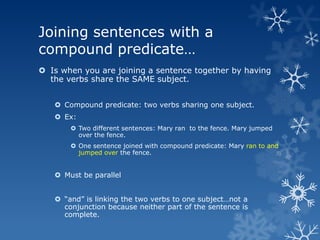
Joining sentences with a
compound predicate…
 Is when you are joining a sentence together by having
  the verbs share the SAME subject.


    Compound predicate: two verbs sharing one subject.
    Ex:
        Two different sentences: Mary ran to the fence. Mary jumped
         over the fence.
        One sentence joined with compound predicate: Mary ran to and
         jumped over the fence.


    Must be parallel


    ―and‖ is linking the two verbs to one subject…not a
     conjunction because neither part of the sentence is
     complete.
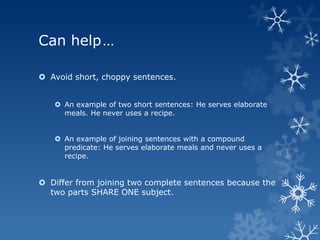
Can help…

 Avoid short, choppy sentences.


    An example of two short sentences: He serves elaborate
     meals. He never uses a recipe.


    An example of joining sentences with a compound
     predicate: He serves elaborate meals and never uses a
     recipe.


 Differ from joining two complete sentences because the
  two parts SHARE ONE subject.
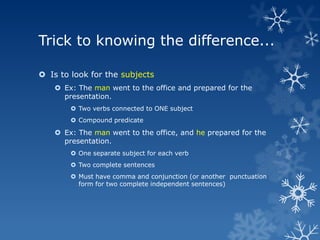
Trick to knowing the difference...

 Is to look for the subjects
     Ex: The man went to the office and prepared for the
      presentation.
         Two verbs connected to ONE subject
         Compound predicate

     Ex: The man went to the office, and he prepared for the
      presentation.
         One separate subject for each verb
         Two complete sentences
         Must have comma and conjunction (or another punctuation
          form for two complete independent sentences)
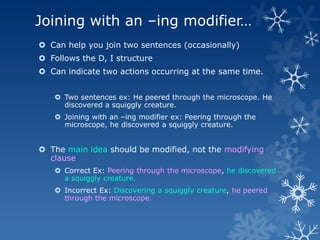
Joining with an –ing modifier…
 Can help you join two sentences (occasionally)
 Follows the D, I structure
 Can indicate two actions occurring at the same time.


    Two sentences ex: He peered through the microscope. He
     discovered a squiggly creature.
    Joining with an –ing modifier ex: Peering through the
     microscope, he discovered a squiggly creature.


 The main idea should be modified, not the modifying
  clause
    Correct Ex: Peering through the microscope, he discovered
     a squiggly creature.
    Incorrect Ex: Discovering a squiggly creature, he peered
     through the microscope.
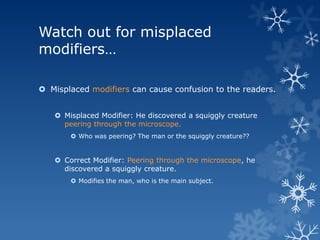
Watch out for misplaced
modifiers…

 Misplaced modifiers can cause confusion to the readers.


    Misplaced Modifier: He discovered a squiggly creature
     peering through the microscope.
        Who was peering? The man or the squiggly creature??


    Correct Modifier: Peering through the microscope, he
     discovered a squiggly creature.
        Modifies the man, who is the main subject.
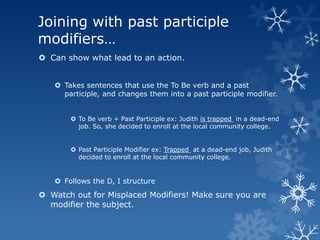
Joining with past participle
modifiers…
 Can show what lead to an action.


    Takes sentences that use the To Be verb and a past
     participle, and changes them into a past participle modifier.


        To Be verb + Past Participle ex: Judith is trapped in a dead-end
         job. So, she decided to enroll at the local community college.


        Past Participle Modifier ex: Trapped at a dead-end job, Judith
         decided to enroll at the local community college.


    Follows the D, I structure
 Watch out for Misplaced Modifiers! Make sure you are
  modifier the subject.
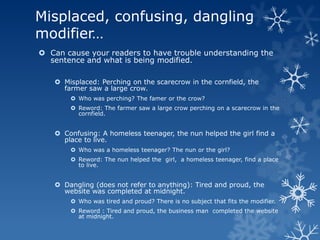
Misplaced, confusing, dangling
modifier…
 Can cause your readers to have trouble understanding the
  sentence and what is being modified.

    Misplaced: Perching on the scarecrow in the cornfield, the
     farmer saw a large crow.
        Who was perching? The famer or the crow?
        Reword: The farmer saw a large crow perching on a scarecrow in the
         cornfield.


    Confusing: A homeless teenager, the nun helped the girl find a
     place to live.
        Who was a homeless teenager? The nun or the girl?
        Reword: The nun helped the girl, a homeless teenager, find a place
         to live.


    Dangling (does not refer to anything): Tired and proud, the
     website was completed at midnight.
        Who was tired and proud? There is no subject that fits the modifier.
        Reword : Tired and proud, the business man completed the website
         at midnight.
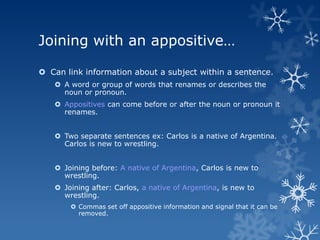
Joining with an appositive…

 Can link information about a subject within a sentence.
    A word or group of words that renames or describes the
     noun or pronoun.
    Appositives can come before or after the noun or pronoun it
     renames.


    Two separate sentences ex: Carlos is a native of Argentina.
     Carlos is new to wrestling.


    Joining before: A native of Argentina, Carlos is new to
     wrestling.
    Joining after: Carlos, a native of Argentina, is new to
     wrestling.
        Commas set off appositive information and signal that it can be
         removed.
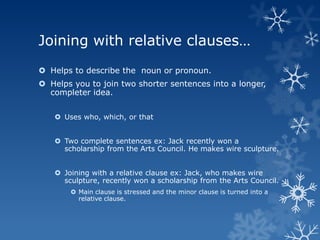
Joining with relative clauses…
 Helps to describe the noun or pronoun.
 Helps you to join two shorter sentences into a longer,
  completer idea.


    Uses who, which, or that


    Two complete sentences ex: Jack recently won a
     scholarship from the Arts Council. He makes wire sculpture.


    Joining with a relative clause ex: Jack, who makes wire
     sculpture, recently won a scholarship from the Arts Council.
        Main clause is stressed and the minor clause is turned into a
         relative clause.
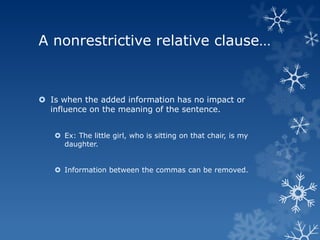
A nonrestrictive relative clause…


 Is when the added information has no impact or
  influence on the meaning of the sentence.


    Ex: The little girl, who is sitting on that chair, is my
     daughter.


    Information between the commas can be removed.
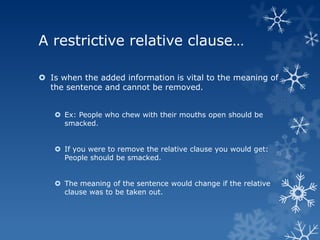
A restrictive relative clause…

 Is when the added information is vital to the meaning of
  the sentence and cannot be removed.


    Ex: People who chew with their mouths open should be
     smacked.


    If you were to remove the relative clause you would get:
     People should be smacked.


    The meaning of the sentence would change if the relative
     clause was to be taken out.

Myohmy,myohmy ch.22

  • 1.
    My oh my,my oh my… Ch. 22: Revising for Sentence Variety
  • 2.
    What is sentencevariety??  It is the different ways you begin, put together, and structure sentences to help them flow and transition better.  It spices things up by:  Combining long and short sentences  Using questions, commands, and exclamations  Beginning with adverbs or prepositional phrases  Joining ideas with compound predicates, -ing modifiers, past participial modifiers, appositives, and relative clauses  Helping to avoid misplaced or confusing modifiers  It helps writers use each sentence/paragraph effectively.
  • 3.
    Combining long andshort sentences…  If sentences are too short, they create a choppy feel in the paper.  Ex. I walked to school. It was nice. I am happy. I made it on time.  If sentence are too long, they can create a heavy, drawn out feeling in the paper.  Ex: I walked to school because its only five minutes from my house and because I like to walk. Also, it is a great source of exercise because it keeps me in shape and healthy as well as makes me happy.
  • 4.
    So…  Mixing longand short sentences together:  Will help to transition your sentences and paragraphs smoothly.  Will help your sentences be engaging.  Ex: I walk to school everyday because I live only five minutes from it, and walking relaxes me. It is really nice. Also, walking is a great source of exercise. Plus, I love it.
  • 5.
    Statements…  Statements—declaratives—are themost commonly used in sentences.  End with a period  Ex: The woman was wearing a satin, full length dress.
  • 6.
    Using a question,a command, or an exclamation…  Can draw attention to specific areas of the paper, making important information stand out.  Shows the points you are going to prove/answer  Gives added emphasis to points and important information.  Provides direction to the readers  Should only be used when they are beneficial and help to influence and to strengthen the main topic.
  • 7.
    Questions…  Are alsoreferred to as rhetorical—you are not looking for the readers to answer the question but are showing them what you are about to answer in the paper.  Ex: How can one stop hunger in the world?  So, what is to be done?  Use of questions in papers is dependent on the professor.  Cannot be carelessly thrown about but must be used effectively.
  • 8.
    Commands…  Are alsoreferred to as imperatives—you are telling the reader to DO something and are giving them direction.  Ex: Action should be taken.  Ex: Don’t pretend it isn’t happening.  Speak from the heart.  Are used frequently in papers.  Need to be used purposefully.
  • 9.
    Exclamations…  Are alsoreferred to as emphasis—you are trying to express strong emotions toward the topic/point.  Ex: Car accidents are running rampant!  Ex: Health issues are destroying the world!  Ex: People must take a stand!  Should be used sparingly and only to draw attention to an important point.
  • 10.
    Beginning with anadverb…  Can help transition sentences.  Ex: The woman hurried to answer the door. Anxiously, she invited the lawyer inside.  Helps to not separate subject and verb.  Some subjects and verbs should stay connect  Ex awkward: I excitedly ran to town.  Ex fluid: Excitedly, I ran to town.  Helps to not split infinitives  Infinitive: to place  Split infinitive: to anxiously place  Correct: to place anxiously  Exception: there are some sentences the flow better as a split infinitive; for example, to boldly go where no man has gone before.
  • 11.
    Beginning with aprepositional phrase..  Can create a setting for the subject.  Creates a dependent clause, so it must follow the D,I sentence structure.  Remember: A prepositional phrase contains a preposition and an object  Ex: To me  Ex: At the moment  Ex: Toward the beach  Sentence ex: At the pool, the woman saw her neighbor.
  • 12.
    However…  Prepositional phrasesare not always movable.  Moveable ex:  With a skip, the girl greeted her father.  The girl greeting her father with a skip.  Maintains the same meaning  Unmovable ex:  Joelle bought a bottle of white wine for the dinner.  Of white wine for the dinner, Joelle bought a bottle.  Doesn’t make sense and/ or changes original meaning.
  • 13.
    Joining sentences witha compound predicate…  Is when you are joining a sentence together by having the verbs share the SAME subject.  Compound predicate: two verbs sharing one subject.  Ex:  Two different sentences: Mary ran to the fence. Mary jumped over the fence.  One sentence joined with compound predicate: Mary ran to and jumped over the fence.  Must be parallel  ―and‖ is linking the two verbs to one subject…not a conjunction because neither part of the sentence is complete.
  • 14.
    Can help…  Avoidshort, choppy sentences.  An example of two short sentences: He serves elaborate meals. He never uses a recipe.  An example of joining sentences with a compound predicate: He serves elaborate meals and never uses a recipe.  Differ from joining two complete sentences because the two parts SHARE ONE subject.
  • 15.
    Trick to knowingthe difference...  Is to look for the subjects  Ex: The man went to the office and prepared for the presentation.  Two verbs connected to ONE subject  Compound predicate  Ex: The man went to the office, and he prepared for the presentation.  One separate subject for each verb  Two complete sentences  Must have comma and conjunction (or another punctuation form for two complete independent sentences)
  • 16.
    Joining with an–ing modifier…  Can help you join two sentences (occasionally)  Follows the D, I structure  Can indicate two actions occurring at the same time.  Two sentences ex: He peered through the microscope. He discovered a squiggly creature.  Joining with an –ing modifier ex: Peering through the microscope, he discovered a squiggly creature.  The main idea should be modified, not the modifying clause  Correct Ex: Peering through the microscope, he discovered a squiggly creature.  Incorrect Ex: Discovering a squiggly creature, he peered through the microscope.
  • 17.
    Watch out formisplaced modifiers…  Misplaced modifiers can cause confusion to the readers.  Misplaced Modifier: He discovered a squiggly creature peering through the microscope.  Who was peering? The man or the squiggly creature??  Correct Modifier: Peering through the microscope, he discovered a squiggly creature.  Modifies the man, who is the main subject.
  • 18.
    Joining with pastparticiple modifiers…  Can show what lead to an action.  Takes sentences that use the To Be verb and a past participle, and changes them into a past participle modifier.  To Be verb + Past Participle ex: Judith is trapped in a dead-end job. So, she decided to enroll at the local community college.  Past Participle Modifier ex: Trapped at a dead-end job, Judith decided to enroll at the local community college.  Follows the D, I structure  Watch out for Misplaced Modifiers! Make sure you are modifier the subject.
  • 19.
    Misplaced, confusing, dangling modifier… Can cause your readers to have trouble understanding the sentence and what is being modified.  Misplaced: Perching on the scarecrow in the cornfield, the farmer saw a large crow.  Who was perching? The famer or the crow?  Reword: The farmer saw a large crow perching on a scarecrow in the cornfield.  Confusing: A homeless teenager, the nun helped the girl find a place to live.  Who was a homeless teenager? The nun or the girl?  Reword: The nun helped the girl, a homeless teenager, find a place to live.  Dangling (does not refer to anything): Tired and proud, the website was completed at midnight.  Who was tired and proud? There is no subject that fits the modifier.  Reword : Tired and proud, the business man completed the website at midnight.
  • 20.
    Joining with anappositive…  Can link information about a subject within a sentence.  A word or group of words that renames or describes the noun or pronoun.  Appositives can come before or after the noun or pronoun it renames.  Two separate sentences ex: Carlos is a native of Argentina. Carlos is new to wrestling.  Joining before: A native of Argentina, Carlos is new to wrestling.  Joining after: Carlos, a native of Argentina, is new to wrestling.  Commas set off appositive information and signal that it can be removed.
  • 21.
    Joining with relativeclauses…  Helps to describe the noun or pronoun.  Helps you to join two shorter sentences into a longer, completer idea.  Uses who, which, or that  Two complete sentences ex: Jack recently won a scholarship from the Arts Council. He makes wire sculpture.  Joining with a relative clause ex: Jack, who makes wire sculpture, recently won a scholarship from the Arts Council.  Main clause is stressed and the minor clause is turned into a relative clause.
  • 22.
    A nonrestrictive relativeclause…  Is when the added information has no impact or influence on the meaning of the sentence.  Ex: The little girl, who is sitting on that chair, is my daughter.  Information between the commas can be removed.
  • 23.
    A restrictive relativeclause…  Is when the added information is vital to the meaning of the sentence and cannot be removed.  Ex: People who chew with their mouths open should be smacked.  If you were to remove the relative clause you would get: People should be smacked.  The meaning of the sentence would change if the relative clause was to be taken out.