Punctuation Marks 
Department of English
What are punctuation marks? 
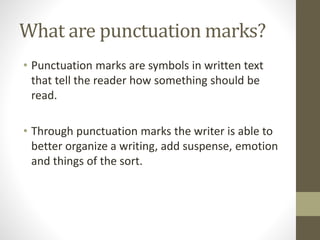
• Punctuation marks are symbols in written text 
that tell the reader how something should be 
read. 
• Through punctuation marks the writer is able to 
better organize a writing, add suspense, emotion 
and things of the sort.
Punctuation Marks 
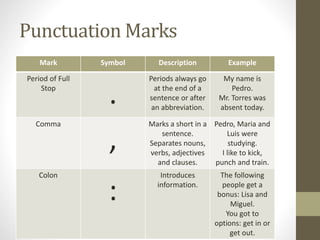
Mark Symbol Description Example 
Period of Full 
Stop . 
Periods always go 
at the end of a 
sentence or after 
an abbreviation. 
My name is 
Pedro. 
Mr. Torres was 
absent today. 
Comma 
, 
Marks a short in a 
sentence. 
Separates nouns, 
verbs, adjectives 
and clauses. 
Pedro, Maria and 
Luis were 
studying. 
I like to kick, 
punch and train. 
Colon 
: 
Introduces 
information. 
The following 
people get a 
bonus: Lisa and 
Miguel. 
You got to 
options: get in or 
get out.
Punctuation Marks 
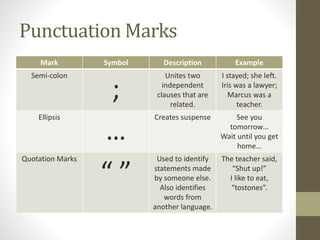
Mark Symbol Description Example 
Semi-colon 
; 
Unites two 
independent 
clauses that are 
related. 
I stayed; she left. 
Iris was a lawyer; 
Marcus was a 
teacher. 
Ellipsis … Creates suspense See you 
tomorrow… 
Wait until you get 
home… 
Quotation Marks “ ” Used to identify 
statements made 
by someone else. 
Also identifies 
words from 
another language. 
The teacher said, 
“Shut up!” 
I like to eat, 
“tostones”.
Punctuation Marks 
Mark Symbol Description Example 
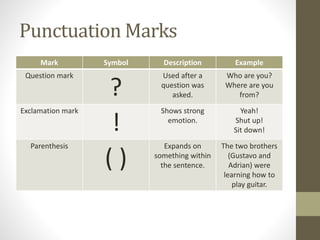
Question mark ? Used after a 
question was 
asked. 
Who are you? 
Where are you 
from? 
Exclamation mark ! Shows strong 
emotion. 
Yeah! 
Shut up! 
Sit down! 
Parenthesis ( ) Expands on 
something within 
the sentence. 
The two brothers 
(Gustavo and 
Adrian) were 
learning how to 
play guitar.
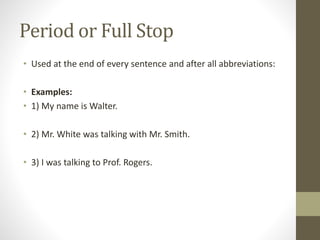
Period or Full Stop 
• Used at the end of every sentence and after all abbreviations: 
• Examples: 
• 1) My name is Walter. 
• 2) Mr. White was talking with Mr. Smith. 
• 3) I was talking to Prof. Rogers.
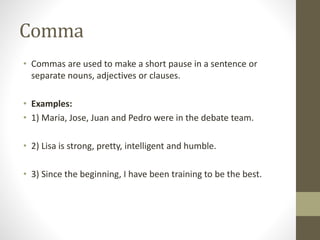
Comma 
• Commas are used to make a short pause in a sentence or 
separate nouns, adjectives or clauses. 
• Examples: 
• 1) Maria, Jose, Juan and Pedro were in the debate team. 
• 2) Lisa is strong, pretty, intelligent and humble. 
• 3) Since the beginning, I have been training to be the best.
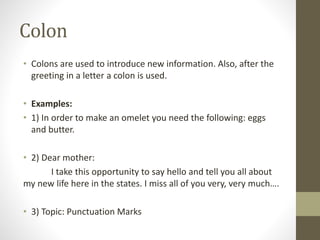
Colon 
• Colons are used to introduce new information. Also, after the 
greeting in a letter a colon is used. 
• Examples: 
• 1) In order to make an omelet you need the following: eggs 
and butter. 
• 2) Dear mother: 
I take this opportunity to say hello and tell you all about 
my new life here in the states. I miss all of you very, very much…. 
• 3) Topic: Punctuation Marks
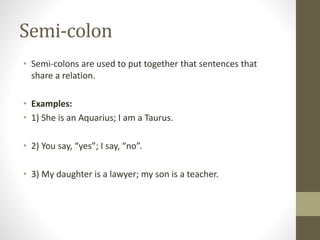
Semi-colon 
• Semi-colons are used to put together that sentences that 
share a relation. 
• Examples: 
• 1) She is an Aquarius; I am a Taurus. 
• 2) You say, “yes”; I say, “no”. 
• 3) My daughter is a lawyer; my son is a teacher.
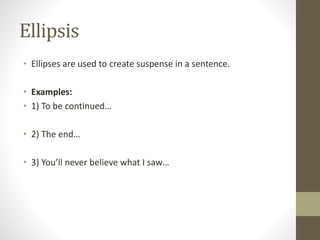
Ellipsis 
• Ellipses are used to create suspense in a sentence. 
• Examples: 
• 1) To be continued… 
• 2) The end… 
• 3) You’ll never believe what I saw…
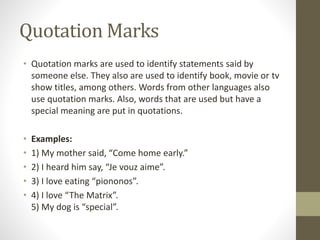
Quotation Marks 
• Quotation marks are used to identify statements said by 
someone else. They also are used to identify book, movie or tv 
show titles, among others. Words from other languages also 
use quotation marks. Also, words that are used but have a 
special meaning are put in quotations. 
• Examples: 
• 1) My mother said, “Come home early.” 
• 2) I heard him say, “Je vouz aime”. 
• 3) I love eating “piononos”. 
• 4) I love “The Matrix”. 
5) My dog is “special”.
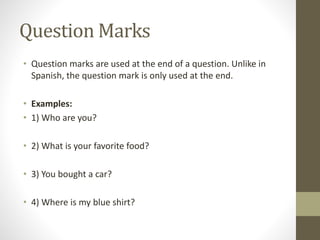
Question Marks 
• Question marks are used at the end of a question. Unlike in 
Spanish, the question mark is only used at the end. 
• Examples: 
• 1) Who are you? 
• 2) What is your favorite food? 
• 3) You bought a car? 
• 4) Where is my blue shirt?
Exclamation Marks 
• Exclamation marks are used to show strong feelings or 
emotions such as hate, anger, frustration, excitement, etc. 
• Examples: 
• 1) Yeah! 
• 2) No! 
• 3) Close the door! 
• 4) Shut up! 
• 5) Sit down!
Parenthesis 
• Parenthesis are used to expand within a statement. They make 
a clarification or add information needed to fully understand 
the intended message. 
• Examples: 
• 1) I used to play sports (basketball and baseball) back in 
college. 
• 2) My kids (Juan and Luis) are very loving. 
• 3) A bought a car (a Honda Accord). 
• 4) You two (Walter and Wanda) sit down and shut up.
Practice exercise 
• 1. Open the door 
• 2. To make an omelet you need the 
following two eggs and butter 
• 3. Veronica Adriana and Lisa were eating 
• 4. No way
Practice exercise 
• 5. Where are you from 
• 6. My friend said to me Goodbye 
• 7. I stayed she left 
• 8. Until next time

Punctuations

  • 1.
  • 2.
    What are punctuationmarks? • Punctuation marks are symbols in written text that tell the reader how something should be read. • Through punctuation marks the writer is able to better organize a writing, add suspense, emotion and things of the sort.
  • 3.
    Punctuation Marks MarkSymbol Description Example Period of Full Stop . Periods always go at the end of a sentence or after an abbreviation. My name is Pedro. Mr. Torres was absent today. Comma , Marks a short in a sentence. Separates nouns, verbs, adjectives and clauses. Pedro, Maria and Luis were studying. I like to kick, punch and train. Colon : Introduces information. The following people get a bonus: Lisa and Miguel. You got to options: get in or get out.
  • 4.
    Punctuation Marks MarkSymbol Description Example Semi-colon ; Unites two independent clauses that are related. I stayed; she left. Iris was a lawyer; Marcus was a teacher. Ellipsis … Creates suspense See you tomorrow… Wait until you get home… Quotation Marks “ ” Used to identify statements made by someone else. Also identifies words from another language. The teacher said, “Shut up!” I like to eat, “tostones”.
  • 5.
    Punctuation Marks MarkSymbol Description Example Question mark ? Used after a question was asked. Who are you? Where are you from? Exclamation mark ! Shows strong emotion. Yeah! Shut up! Sit down! Parenthesis ( ) Expands on something within the sentence. The two brothers (Gustavo and Adrian) were learning how to play guitar.
  • 6.
    Period or FullStop • Used at the end of every sentence and after all abbreviations: • Examples: • 1) My name is Walter. • 2) Mr. White was talking with Mr. Smith. • 3) I was talking to Prof. Rogers.
  • 7.
    Comma • Commasare used to make a short pause in a sentence or separate nouns, adjectives or clauses. • Examples: • 1) Maria, Jose, Juan and Pedro were in the debate team. • 2) Lisa is strong, pretty, intelligent and humble. • 3) Since the beginning, I have been training to be the best.
  • 8.
    Colon • Colonsare used to introduce new information. Also, after the greeting in a letter a colon is used. • Examples: • 1) In order to make an omelet you need the following: eggs and butter. • 2) Dear mother: I take this opportunity to say hello and tell you all about my new life here in the states. I miss all of you very, very much…. • 3) Topic: Punctuation Marks
  • 9.
    Semi-colon • Semi-colonsare used to put together that sentences that share a relation. • Examples: • 1) She is an Aquarius; I am a Taurus. • 2) You say, “yes”; I say, “no”. • 3) My daughter is a lawyer; my son is a teacher.
  • 10.
    Ellipsis • Ellipsesare used to create suspense in a sentence. • Examples: • 1) To be continued… • 2) The end… • 3) You’ll never believe what I saw…
  • 11.
    Quotation Marks •Quotation marks are used to identify statements said by someone else. They also are used to identify book, movie or tv show titles, among others. Words from other languages also use quotation marks. Also, words that are used but have a special meaning are put in quotations. • Examples: • 1) My mother said, “Come home early.” • 2) I heard him say, “Je vouz aime”. • 3) I love eating “piononos”. • 4) I love “The Matrix”. 5) My dog is “special”.
  • 12.
    Question Marks •Question marks are used at the end of a question. Unlike in Spanish, the question mark is only used at the end. • Examples: • 1) Who are you? • 2) What is your favorite food? • 3) You bought a car? • 4) Where is my blue shirt?
  • 13.
    Exclamation Marks •Exclamation marks are used to show strong feelings or emotions such as hate, anger, frustration, excitement, etc. • Examples: • 1) Yeah! • 2) No! • 3) Close the door! • 4) Shut up! • 5) Sit down!
  • 14.
    Parenthesis • Parenthesisare used to expand within a statement. They make a clarification or add information needed to fully understand the intended message. • Examples: • 1) I used to play sports (basketball and baseball) back in college. • 2) My kids (Juan and Luis) are very loving. • 3) A bought a car (a Honda Accord). • 4) You two (Walter and Wanda) sit down and shut up.
  • 15.
    Practice exercise •1. Open the door • 2. To make an omelet you need the following two eggs and butter • 3. Veronica Adriana and Lisa were eating • 4. No way
  • 16.
    Practice exercise •5. Where are you from • 6. My friend said to me Goodbye • 7. I stayed she left • 8. Until next time