



Group 6
•
•
•
•
•
•

Edwin Firmansyah
Idah Caridah
Indah Mutian Hapsak
Rani Tanjung
Ristina
Santi Damayanti

TRANSLATIO
N II
The Word in Different
Language
A few foreign languages which will bridge the gap of
cultural and social differences, since it also brings along
knowledge of new traditions and customs and hence, a
fresh perspective to life itself.

Here is a list of some of the languages spoken around
the world, the important thing to know is that every
language is intricate and unique.
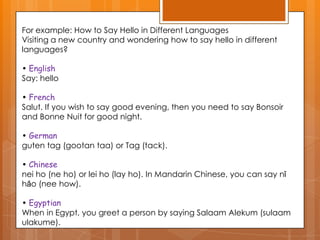
For example: How to Say Hello in Different Languages
Visiting a new country and wondering how to say hello in different
languages?
• English
Say: hello

• French
Salut. If you wish to say good evening, then you need to say Bonsoir
and Bonne Nuit for good night.
• German
guten tag (gootan taa) or Tag (tack).
• Chinese
nei ho (ne ho) or lei ho (lay ho). In Mandarin Chinese, you can say nǐ
hǎo (nee how).

• Egyptian
When in Egypt, you greet a person by saying Salaam Alekum (sulaam
ulakume).
What is Lexical Meaning?
Lexical meaning is defined as the meaning of a base or root word
without considering any prefix or suffix which may be attached.
(noun)
An example of lexical meaning is the meaning of the word "port" in
the words import or portable.
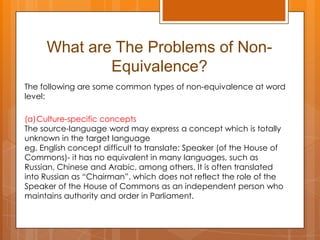
What are The Problems of NonEquivalence?
The following are some common types of non-equivalence at word
level:

(a)Culture-specific concepts
The source-language word may express a concept which is totally
unknown in the target language
eg. English concept difficult to translate: Speaker (of the House of
Commons)- it has no equivalent in many languages, such as
Russian, Chinese and Arabic, among others. It is often translated
into Russian as “Chairman”, which does not reflect the role of the
Speaker of the House of Commons as an independent person who
maintains authority and order in Parliament.
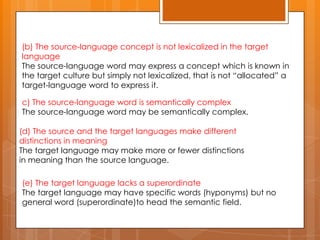
(b) The source-language concept is not lexicalized in the target
language
The source-language word may express a concept which is known in
the target culture but simply not lexicalized, that is not “allocated” a
target-language word to express it.
c) The source-language word is semantically complex
The source-language word may be semantically complex.
(d) The source and the target languages make different
distinctions in meaning
The target language may make more or fewer distinctions
in meaning than the source language.

(e) The target language lacks a superordinate
The target language may have specific words (hyponyms) but no
general word (superordinate)to head the semantic field.
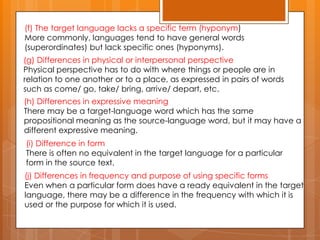
(f) The target language lacks a specific term (hyponym)
More commonly, languages tend to have general words
(superordinates) but lack specific ones (hyponyms).
(g) Differences in physical or interpersonal perspective
Physical perspective has to do with where things or people are in
relation to one another or to a place, as expressed in pairs of words
such as come/ go, take/ bring, arrive/ depart, etc.
(h) Differences in expressive meaning
There may be a target-language word which has the same
propositional meaning as the source-language word, but it may have a
different expressive meaning.
(i) Difference in form
There is often no equivalent in the target language for a particular
form in the source text.
(j) Differences in frequency and purpose of using specific forms
Even when a particular form does have a ready equivalent in the target
language, there may be a difference in the frequency with which it is
used or the purpose for which it is used.
(k) The use of loan words in the source text
Words such as au fait, chic and alfresco in English are used for their
prestige value, because they add an air of sophistication to the text or
its subject matter.
The Word in Different Language

The Word in Different Language

  • 1.
    Group 6 • • • • • • Edwin Firmansyah IdahCaridah Indah Mutian Hapsak Rani Tanjung Ristina Santi Damayanti TRANSLATIO N II
  • 2.
    The Word inDifferent Language A few foreign languages which will bridge the gap of cultural and social differences, since it also brings along knowledge of new traditions and customs and hence, a fresh perspective to life itself. Here is a list of some of the languages spoken around the world, the important thing to know is that every language is intricate and unique.
  • 3.
    For example: Howto Say Hello in Different Languages Visiting a new country and wondering how to say hello in different languages? • English Say: hello • French Salut. If you wish to say good evening, then you need to say Bonsoir and Bonne Nuit for good night. • German guten tag (gootan taa) or Tag (tack). • Chinese nei ho (ne ho) or lei ho (lay ho). In Mandarin Chinese, you can say nǐ hǎo (nee how). • Egyptian When in Egypt, you greet a person by saying Salaam Alekum (sulaam ulakume).
  • 4.
    What is LexicalMeaning? Lexical meaning is defined as the meaning of a base or root word without considering any prefix or suffix which may be attached. (noun) An example of lexical meaning is the meaning of the word "port" in the words import or portable.
  • 5.
    What are TheProblems of NonEquivalence? The following are some common types of non-equivalence at word level: (a)Culture-specific concepts The source-language word may express a concept which is totally unknown in the target language eg. English concept difficult to translate: Speaker (of the House of Commons)- it has no equivalent in many languages, such as Russian, Chinese and Arabic, among others. It is often translated into Russian as “Chairman”, which does not reflect the role of the Speaker of the House of Commons as an independent person who maintains authority and order in Parliament.
  • 6.
    (b) The source-languageconcept is not lexicalized in the target language The source-language word may express a concept which is known in the target culture but simply not lexicalized, that is not “allocated” a target-language word to express it. c) The source-language word is semantically complex The source-language word may be semantically complex. (d) The source and the target languages make different distinctions in meaning The target language may make more or fewer distinctions in meaning than the source language. (e) The target language lacks a superordinate The target language may have specific words (hyponyms) but no general word (superordinate)to head the semantic field.
  • 7.
    (f) The targetlanguage lacks a specific term (hyponym) More commonly, languages tend to have general words (superordinates) but lack specific ones (hyponyms). (g) Differences in physical or interpersonal perspective Physical perspective has to do with where things or people are in relation to one another or to a place, as expressed in pairs of words such as come/ go, take/ bring, arrive/ depart, etc. (h) Differences in expressive meaning There may be a target-language word which has the same propositional meaning as the source-language word, but it may have a different expressive meaning. (i) Difference in form There is often no equivalent in the target language for a particular form in the source text. (j) Differences in frequency and purpose of using specific forms Even when a particular form does have a ready equivalent in the target language, there may be a difference in the frequency with which it is used or the purpose for which it is used.
  • 8.
    (k) The useof loan words in the source text Words such as au fait, chic and alfresco in English are used for their prestige value, because they add an air of sophistication to the text or its subject matter.