Vortioxetine
Dr. Subodh Sharma
Resident
Department Of Psychiatry
NMCTH, Birgunj, Nepal
Introduction
Novel antidepressant approved for use in Major Depressive
Disorder (MDD) in 2013 by FDA.
Manufactured by Takeda Pharmaceuticals
Falls under category of Serotonin Modulators
Shift of Paradigm
Selectively Inhibiting the
Serotonin Transporter
(SERT)
Serotonin transporters +
Multiple Actions within
Serotonin System
Results in:
• Higher remission rates
• Reduction of residual symptoms
• (e.g. insomnia, anxiety)
• Reduced side effect burden
• Novel drugs are now combining various
mechanisms within a single molecule
Serotonin Modulators
Antagonize postsynaptic serotonin receptors
Inhibit reuptake of postsynaptic serotonin to varying
degrees
Increase synaptic concentrations of 5-HT, NE, DA, ACh,
and histamine
Examples:
Nefazodone
Trazodone
Vilazodone
Vortioxetine
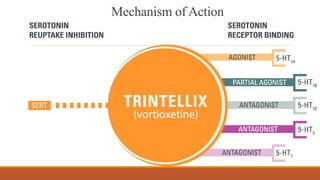
Mechanism of Action
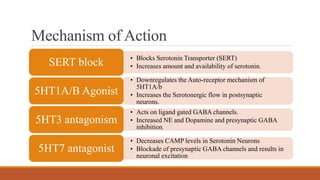
Mechanism of Action
• Blocks Serotonin Transporter (SERT)
• Increases amount and availability of serotonin.
SERT block
• Downregulates the Auto-receptor mechanism of
5HT1A/b
• Increases the Serotonergic flow in postsynaptic
neurons.
5HT1A/B Agonist
• Acts on ligand gated GABA channels.
• Increased NE and Dopamine and presynaptic GABA
inhibition.
5HT3 antagonism
• Decreases CAMP levels in Serotonin Neurons
• Blockade of presynaptic GABA channels and results in
neuronal excitation
5HT7 antagonist
Pharmacology
Bioavailability : 75%
Peak plasma Concentration: 7-11 hrs.
Half Life: 66 hrs.
Protein Binding: 98%
Elimination: Urine (59%) and Feces (31%)
Studies
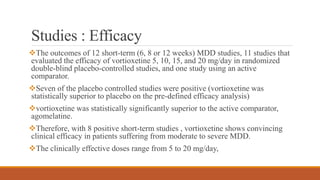
Studies : Efficacy
The outcomes of 12 short-term (6, 8 or 12 weeks) MDD studies, 11 studies that
evaluated the efficacy of vortioxetine 5, 10, 15, and 20 mg/day in randomized
double-blind placebo-controlled studies, and one study using an active
comparator.
Seven of the placebo controlled studies were positive (vortioxetine was
statistically superior to placebo on the pre-defined efficacy analysis)
vortioxetine was statistically significantly superior to the active comparator,
agomelatine.
Therefore, with 8 positive short-term studies , vortioxetine shows convincing
clinical efficacy in patients suffering from moderate to severe MDD.
The clinically effective doses range from 5 to 20 mg/day,
Long term use
(Boulenger et al., 2012). The study showed that the time to relapse was statistically
significantly in favor of vortioxetine compared to placebo (hazard ratio of 2.01), with
relapse rates of 13% with vortioxetine versus 26% in the placebo group.
In the Baldwin et al. (2012a) study, 535 MDD patients from the 8-week lead-in
study, with a mean MADRS total score of 13.5, entered a long-term (52-week) safety
study, mainly with vortioxetine 5 and 10 mg/day.
At the end of the treatment period (week 52), the mean MADRS total score had
improved by 8 points, and remission rate of 83% (versus 42% in the lead-in study).
The results from these studies support the efficacy of vortioxetine in treating MDD
and in decreasing the risk of recurrence of depressive episodes after remission is
achieved.
Efficacy
Furthermore, assessments of vortioxetine's effects on cognitive function indicate that it
may have beneficial effects by alleviating cognitive dysfunction in addition to depressive
symptoms. Future preclinical and clinical studies will extend these observations and shed
light on their underlying biological substrates.
(Brecht et al., 2007; Stein and Lopez, 2011)
In clinical trials with vortioxetine the incidence of sleep-related TEAEs (insomnia,
initial insomnia, middle insomnia, hyposomnia, sleep disorder, dyssomnia, poor quality
sleep, terminal insomnia) was low and not dose related, with an incidence of 2.0 to
5.1% compared to 4.4% with placebo (Baldwin et al., 2013).
This differs from SSRIs and SNRIs, which have an incidence of sleep-related TEAEs
significantly higher than placebo.
Studies
Alvarez et al. Int J Neuropsychopharmacologie. 2012
A randomized, double-blind, placebo- and active controlled, fixed-dose
study spanning 6 weeks. Patients were randomly assigned to placebo,
vortioxetine 5 mg/day, vortioxetine 10 mg/day, or venlafaxine XR 225
mg/day. Venlafaxine doses were titrated appropriately
Results: Treatment with vortioxetine 5 mg/day, vortioxetine 10 mg/day, and
venlafaxine XR 225 mg/day showed similar and significant improvements in
depression symptoms compared to placebo.
Sufficient Comparative Studies were not found which compared other
antidepressants with Vortioxetine.
Prescribing Guidelines
For Major Depressive Disorders
Initial therapy: 10mg may be increased up to 20mg once tolerated.
Maintenance: 5-20mg
Discontinuation: dose up to 10mg can be discontinued abruptly higher doses
can be reduced by 10mg/week.
Off label use in Anxiety (No Sufficient Studies)
 Under studies for ADHD, Bipolar Depression and Binge Eating Disorders
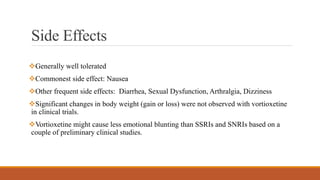
Side Effects
Generally well tolerated
Commonest side effect: Nausea
Other frequent side effects: Diarrhea, Sexual Dysfunction, Arthralgia, Dizziness
Significant changes in body weight (gain or loss) were not observed with vortioxetine
in clinical trials.
Vortioxetine might cause less emotional blunting than SSRIs and SNRIs based on a
couple of preliminary clinical studies.
Cautions
Pregnancy category: C
Lactation: not known secretion
Cautious use with:
CYP- inhibitors (ketoconazole, Carbamazepine)
Rifampicin, Buspirone, Fluoxetine
Contraindicated with MAO inhibitors
Availability
Not Available in Nepal
Available and Prescribed India
Cost: Brintellix 20mg x 10tab Pack Costs 1244INR which is about 4 times
expensive than Duloxetine 60mg capsules.
Conclusion
Results of placebo-controlled trials suggest efficacy and an overall safety
profile comparable to existing first-line antidepressants.
The most common side effects are nausea, vomiting and constipation.
Results of several studies indicate that vortioxetine may have therapeutic
effects on cognition (e.g., memory and executive functioning) that exceed
that of standard antidepressants.
Disadvantages include cost and the current paucity of long-term efficacy
data from large clinical trials.
Many authors suggest that vortioxetine is currently a good second-line
antidepressant option and shows promise, pending additional long-term
data, to become a first-line antidepressant option.
References:
1. Stephen M. Stahl, Et al. Serotonergic Drugs for Depression and Beyond, Current
Drug Targets, volume 14, issue 5, pages 578-585, 2013
(http://www.eurekaselect.com/node/109205/article)
2. Vortioxetine, a novel antidepressant with multimodal activity: Review of preclinical
and clinical data Connie Sanchez , Karen E. Asin , Francesc Artigas
3. Stahl’s Essential Psychopharmacology, fourth edition, SM Stahl
4. UpToDate
5. Serotonin Modulator Antidepressants, Elsevier Publication’s Research Article
Thank You

Vortioxetine

  • 1.
    Vortioxetine Dr. Subodh Sharma Resident DepartmentOf Psychiatry NMCTH, Birgunj, Nepal
  • 2.
    Introduction Novel antidepressant approvedfor use in Major Depressive Disorder (MDD) in 2013 by FDA. Manufactured by Takeda Pharmaceuticals Falls under category of Serotonin Modulators
  • 3.
    Shift of Paradigm SelectivelyInhibiting the Serotonin Transporter (SERT) Serotonin transporters + Multiple Actions within Serotonin System Results in: • Higher remission rates • Reduction of residual symptoms • (e.g. insomnia, anxiety) • Reduced side effect burden • Novel drugs are now combining various mechanisms within a single molecule
  • 4.
    Serotonin Modulators Antagonize postsynapticserotonin receptors Inhibit reuptake of postsynaptic serotonin to varying degrees Increase synaptic concentrations of 5-HT, NE, DA, ACh, and histamine
  • 5.
  • 6.
  • 7.
    Mechanism of Action •Blocks Serotonin Transporter (SERT) • Increases amount and availability of serotonin. SERT block • Downregulates the Auto-receptor mechanism of 5HT1A/b • Increases the Serotonergic flow in postsynaptic neurons. 5HT1A/B Agonist • Acts on ligand gated GABA channels. • Increased NE and Dopamine and presynaptic GABA inhibition. 5HT3 antagonism • Decreases CAMP levels in Serotonin Neurons • Blockade of presynaptic GABA channels and results in neuronal excitation 5HT7 antagonist
  • 8.
    Pharmacology Bioavailability : 75% Peakplasma Concentration: 7-11 hrs. Half Life: 66 hrs. Protein Binding: 98% Elimination: Urine (59%) and Feces (31%)
  • 9.
  • 10.
    Studies : Efficacy Theoutcomes of 12 short-term (6, 8 or 12 weeks) MDD studies, 11 studies that evaluated the efficacy of vortioxetine 5, 10, 15, and 20 mg/day in randomized double-blind placebo-controlled studies, and one study using an active comparator. Seven of the placebo controlled studies were positive (vortioxetine was statistically superior to placebo on the pre-defined efficacy analysis) vortioxetine was statistically significantly superior to the active comparator, agomelatine. Therefore, with 8 positive short-term studies , vortioxetine shows convincing clinical efficacy in patients suffering from moderate to severe MDD. The clinically effective doses range from 5 to 20 mg/day,
  • 11.
    Long term use (Boulengeret al., 2012). The study showed that the time to relapse was statistically significantly in favor of vortioxetine compared to placebo (hazard ratio of 2.01), with relapse rates of 13% with vortioxetine versus 26% in the placebo group. In the Baldwin et al. (2012a) study, 535 MDD patients from the 8-week lead-in study, with a mean MADRS total score of 13.5, entered a long-term (52-week) safety study, mainly with vortioxetine 5 and 10 mg/day. At the end of the treatment period (week 52), the mean MADRS total score had improved by 8 points, and remission rate of 83% (versus 42% in the lead-in study). The results from these studies support the efficacy of vortioxetine in treating MDD and in decreasing the risk of recurrence of depressive episodes after remission is achieved.
  • 12.
    Efficacy Furthermore, assessments ofvortioxetine's effects on cognitive function indicate that it may have beneficial effects by alleviating cognitive dysfunction in addition to depressive symptoms. Future preclinical and clinical studies will extend these observations and shed light on their underlying biological substrates. (Brecht et al., 2007; Stein and Lopez, 2011) In clinical trials with vortioxetine the incidence of sleep-related TEAEs (insomnia, initial insomnia, middle insomnia, hyposomnia, sleep disorder, dyssomnia, poor quality sleep, terminal insomnia) was low and not dose related, with an incidence of 2.0 to 5.1% compared to 4.4% with placebo (Baldwin et al., 2013). This differs from SSRIs and SNRIs, which have an incidence of sleep-related TEAEs significantly higher than placebo.
  • 13.
    Studies Alvarez et al.Int J Neuropsychopharmacologie. 2012 A randomized, double-blind, placebo- and active controlled, fixed-dose study spanning 6 weeks. Patients were randomly assigned to placebo, vortioxetine 5 mg/day, vortioxetine 10 mg/day, or venlafaxine XR 225 mg/day. Venlafaxine doses were titrated appropriately Results: Treatment with vortioxetine 5 mg/day, vortioxetine 10 mg/day, and venlafaxine XR 225 mg/day showed similar and significant improvements in depression symptoms compared to placebo. Sufficient Comparative Studies were not found which compared other antidepressants with Vortioxetine.
  • 14.
    Prescribing Guidelines For MajorDepressive Disorders Initial therapy: 10mg may be increased up to 20mg once tolerated. Maintenance: 5-20mg Discontinuation: dose up to 10mg can be discontinued abruptly higher doses can be reduced by 10mg/week. Off label use in Anxiety (No Sufficient Studies)  Under studies for ADHD, Bipolar Depression and Binge Eating Disorders
  • 15.
    Side Effects Generally welltolerated Commonest side effect: Nausea Other frequent side effects: Diarrhea, Sexual Dysfunction, Arthralgia, Dizziness Significant changes in body weight (gain or loss) were not observed with vortioxetine in clinical trials. Vortioxetine might cause less emotional blunting than SSRIs and SNRIs based on a couple of preliminary clinical studies.
  • 16.
    Cautions Pregnancy category: C Lactation:not known secretion Cautious use with: CYP- inhibitors (ketoconazole, Carbamazepine) Rifampicin, Buspirone, Fluoxetine Contraindicated with MAO inhibitors
  • 17.
    Availability Not Available inNepal Available and Prescribed India Cost: Brintellix 20mg x 10tab Pack Costs 1244INR which is about 4 times expensive than Duloxetine 60mg capsules.
  • 18.
    Conclusion Results of placebo-controlledtrials suggest efficacy and an overall safety profile comparable to existing first-line antidepressants. The most common side effects are nausea, vomiting and constipation. Results of several studies indicate that vortioxetine may have therapeutic effects on cognition (e.g., memory and executive functioning) that exceed that of standard antidepressants. Disadvantages include cost and the current paucity of long-term efficacy data from large clinical trials. Many authors suggest that vortioxetine is currently a good second-line antidepressant option and shows promise, pending additional long-term data, to become a first-line antidepressant option.
  • 19.
    References: 1. Stephen M.Stahl, Et al. Serotonergic Drugs for Depression and Beyond, Current Drug Targets, volume 14, issue 5, pages 578-585, 2013 (http://www.eurekaselect.com/node/109205/article) 2. Vortioxetine, a novel antidepressant with multimodal activity: Review of preclinical and clinical data Connie Sanchez , Karen E. Asin , Francesc Artigas 3. Stahl’s Essential Psychopharmacology, fourth edition, SM Stahl 4. UpToDate 5. Serotonin Modulator Antidepressants, Elsevier Publication’s Research Article
  • 20.