


HALLUCINATION
Presenter: Dr. Subodh Kumar Sharma
MD Psychiatry Resident
Moderator: Dr. Shuva Shrestha, MD
Department Of Psychiatry
National Medical College, Birgunj, Nepal
CONTENT
• History
• Definitions
• Causes
• Hallucinations of individual senses
• Hallucinatory syndromes
• Special hallucinations
• Body image distortions
• Patient’s attitude towards hallucination
HISTORY
• Derived from Latin word /allucinari/
• Meaning “wander in the mind to mislead”
• Brought into English literature by Sir Thomas Browne, 1646
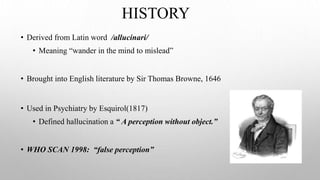
• Used in Psychiatry by Esquirol(1817)
• Defined hallucination a “ A perception without object.”
• WHO SCAN 1998: “false perception”
DEFINITIONS
• Jaspers, (1962): False perception which is not a sensory distortion or a misinterpretation,
but which occurs at the same time as real perceptions.
• Slade, (1976): Three criteria are essential for an operational definition
(A) Percept-like experience in the absence of an external stimulus;
(B) Percept-like experience that has the full force and impact of a real perception
(C) Percept-like experience that is unwilled, occurs spontaneously and cannot be
readily controlled by the percipient.
DEFINITIONS
• Horowitz (1975): Hallucinations are mental images that
• occur in the form of images,
• are derived from internal sources of information,
• are appraised incorrectly as if from external sources of information,
• usually occur intrusively.
QUALITIES OF HALLUCINATION
• Perceiving:
Experienced as sensation and not as thought or fantasy.
• Behavioral relevance:
Relevance for his own emotions, needs or actions
• Objectivity and existence:
An object is considered to exist if the observer feels certain that it still exists even
though nobody else is experiencing it at that time
• Involuntary:
Doesn’t depend on subject’s will
• Quality of independence:
That his experience is not simply the result of being in an unusual mental state
What the doctor calls a “hallucination” is a
“normal sensory experience” to the patient.
• The quality of Publicness: found mostly to be absent
with hallucination in which the experiencer would be
aware that anybody else with normal sensory faculties
would be able to perceive this something.
• Often, the hallucinator does not believe that others
could share his experience.
(SIMS’ Symptoms in Mind, Fifth Edition, Femi Oyebode)
CAUSES OF HALLUCINATIONS
• Intense emotions
• Suggestion
• Disorders of sense organs
• Sensory deprivation
• Disorders of CNS
• Psychiatric disorders
INTENSE EMOTIONS
• Depressed patients with delusion of guilt
• Hallucination: short phrases, words, usually abusive or unpleasant
• Schizophrenia or Severe depression with psychotic features:
• Persistent hallucinatory voices
• More organized and complete sentences
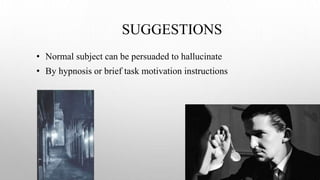
SUGGESTIONS
• Normal subject can be persuaded to hallucinate
• By hypnosis or brief task motivation instructions
DISORDERS OF SENSE ORGANS
• Hallucinatory voices : in ear diseases
• Hallucinatory images: in eye disease or CNS disorders
• Hallucinations in organic states: peripheral lesions in sense organs
• Charles Bonnet Syndrome: no obvious psychopathology
SENSORY DEPRIVATION
• In normal subject if incoming stimuli reduced to minimum they can hallucinate
after few hours
• Changing visual hallucinations
• Repetitive phrases
• Black patch disease delirium following cataract extraction in the aged result of
sensory deprivation and mild senile brain changes.
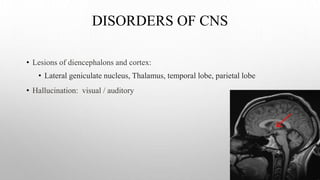
DISORDERS OF CNS
• Lesions of diencephalons and cortex:
• Lateral geniculate nucleus, Thalamus, temporal lobe, parietal lobe
• Hallucination: visual / auditory
PSYCHIATRIC DISORDERS
• Severe Depression with psychotic symptoms
• Schizophrenia
• Schizoaffective Disorder
• Bipolar Disorder with psychotic symptoms
• Delirium
• Dementia
• Sleep Disturbances
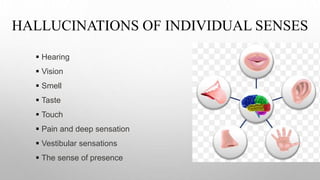
HALLUCINATIONS OF INDIVIDUAL SENSES
 Hearing
 Vision
 Smell
 Taste
 Touch
 Pain and deep sensation
 Vestibular sensations
 The sense of presence
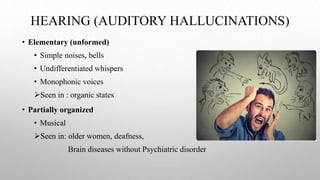
HEARING (AUDITORY HALLUCINATIONS)
• Elementary (unformed)
• Simple noises, bells
• Undifferentiated whispers
• Monophonic voices
Seen in : organic states
• Partially organized
• Musical
Seen in: older women, deafness,
Brain diseases without Psychiatric disorder
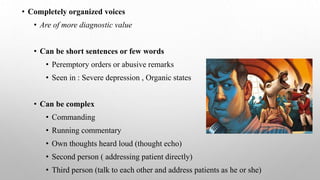
• Completely organized voices
• Are of more diagnostic value
• Can be short sentences or few words
• Peremptory orders or abusive remarks
• Seen in : Severe depression , Organic states
• Can be complex
• Commanding
• Running commentary
• Own thoughts heard loud (thought echo)
• Second person ( addressing patient directly)
• Third person (talk to each other and address patients as he or she)
• Nature Of Auditory Hallucinations
• Adverse
• Neutral
• Helpful
• Incomprehensible/ Nonsense
• Neologism
• Running commentary
• Thought echo
• Gedankenlautwerden: thoughts spoken at the same time or before they are
occurring.
• Echo de la penses: thoughts are spoken just after they occurred.
VISION (VISUAL HALLUCINATION)
• Elementary- flashes of light
• Partly organized- patterns
• Completely organized- people, animals, objects.
May appear against the normally perceived environment
or
Can occur as scenic hallucinations in which whole scenes are hallucinated rather like a
cinema film as in epilepsy.
Common causes of visual hallucinations:
• Ophthalmic disorders: Cataract, Macular degeneration, Glaucoma. Blindness
• Neurological disorder: Optic nerve disorder, Brain stem lesions
• Migraine: patient may see spots and zig zag line in his vision.
• Epilepsy
• Visual cortex lesions of brain
• Toxic and metabolic causes:
 Hepatic Diseases, Endocrine Diseases, Vitamin Deficiencies, Infectious Diseases
 Recreational drugs: Marijuana, LSD
 Drugs used in the treatment of depression, Parkinsonism, Convulsion
 Drug and alcohol withdrawal
• Psychiatric disorders:
 Schizophrenia, Schizoaffective Disorders
 Dissociative Disorders
 Sleep deprivation
 Hypnotic trance or when a person is under mental stress and fatigue
CHARLES BONNET SYNDROME
• Named after the 18th century Swiss scientist, Charles Bonnet
• Is a condition that causes people with decreased vision and
various eye diseases to have visual hallucinations.
• These hallucinations can include seeing patterns, or more
complex images such as people, animals, flowers, and buildings.
• No obvious psychopathology are demonstrable .
Hallucinations in Charles Bonnet Syndrome
• Occur in a “state of quiet restfulness”
• Start without warning, last for a few minutes or for several hours
• Are very detailed, and much clearer than patient’s current vision
• Interact and conform to actual surroundings
• Always outside the body
• Patient knows they are not real
• Have no personal meaning to the patient
LILLIPUTIAN HALLUCINATION
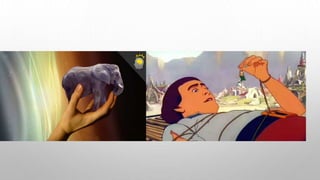
Micropsia affects visual hallucination so that they see tiny object or people.
• Alcohol withdrawal Syndrome with Delirium Tremens
• Rarely in schizophrenia
• Charles Bonnet Syndrome
OLFACTORY HALLUCINATION
• PHANTOSMIA
• Usually foul or disgusted odor are perceived:
• Schizophrenia
• Organic states like temporal lobe epilepsy
• Depression (uncommon)
• Rarely pleasant smell:
• PADRE PIO PHENOMENON- religious people can smell roses around
certain saints.
GUSTATORY HALLUCINATION
• Seen in
• Schizophrenia
• Organic states
• Depression : loss of taste or loss in distinction of taste
• Temporal lobe lesions of brain
TACTILE HALLUCINATION
• False perception of tactile sensory input that creates a hallucinatory sensation of
physical contact with an imaginary object.
• Classified into 3 types
• Superficial
• Kinesthetic
• Visceral
TACTILE HALLUCINATION
• Superficial:
• Thermic: an abnormal perception of heat and cold
• Haptic: of touch
• Hygric, a perception of fluid
• Paraesthesia : sensation of tingling or ‘pins and needles’.
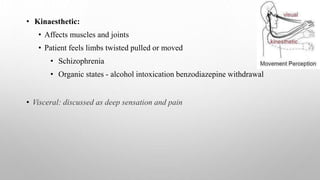
• Kinaesthetic:
• Affects muscles and joints
• Patient feels limbs twisted pulled or moved
• Schizophrenia
• Organic states - alcohol intoxication benzodiazepine withdrawal
• Visceral: discussed as deep sensation and pain
TACTILE HALLUCINATION
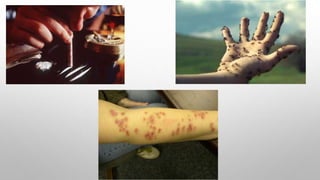
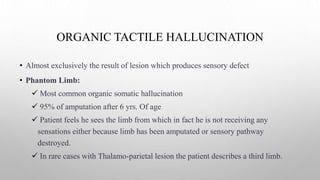
Formication- animals crawling over the body
• In organic states
• Cocaine Bug / Magnan syndrome (cocaine intoxication psychosis)
• Ekbom Syndrome (tactile hallucination along with delusion of infestation)
Sexual hallucinations- having intercourse or genital stimulation
• acute and chronic schizophrenia
ORGANIC TACTILE HALLUCINATION
• Almost exclusively the result of lesion which produces sensory defect
• Phantom Limb:
 Most common organic somatic hallucination
 95% of amputation after 6 yrs. Of age
 Patient feels he sees the limb from which in fact he is not receiving any
sensations either because limb has been amputated or sensory pathway
destroyed.
 In rare cases with Thalamo-parietal lesion the patient describes a third limb.
PHANTOM LIMB
• Most phantom limbs are produced by peripheral and central disorders.
• Occasionally it develops from lesion of peripheral nerve or the medulla or spinal
cord.
• Thalamoparietal lesions have phantom third arm or leg.
• Correspond to the previous image of the limb.
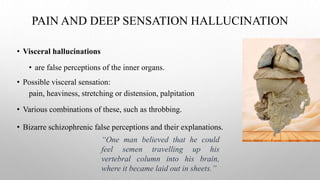
PAIN AND DEEP SENSATION HALLUCINATION
• Visceral hallucinations
• are false perceptions of the inner organs.
• Possible visceral sensation:
pain, heaviness, stretching or distension, palpitation
• Various combinations of these, such as throbbing.
• Bizarre schizophrenic false perceptions and their explanations.
“One man believed that he could
feel semen travelling up his
vertebral column into his brain,
where it became laid out in sheets.”
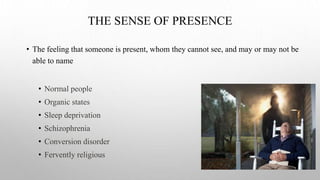
THE SENSE OF PRESENCE
• The feeling that someone is present, whom they cannot see, and may or may not be
able to name
• Normal people
• Organic states
• Sleep deprivation
• Schizophrenia
• Conversion disorder
• Fervently religious
SPECIAL HALLUCINATIONS
• Functional hallucinations: A stimulus causes a hallucination but the stimulus is
experienced as well as the hallucination.
• Reflex hallucinations : Morbid form of Synesthesia.
• Stimulus in one sensory field produces a hallucination in another
• Unlike in functional hallucination normal stimuli cannot be perceived.
• Extracampine hallucinations: the patient has a hallucination that is outside the
limits of the sensory field.
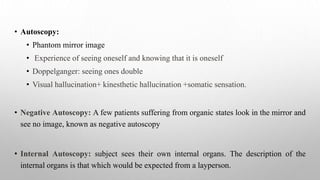
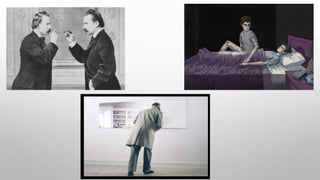
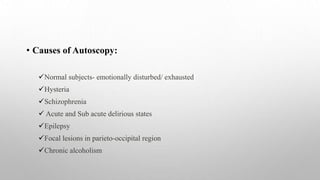
• Autoscopy:
• Phantom mirror image
• Experience of seeing oneself and knowing that it is oneself
• Doppelganger: seeing ones double
• Visual hallucination+ kinesthetic hallucination +somatic sensation.
• Negative Autoscopy: A few patients suffering from organic states look in the mirror and
see no image, known as negative autoscopy
• Internal Autoscopy: subject sees their own internal organs. The description of the
internal organs is that which would be expected from a layperson.
.
• Causes of Autoscopy:
Normal subjects- emotionally disturbed/ exhausted
Hysteria
Schizophrenia
 Acute and Sub acute delirious states
Epilepsy
Focal lesions in parieto-occipital region
Chronic alcoholism
HYPNAGOGIC HALLUCINATION
• Occur when the subject is falling asleep during drowsiness
• Are discontinuous
• Appears to force themselves on the subject
• Commonest is auditory but visual and tactile forms are not uncommon.
• Geometrical designs , abstract shapes , faces , figures or scenes from nature
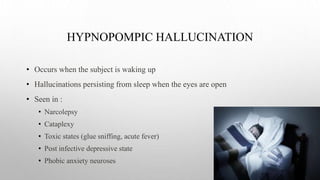
HYPNOPOMPIC HALLUCINATION
• Occurs when the subject is waking up
• Hallucinations persisting from sleep when the eyes are open
• Seen in :
• Narcolepsy
• Cataplexy
• Toxic states (glue sniffing, acute fever)
• Post infective depressive state
• Phobic anxiety neuroses
BODY IMAGE DISTORTIONS
• Hyperschemazia – perceived magnifications of body parts
Organic causes Non organic causes
1. Brown Sequard Syndrome
2. Peripheral Vascular
Disease
3. Multiple Sclerosis
4. Thrombosis of Posterior
Inferior Cerebral Artery
oHypochondriasis
oConversion disorder
o Depersonalization
oAnorexia nervosa
• Hyposchemazia – body parts as diminished
• Paraschemazia – distorted of body image as a feeling that body parts are
distorted or twisted from rest of the body.
• Hemisomatognosia- unilateral lack of body image in which the person behaves
as if one side of body is missing
• Aschemazia- perception of body parts as absent
• Anosgnosia: “denial of illness” Right hemisphere strokes denied their
knowledge early after stroke and refused to admit to any weakness in their left
arm
• Somatoparaphrenia: delusional beliefs about the body, distorted, inanimate ,
severed, or in any other ways abnormal.
HALLUCINATORY SYNDROMES
• Hallucinosis, refer to those disorders in which there are persistent hallucinations
in any sensory modality in the absence of other psychotic features.
• Alcoholic Hallucinosis:
• These hallucinations are usually auditory
• Occur during periods of relative abstinence.
• They may be threatening, although some patients report benign voices.
• Sensorium is clear and hallucinations rarely persist longer than 1 week
• Associated with long-standing alcohol misuse
• Organic Hallucinosis
• These are present in 20−30% of patients with dementia
• Especially of the Alzheimer’s Dementia
• Most commonly auditory or visual.
• There is also disorientation and memory is impaired.
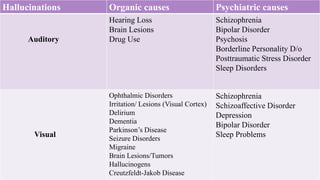
Hallucinations Organic causes Psychiatric causes
Auditory
Hearing Loss
Brain Lesions
Drug Use
Schizophrenia
Bipolar Disorder
Psychosis
Borderline Personality D/o
Posttraumatic Stress Disorder
Sleep Disorders
Visual
Ophthalmic Disorders
Irritation/ Lesions (Visual Cortex)
Delirium
Dementia
Parkinson’s Disease
Seizure Disorders
Migraine
Brain Lesions/Tumors
Hallucinogens
Creutzfeldt-Jakob Disease
Schizophrenia
Schizoaffective Disorder
Depression
Bipolar Disorder
Sleep Problems
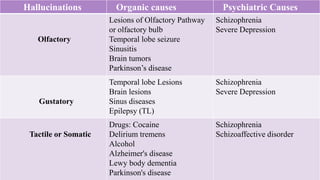
Hallucinations Organic causes Psychiatric Causes
Olfactory
Lesions of Olfactory Pathway
or olfactory bulb
Temporal lobe seizure
Sinusitis
Brain tumors
Parkinson’s disease
Schizophrenia
Severe Depression
Gustatory
Temporal lobe Lesions
Brain lesions
Sinus diseases
Epilepsy (TL)
Schizophrenia
Severe Depression
Tactile or Somatic
Drugs: Cocaine
Delirium tremens
Alcohol
Alzheimer's disease
Lewy body dementia
Parkinson's disease
Schizophrenia
Schizoaffective disorder
PATIENTS ATTITUDE TOWARDS HALLUCINATION
• In organic hallucinations the patient is usually terrified by the visual
hallucinations and may try desperately to get away from them.
• Most delirious patients feel threatened and are generally suspicious.
• Impulsive attempts to escape from the threatening situation may jeopardize
their lives.
• The exception is lilliputian hallucinations, which are usually regarded with
amusement by the patient and may be watched with delight.
• Patients with depression often hear disjointed voices abusing them or telling
them to kill themselves.
• They are not terrified by the voices.
• Voices in acute schizophrenia is often very frightening
• The patient at times may attack the person he believes to be their source.
• Those patients who are knowledgeable about their illness or who have insight
into it may deny hallucinations, since they know this is an abnormal feature.
ASSESMENT OF HALLUCINATING SUBJECT
1. Form/ Nature of hallucination (experience) ? Auditory/ ?Visual
2. Is it distressing , pleasant or fluctuating?
3. Is it in same form through out? Flashes, patterns vs objects OR sounds,
phrases vs sentences
4. Clarity of the experience. Clear, blurred, loud, low
5. Hostility or friendliness of the experience
6. Location of perception? How far?
7. Do subject think anybody else can see or hear the same experience?
8. Duration. How long they last?
9. Referral? Second person/ third person?
10. Familiarity of object or voices?
11. Condition of occurrence? While in crowd or only alone?
12. What do they say or do?
13. Are voices or objects suggesting or commanding?
14. Do you try to control the experience? How?
15. Diurnal variation of experience.
16. Variation in number of objects or sounds?
17. Does medicine/drugs/alcohol has any effect in the experience? What?
18. Age of onset when first experienced?
19. What as he doing during the first experience?
20. Has the experience been better, gone away or become worse? Why do you
think?
21. Anything you want to add on the experience?
REFERENCES
• Fish’s Clinical Psychopathology, 3rd Edition, Patricia Casey, Brendan Kelly
• Sims’ Symptoms In The Mind, Text Book Of Descriptive Psychopathology, 5th Edition, Femi
Oyebode
• Shorter Oxford Text Book of Psychiatry, 6th Edition, P. Cowen, P. Harrison, T. Burns
• Kaplan and Sadock’s Synopsis of Psychiatry, 11th Edition, BJ Sadock, VA Sadock, Pedro Ruiz
• Auditory Hallucinations Interview Guide, Louise Nigh Trygstad, Robin K. Buccheri, Martha D.
THANK
YOU!

Hallucination

  • 1.
    HALLUCINATION Presenter: Dr. SubodhKumar Sharma MD Psychiatry Resident Moderator: Dr. Shuva Shrestha, MD Department Of Psychiatry National Medical College, Birgunj, Nepal
  • 2.
    CONTENT • History • Definitions •Causes • Hallucinations of individual senses • Hallucinatory syndromes • Special hallucinations • Body image distortions • Patient’s attitude towards hallucination
  • 3.
    HISTORY • Derived fromLatin word /allucinari/ • Meaning “wander in the mind to mislead” • Brought into English literature by Sir Thomas Browne, 1646 • Used in Psychiatry by Esquirol(1817) • Defined hallucination a “ A perception without object.” • WHO SCAN 1998: “false perception”
  • 4.
    DEFINITIONS • Jaspers, (1962):False perception which is not a sensory distortion or a misinterpretation, but which occurs at the same time as real perceptions. • Slade, (1976): Three criteria are essential for an operational definition (A) Percept-like experience in the absence of an external stimulus; (B) Percept-like experience that has the full force and impact of a real perception (C) Percept-like experience that is unwilled, occurs spontaneously and cannot be readily controlled by the percipient.
  • 5.
    DEFINITIONS • Horowitz (1975):Hallucinations are mental images that • occur in the form of images, • are derived from internal sources of information, • are appraised incorrectly as if from external sources of information, • usually occur intrusively.
  • 6.
    QUALITIES OF HALLUCINATION •Perceiving: Experienced as sensation and not as thought or fantasy. • Behavioral relevance: Relevance for his own emotions, needs or actions • Objectivity and existence: An object is considered to exist if the observer feels certain that it still exists even though nobody else is experiencing it at that time • Involuntary: Doesn’t depend on subject’s will • Quality of independence: That his experience is not simply the result of being in an unusual mental state
  • 7.
    What the doctorcalls a “hallucination” is a “normal sensory experience” to the patient.
  • 8.
    • The qualityof Publicness: found mostly to be absent with hallucination in which the experiencer would be aware that anybody else with normal sensory faculties would be able to perceive this something. • Often, the hallucinator does not believe that others could share his experience. (SIMS’ Symptoms in Mind, Fifth Edition, Femi Oyebode)
  • 9.
    CAUSES OF HALLUCINATIONS •Intense emotions • Suggestion • Disorders of sense organs • Sensory deprivation • Disorders of CNS • Psychiatric disorders
  • 10.
    INTENSE EMOTIONS • Depressedpatients with delusion of guilt • Hallucination: short phrases, words, usually abusive or unpleasant • Schizophrenia or Severe depression with psychotic features: • Persistent hallucinatory voices • More organized and complete sentences
  • 11.
    SUGGESTIONS • Normal subjectcan be persuaded to hallucinate • By hypnosis or brief task motivation instructions
  • 12.
    DISORDERS OF SENSEORGANS • Hallucinatory voices : in ear diseases • Hallucinatory images: in eye disease or CNS disorders • Hallucinations in organic states: peripheral lesions in sense organs • Charles Bonnet Syndrome: no obvious psychopathology
  • 13.
    SENSORY DEPRIVATION • Innormal subject if incoming stimuli reduced to minimum they can hallucinate after few hours • Changing visual hallucinations • Repetitive phrases • Black patch disease delirium following cataract extraction in the aged result of sensory deprivation and mild senile brain changes.
  • 14.
    DISORDERS OF CNS •Lesions of diencephalons and cortex: • Lateral geniculate nucleus, Thalamus, temporal lobe, parietal lobe • Hallucination: visual / auditory
  • 15.
    PSYCHIATRIC DISORDERS • SevereDepression with psychotic symptoms • Schizophrenia • Schizoaffective Disorder • Bipolar Disorder with psychotic symptoms • Delirium • Dementia • Sleep Disturbances
  • 16.
    HALLUCINATIONS OF INDIVIDUALSENSES  Hearing  Vision  Smell  Taste  Touch  Pain and deep sensation  Vestibular sensations  The sense of presence
  • 17.
    HEARING (AUDITORY HALLUCINATIONS) •Elementary (unformed) • Simple noises, bells • Undifferentiated whispers • Monophonic voices Seen in : organic states • Partially organized • Musical Seen in: older women, deafness, Brain diseases without Psychiatric disorder
  • 18.
    • Completely organizedvoices • Are of more diagnostic value • Can be short sentences or few words • Peremptory orders or abusive remarks • Seen in : Severe depression , Organic states • Can be complex • Commanding • Running commentary • Own thoughts heard loud (thought echo) • Second person ( addressing patient directly) • Third person (talk to each other and address patients as he or she)
  • 19.
    • Nature OfAuditory Hallucinations • Adverse • Neutral • Helpful • Incomprehensible/ Nonsense • Neologism • Running commentary • Thought echo • Gedankenlautwerden: thoughts spoken at the same time or before they are occurring. • Echo de la penses: thoughts are spoken just after they occurred.
  • 20.
    VISION (VISUAL HALLUCINATION) •Elementary- flashes of light • Partly organized- patterns • Completely organized- people, animals, objects. May appear against the normally perceived environment or Can occur as scenic hallucinations in which whole scenes are hallucinated rather like a cinema film as in epilepsy.
  • 22.
    Common causes ofvisual hallucinations: • Ophthalmic disorders: Cataract, Macular degeneration, Glaucoma. Blindness • Neurological disorder: Optic nerve disorder, Brain stem lesions • Migraine: patient may see spots and zig zag line in his vision. • Epilepsy • Visual cortex lesions of brain
  • 23.
    • Toxic andmetabolic causes:  Hepatic Diseases, Endocrine Diseases, Vitamin Deficiencies, Infectious Diseases  Recreational drugs: Marijuana, LSD  Drugs used in the treatment of depression, Parkinsonism, Convulsion  Drug and alcohol withdrawal • Psychiatric disorders:  Schizophrenia, Schizoaffective Disorders  Dissociative Disorders  Sleep deprivation  Hypnotic trance or when a person is under mental stress and fatigue
  • 24.
    CHARLES BONNET SYNDROME •Named after the 18th century Swiss scientist, Charles Bonnet • Is a condition that causes people with decreased vision and various eye diseases to have visual hallucinations. • These hallucinations can include seeing patterns, or more complex images such as people, animals, flowers, and buildings. • No obvious psychopathology are demonstrable .
  • 25.
    Hallucinations in CharlesBonnet Syndrome • Occur in a “state of quiet restfulness” • Start without warning, last for a few minutes or for several hours • Are very detailed, and much clearer than patient’s current vision • Interact and conform to actual surroundings • Always outside the body • Patient knows they are not real • Have no personal meaning to the patient
  • 27.
    LILLIPUTIAN HALLUCINATION Micropsia affectsvisual hallucination so that they see tiny object or people. • Alcohol withdrawal Syndrome with Delirium Tremens • Rarely in schizophrenia • Charles Bonnet Syndrome
  • 29.
    OLFACTORY HALLUCINATION • PHANTOSMIA •Usually foul or disgusted odor are perceived: • Schizophrenia • Organic states like temporal lobe epilepsy • Depression (uncommon) • Rarely pleasant smell: • PADRE PIO PHENOMENON- religious people can smell roses around certain saints.
  • 30.
    GUSTATORY HALLUCINATION • Seenin • Schizophrenia • Organic states • Depression : loss of taste or loss in distinction of taste • Temporal lobe lesions of brain
  • 31.
    TACTILE HALLUCINATION • Falseperception of tactile sensory input that creates a hallucinatory sensation of physical contact with an imaginary object. • Classified into 3 types • Superficial • Kinesthetic • Visceral
  • 32.
    TACTILE HALLUCINATION • Superficial: •Thermic: an abnormal perception of heat and cold • Haptic: of touch • Hygric, a perception of fluid • Paraesthesia : sensation of tingling or ‘pins and needles’.
  • 34.
    • Kinaesthetic: • Affectsmuscles and joints • Patient feels limbs twisted pulled or moved • Schizophrenia • Organic states - alcohol intoxication benzodiazepine withdrawal • Visceral: discussed as deep sensation and pain
  • 35.
    TACTILE HALLUCINATION Formication- animalscrawling over the body • In organic states • Cocaine Bug / Magnan syndrome (cocaine intoxication psychosis) • Ekbom Syndrome (tactile hallucination along with delusion of infestation) Sexual hallucinations- having intercourse or genital stimulation • acute and chronic schizophrenia
  • 37.
    ORGANIC TACTILE HALLUCINATION •Almost exclusively the result of lesion which produces sensory defect • Phantom Limb:  Most common organic somatic hallucination  95% of amputation after 6 yrs. Of age  Patient feels he sees the limb from which in fact he is not receiving any sensations either because limb has been amputated or sensory pathway destroyed.  In rare cases with Thalamo-parietal lesion the patient describes a third limb.
  • 38.
    PHANTOM LIMB • Mostphantom limbs are produced by peripheral and central disorders. • Occasionally it develops from lesion of peripheral nerve or the medulla or spinal cord. • Thalamoparietal lesions have phantom third arm or leg. • Correspond to the previous image of the limb.
  • 40.
    PAIN AND DEEPSENSATION HALLUCINATION • Visceral hallucinations • are false perceptions of the inner organs. • Possible visceral sensation: pain, heaviness, stretching or distension, palpitation • Various combinations of these, such as throbbing. • Bizarre schizophrenic false perceptions and their explanations. “One man believed that he could feel semen travelling up his vertebral column into his brain, where it became laid out in sheets.”
  • 41.
    THE SENSE OFPRESENCE • The feeling that someone is present, whom they cannot see, and may or may not be able to name • Normal people • Organic states • Sleep deprivation • Schizophrenia • Conversion disorder • Fervently religious
  • 42.
    SPECIAL HALLUCINATIONS • Functionalhallucinations: A stimulus causes a hallucination but the stimulus is experienced as well as the hallucination. • Reflex hallucinations : Morbid form of Synesthesia. • Stimulus in one sensory field produces a hallucination in another • Unlike in functional hallucination normal stimuli cannot be perceived. • Extracampine hallucinations: the patient has a hallucination that is outside the limits of the sensory field.
  • 43.
    • Autoscopy: • Phantommirror image • Experience of seeing oneself and knowing that it is oneself • Doppelganger: seeing ones double • Visual hallucination+ kinesthetic hallucination +somatic sensation. • Negative Autoscopy: A few patients suffering from organic states look in the mirror and see no image, known as negative autoscopy • Internal Autoscopy: subject sees their own internal organs. The description of the internal organs is that which would be expected from a layperson.
  • 44.
  • 45.
    • Causes ofAutoscopy: Normal subjects- emotionally disturbed/ exhausted Hysteria Schizophrenia  Acute and Sub acute delirious states Epilepsy Focal lesions in parieto-occipital region Chronic alcoholism
  • 46.
    HYPNAGOGIC HALLUCINATION • Occurwhen the subject is falling asleep during drowsiness • Are discontinuous • Appears to force themselves on the subject • Commonest is auditory but visual and tactile forms are not uncommon. • Geometrical designs , abstract shapes , faces , figures or scenes from nature
  • 47.
    HYPNOPOMPIC HALLUCINATION • Occurswhen the subject is waking up • Hallucinations persisting from sleep when the eyes are open • Seen in : • Narcolepsy • Cataplexy • Toxic states (glue sniffing, acute fever) • Post infective depressive state • Phobic anxiety neuroses
  • 48.
    BODY IMAGE DISTORTIONS •Hyperschemazia – perceived magnifications of body parts Organic causes Non organic causes 1. Brown Sequard Syndrome 2. Peripheral Vascular Disease 3. Multiple Sclerosis 4. Thrombosis of Posterior Inferior Cerebral Artery oHypochondriasis oConversion disorder o Depersonalization oAnorexia nervosa
  • 49.
    • Hyposchemazia –body parts as diminished • Paraschemazia – distorted of body image as a feeling that body parts are distorted or twisted from rest of the body. • Hemisomatognosia- unilateral lack of body image in which the person behaves as if one side of body is missing
  • 50.
    • Aschemazia- perceptionof body parts as absent • Anosgnosia: “denial of illness” Right hemisphere strokes denied their knowledge early after stroke and refused to admit to any weakness in their left arm • Somatoparaphrenia: delusional beliefs about the body, distorted, inanimate , severed, or in any other ways abnormal.
  • 51.
    HALLUCINATORY SYNDROMES • Hallucinosis,refer to those disorders in which there are persistent hallucinations in any sensory modality in the absence of other psychotic features. • Alcoholic Hallucinosis: • These hallucinations are usually auditory • Occur during periods of relative abstinence. • They may be threatening, although some patients report benign voices. • Sensorium is clear and hallucinations rarely persist longer than 1 week • Associated with long-standing alcohol misuse
  • 52.
    • Organic Hallucinosis •These are present in 20−30% of patients with dementia • Especially of the Alzheimer’s Dementia • Most commonly auditory or visual. • There is also disorientation and memory is impaired.
  • 53.
    Hallucinations Organic causesPsychiatric causes Auditory Hearing Loss Brain Lesions Drug Use Schizophrenia Bipolar Disorder Psychosis Borderline Personality D/o Posttraumatic Stress Disorder Sleep Disorders Visual Ophthalmic Disorders Irritation/ Lesions (Visual Cortex) Delirium Dementia Parkinson’s Disease Seizure Disorders Migraine Brain Lesions/Tumors Hallucinogens Creutzfeldt-Jakob Disease Schizophrenia Schizoaffective Disorder Depression Bipolar Disorder Sleep Problems
  • 54.
    Hallucinations Organic causesPsychiatric Causes Olfactory Lesions of Olfactory Pathway or olfactory bulb Temporal lobe seizure Sinusitis Brain tumors Parkinson’s disease Schizophrenia Severe Depression Gustatory Temporal lobe Lesions Brain lesions Sinus diseases Epilepsy (TL) Schizophrenia Severe Depression Tactile or Somatic Drugs: Cocaine Delirium tremens Alcohol Alzheimer's disease Lewy body dementia Parkinson's disease Schizophrenia Schizoaffective disorder
  • 55.
    PATIENTS ATTITUDE TOWARDSHALLUCINATION • In organic hallucinations the patient is usually terrified by the visual hallucinations and may try desperately to get away from them. • Most delirious patients feel threatened and are generally suspicious. • Impulsive attempts to escape from the threatening situation may jeopardize their lives. • The exception is lilliputian hallucinations, which are usually regarded with amusement by the patient and may be watched with delight.
  • 56.
    • Patients withdepression often hear disjointed voices abusing them or telling them to kill themselves. • They are not terrified by the voices. • Voices in acute schizophrenia is often very frightening • The patient at times may attack the person he believes to be their source. • Those patients who are knowledgeable about their illness or who have insight into it may deny hallucinations, since they know this is an abnormal feature.
  • 57.
    ASSESMENT OF HALLUCINATINGSUBJECT 1. Form/ Nature of hallucination (experience) ? Auditory/ ?Visual 2. Is it distressing , pleasant or fluctuating? 3. Is it in same form through out? Flashes, patterns vs objects OR sounds, phrases vs sentences 4. Clarity of the experience. Clear, blurred, loud, low 5. Hostility or friendliness of the experience 6. Location of perception? How far? 7. Do subject think anybody else can see or hear the same experience? 8. Duration. How long they last?
  • 58.
    9. Referral? Secondperson/ third person? 10. Familiarity of object or voices? 11. Condition of occurrence? While in crowd or only alone? 12. What do they say or do? 13. Are voices or objects suggesting or commanding? 14. Do you try to control the experience? How? 15. Diurnal variation of experience.
  • 59.
    16. Variation innumber of objects or sounds? 17. Does medicine/drugs/alcohol has any effect in the experience? What? 18. Age of onset when first experienced? 19. What as he doing during the first experience? 20. Has the experience been better, gone away or become worse? Why do you think? 21. Anything you want to add on the experience?
  • 60.
    REFERENCES • Fish’s ClinicalPsychopathology, 3rd Edition, Patricia Casey, Brendan Kelly • Sims’ Symptoms In The Mind, Text Book Of Descriptive Psychopathology, 5th Edition, Femi Oyebode • Shorter Oxford Text Book of Psychiatry, 6th Edition, P. Cowen, P. Harrison, T. Burns • Kaplan and Sadock’s Synopsis of Psychiatry, 11th Edition, BJ Sadock, VA Sadock, Pedro Ruiz • Auditory Hallucinations Interview Guide, Louise Nigh Trygstad, Robin K. Buccheri, Martha D.
  • 61.

Editor's Notes

  • #5  slade: This definition is derived from Jasper’s formal characteristics of a normal perception
  • #7 Quality of objectivity, in that the experiencer feels that under favorable circumstances he would be able to experience the same something with another modality of sensation; this is also the experience of the hallucinator. When a subject experiences something, he realizes its possible relevance for his own emotions, needs or actions; hallucinations also have this quality of behavioural relevance.
  • #8 Ie they occur in real time and regarded as true perceptions by the patient or subject.
  • #9 This note gives us the freedom to say that, hallucinations may not always be as real perceptions. As theres a debate between different psychology authors.
  • #14 These hallucinations are usually changing visual hallucinations and repetitive words and phrases. It has been suggested that the sensory isolation produced by deafness may cause paranoid disorders in the deaf along with third person auditory hallucination
  • #18 Elementary: mostly unpleasant or frightening
  • #24 Visual hallucinations are more common in acute organic states with clouding of consciousness than in functional psychosis.
  • #32 Visceral hallucination is discussed as hallucination of pain and deep sensation in Fish’s psychopathology
  • #35 Sense of joint positiona and movement is affected
  • #45 Out of the body experience or even think they are dead.
  • #49 Feels larger than the normal