SENSATION and
PERCEPTION
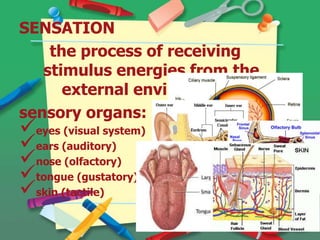
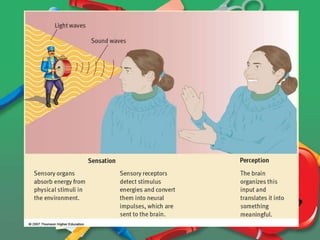
SENSATION
the process of receiving
stimulus energies from the
external environment.
sensory organs:

eyes (visual system)
ears (auditory)
nose (olfactory)
tongue (gustatory)
skin (tactile)
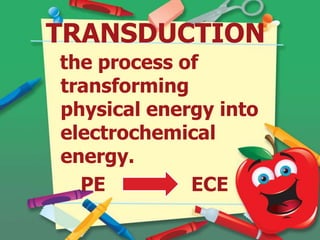
TRANSDUCTION
the process of
transforming
physical energy into
electrochemical
energy.
PE
ECE
PERCEPTION
the process of
organizing and
interpreting
sensory
information to
give it
meaning.

Prior experiences
Expectations
Memory
Biases
BOTTOM-UP PROCESSING

Processing that begins with sensory
receptors registering environmental
information and sending it to the brain
for cognitive processing and integration.
TOP-DOWN PROCESSING

Processing of perpetual information that
starts out with cognitive processing at the
higher levels of the brain.
JIGSAW
PUZZLE
Why is it important to study sensation
and perception?
The purpose of perception is:
1) to represent information from the outside
world internally;
2) adaptation that improves a species’ chances
for survival; and
3) to help in designing devices to restore
perception to those who have lost some (or
all) and also to devise treatments for other
perceptual problems.
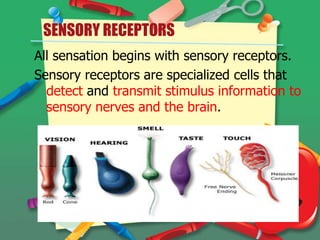
SENSORY RECEPTORS
All sensation begins with sensory receptors.
Sensory receptors are specialized cells that
detect and transmit stimulus information to
sensory nerves and the brain.
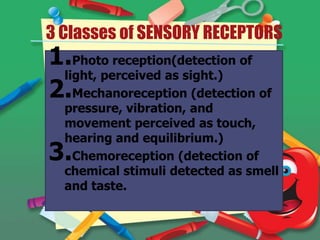
3 Classes of SENSORY RECEPTORS

1.Photo reception(detection of
light, perceived as sight.)
2.Mechanoreception (detection of

pressure, vibration, and
movement perceived as touch,
hearing and equilibrium.)
Chemoreception (detection of
chemical stimuli detected as smell
and taste.

3.
How close does an
approaching bumblebee have
to be before you can here its
buzzing?

Difference between a ā€˜Coke’
and a ā€˜Coke Zero’?
The percentage of fat in a ā€˜low
fat’ and a regular milk?
THRESHOLD
A level or point at
which something
starts or ceases to
happen or come in
to effect.
SENSORY THRESHOLDS
Absolute Threshold
Orange juice
One tablespoon?
Two tablespoon?
Three tablespoon!
-Watching TV while your roommate
is sleeping.
Volume?

-
SENSORY THRESHOLDS
Absolute threshold
-

Minimum amount of energy that a person
can detect.
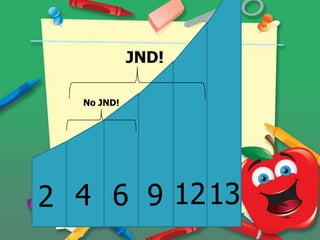
Difference threshold

-

just noticeable difference (jnd)
the degree of difference that must exist
between two stimuli before the difference
is detected.
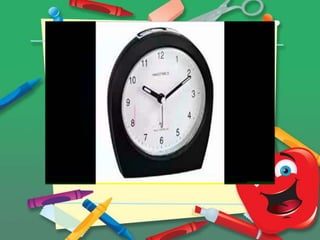
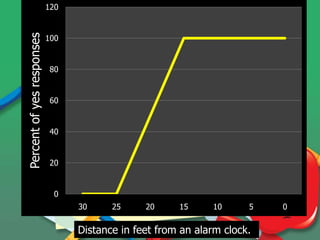
Percent of yes responses

120

100

80

60

40

20

0
30

25

20

15

10

5

Distance in feet from an alarm clock.

0
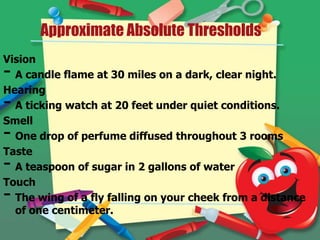
Approximate Absolute Thresholds
Vision
A candle flame at 30 miles on a dark, clear night.
Hearing
A ticking watch at 20 feet under quiet conditions.
Smell
One drop of perfume diffused throughout 3 rooms
Taste
A teaspoon of sugar in 2 gallons of water
Touch
The wing of a fly falling on your cheek from a distance
of one centimeter.

-
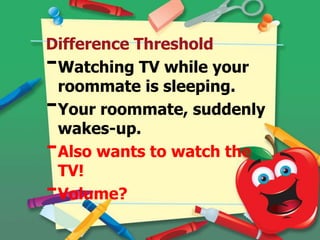
Difference Threshold
Watching TV while your
roommate is sleeping.
Your roommate, suddenly
wakes-up.
Also wants to watch the
TV!
Volume?

-
JND!
No JND!

2 4 6 9 1213
A student late for his class.
10: 03 – late?
10:05 – late?
10: 10 – late?
10:15 – late!!!
It takes 15 minutes for a student to
be detected as late.
Absolute or difference threshold?
*Depends on the individual who
perceives and the condition of the
environment.
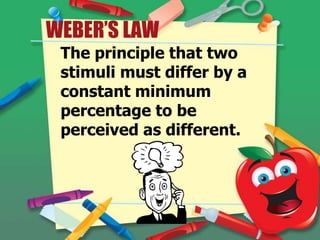
WEBER’S LAW
The principle that two
stimuli must differ by a
constant minimum
percentage to be
perceived as different.
Subliminal Perception

-the ability to detect

information below the
level of conscious
awareness.
SIGNAL DETECTION THEORY
The theory that focuses on
decision making about
stimuli in the presence of
uncertainty; detection
depends on a variety of
factors beside the physical
intensity of the stimulus and
the sensory abilities of the
observer.
PERCEIVING SENSORY STIMULI

A.Attention

Selective Attention—

focusing on a specific
aspect of experience while
ignoring others.
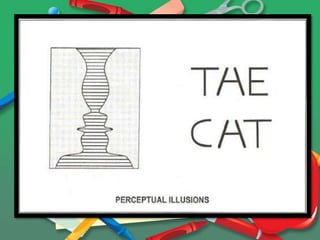
B. Perceptual Set
a predisposition, or
readiness, to perceive something
in a particular way.

Sensory Adaptation
A change in the
responsiveness of the sensory
system based on the average level
of surrounding stimulation.
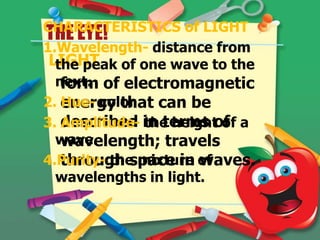
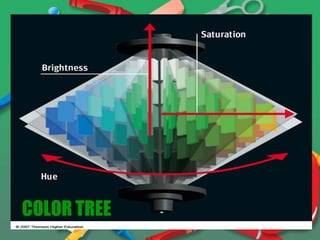
CHARACTERISTICS of LIGHT
THE EYE!
1.Wavelength- distance from
LIGHT of one wave to the
the peak
next. of electromagnetic
form
2. energy that can be
Hue- color
3. described in terms of a
Amplitude- the height of
wave.
wavelength; travels
4.Purity- the mixture of
through space in waves.
wavelengths in light.
COLOR TREE
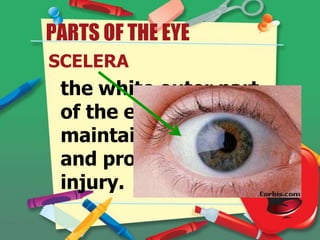
PARTS OF THE EYE
SCELERA

the white outer part
of the eye that helps
maintain the shape
and protects from
injury.
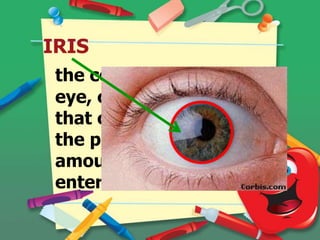
IRIS
the colored part of the
eye, contains muscle
that control the size of
the pupil, hence, the
amount of light that
enters.
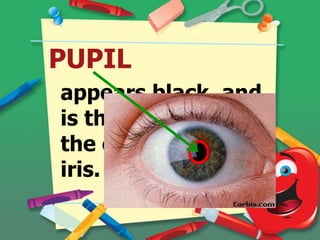
PUPIL
appears black, and
is the opening in
the center of the
iris.
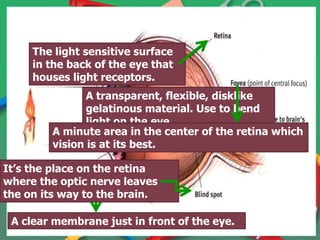
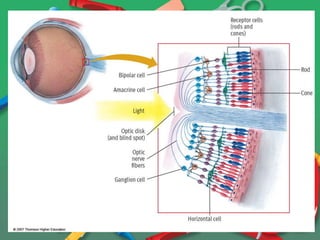
The light sensitive surface
in the back of the eye that
houses light receptors.
A transparent, flexible, disklike
gelatinous material. Use to bend
light on the eye.
A minute area in the center of the retina which
vision is at its best.
It’s the place on the retina
where the optic nerve leaves
the on its way to the brain.
A clear membrane just in front of the eye.
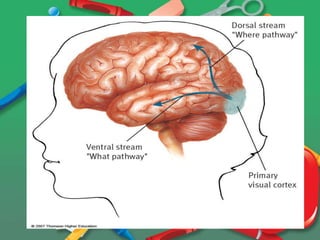
VISUAL CORTEX
located in the occipital lobe of
the brain. Visual information
processing involves feature
detection, parallel processing
and binding.
Feature Detectors
(David Hubel&Torsten Wiesel)
neurons of the brain’s visual
system that respond to particular
lines or other features of a
stimulus.

A.
PARALLEL PROCESSING

1.What Pathway

processes information about
what the object is, its color, form
and its texture; temporal lobe.
Where Pathway
processes information on an
object’s location, movement, depth
of the object; parietal lobe.

2.
BINDING
The bringing together
and integration of
what is processed by
different pathways
or cells.
TRICHROMATIC THEORY
(THOMAS YOUNG 1802)
(ex: HERMANN von HELMONTZ 1852)
Color perception is based
on the existence of three
of color receptors that are
maximally sensitive to
different, but overlapping
ranges wavelengths.
COLOR VISION

1.Trichromatic theory
Color perception is based on
the existence of three color
receptors that are maximally
sensitive to different, but
overlapping, ranges of
wavelengths.
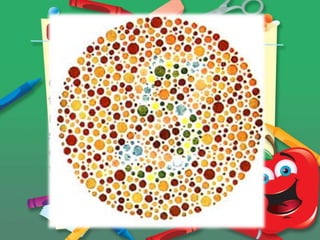
A.Dichromats
people with only two kinds of cones.
B.Trichromats

have three kinds of cone receptors and
normal vision.

C.Afterimages- sensations that remain after a
stimulus is removed.

OPPONENT-PROCESS Theory
Cells in the visual sys. respond to green and
blue-yellow colors; a given cell might be
excited be red and inhibited by
green, whereas another might be excited by
yellow and inhibited by blue.
Sensory adaptation
The sensory receptor cells become less
responsive to an unchanging stimulus.
The receptors are no longer sending signals to
the brain.

-

Habituation
- The sensory receptor cells are still responding to
the stimulus, but the lower centers of the brain
are not sending the signals from those
receptors in the cortex.
QUESTIONS?

SENSATION AND PERCEPTION Psychology

  • 2.
  • 3.
    SENSATION the process ofreceiving stimulus energies from the external environment. sensory organs: eyes (visual system) ears (auditory) nose (olfactory) tongue (gustatory) skin (tactile)
  • 4.
    TRANSDUCTION the process of transforming physicalenergy into electrochemical energy. PE ECE
  • 5.
    PERCEPTION the process of organizingand interpreting sensory information to give it meaning. Prior experiences Expectations Memory Biases
  • 7.
    BOTTOM-UP PROCESSING Processing thatbegins with sensory receptors registering environmental information and sending it to the brain for cognitive processing and integration. TOP-DOWN PROCESSING Processing of perpetual information that starts out with cognitive processing at the higher levels of the brain.
  • 8.
  • 9.
    Why is itimportant to study sensation and perception? The purpose of perception is: 1) to represent information from the outside world internally; 2) adaptation that improves a species’ chances for survival; and 3) to help in designing devices to restore perception to those who have lost some (or all) and also to devise treatments for other perceptual problems.
  • 10.
    SENSORY RECEPTORS All sensationbegins with sensory receptors. Sensory receptors are specialized cells that detect and transmit stimulus information to sensory nerves and the brain.
  • 11.
    3 Classes ofSENSORY RECEPTORS 1.Photo reception(detection of light, perceived as sight.) 2.Mechanoreception (detection of pressure, vibration, and movement perceived as touch, hearing and equilibrium.) Chemoreception (detection of chemical stimuli detected as smell and taste. 3.
  • 12.
    How close doesan approaching bumblebee have to be before you can here its buzzing? Difference between a ā€˜Coke’ and a ā€˜Coke Zero’? The percentage of fat in a ā€˜low fat’ and a regular milk?
  • 13.
    THRESHOLD A level orpoint at which something starts or ceases to happen or come in to effect.
  • 14.
    SENSORY THRESHOLDS Absolute Threshold Orangejuice One tablespoon? Two tablespoon? Three tablespoon! -Watching TV while your roommate is sleeping. Volume? -
  • 15.
    SENSORY THRESHOLDS Absolute threshold - Minimumamount of energy that a person can detect. Difference threshold - just noticeable difference (jnd) the degree of difference that must exist between two stimuli before the difference is detected.
  • 17.
    Percent of yesresponses 120 100 80 60 40 20 0 30 25 20 15 10 5 Distance in feet from an alarm clock. 0
  • 18.
    Approximate Absolute Thresholds Vision Acandle flame at 30 miles on a dark, clear night. Hearing A ticking watch at 20 feet under quiet conditions. Smell One drop of perfume diffused throughout 3 rooms Taste A teaspoon of sugar in 2 gallons of water Touch The wing of a fly falling on your cheek from a distance of one centimeter. -
  • 19.
    Difference Threshold Watching TVwhile your roommate is sleeping. Your roommate, suddenly wakes-up. Also wants to watch the TV! Volume? -
  • 20.
  • 21.
    A student latefor his class. 10: 03 – late? 10:05 – late? 10: 10 – late? 10:15 – late!!! It takes 15 minutes for a student to be detected as late. Absolute or difference threshold? *Depends on the individual who perceives and the condition of the environment.
  • 22.
    WEBER’S LAW The principlethat two stimuli must differ by a constant minimum percentage to be perceived as different.
  • 23.
    Subliminal Perception -the abilityto detect information below the level of conscious awareness.
  • 24.
    SIGNAL DETECTION THEORY Thetheory that focuses on decision making about stimuli in the presence of uncertainty; detection depends on a variety of factors beside the physical intensity of the stimulus and the sensory abilities of the observer.
  • 26.
    PERCEIVING SENSORY STIMULI A.Attention SelectiveAttention— focusing on a specific aspect of experience while ignoring others.
  • 28.
    B. Perceptual Set apredisposition, or readiness, to perceive something in a particular way. Sensory Adaptation A change in the responsiveness of the sensory system based on the average level of surrounding stimulation.
  • 30.
    CHARACTERISTICS of LIGHT THEEYE! 1.Wavelength- distance from LIGHT of one wave to the the peak next. of electromagnetic form 2. energy that can be Hue- color 3. described in terms of a Amplitude- the height of wave. wavelength; travels 4.Purity- the mixture of through space in waves. wavelengths in light.
  • 31.
  • 32.
    PARTS OF THEEYE SCELERA the white outer part of the eye that helps maintain the shape and protects from injury.
  • 33.
    IRIS the colored partof the eye, contains muscle that control the size of the pupil, hence, the amount of light that enters.
  • 34.
    PUPIL appears black, and isthe opening in the center of the iris.
  • 35.
    The light sensitivesurface in the back of the eye that houses light receptors. A transparent, flexible, disklike gelatinous material. Use to bend light on the eye. A minute area in the center of the retina which vision is at its best. It’s the place on the retina where the optic nerve leaves the on its way to the brain. A clear membrane just in front of the eye.
  • 37.
    VISUAL CORTEX located inthe occipital lobe of the brain. Visual information processing involves feature detection, parallel processing and binding. Feature Detectors (David Hubel&Torsten Wiesel) neurons of the brain’s visual system that respond to particular lines or other features of a stimulus. A.
  • 38.
    PARALLEL PROCESSING 1.What Pathway processesinformation about what the object is, its color, form and its texture; temporal lobe. Where Pathway processes information on an object’s location, movement, depth of the object; parietal lobe. 2.
  • 40.
    BINDING The bringing together andintegration of what is processed by different pathways or cells.
  • 41.
    TRICHROMATIC THEORY (THOMAS YOUNG1802) (ex: HERMANN von HELMONTZ 1852) Color perception is based on the existence of three of color receptors that are maximally sensitive to different, but overlapping ranges wavelengths.
  • 42.
    COLOR VISION 1.Trichromatic theory Colorperception is based on the existence of three color receptors that are maximally sensitive to different, but overlapping, ranges of wavelengths.
  • 43.
    A.Dichromats people with onlytwo kinds of cones. B.Trichromats have three kinds of cone receptors and normal vision. C.Afterimages- sensations that remain after a stimulus is removed. OPPONENT-PROCESS Theory Cells in the visual sys. respond to green and blue-yellow colors; a given cell might be excited be red and inhibited by green, whereas another might be excited by yellow and inhibited by blue.
  • 44.
    Sensory adaptation The sensoryreceptor cells become less responsive to an unchanging stimulus. The receptors are no longer sending signals to the brain. - Habituation - The sensory receptor cells are still responding to the stimulus, but the lower centers of the brain are not sending the signals from those receptors in the cortex.
  • 45.