


Disorders of Perception
Presenter: Dr. Subodh Kumar Sharma
Resident, MD Psychiatry
Moderator: Dr. Shuva Shrestha, MD
Department of Psychiatry
NMCTH, Birgunj, Nepal
Contents
Perception
Imagery
Synesthesia
Abnormal Perceptions
Sensory Distortions
Sensory Deceptions
Illusion
Hallucination
Pseudo hallucination
Perception
 The transformation of raw sensory stimuli into sensory information that is then
decoded into meaningful perception at the cortical level involves active processes
that are influenced by attention, affect, cultural expectations, context, prior
experiences, memory and, most importantly, prior concepts.
 ‘we are not given the world: we make our world through incessant experience,
categorization, memory, reconnection’ (Sachs 1995)
 It is therefore perception is not a passive process but an active one that involves the
construction of an external world that depends on internal templates.
(SIMS’ Symptoms in Mind 5th edition)
Characteristics of Perception
 Are of concrete reality
 Occur in external objective space
 Clearly delineated
 Sensory elements are full and fresh
 Constant and remain unaltered
 Independent of our will
(Jaspers, 1962)
IMAGERY
visually descriptive or figurative language,
Imagery
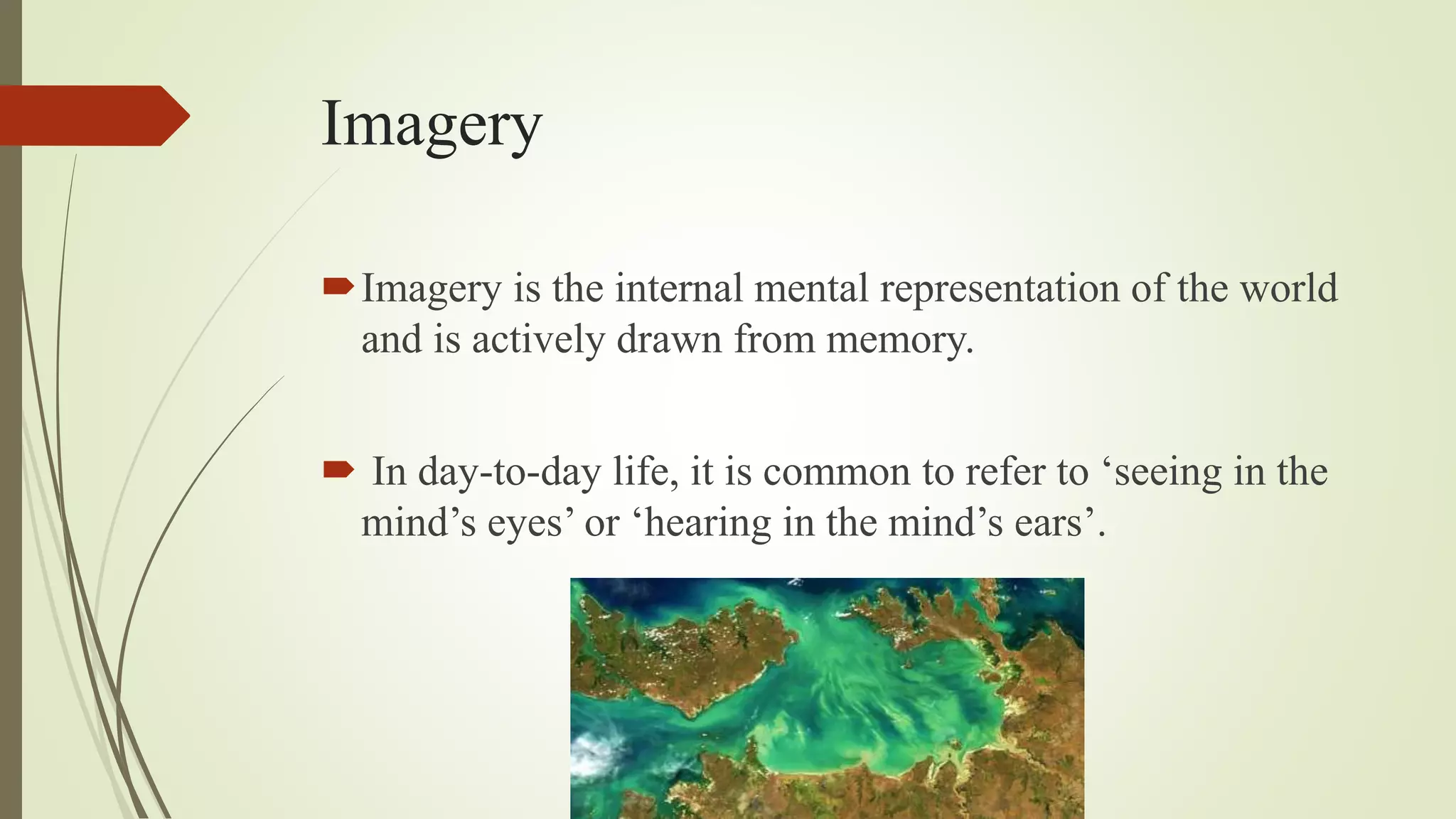
Imagery is the internal mental representation of the world
and is actively drawn from memory.
 In day-to-day life, it is common to refer to ‘seeing in the
mind’s eyes’ or ‘hearing in the mind’s ears’.
Characteristics Of Imagery
Images are figurative and have a character of subjectivity
They appear in inner subjective space
They are not clearly delineated and come before us incomplete
Although sensory elements are individually the equal of those
in perception, mostly they are insufficient
Images dissipate and always have to be recreated
Images are actively created and are dependent on our will.
Jaspers (1962), SIMS’ 5th Edition
Applied aspect of Imagery
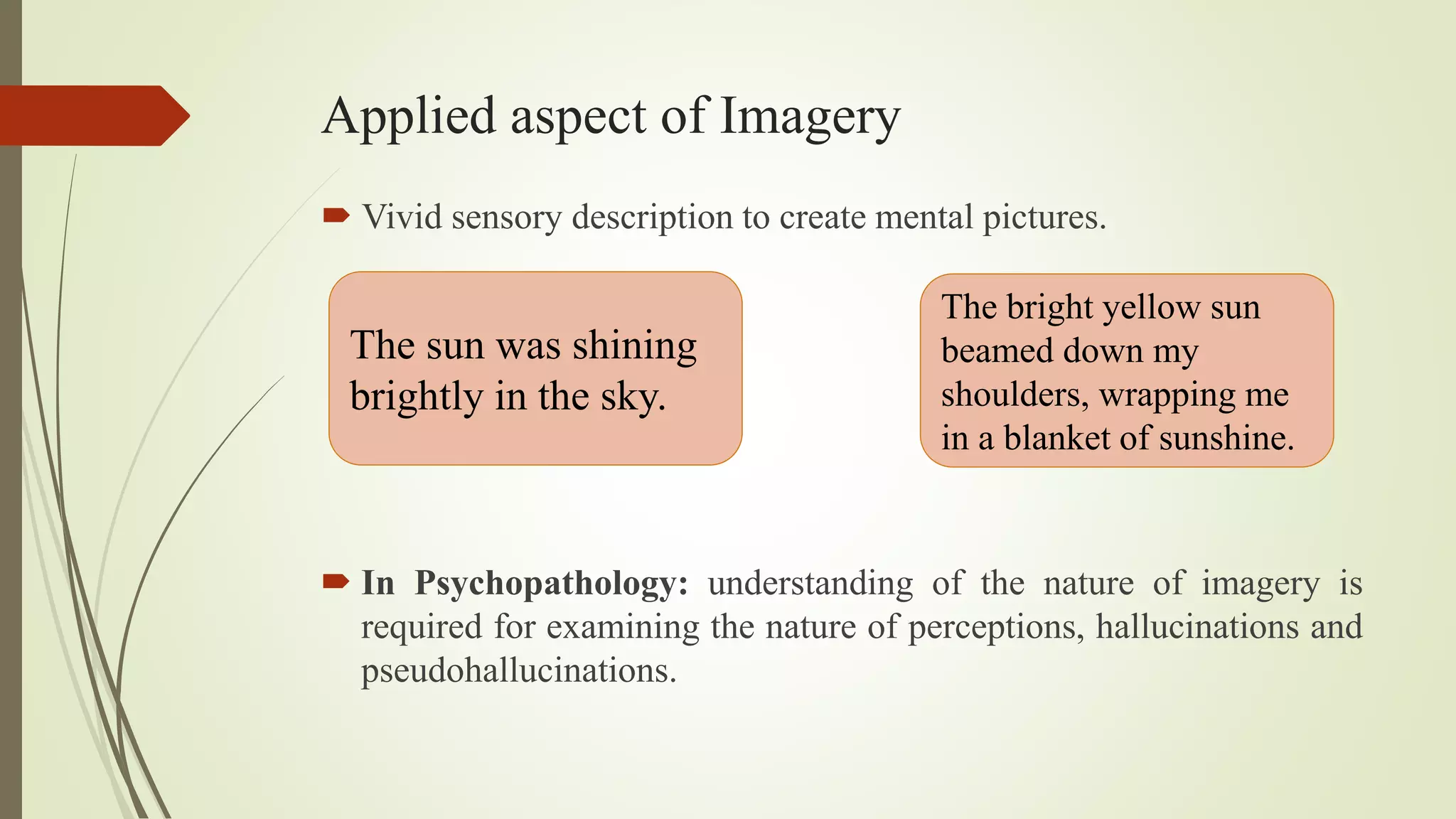
 Vivid sensory description to create mental pictures.
The sun was shining
brightly in the sky.
The bright yellow sun
beamed down my
shoulders, wrapping me
in a blanket of sunshine.
 In Psychopathology: understanding of the nature of imagery is
required for examining the nature of perceptions, hallucinations and
pseudohallucinations.
Synesthesia
 Perception of an object, presented in one sensory modality at the
same time as in different sensory modality.
“I don’t know what the color green looks like. But I know what green tastes
like!” –Taria Camerino
One of the things I love about my husband are the colors of his voice and his
laugh. It’s a wonderful golden brown, like crisp, buttery toast, which sounds
very odd, I know, but it is very real. (Cytowic and Eagleman, 2009)
Synesthesia continued..
Various forms:
grapheme to color; time unit to color; musical sounds to color;
general sounds to color; and, phoneme to color.
sounds to taste, sound to touch;
vision to taste
 spatially extended, but different from seeing or imagining
 Experience close to the body and within ‘peri-personal space’
 Consistent over time
 Elementary and specific in nature
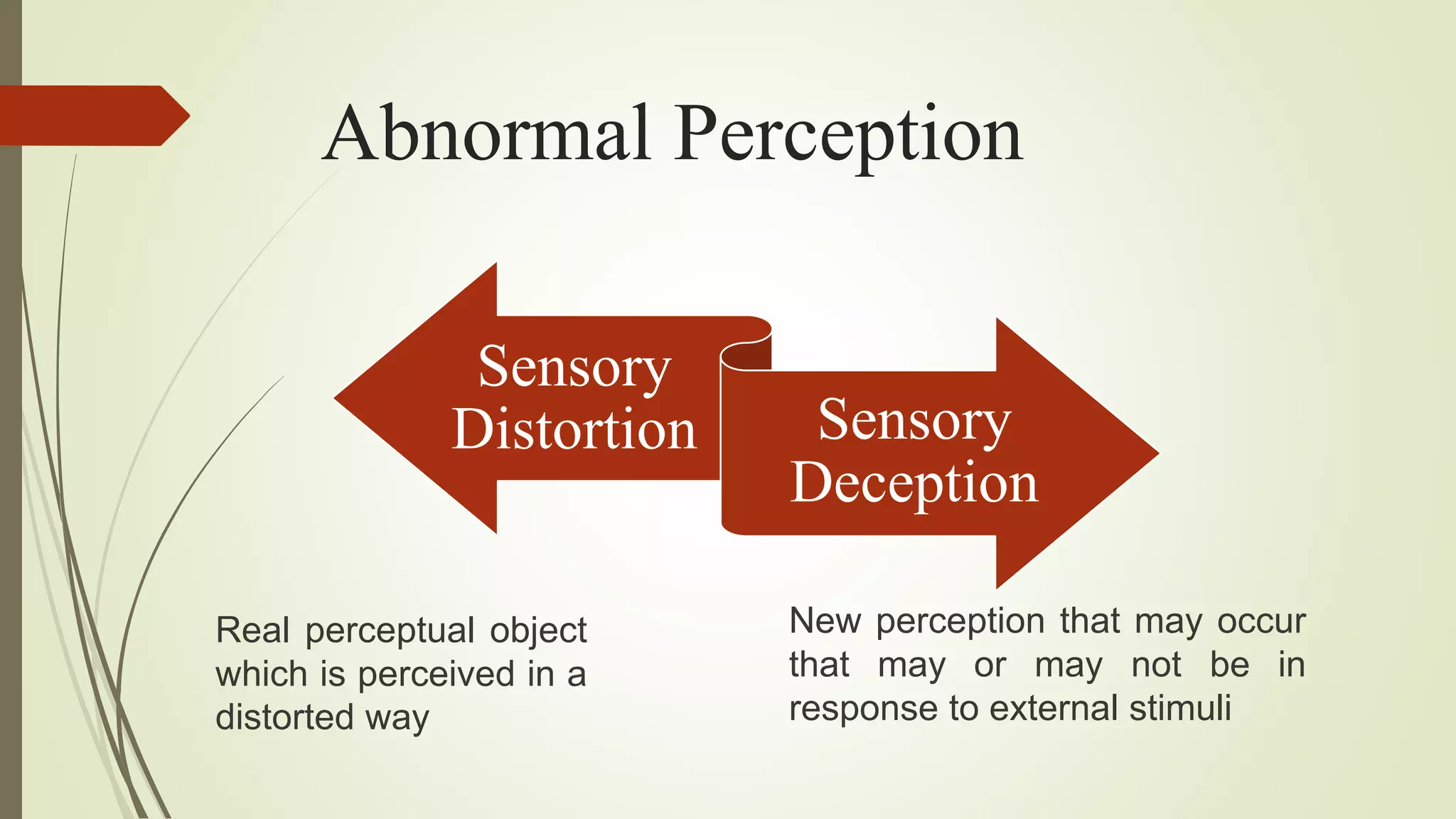
Abnormal Perception
Sensory
Distortion Sensory
Deception
Real perceptual object
which is perceived in a
distorted way
New perception that may occur
that may or may not be in
response to external stimuli
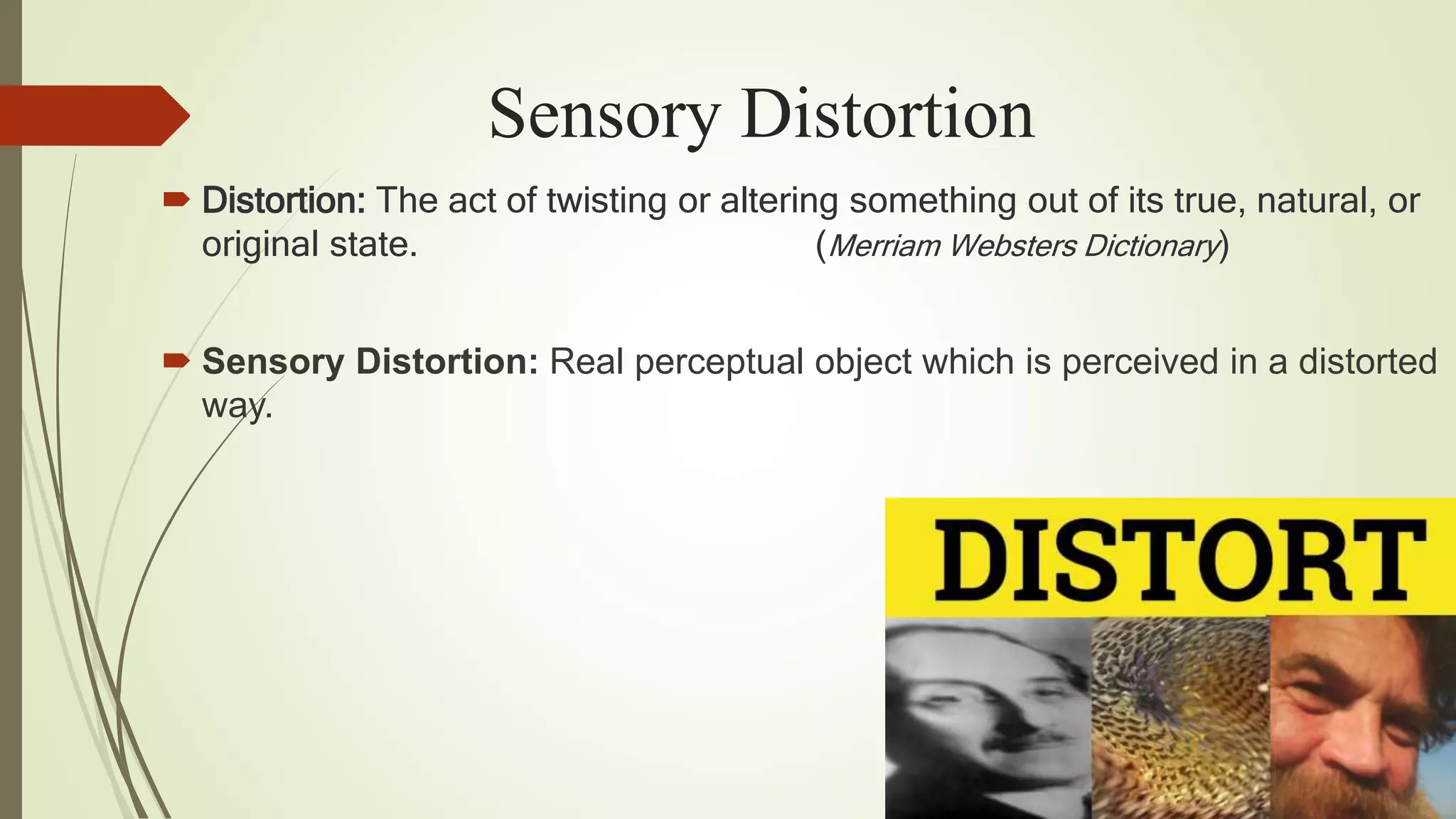
Sensory Distortion
 Distortion: The act of twisting or altering something out of its true, natural, or
original state. (Merriam Websters Dictionary)
 Sensory Distortion: Real perceptual object which is perceived in a distorted
way.
Sensory Distortion
Intensity
Quality
Spatial form
Distortion in Intensity
 Hyperesthesia
 Hyperacusis
 Causes:
 Lowering of physiological
threshold.
 Intense emotions
 Experienced in:
anxiety
depressive disorder,
Hangover from alcohol
Migraine
hypochondriacal
personalities
 Hypoesthesia
Hypoacusis
 Causes:
 Increase of physiological
threshold.
 Decreased attention
 Experienced in
Delirium
 Depression
 Attention deficit disorder
Quality Distortion
 Drug toxicity
 Digitalis, Santonin: Xanthopsia
 Mesacline: Chloropsia
 Viagra: Erythropsia
 Lithium: Metallic taste
 Derealization
 Everything looks unreal and strange
 Mania
 Objects looks perfect and beautiful
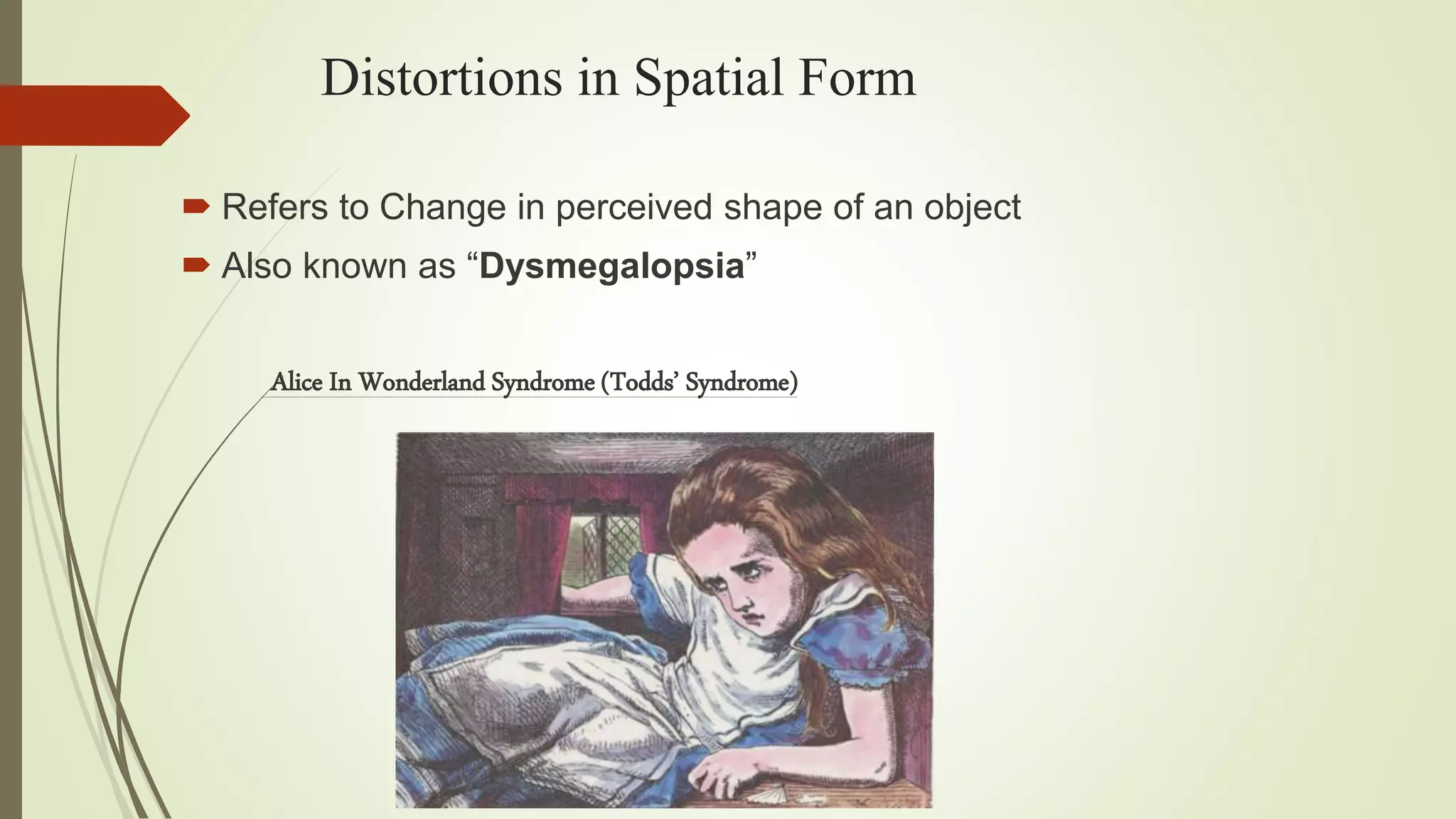
Distortions in Spatial Form
 Refers to Change in perceived shape of an object
 Also known as “Dysmegalopsia”
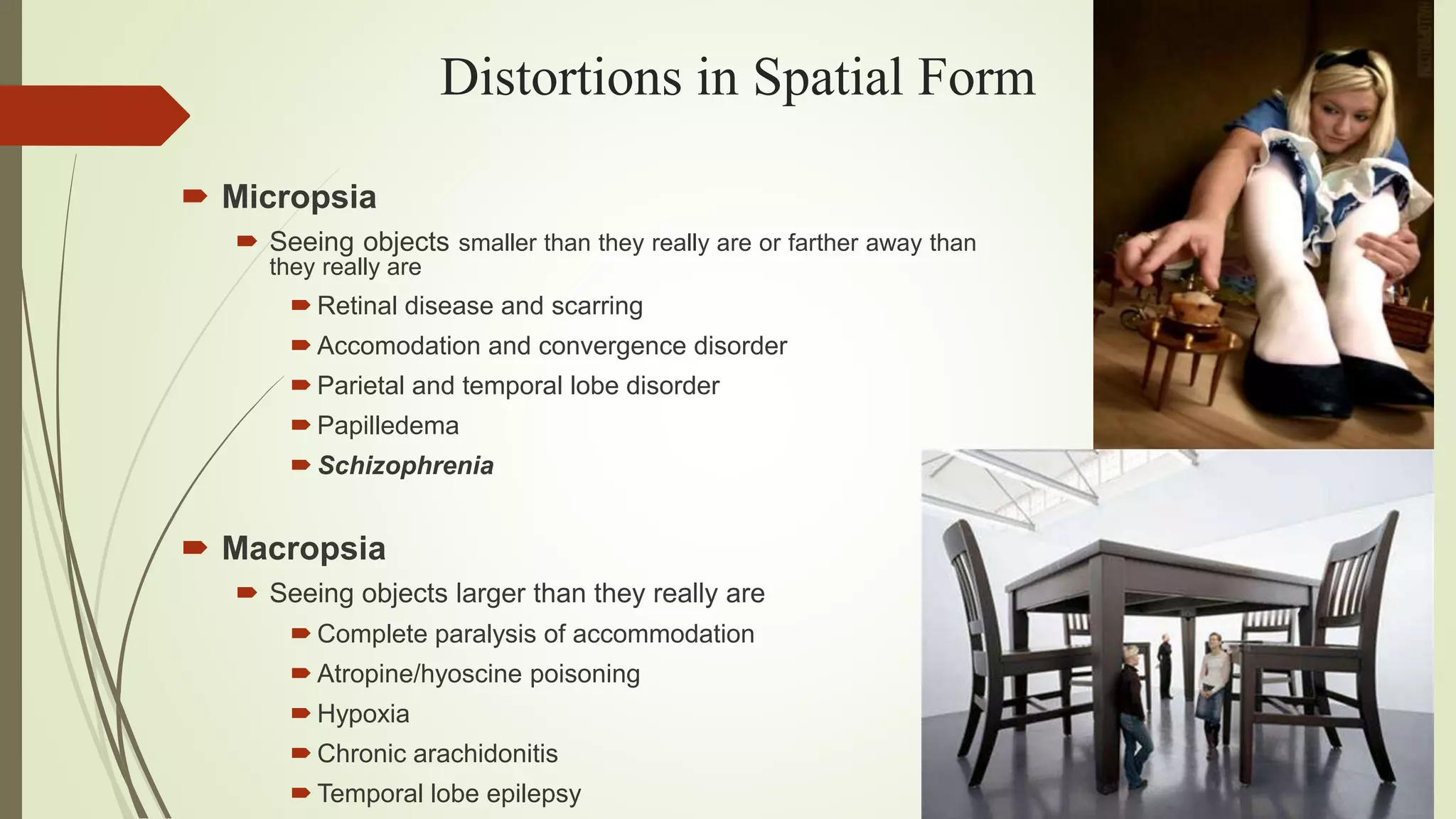
Alice In Wonderland Syndrome (Todds’ Syndrome)
Distortions in Spatial Form
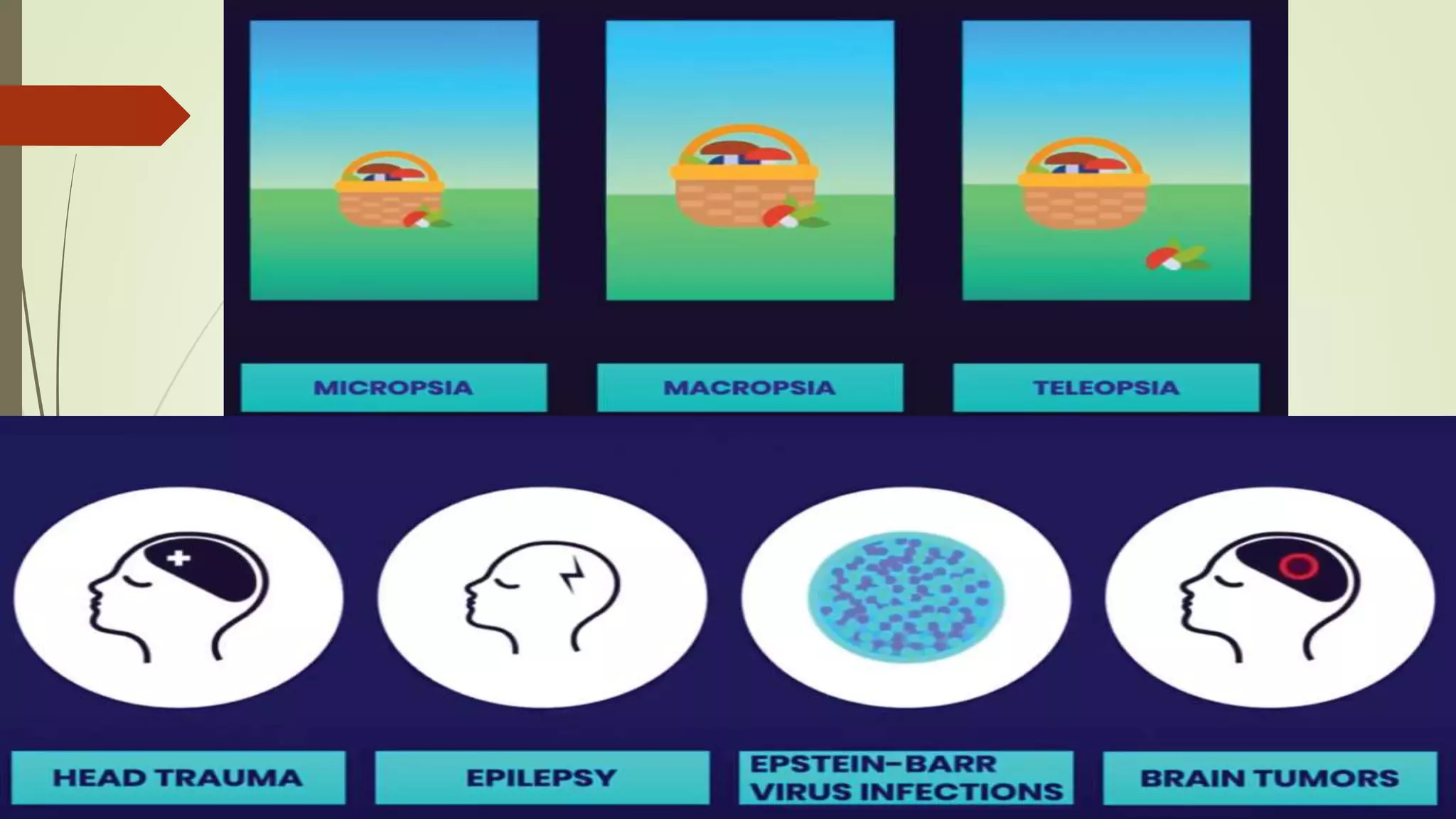
 Micropsia
 Seeing objects smaller than they really are or farther away than
they really are
 Retinal disease and scarring
 Accomodation and convergence disorder
 Parietal and temporal lobe disorder
 Papilledema
 Schizophrenia
 Macropsia
 Seeing objects larger than they really are
 Complete paralysis of accommodation
 Atropine/hyoscine poisoning
 Hypoxia
 Chronic arachidonitis
 Temporal lobe epilepsy
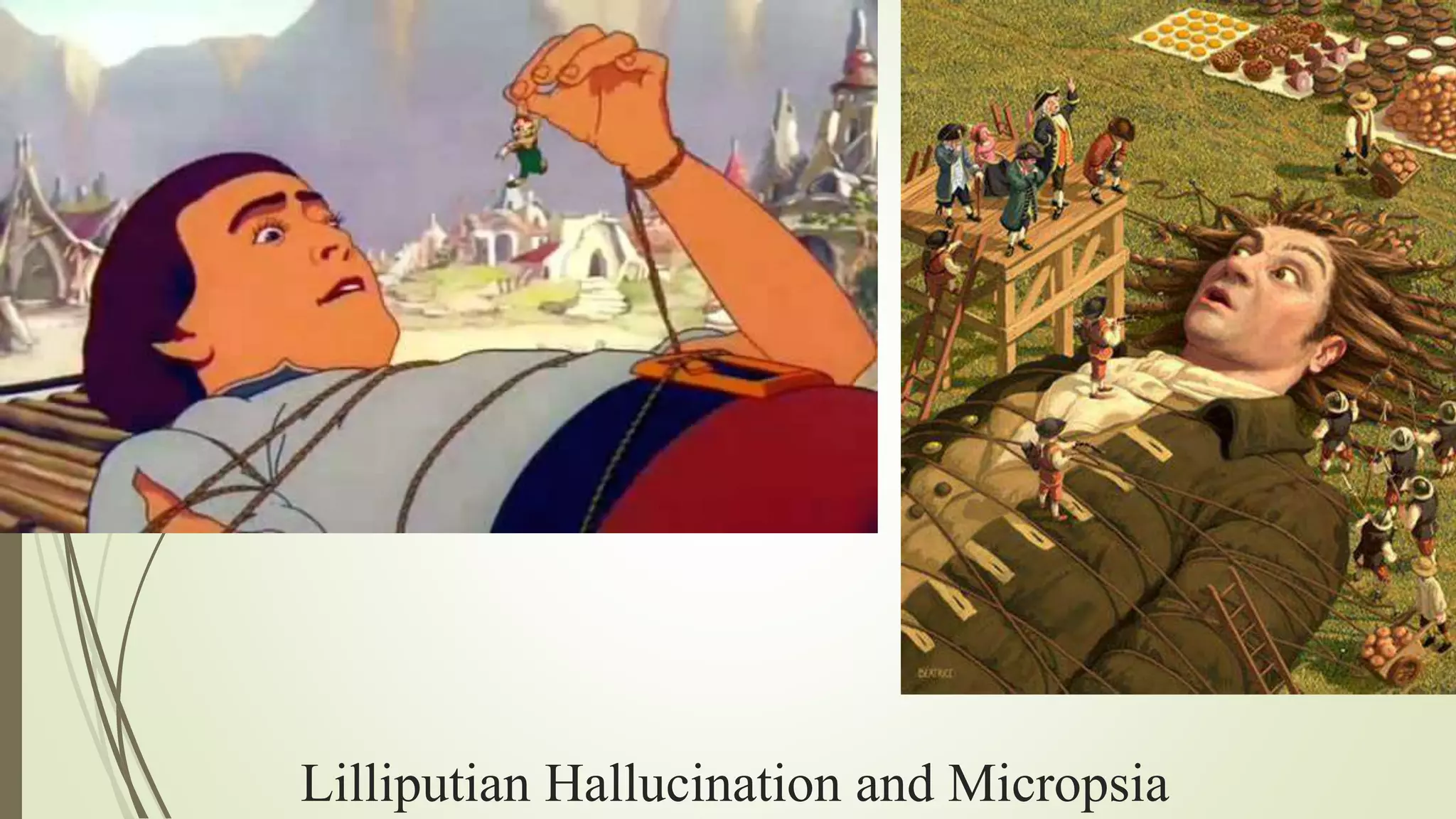
Lilliputian Hallucination and Micropsia
Distortions in Spatial Form
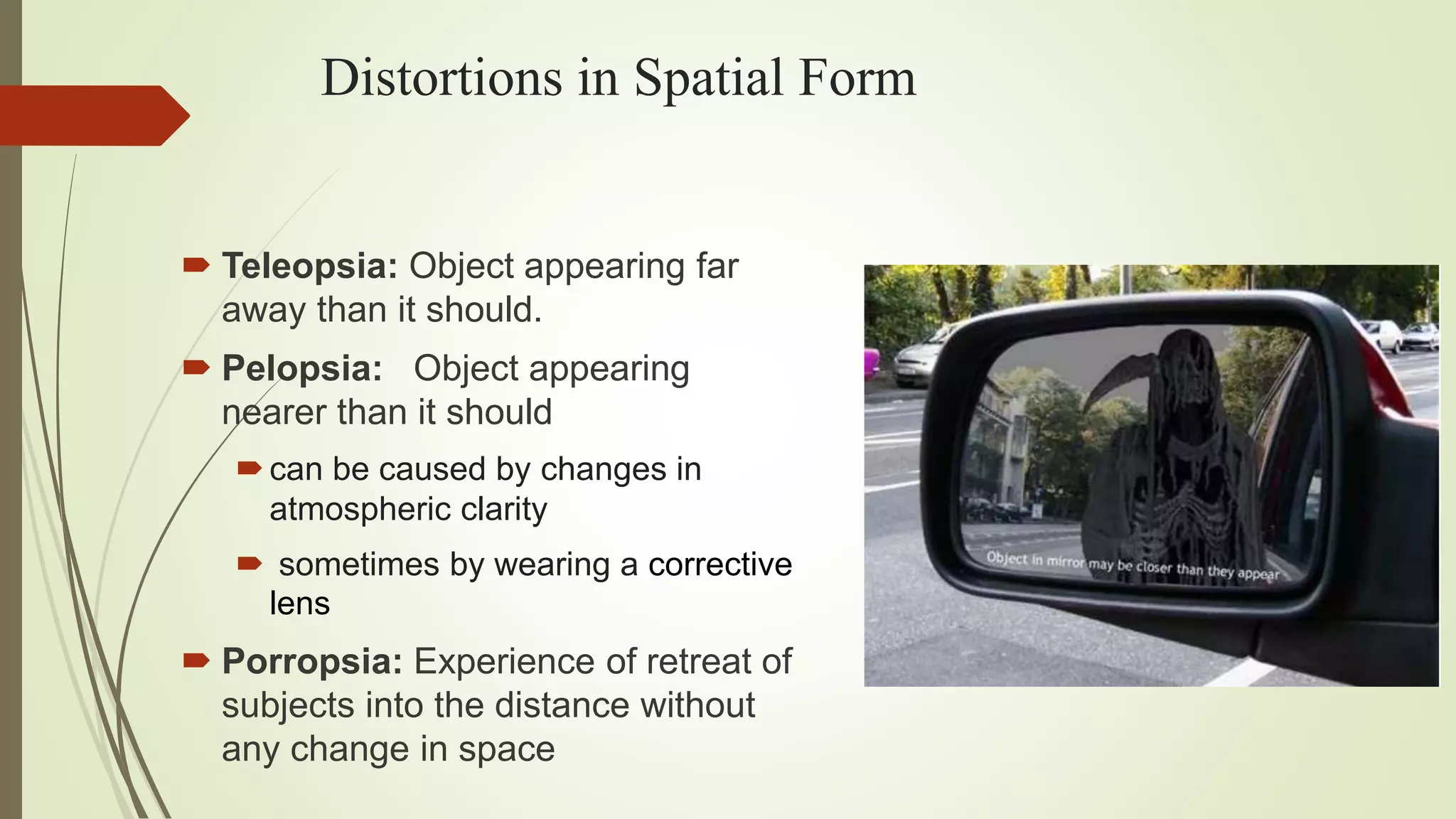
 Teleopsia: Object appearing far
away than it should.
 Pelopsia: Object appearing
nearer than it should
can be caused by changes in
atmospheric clarity
 sometimes by wearing a corrective
lens
 Porropsia: Experience of retreat of
subjects into the distance without
any change in space
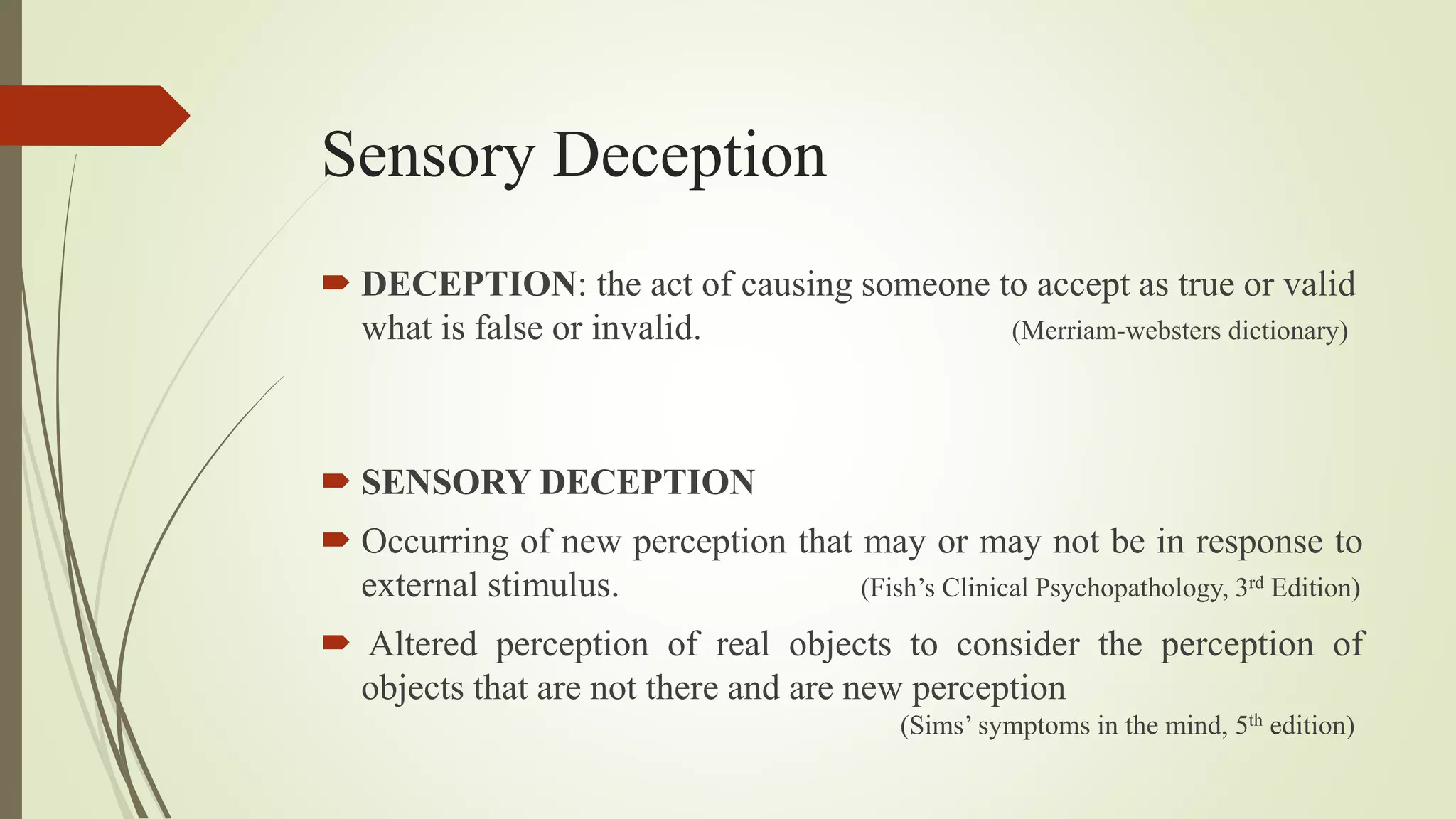
Sensory Deception
 DECEPTION: the act of causing someone to accept as true or valid
what is false or invalid. (Merriam-websters dictionary)
 SENSORY DECEPTION
 Occurring of new perception that may or may not be in response to
external stimulus. (Fish’s Clinical Psychopathology, 3rd Edition)
 Altered perception of real objects to consider the perception of
objects that are not there and are new perception
(Sims’ symptoms in the mind, 5th edition)
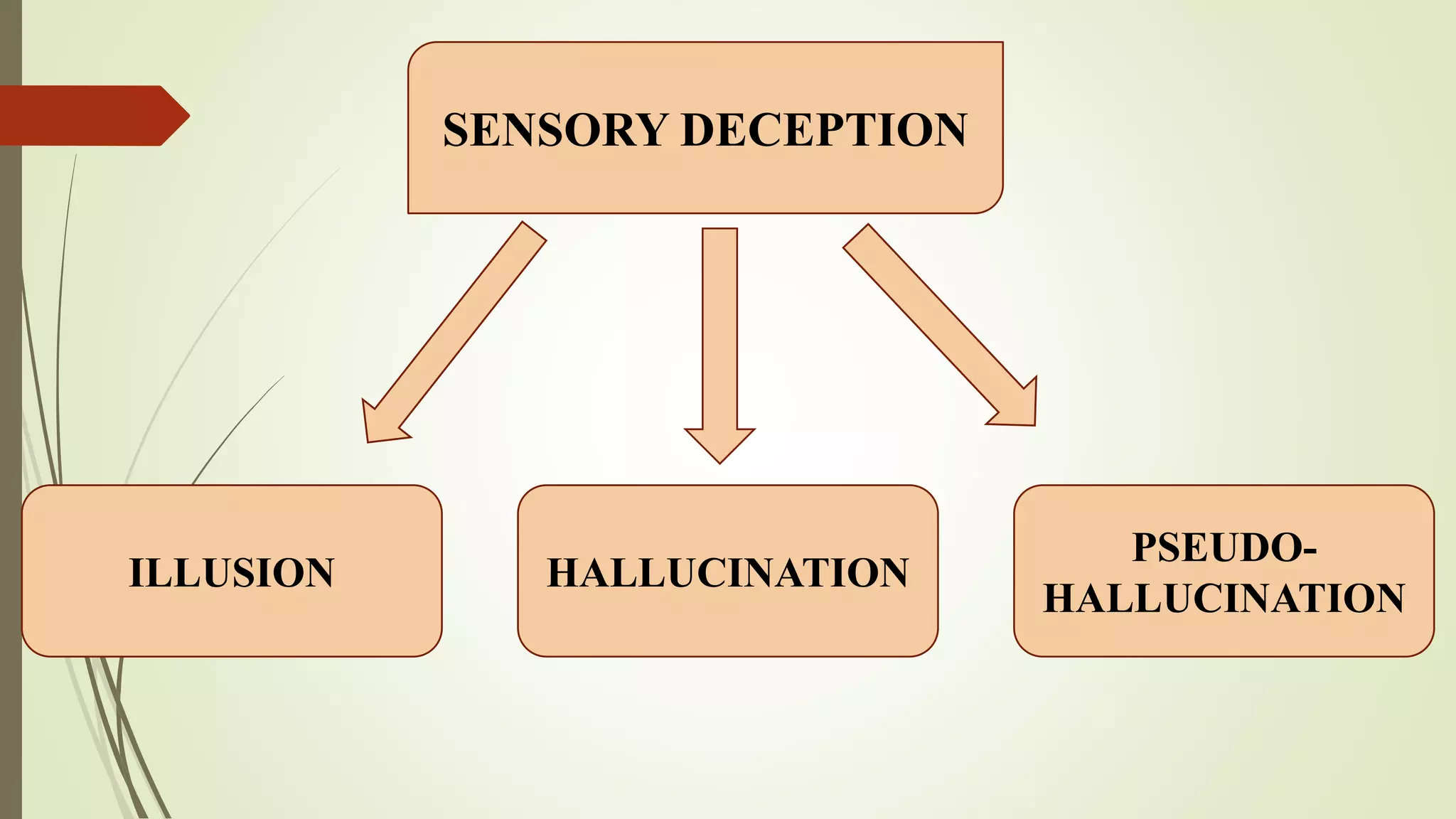
SENSORY DECEPTION
ILLUSION
PSEUDO-
HALLUCINATION
HALLUCINATION
Illusion
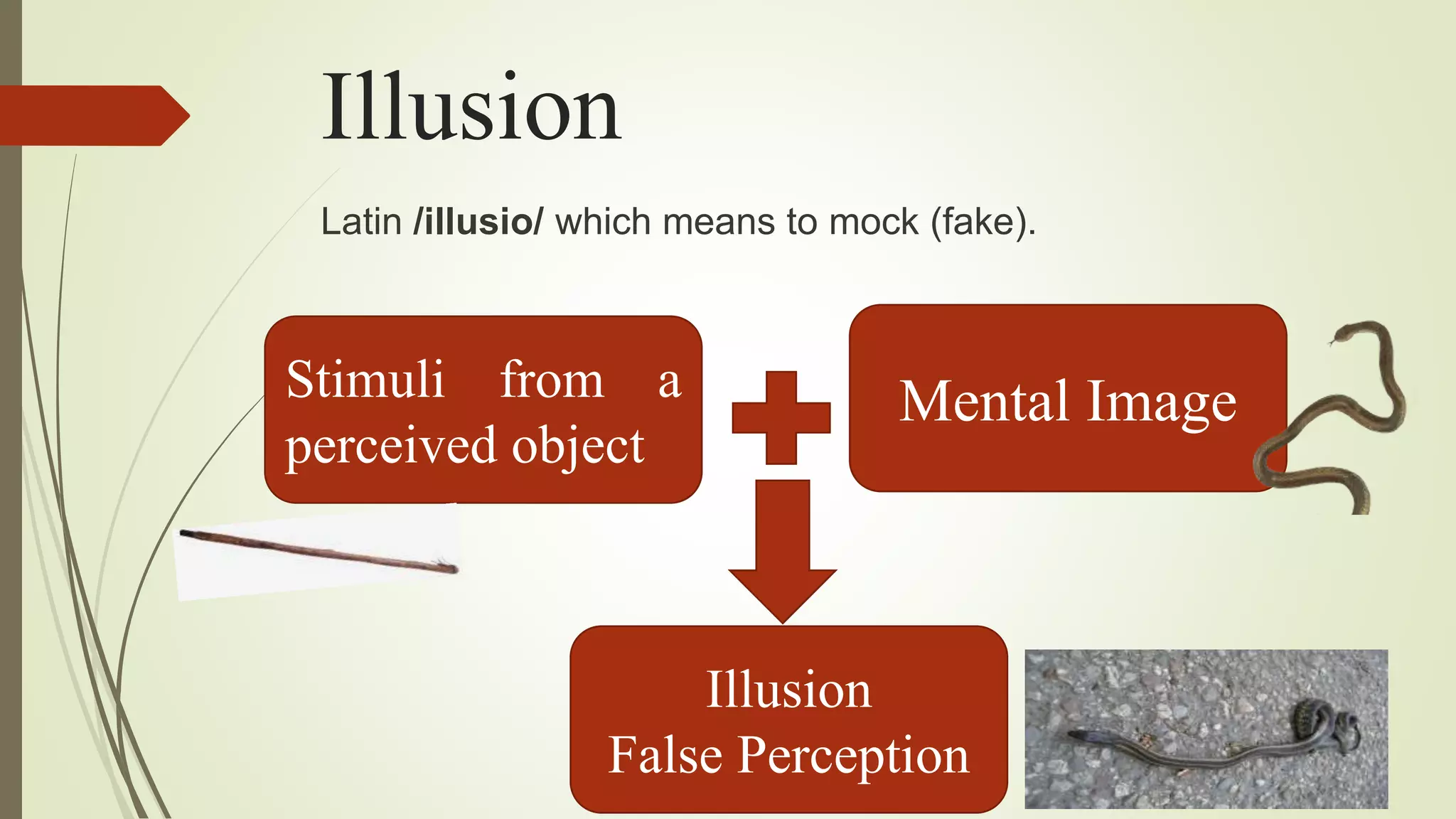
Latin /illusio/ which means to mock (fake).
Stimuli from a
perceived object
Mental Image
Illusion
False Perception
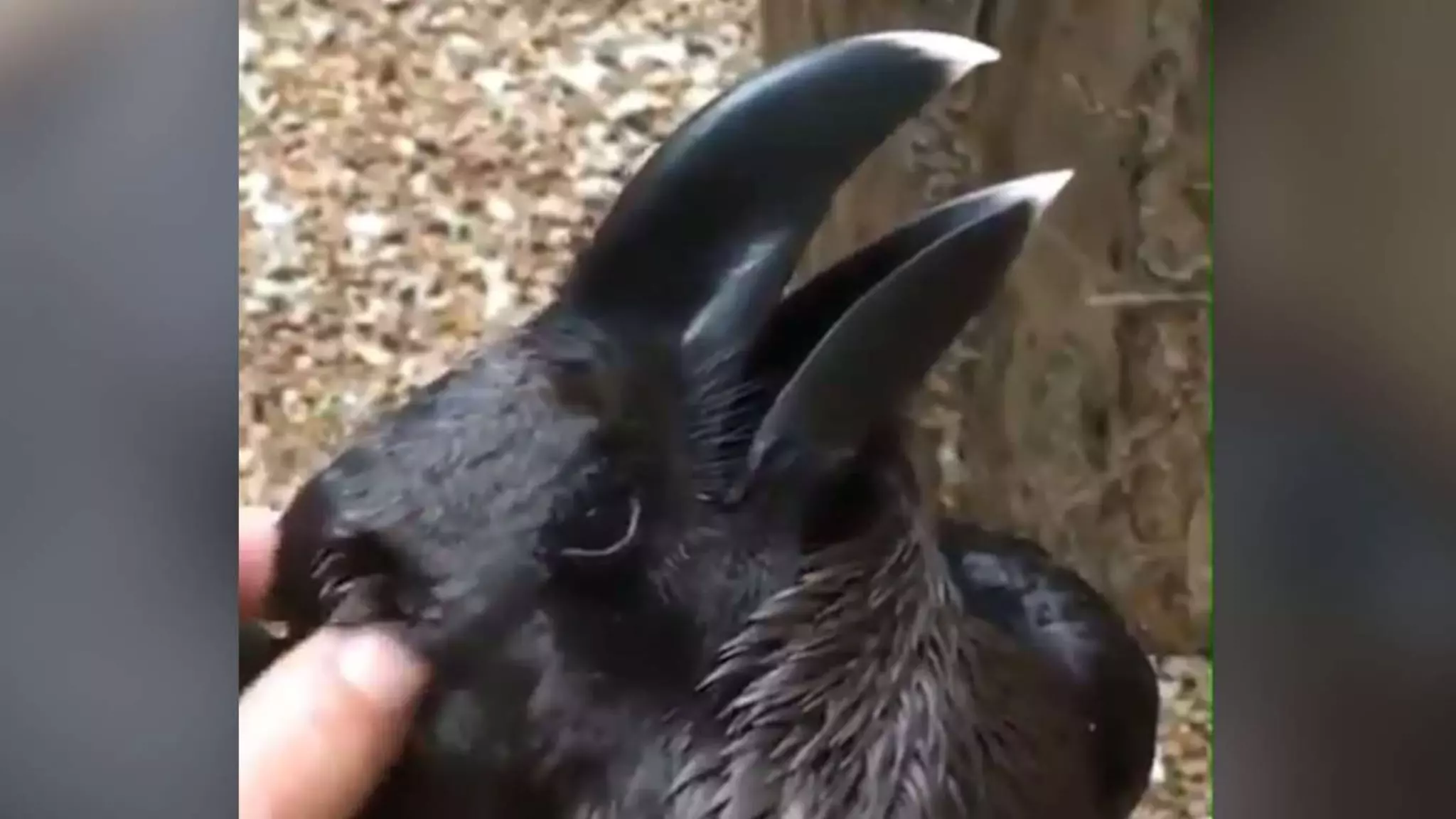
Bunny or Bird??
Illusion
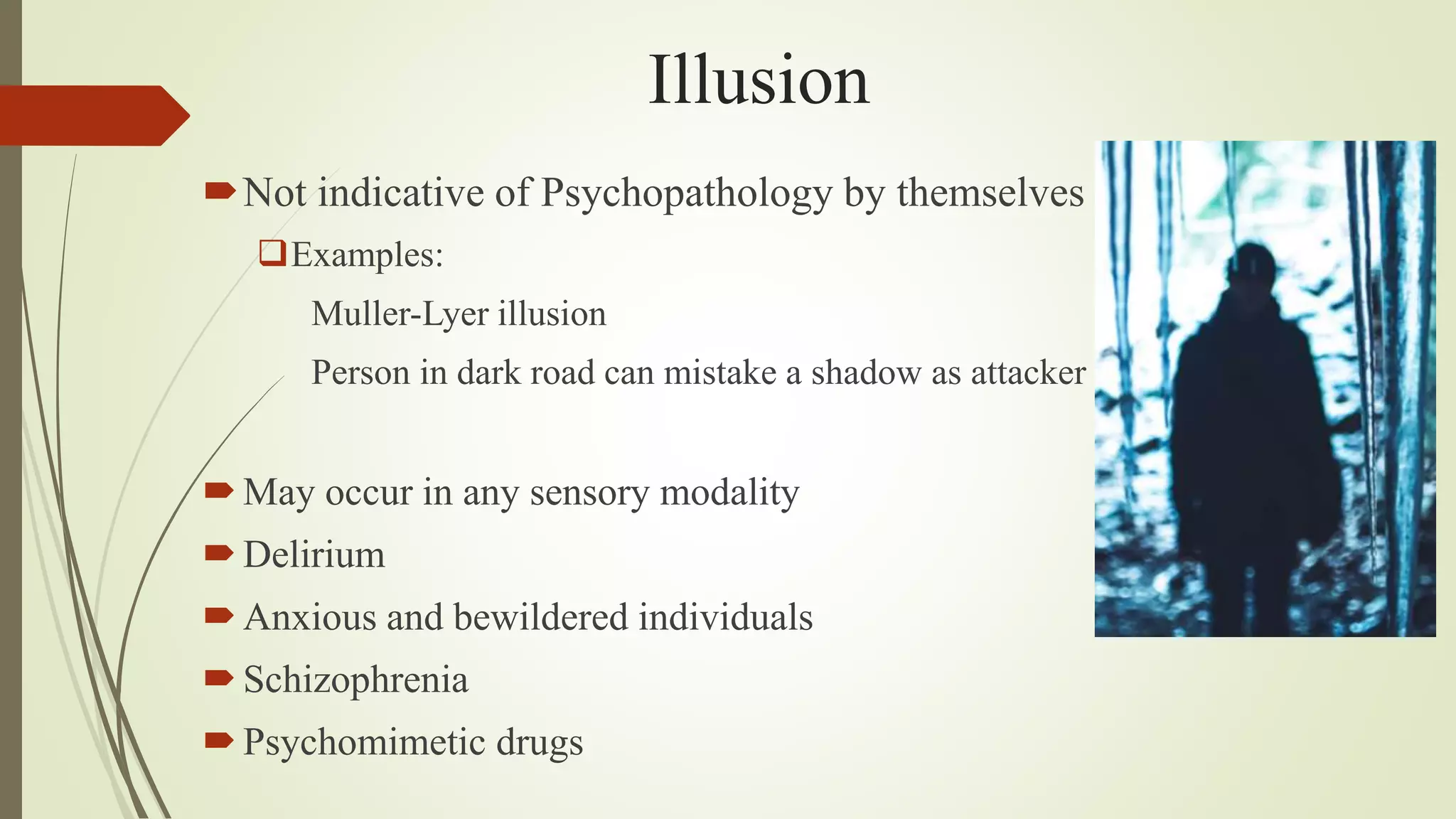
Not indicative of Psychopathology by themselves
Examples:
Muller-Lyer illusion
Person in dark road can mistake a shadow as attacker
May occur in any sensory modality
Delirium
Anxious and bewildered individuals
Schizophrenia
Psychomimetic drugs
Illusion
Completion Illusion Pareidolia
Affect Illusion
Result of inattention, misreading Result of Mood state D/t excessive fantasy thinking
and vivid visual imagery
Fantastic Illusion
 Fantastic illusions in which patients saw
extraordinary modifications to their
environment
 Most of the time attributed to exaggeration
and confabulation.
 More common in world of fiction than
psychiatric realm. (Hamilton 1974)
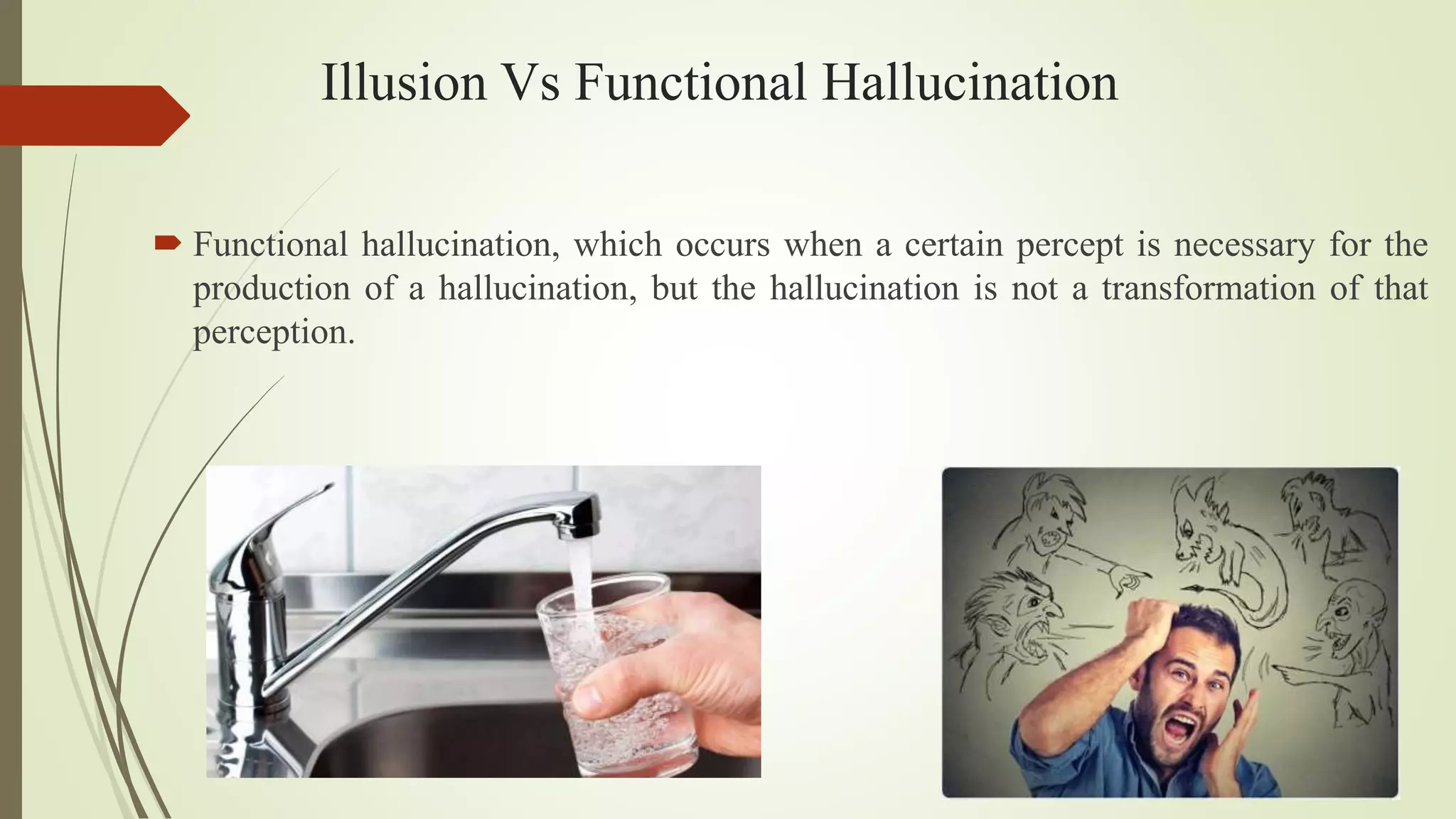
Illusion Vs Functional Hallucination
 Functional hallucination, which occurs when a certain percept is necessary for the
production of a hallucination, but the hallucination is not a transformation of that
perception.
Illusion VS Perceptual Misinterpretation
 Making a mistake as to the nature of perception without that perception being
particularly influenced by emotion mixed with fantasy.
 Rather it can be affected by previous information.
Hallucination
 Latin word /allucinari/
Meaning wander in mind and intent to mislead
 In English: Sir Thomas Browne (1646)
 In psychiatry: Esquirol (1817)
A perception without object
Hallucination
 Definition: Hallucinations proper are false perceptions that are not in any way
distortions of real perceptions but spring up on their own as something quite new and
occur simultaneously with and alongside real perception
(Jaspers 1962)
Definitions
 Horowitz (1975) Hallucinations are mental images that
 occur in the form of images,
 are derived from internal sources of information,
 are appraised incorrectly as if from external sources of information,
 usually occur intrusively.
 False sensory perceptions occurring in the absence of any relevant external
stimulation of the sensory modality involved.
(Kaplan & Saddock's Synopsis Of Psychiatry)
Causes of Hallucinations
Intense emotions
Suggestion
Disorders of sense organs
Sensory deprivation
Disorders of CNS
Psychiatric disorders
Pseudohallucination
 Pseudohallucination is a perceptual experience which is figurative , not
concretely real, and occurs in inner subjective space, not in external
objective space. (SIMS Symptoms In The Mind3rd Edition)
 Subjective perceptions similar to hallucinations, with respect to its
character and vividness, but that differ from those because these do not
have objective reality.
-Victor Kandinsky
 Corelates to Imagery as hallucination relates to Perception.
Qualities of Pseudohallucination
 Full consciousness
 Inner subjective space
 Definite outlines
 Constancy retained, insight preserved
 Relevant to emotions, needs and actions
 Depends on the observer for existence
By Jasper 1962
Pseudohallucination and Psychiatry
 Its presence merely doesn’t determine presence of any psychopathology.
 But, can be experienced in:
Obsessional
Depressive
Histrionic
Delirious
Psychomimmetic Drug Users
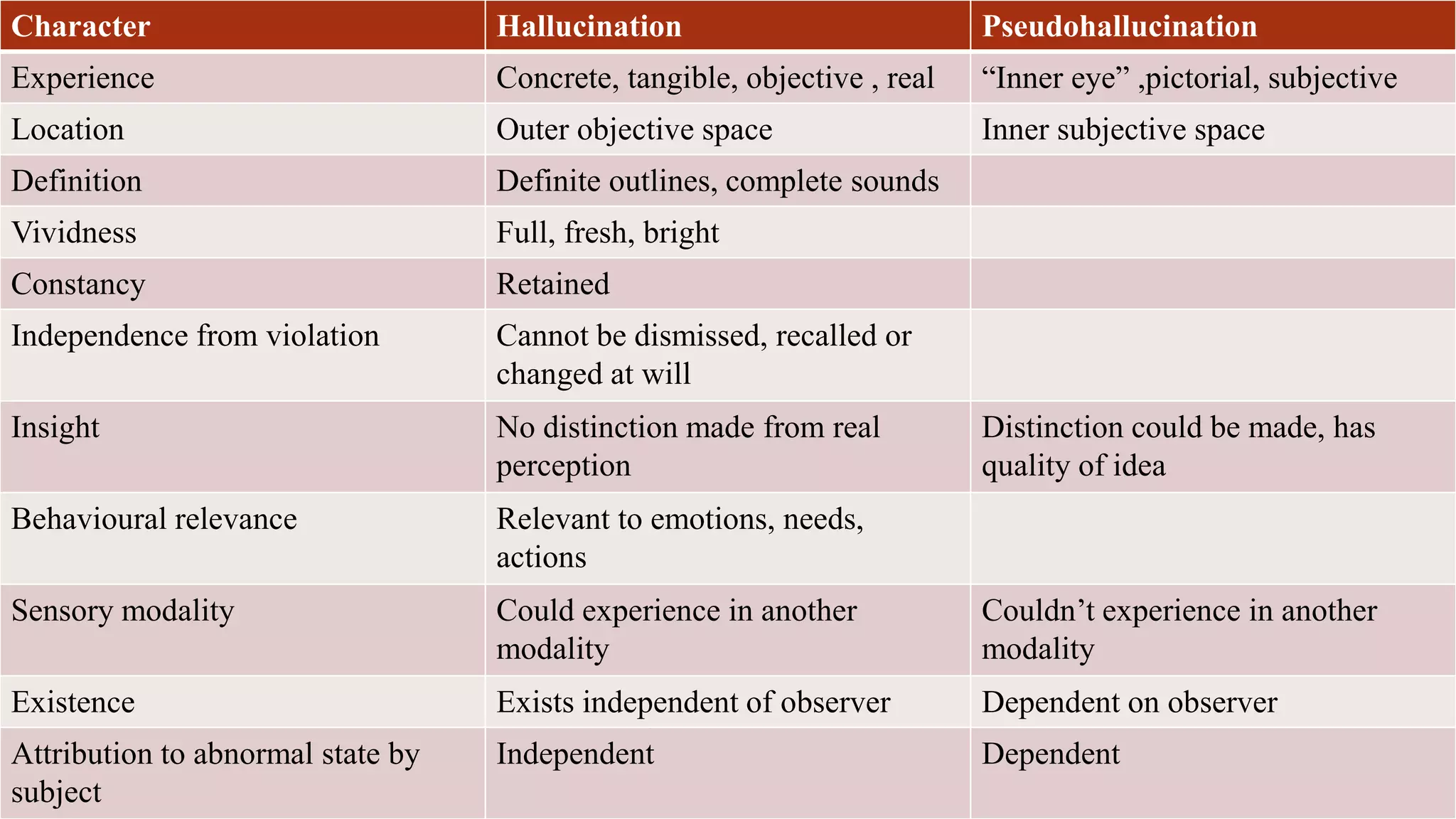
Hallucination and Pseudohallucination
Character Hallucination Pseudohallucination
Experience Concrete, tangible, objective , real “Inner eye” ,pictorial, subjective
Location Outer objective space Inner subjective space
Definition Definite outlines, complete sounds
Vividness Full, fresh, bright
Constancy Retained
Independence from violation Cannot be dismissed, recalled or
changed at will
Insight No distinction made from real
perception
Distinction could be made, has
quality of idea
Behavioural relevance Relevant to emotions, needs,
actions
Sensory modality Could experience in another
modality
Couldn’t experience in another
modality
Existence Exists independent of observer Dependent on observer
Attribution to abnormal state by
subject
Independent Dependent
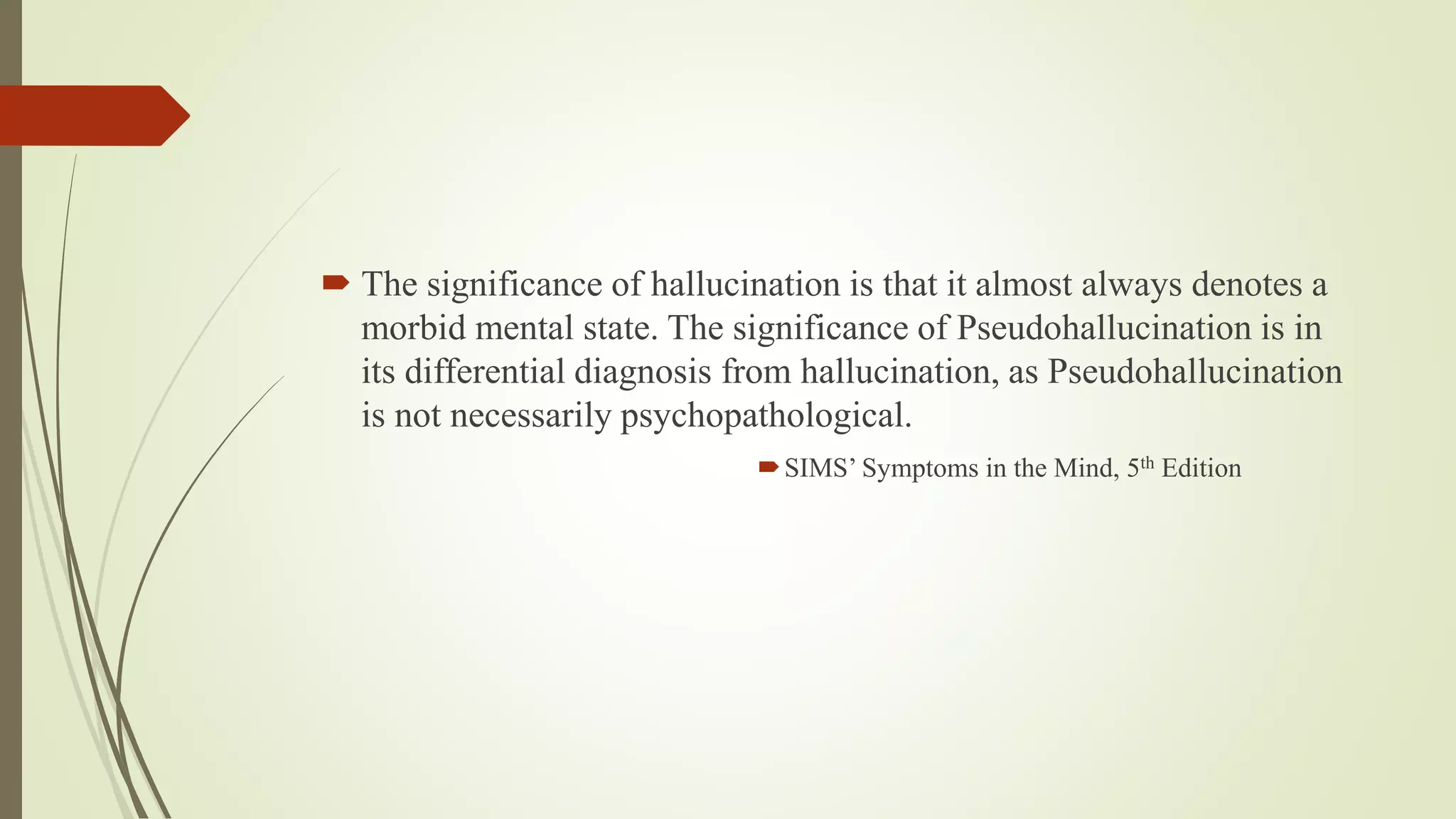
 The significance of hallucination is that it almost always denotes a
morbid mental state. The significance of Pseudohallucination is in
its differential diagnosis from hallucination, as Pseudohallucination
is not necessarily psychopathological.
SIMS’ Symptoms in the Mind, 5th Edition
References
 Fish’s Clinical Psychopatholgy, 3rd Edition,
Patricia Casey, Berndan Kelly
 SIMS’ Symptoms in the Mind, 5th Edition,
Femi Oyebode
 Kaplan And Sadock’s Synopsis of Psychiatry, 11th edition
BJ Sadock, VA Sadock, Pedro Ruiz
THANK YOU!

Disorders of perception

  • 1.
    Disorders of Perception Presenter:Dr. Subodh Kumar Sharma Resident, MD Psychiatry Moderator: Dr. Shuva Shrestha, MD Department of Psychiatry NMCTH, Birgunj, Nepal
  • 2.
  • 3.
    Perception  The transformationof raw sensory stimuli into sensory information that is then decoded into meaningful perception at the cortical level involves active processes that are influenced by attention, affect, cultural expectations, context, prior experiences, memory and, most importantly, prior concepts.  ‘we are not given the world: we make our world through incessant experience, categorization, memory, reconnection’ (Sachs 1995)  It is therefore perception is not a passive process but an active one that involves the construction of an external world that depends on internal templates. (SIMS’ Symptoms in Mind 5th edition)
  • 4.
    Characteristics of Perception Are of concrete reality  Occur in external objective space  Clearly delineated  Sensory elements are full and fresh  Constant and remain unaltered  Independent of our will (Jaspers, 1962)
  • 5.
    IMAGERY visually descriptive orfigurative language,
  • 6.
    Imagery Imagery is theinternal mental representation of the world and is actively drawn from memory.  In day-to-day life, it is common to refer to ‘seeing in the mind’s eyes’ or ‘hearing in the mind’s ears’.
  • 7.
    Characteristics Of Imagery Imagesare figurative and have a character of subjectivity They appear in inner subjective space They are not clearly delineated and come before us incomplete Although sensory elements are individually the equal of those in perception, mostly they are insufficient Images dissipate and always have to be recreated Images are actively created and are dependent on our will. Jaspers (1962), SIMS’ 5th Edition
  • 8.
    Applied aspect ofImagery  Vivid sensory description to create mental pictures. The sun was shining brightly in the sky. The bright yellow sun beamed down my shoulders, wrapping me in a blanket of sunshine.  In Psychopathology: understanding of the nature of imagery is required for examining the nature of perceptions, hallucinations and pseudohallucinations.
  • 10.
    Synesthesia  Perception ofan object, presented in one sensory modality at the same time as in different sensory modality. “I don’t know what the color green looks like. But I know what green tastes like!” –Taria Camerino One of the things I love about my husband are the colors of his voice and his laugh. It’s a wonderful golden brown, like crisp, buttery toast, which sounds very odd, I know, but it is very real. (Cytowic and Eagleman, 2009)
  • 11.
    Synesthesia continued.. Various forms: graphemeto color; time unit to color; musical sounds to color; general sounds to color; and, phoneme to color. sounds to taste, sound to touch; vision to taste  spatially extended, but different from seeing or imagining  Experience close to the body and within ‘peri-personal space’  Consistent over time  Elementary and specific in nature
  • 12.
    Abnormal Perception Sensory Distortion Sensory Deception Realperceptual object which is perceived in a distorted way New perception that may occur that may or may not be in response to external stimuli
  • 13.
    Sensory Distortion  Distortion:The act of twisting or altering something out of its true, natural, or original state. (Merriam Websters Dictionary)  Sensory Distortion: Real perceptual object which is perceived in a distorted way.
  • 14.
  • 15.
    Distortion in Intensity Hyperesthesia  Hyperacusis  Causes:  Lowering of physiological threshold.  Intense emotions  Experienced in: anxiety depressive disorder, Hangover from alcohol Migraine hypochondriacal personalities  Hypoesthesia Hypoacusis  Causes:  Increase of physiological threshold.  Decreased attention  Experienced in Delirium  Depression  Attention deficit disorder
  • 17.
    Quality Distortion  Drugtoxicity  Digitalis, Santonin: Xanthopsia  Mesacline: Chloropsia  Viagra: Erythropsia  Lithium: Metallic taste  Derealization  Everything looks unreal and strange  Mania  Objects looks perfect and beautiful
  • 18.
    Distortions in SpatialForm  Refers to Change in perceived shape of an object  Also known as “Dysmegalopsia” Alice In Wonderland Syndrome (Todds’ Syndrome)
  • 19.
    Distortions in SpatialForm  Micropsia  Seeing objects smaller than they really are or farther away than they really are  Retinal disease and scarring  Accomodation and convergence disorder  Parietal and temporal lobe disorder  Papilledema  Schizophrenia  Macropsia  Seeing objects larger than they really are  Complete paralysis of accommodation  Atropine/hyoscine poisoning  Hypoxia  Chronic arachidonitis  Temporal lobe epilepsy
  • 20.
  • 21.
    Distortions in SpatialForm  Teleopsia: Object appearing far away than it should.  Pelopsia: Object appearing nearer than it should can be caused by changes in atmospheric clarity  sometimes by wearing a corrective lens  Porropsia: Experience of retreat of subjects into the distance without any change in space
  • 23.
    Sensory Deception  DECEPTION:the act of causing someone to accept as true or valid what is false or invalid. (Merriam-websters dictionary)  SENSORY DECEPTION  Occurring of new perception that may or may not be in response to external stimulus. (Fish’s Clinical Psychopathology, 3rd Edition)  Altered perception of real objects to consider the perception of objects that are not there and are new perception (Sims’ symptoms in the mind, 5th edition)
  • 24.
  • 25.
    Illusion Latin /illusio/ whichmeans to mock (fake). Stimuli from a perceived object Mental Image Illusion False Perception
  • 26.
  • 27.
    Illusion Not indicative ofPsychopathology by themselves Examples: Muller-Lyer illusion Person in dark road can mistake a shadow as attacker May occur in any sensory modality Delirium Anxious and bewildered individuals Schizophrenia Psychomimetic drugs
  • 28.
    Illusion Completion Illusion Pareidolia AffectIllusion Result of inattention, misreading Result of Mood state D/t excessive fantasy thinking and vivid visual imagery
  • 29.
    Fantastic Illusion  Fantasticillusions in which patients saw extraordinary modifications to their environment  Most of the time attributed to exaggeration and confabulation.  More common in world of fiction than psychiatric realm. (Hamilton 1974)
  • 30.
    Illusion Vs FunctionalHallucination  Functional hallucination, which occurs when a certain percept is necessary for the production of a hallucination, but the hallucination is not a transformation of that perception.
  • 31.
    Illusion VS PerceptualMisinterpretation  Making a mistake as to the nature of perception without that perception being particularly influenced by emotion mixed with fantasy.  Rather it can be affected by previous information.
  • 32.
    Hallucination  Latin word/allucinari/ Meaning wander in mind and intent to mislead  In English: Sir Thomas Browne (1646)  In psychiatry: Esquirol (1817) A perception without object
  • 33.
    Hallucination  Definition: Hallucinationsproper are false perceptions that are not in any way distortions of real perceptions but spring up on their own as something quite new and occur simultaneously with and alongside real perception (Jaspers 1962)
  • 34.
    Definitions  Horowitz (1975)Hallucinations are mental images that  occur in the form of images,  are derived from internal sources of information,  are appraised incorrectly as if from external sources of information,  usually occur intrusively.  False sensory perceptions occurring in the absence of any relevant external stimulation of the sensory modality involved. (Kaplan & Saddock's Synopsis Of Psychiatry)
  • 35.
    Causes of Hallucinations Intenseemotions Suggestion Disorders of sense organs Sensory deprivation Disorders of CNS Psychiatric disorders
  • 36.
    Pseudohallucination  Pseudohallucination isa perceptual experience which is figurative , not concretely real, and occurs in inner subjective space, not in external objective space. (SIMS Symptoms In The Mind3rd Edition)  Subjective perceptions similar to hallucinations, with respect to its character and vividness, but that differ from those because these do not have objective reality. -Victor Kandinsky  Corelates to Imagery as hallucination relates to Perception.
  • 37.
    Qualities of Pseudohallucination Full consciousness  Inner subjective space  Definite outlines  Constancy retained, insight preserved  Relevant to emotions, needs and actions  Depends on the observer for existence By Jasper 1962
  • 38.
    Pseudohallucination and Psychiatry Its presence merely doesn’t determine presence of any psychopathology.  But, can be experienced in: Obsessional Depressive Histrionic Delirious Psychomimmetic Drug Users
  • 39.
    Hallucination and Pseudohallucination CharacterHallucination Pseudohallucination Experience Concrete, tangible, objective , real “Inner eye” ,pictorial, subjective Location Outer objective space Inner subjective space Definition Definite outlines, complete sounds Vividness Full, fresh, bright Constancy Retained Independence from violation Cannot be dismissed, recalled or changed at will Insight No distinction made from real perception Distinction could be made, has quality of idea Behavioural relevance Relevant to emotions, needs, actions Sensory modality Could experience in another modality Couldn’t experience in another modality Existence Exists independent of observer Dependent on observer Attribution to abnormal state by subject Independent Dependent
  • 40.
     The significanceof hallucination is that it almost always denotes a morbid mental state. The significance of Pseudohallucination is in its differential diagnosis from hallucination, as Pseudohallucination is not necessarily psychopathological. SIMS’ Symptoms in the Mind, 5th Edition
  • 41.
    References  Fish’s ClinicalPsychopatholgy, 3rd Edition, Patricia Casey, Berndan Kelly  SIMS’ Symptoms in the Mind, 5th Edition, Femi Oyebode  Kaplan And Sadock’s Synopsis of Psychiatry, 11th edition BJ Sadock, VA Sadock, Pedro Ruiz
  • 42.

Editor's Notes

  • #2 Good morning faculty members and my senior and interns
  • #7 Imagery underlies our capacity for many crucial cognitive activities, such as mental arithmetic, map reading, visualizing and imagining places previously visited and recollecting spoken speech.
  • #19 The Alice in Wonderland syndrome is a term applied to altered bizarre perceptions of size and shapes of a patient's body and illusions of changes in the forms, dimensions, and motions of objects that a patient with this syndrome encounters.
  • #22 1. A case of occipital metastatic osteomyelitis of the skull with an epidural abscess associated with a right sided chronic subdural hematoma is reported
  • #29  completion illusion: Gestalt theory of closure and completion pareidolia: the perception of apparently significant patterns or recognizable images, especially faces, in random or accidental arrangements of shapes and lines Pareidolic illusion occurs in children more than in adults Pareidolia occurs in a considerable proportion of normal people. It may also be provoked by psychomimetic drugs
  • #31 For example, the patient hears voices when the tap is turned on; he hears voices in the running water, but the voices and the noise of water are quite distinct and can be heard separately and synchronously like any other voice that is heard against a background noise The perception of hearing running water is necessary to produce the hallucination, but the hallucination is not a transformation of that perception