Dr. Subodh Sharma
Resident, MD Psychiatry
Department of Psychiatry
NMCTH, Birgunj , Nepal
Selective Norepinephrine Reuptake Inhibitor
Approved in 2002 for treatment of ADHD
Developed by Eli Lilly Pharmaceuticals (Strattera)
Off label use: Uni/Bipolar Depression
Weak antidepressant
Norepinephrine Reuptake Inhibition,
Dopamine facilitation in PFC
Increases Cortical Acetylcholine level
 Duration of action: Up to 24 hours
 Absorption: Rapid
 Distribution: Vd: IV: 0.85 L/kg
 Protein binding: 98%, primarily albumin
 Metabolism: Hepatic, via CYP2D6 and CYP2C19
 Half-life elimination: Atomoxetine: 5 hours (up to 24 hours in poor
metabolizers)
 Time to peak, plasma: 1-2 hours; delayed high-fat meal
 Excretion: Urine (80%) <3% is excreted unchanged); feces (17%)
 Comparative efficacy and safety of methylphenidate and atomoxetine for attention-
deficit hyperactivity disorder in children and adolescents: Meta-analysis based on
head-to-head trials Qiang Liu Et. Al. 2017
 Included 11 studies from all over the world from 2002-2013
 Concluded that Methylphenidate should be the first line of treatment in children
and adolescent.
 “Compared to ATX, MPH showed a higher response rate (RR = 1.14, 95% CI [1.
09, 1.20]), decreased inattention (SMD = −0.13, 95% CI [−0.25, −0.01]) and
lower risk of adverse events (drowsiness: RR = 0.17, 95% CI [0.11, 0.26; nausea:
RR = 0.49; 95% CI [0.29, 0.85; vomiting: RR = 0.41, 95% CI [0.27, 0.63]).”
 Comparative efficacy and acceptability of atomoxetine, lisdexamfetamine,
bupropion and methylphenidate in treatment of attention deficit hyperactivity
disorder in children and adolescents: A meta-analysis with focus on bupropion;
Matej Stuhec et. Al. 2015
 Efficacy in reducing ADHD symptoms compared to placebo was small for
bupropion, while modest efficacy was shown for atomoxetine and
methylphenidate and high efficacy was observed for lisdexamfetamine.
 Compared to placebo treatment discontinuation was statistically significantly
lower for methylphenidate, while it was not significantly different for
atomoxetine, lisdexamfetamine, and bupropion
 Comparative efficacy and tolerability of medications for attention-deficit
hyperactivity disorder in children, adolescents, and adults: a systematic review
and network meta-analysis; Samuele Cortese et. al. 2018; The Lancet
 Clinician rating; all drugs i.e. Methylphenidate, Amphetamine, Modafinil and
Atomoxetine were superior than placebo.
 Teacher rating; only Methylphenidate and Modafinil were efficacious than
placebo
 Adult clinician rating: amphetamines, methylphenidate, bupropion, and
atomoxetine, but not modafinil, were better than placebo.
 With respect to tolerability, amphetamines were inferior to placebo in both
children and adolescents (odds ratio [OR] 2·30, 95% CI 1·36–3·89) and adults
(3·26, 1·54–6·92)
 Atomoxetine (2·33, 1·28–4·25), Methylphenidate (2·39, 1·40–4·08), and
Modafinil (4·01, 1·42–11·33) were less well tolerated than placebo in adults
only.
 In head-to-head comparisons, only differences in efficacy (clinicians’ ratings)
were found, favoring amphetamines over modafinil, atomoxetine, and
methylphenidate in both children and adolescents (SMDs –0·46 to –0·24) and
adults (–0·94 to –0·29).
 Similar efficacy to IR Methylphenidate.
 Mild to Moderate side effects.
 Treatment algorithms involving the initial use of atomoxetine appear cost
effective versus algorithms involving initial methylphenidate (immediate- or
extended-release), dexamphetamine, tricyclic antidepressants.
 Data suggest that atomoxetine is unlikely to have any abuse potential.
 Atomoxetine appeared less likely than methylphenidate to exacerbate
disordered sleep in pediatric patients with ADHD.
 Atomoxetine; A Review of its Use in Attention-Deficit Hyperactivity Disorder in Children
and Adolescents; Karly P. Garnock-Jones et al, 2009
 Atomoxetine may be preferred in patients with :
 Other comorbid psychiatric disorders,
 Those who cannot tolerate stimulants,
 those with a substance misuse recurring history.
Pretreatment assessment of Hepatic Function is mandatory.
Adult
 Initial 40mg/day, may increase to 80mg/day (after 3 days) up to 100mg/day
(maximum dose)
 May be withdrawn without tapering
 Pediatrics (>6yrs of age):
 Initial 0.5mg/kg/day may increase to 1.2mg/kg/day
 Maximum 1.4mg/kg/day or 100mg/day whichever is less.
 Dose adjustment is required in hepatic impairment.
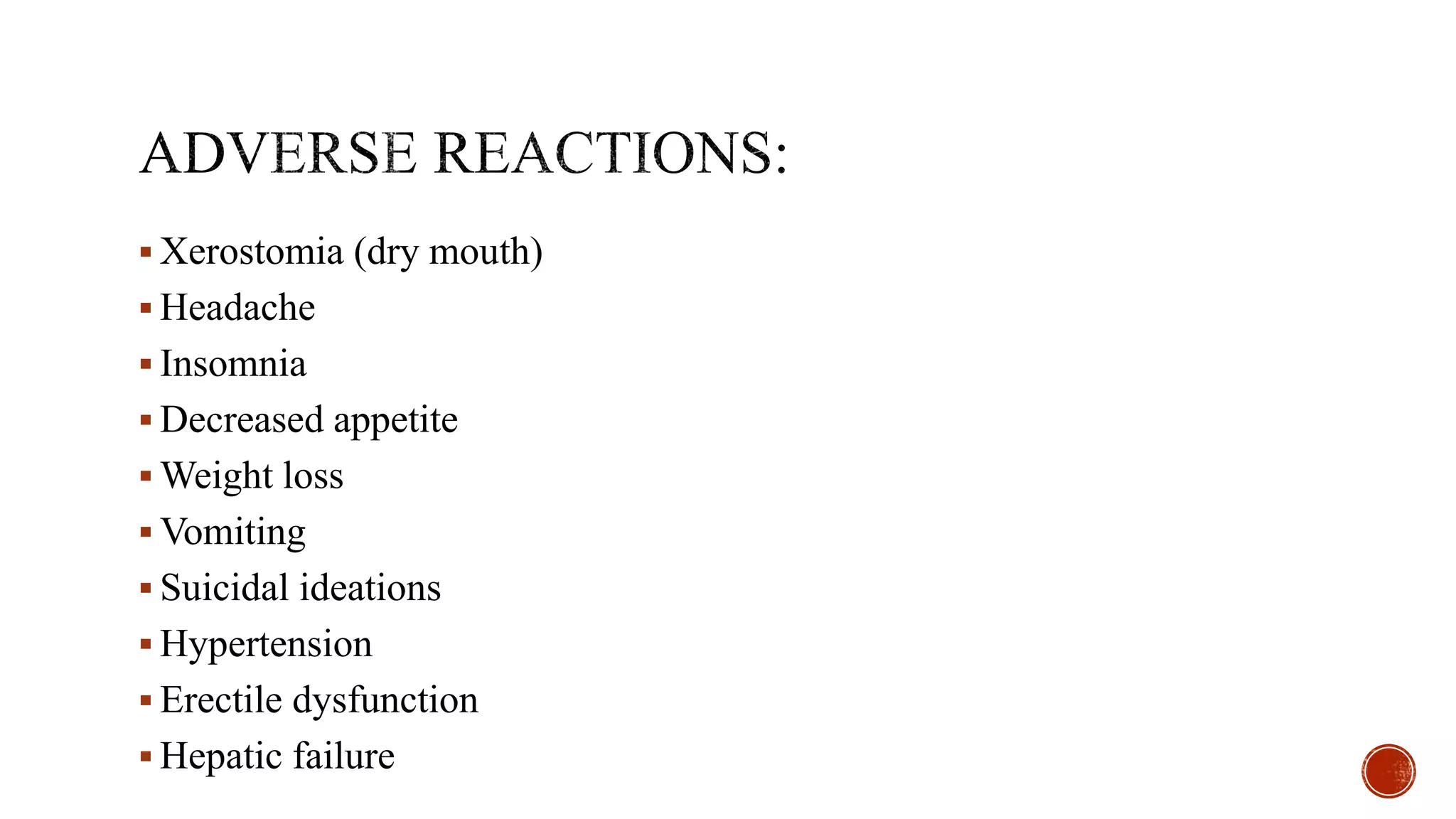
 Xerostomia (dry mouth)
 Headache
 Insomnia
 Decreased appetite
 Weight loss
 Vomiting
 Suicidal ideations
 Hypertension
 Erectile dysfunction
 Hepatic failure
Hypersensitivity
Hypertension
Angle closure glaucoma
Pheochromocytoma
Severe cardiac or vascular disorders
 Appropriate contraception is recommended for sexually active women
of childbearing potential (Heiligenstein 2003).
 Consider discontinuing or changing treatment in women who become
pregnant during atomoxetine therapy (Larsen 2015).
 An agent other than atomoxetine is preferred for the treatment of
attention-deficit/hyperactivity disorder (ADHD) in women who are
breastfeeding (Larsen 2015).
 Not registered in Nepal.
 Available in India.
 Brand names: Attentrol (Sun), Axepta (Intas)
 Price: Approximately 10rs/10mg tablet
 Atomoxetine is similarly efficacious compared to Methylphenidate and other
available options.
 Its low abuse potential and relatively low cost as compared to stimulants
makes it a good choice in number of situations.
 It can be combined with Stimulants if monotherapy is not efficacious.
 More readily available than stimulants in neighboring country gives us
opportunity for prescription.
Triangle Principle of treatment of ADHD
Pharmacotherapy
Parent Education &
Behaviour Therapy
School Instructions
2 major Principals:
Encouraging and rewarding good behavior
(positive reinforcement).
Removing rewards by following bad behavior
with appropriate consequences, leading to the
extinguishing of bad behavior (punishment)
 Decide ahead of time which behaviors
are acceptable and which are not.
 Define the rules, but allow some
flexibility
 Manage aggression; Time out
 Create structure
 Break tasks into manageable pieces
 Simplify and organize your child’s life
 Limit distractions
 Encourage exercise
 Regulate sleep patterns
 Encourage out-loud thinking
 Promote wait time
 Calm yourself
Social skills training
Communication training
Family therapy
School-based interventions
Behavioral peer intervention
 Kaplan and Sadocks Comprehensive text Book of Psychiatry, Tenth edition, BJ Sadock et al.
 Stahl’s Essentials of Psychopharmacology, Fourth Edition, SM Stahl
 Atomoxetine; A Review of its Use in Attention-Deficit Hyperactivity Disorder in Children and Adolescents; Karly P.
Garnock-Jones et al, 2009
 Comparative efficacy and safety of methylphenidate and atomoxetine for attention-deficit hyperactivity disorder in children
and adolescents: Meta-analysis based on head-to-head trials Qiang Liu Et. Al. 2017
 Comparative efficacy and acceptability of atomoxetine, lisdexamfetamine, bupropion and methylphenidate in treatment of
attention deficit hyperactivity disorder in children and adolescents: A meta-analysis with focus on bupropion; Matej Stuhec
et. Al. 2015
 Comparative efficacy and tolerability of medications for attention-deficit hyperactivity disorder in children, adolescents,
and adults: a systematic review and network meta-analysis; Samuele Cortese et. al. 2018; The Lancet
 Comparative efficacy and acceptability of atomoxetine, lisdexamfetamine, bupropion and methylphenidate in treatment of
attention deficit hyperactivity disorder in children and adolescents: A meta-analysis with focus on bupropion Matej Stuhec
et al 2015
 Evidence-based guidelines for the pharmacological management of attention deficit hyperactivity disorder: Update on
recommendations from the British Association for Psychopharmacology Blanca Bolea-Alamañac, 2017
 UpToDate
Atomoxetine

Atomoxetine

  • 1.
    Dr. Subodh Sharma Resident,MD Psychiatry Department of Psychiatry NMCTH, Birgunj , Nepal
  • 2.
    Selective Norepinephrine ReuptakeInhibitor Approved in 2002 for treatment of ADHD Developed by Eli Lilly Pharmaceuticals (Strattera) Off label use: Uni/Bipolar Depression Weak antidepressant
  • 3.
    Norepinephrine Reuptake Inhibition, Dopaminefacilitation in PFC Increases Cortical Acetylcholine level
  • 4.
     Duration ofaction: Up to 24 hours  Absorption: Rapid  Distribution: Vd: IV: 0.85 L/kg  Protein binding: 98%, primarily albumin  Metabolism: Hepatic, via CYP2D6 and CYP2C19  Half-life elimination: Atomoxetine: 5 hours (up to 24 hours in poor metabolizers)  Time to peak, plasma: 1-2 hours; delayed high-fat meal  Excretion: Urine (80%) <3% is excreted unchanged); feces (17%)
  • 5.
     Comparative efficacyand safety of methylphenidate and atomoxetine for attention- deficit hyperactivity disorder in children and adolescents: Meta-analysis based on head-to-head trials Qiang Liu Et. Al. 2017  Included 11 studies from all over the world from 2002-2013  Concluded that Methylphenidate should be the first line of treatment in children and adolescent.  “Compared to ATX, MPH showed a higher response rate (RR = 1.14, 95% CI [1. 09, 1.20]), decreased inattention (SMD = −0.13, 95% CI [−0.25, −0.01]) and lower risk of adverse events (drowsiness: RR = 0.17, 95% CI [0.11, 0.26; nausea: RR = 0.49; 95% CI [0.29, 0.85; vomiting: RR = 0.41, 95% CI [0.27, 0.63]).”
  • 7.
     Comparative efficacyand acceptability of atomoxetine, lisdexamfetamine, bupropion and methylphenidate in treatment of attention deficit hyperactivity disorder in children and adolescents: A meta-analysis with focus on bupropion; Matej Stuhec et. Al. 2015  Efficacy in reducing ADHD symptoms compared to placebo was small for bupropion, while modest efficacy was shown for atomoxetine and methylphenidate and high efficacy was observed for lisdexamfetamine.  Compared to placebo treatment discontinuation was statistically significantly lower for methylphenidate, while it was not significantly different for atomoxetine, lisdexamfetamine, and bupropion
  • 8.
     Comparative efficacyand tolerability of medications for attention-deficit hyperactivity disorder in children, adolescents, and adults: a systematic review and network meta-analysis; Samuele Cortese et. al. 2018; The Lancet  Clinician rating; all drugs i.e. Methylphenidate, Amphetamine, Modafinil and Atomoxetine were superior than placebo.  Teacher rating; only Methylphenidate and Modafinil were efficacious than placebo  Adult clinician rating: amphetamines, methylphenidate, bupropion, and atomoxetine, but not modafinil, were better than placebo.
  • 9.
     With respectto tolerability, amphetamines were inferior to placebo in both children and adolescents (odds ratio [OR] 2·30, 95% CI 1·36–3·89) and adults (3·26, 1·54–6·92)  Atomoxetine (2·33, 1·28–4·25), Methylphenidate (2·39, 1·40–4·08), and Modafinil (4·01, 1·42–11·33) were less well tolerated than placebo in adults only.  In head-to-head comparisons, only differences in efficacy (clinicians’ ratings) were found, favoring amphetamines over modafinil, atomoxetine, and methylphenidate in both children and adolescents (SMDs –0·46 to –0·24) and adults (–0·94 to –0·29).
  • 10.
     Similar efficacyto IR Methylphenidate.  Mild to Moderate side effects.  Treatment algorithms involving the initial use of atomoxetine appear cost effective versus algorithms involving initial methylphenidate (immediate- or extended-release), dexamphetamine, tricyclic antidepressants.  Data suggest that atomoxetine is unlikely to have any abuse potential.  Atomoxetine appeared less likely than methylphenidate to exacerbate disordered sleep in pediatric patients with ADHD.  Atomoxetine; A Review of its Use in Attention-Deficit Hyperactivity Disorder in Children and Adolescents; Karly P. Garnock-Jones et al, 2009
  • 11.
     Atomoxetine maybe preferred in patients with :  Other comorbid psychiatric disorders,  Those who cannot tolerate stimulants,  those with a substance misuse recurring history.
  • 12.
    Pretreatment assessment ofHepatic Function is mandatory. Adult  Initial 40mg/day, may increase to 80mg/day (after 3 days) up to 100mg/day (maximum dose)  May be withdrawn without tapering  Pediatrics (>6yrs of age):  Initial 0.5mg/kg/day may increase to 1.2mg/kg/day  Maximum 1.4mg/kg/day or 100mg/day whichever is less.  Dose adjustment is required in hepatic impairment.
  • 13.
     Xerostomia (drymouth)  Headache  Insomnia  Decreased appetite  Weight loss  Vomiting  Suicidal ideations  Hypertension  Erectile dysfunction  Hepatic failure
  • 14.
  • 15.
     Appropriate contraceptionis recommended for sexually active women of childbearing potential (Heiligenstein 2003).  Consider discontinuing or changing treatment in women who become pregnant during atomoxetine therapy (Larsen 2015).  An agent other than atomoxetine is preferred for the treatment of attention-deficit/hyperactivity disorder (ADHD) in women who are breastfeeding (Larsen 2015).
  • 16.
     Not registeredin Nepal.  Available in India.  Brand names: Attentrol (Sun), Axepta (Intas)  Price: Approximately 10rs/10mg tablet
  • 17.
     Atomoxetine issimilarly efficacious compared to Methylphenidate and other available options.  Its low abuse potential and relatively low cost as compared to stimulants makes it a good choice in number of situations.  It can be combined with Stimulants if monotherapy is not efficacious.  More readily available than stimulants in neighboring country gives us opportunity for prescription.
  • 18.
    Triangle Principle oftreatment of ADHD Pharmacotherapy Parent Education & Behaviour Therapy School Instructions
  • 19.
    2 major Principals: Encouragingand rewarding good behavior (positive reinforcement). Removing rewards by following bad behavior with appropriate consequences, leading to the extinguishing of bad behavior (punishment)
  • 20.
     Decide aheadof time which behaviors are acceptable and which are not.  Define the rules, but allow some flexibility  Manage aggression; Time out  Create structure  Break tasks into manageable pieces  Simplify and organize your child’s life  Limit distractions  Encourage exercise  Regulate sleep patterns  Encourage out-loud thinking  Promote wait time  Calm yourself
  • 21.
    Social skills training Communicationtraining Family therapy School-based interventions Behavioral peer intervention
  • 22.
     Kaplan andSadocks Comprehensive text Book of Psychiatry, Tenth edition, BJ Sadock et al.  Stahl’s Essentials of Psychopharmacology, Fourth Edition, SM Stahl  Atomoxetine; A Review of its Use in Attention-Deficit Hyperactivity Disorder in Children and Adolescents; Karly P. Garnock-Jones et al, 2009  Comparative efficacy and safety of methylphenidate and atomoxetine for attention-deficit hyperactivity disorder in children and adolescents: Meta-analysis based on head-to-head trials Qiang Liu Et. Al. 2017  Comparative efficacy and acceptability of atomoxetine, lisdexamfetamine, bupropion and methylphenidate in treatment of attention deficit hyperactivity disorder in children and adolescents: A meta-analysis with focus on bupropion; Matej Stuhec et. Al. 2015  Comparative efficacy and tolerability of medications for attention-deficit hyperactivity disorder in children, adolescents, and adults: a systematic review and network meta-analysis; Samuele Cortese et. al. 2018; The Lancet  Comparative efficacy and acceptability of atomoxetine, lisdexamfetamine, bupropion and methylphenidate in treatment of attention deficit hyperactivity disorder in children and adolescents: A meta-analysis with focus on bupropion Matej Stuhec et al 2015  Evidence-based guidelines for the pharmacological management of attention deficit hyperactivity disorder: Update on recommendations from the British Association for Psychopharmacology Blanca Bolea-Alamañac, 2017  UpToDate