THRESHOLD
BY
PROF. JIGYASA THAKUR
EP PSY #402
RENAISSANCE UNIVERSITY, INDORE
TAKE AWAY
• Types of Threshold
• Definitions of thresholds explained
• Various thresholds and their roles
• Examples of each of them
TERMINOLOGY:
• Threshold: Edge or a boundary/ Detection of stimulus
• Stimulus/ Stimuli:
• Detection: All or None scenario: (Sense impairment example)
• Sensations vs Perception
• Sensory Adaptation
• Selective Attention (Overt/Covert): (ADD/ADHD example), with picking on Meaning vs Actual stimulus
ABSOLUTE THRESHOLD (RL)
• The minimum amount of stimulation required to trigger a reaction or produce a sensation. Absolute
threshold is measured across several trials. It is the lowest or weakest level of stimulation (e.g., the
slightest, most indistinct sound) that can be detected on 50% of trials. Although the name suggests a
fixed level at which stimuli effectively elicit sensations, the absolute threshold fluctuates according to
alterations in receptors and environmental conditions. Also called absolute limen (AL); detection
threshold; sensation threshold.
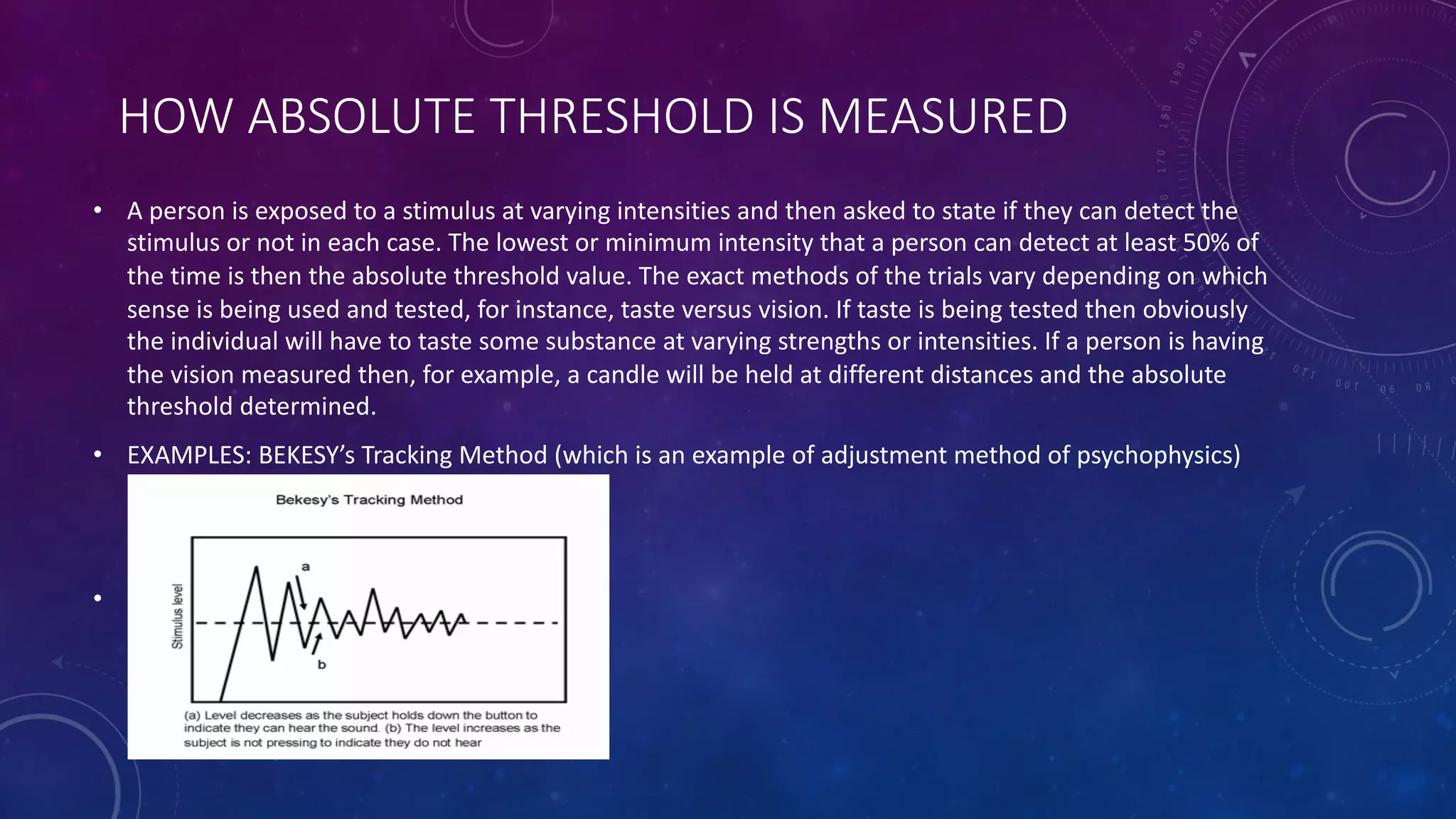
• Relative Threshold : are nothing but just mere deviations
the base line. (which are very common because of many
factors interfering with the exact JND assessment with
Human factor involved).
The un-deviated baseline will be JND.
HOW ABSOLUTE THRESHOLD IS MEASURED
• A person is exposed to a stimulus at varying intensities and then asked to state if they can detect the
stimulus or not in each case. The lowest or minimum intensity that a person can detect at least 50% of
the time is then the absolute threshold value. The exact methods of the trials vary depending on which
sense is being used and tested, for instance, taste versus vision. If taste is being tested then obviously
the individual will have to taste some substance at varying strengths or intensities. If a person is having
the vision measured then, for example, a candle will be held at different distances and the absolute
threshold determined.
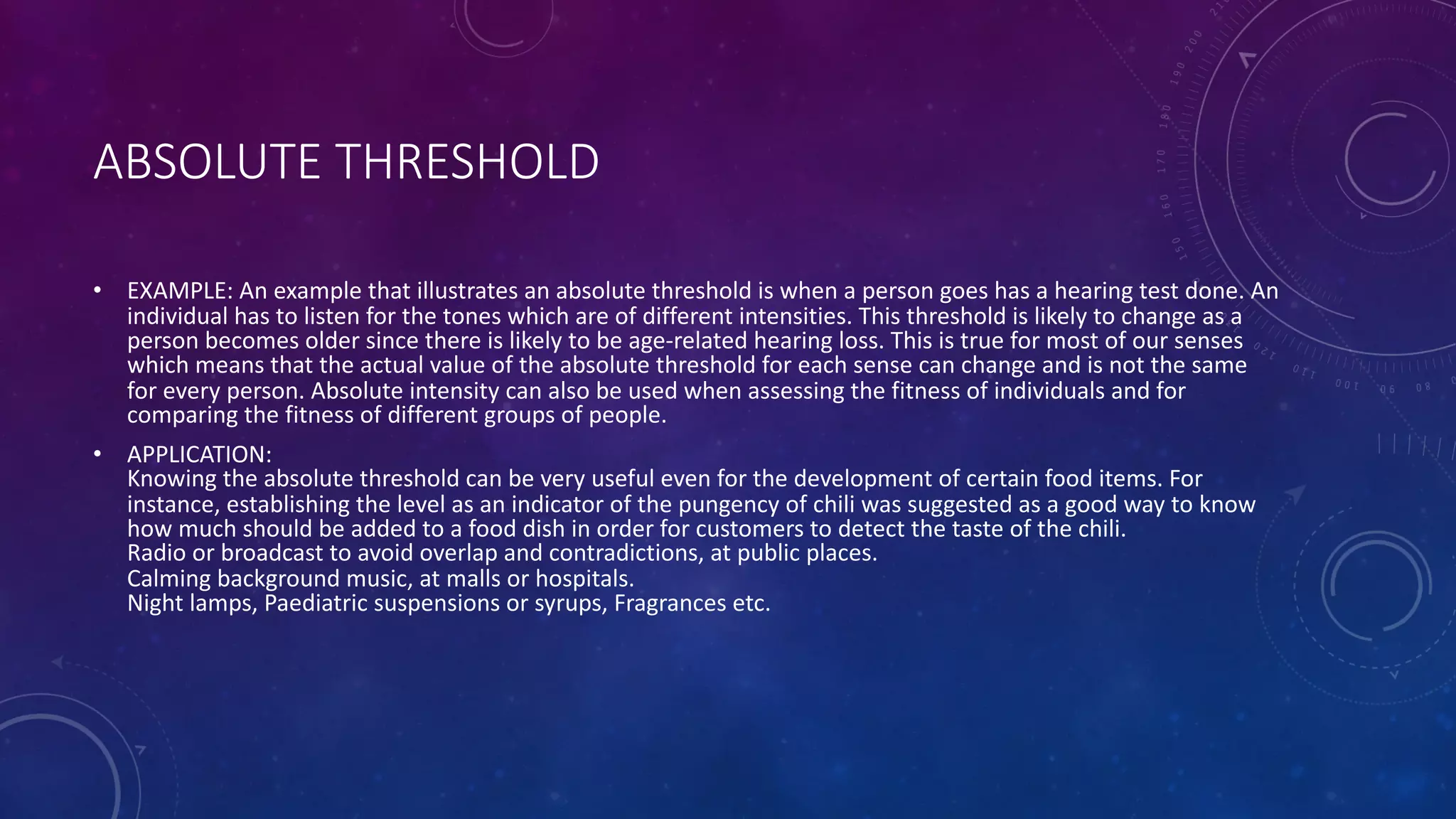
• EXAMPLES: BEKESY’s Tracking Method (which is an example of adjustment method of psychophysics)
•
ABSOLUTE THRESHOLD
• EXAMPLE: An example that illustrates an absolute threshold is when a person goes has a hearing test done. An
individual has to listen for the tones which are of different intensities. This threshold is likely to change as a
person becomes older since there is likely to be age-related hearing loss. This is true for most of our senses
which means that the actual value of the absolute threshold for each sense can change and is not the same
for every person. Absolute intensity can also be used when assessing the fitness of individuals and for
comparing the fitness of different groups of people.
• APPLICATION:
Knowing the absolute threshold can be very useful even for the development of certain food items. For
instance, establishing the level as an indicator of the pungency of chili was suggested as a good way to know
how much should be added to a food dish in order for customers to detect the taste of the chili.
Radio or broadcast to avoid overlap and contradictions, at public places.
Calming background music, at malls or hospitals.
Night lamps, Paediatric suspensions or syrups, Fragrances etc.
DIFFERENCE THRESHOLD
• the smallest difference between two stimuli that can be consistently and accurately detected on 50% of
trials. Also called difference limen (DL); just noticeable difference (JND; jnd)
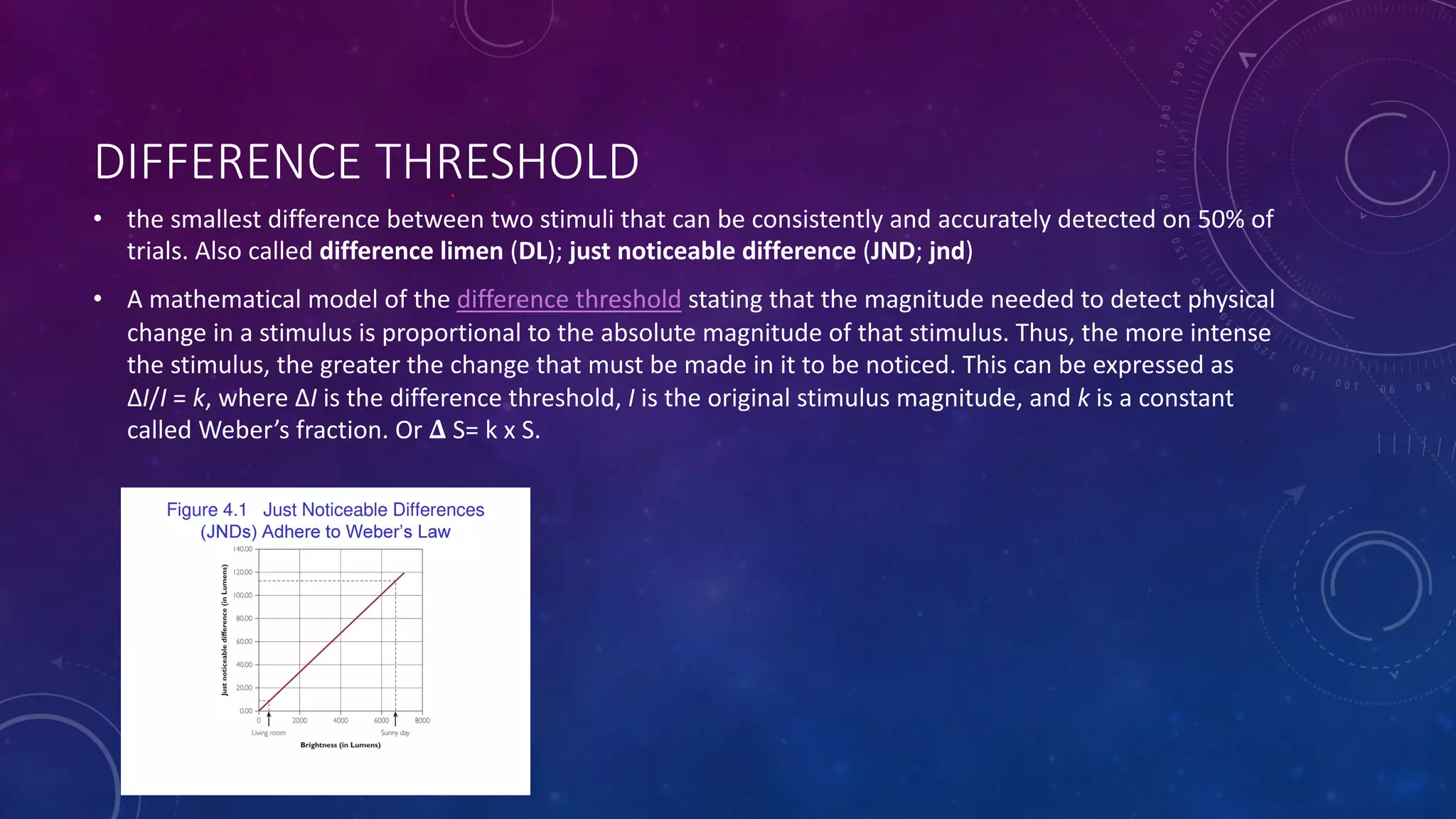
• A mathematical model of the difference threshold stating that the magnitude needed to detect physical
change in a stimulus is proportional to the absolute magnitude of that stimulus. Thus, the more intense
the stimulus, the greater the change that must be made in it to be noticed. This can be expressed as
ΔI/I = k, where ΔI is the difference threshold, I is the original stimulus magnitude, and k is a constant
called Weber’s fraction. Or 𝚫 S= k x S.
HOW DL IS MEASURED
• [(Concept of Upper and Lower threshold) It is often measured as an upper and a lower value, with the
upper being the difference between intensity and 80% of all trials. A lower threshold is the difference
between what is perceived and 20% of the total number of trials]. – Ignore for MA/MSc syllabus.
(Usually, the difference threshold is calculated as an average value of these two difference threshold
values).
• The idea of difference threshold led to the development of a specific formula by Weber, which is delta
I/I = k or 𝚫 S = k x S. The values are k = a constant, I/S = initial or starting intensity and delta I is the
difference threshold value. Rearranging the formula we can then determine distance threshold which is
delta I. Delta I = k multiplied by I. The Weber constant is also known as the Weber fraction. An example
of what the fraction means is for instance if k =0.02 then it means that people can detect a 2% change
in the intensity of a particular stimulus. Weber’s law assumes that the change is by a constant amount
which is described by the fraction or constant.
(The k will be SI unit or if multiplied by 100 will be converted into percentage value)
DIFFERENCE THRESHOLD
• EXAMPLE:
Listener can identify or detect the difference between two audio signals being transmitted successively,
as to avoid selective attention and distraction phenomenon with simultaneous exposure. Like Piano
tuning.
• APPLICATION: Setting up the scales in anywhere across industries, for human use.
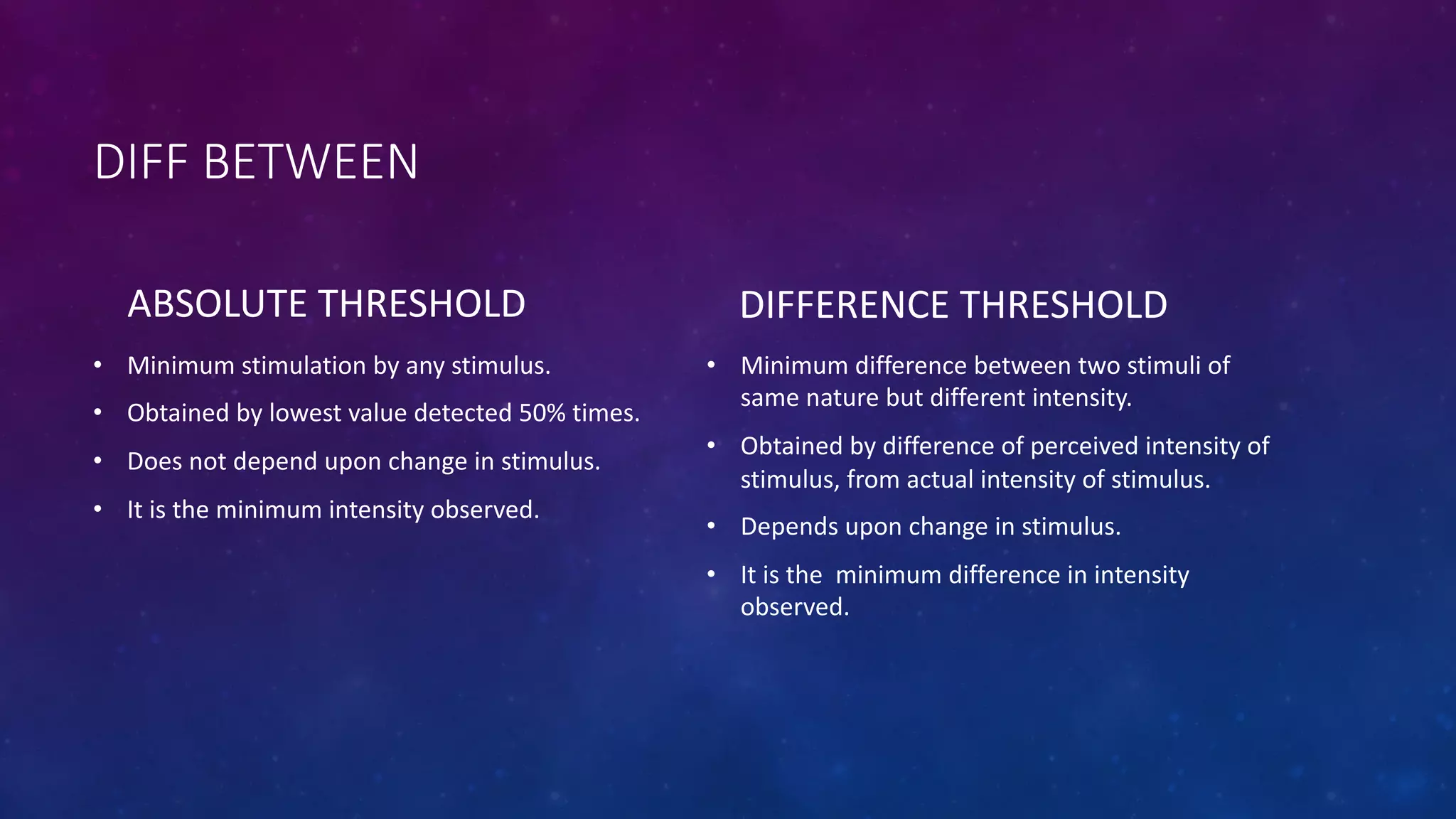
DIFF BETWEEN
ABSOLUTE THRESHOLD
• Minimum stimulation by any stimulus.
• Obtained by lowest value detected 50% times.
• Does not depend upon change in stimulus.
• It is the minimum intensity observed.
DIFFERENCE THRESHOLD
• Minimum difference between two stimuli of
same nature but different intensity.
• Obtained by difference of perceived intensity of
stimulus, from actual intensity of stimulus.
• Depends upon change in stimulus.
• It is the minimum difference in intensity
observed.
SUBLIMINAL THRESHOLD
• Registration of a stimulus below the awareness. (Stimuli are either too weak or too low to be
consciously perceived).
• Used in marketing mostly, but has no concrete evidence of impact on subject at the time of exposure or
later.
• SUPRALIMINAL: Adequate to evoke a response (in conscious process).
TERMINAL THRESHOLD
• Extreme upper limit of threshold beyond which no difference threshold exists.
• The stimulus intensity above which no further changes in sensation occur.
• Terminal Thresholds can alter Temporary Threshold shift or Permanent Threshold shifts.
• EXAMPLE: Loud noise or Music may alter Absolute Threshold temporary or permanently, like Bomb
blast or Gun shot, or party music or living in metro noise pollution.

Threshold in Psychophysics Psychology

  • 1.
    THRESHOLD BY PROF. JIGYASA THAKUR EPPSY #402 RENAISSANCE UNIVERSITY, INDORE
  • 2.
    TAKE AWAY • Typesof Threshold • Definitions of thresholds explained • Various thresholds and their roles • Examples of each of them
  • 3.
    TERMINOLOGY: • Threshold: Edgeor a boundary/ Detection of stimulus • Stimulus/ Stimuli: • Detection: All or None scenario: (Sense impairment example) • Sensations vs Perception • Sensory Adaptation • Selective Attention (Overt/Covert): (ADD/ADHD example), with picking on Meaning vs Actual stimulus
  • 4.
    ABSOLUTE THRESHOLD (RL) •The minimum amount of stimulation required to trigger a reaction or produce a sensation. Absolute threshold is measured across several trials. It is the lowest or weakest level of stimulation (e.g., the slightest, most indistinct sound) that can be detected on 50% of trials. Although the name suggests a fixed level at which stimuli effectively elicit sensations, the absolute threshold fluctuates according to alterations in receptors and environmental conditions. Also called absolute limen (AL); detection threshold; sensation threshold. • Relative Threshold : are nothing but just mere deviations the base line. (which are very common because of many factors interfering with the exact JND assessment with Human factor involved). The un-deviated baseline will be JND.
  • 5.
    HOW ABSOLUTE THRESHOLDIS MEASURED • A person is exposed to a stimulus at varying intensities and then asked to state if they can detect the stimulus or not in each case. The lowest or minimum intensity that a person can detect at least 50% of the time is then the absolute threshold value. The exact methods of the trials vary depending on which sense is being used and tested, for instance, taste versus vision. If taste is being tested then obviously the individual will have to taste some substance at varying strengths or intensities. If a person is having the vision measured then, for example, a candle will be held at different distances and the absolute threshold determined. • EXAMPLES: BEKESY’s Tracking Method (which is an example of adjustment method of psychophysics) •
  • 8.
    ABSOLUTE THRESHOLD • EXAMPLE:An example that illustrates an absolute threshold is when a person goes has a hearing test done. An individual has to listen for the tones which are of different intensities. This threshold is likely to change as a person becomes older since there is likely to be age-related hearing loss. This is true for most of our senses which means that the actual value of the absolute threshold for each sense can change and is not the same for every person. Absolute intensity can also be used when assessing the fitness of individuals and for comparing the fitness of different groups of people. • APPLICATION: Knowing the absolute threshold can be very useful even for the development of certain food items. For instance, establishing the level as an indicator of the pungency of chili was suggested as a good way to know how much should be added to a food dish in order for customers to detect the taste of the chili. Radio or broadcast to avoid overlap and contradictions, at public places. Calming background music, at malls or hospitals. Night lamps, Paediatric suspensions or syrups, Fragrances etc.
  • 9.
    DIFFERENCE THRESHOLD • thesmallest difference between two stimuli that can be consistently and accurately detected on 50% of trials. Also called difference limen (DL); just noticeable difference (JND; jnd) • A mathematical model of the difference threshold stating that the magnitude needed to detect physical change in a stimulus is proportional to the absolute magnitude of that stimulus. Thus, the more intense the stimulus, the greater the change that must be made in it to be noticed. This can be expressed as ΔI/I = k, where ΔI is the difference threshold, I is the original stimulus magnitude, and k is a constant called Weber’s fraction. Or 𝚫 S= k x S.
  • 10.
    HOW DL ISMEASURED • [(Concept of Upper and Lower threshold) It is often measured as an upper and a lower value, with the upper being the difference between intensity and 80% of all trials. A lower threshold is the difference between what is perceived and 20% of the total number of trials]. – Ignore for MA/MSc syllabus. (Usually, the difference threshold is calculated as an average value of these two difference threshold values). • The idea of difference threshold led to the development of a specific formula by Weber, which is delta I/I = k or 𝚫 S = k x S. The values are k = a constant, I/S = initial or starting intensity and delta I is the difference threshold value. Rearranging the formula we can then determine distance threshold which is delta I. Delta I = k multiplied by I. The Weber constant is also known as the Weber fraction. An example of what the fraction means is for instance if k =0.02 then it means that people can detect a 2% change in the intensity of a particular stimulus. Weber’s law assumes that the change is by a constant amount which is described by the fraction or constant. (The k will be SI unit or if multiplied by 100 will be converted into percentage value)
  • 11.
    DIFFERENCE THRESHOLD • EXAMPLE: Listenercan identify or detect the difference between two audio signals being transmitted successively, as to avoid selective attention and distraction phenomenon with simultaneous exposure. Like Piano tuning. • APPLICATION: Setting up the scales in anywhere across industries, for human use.
  • 12.
    DIFF BETWEEN ABSOLUTE THRESHOLD •Minimum stimulation by any stimulus. • Obtained by lowest value detected 50% times. • Does not depend upon change in stimulus. • It is the minimum intensity observed. DIFFERENCE THRESHOLD • Minimum difference between two stimuli of same nature but different intensity. • Obtained by difference of perceived intensity of stimulus, from actual intensity of stimulus. • Depends upon change in stimulus. • It is the minimum difference in intensity observed.
  • 13.
    SUBLIMINAL THRESHOLD • Registrationof a stimulus below the awareness. (Stimuli are either too weak or too low to be consciously perceived). • Used in marketing mostly, but has no concrete evidence of impact on subject at the time of exposure or later. • SUPRALIMINAL: Adequate to evoke a response (in conscious process).
  • 14.
    TERMINAL THRESHOLD • Extremeupper limit of threshold beyond which no difference threshold exists. • The stimulus intensity above which no further changes in sensation occur. • Terminal Thresholds can alter Temporary Threshold shift or Permanent Threshold shifts. • EXAMPLE: Loud noise or Music may alter Absolute Threshold temporary or permanently, like Bomb blast or Gun shot, or party music or living in metro noise pollution.