VARENICLINE
Dr. Subodh Sharma
Resident (First Year)
Department of Psychiatry
NMCTH, Birgunj , Nepal
Introduction
 It is a high-affinity partial agonist for the α4β2 nicotinic
acetylcholine receptor subtype (nACh)
 Used as pharmacotherapeutic agent for smoking cessation.
 Non nicotine drugs for smoking.
 Approved by FDA in 2006
 Use of Cytisus plants as a smoking substitutes during World War
II led to extraction of cytisine.
 Cytisine analogs led to varenicline at Pfizer.
Available options for Smoking Cessation
 Non pharmacological
Behavior therapy (individual / group/ telephone quit line)
Clinical counselling
 Pharmacological
Nicotine replacement (patches/ gums/lozenges)
Bupropion
Varenicline
Studies on Varenicline
 A meta-analysis of randomized trials found that varenicline was more
effective for smoking cessation than placebo (RR 2.27, 95% CI 2.02-2.55)
 Cahill K, Stevens S, Perera R, Lancaster T. Pharmacological interventions for smoking
cessation: an overview and network meta-analysis. Cochrane Database Syst Rev 2013;
:CD009329.
 In another meta-analysis of randomized controlled trials, more patients were
abstinent at 24 weeks with varenicline compared with both placebo
and nicotine patch (RR 2.24, 95% CI 2.06-2.43; and RR 1.25, 95% CI 1.14-
1.37 respectively)
 Cahill K, Lindson-Hawley N, Thomas KH, et al. Nicotine receptor partial agonists for
smoking cessation. Cochrane Database Syst Rev 2016; :CD006103.
 Head-to-head double-blinded randomized controlled trial comparing
multiple agents (varenicline, bupropion, nicotine patch) and placebo,
varenicline was more effective in producing six months of tobacco
abstinence than other drugs or placebo.
Anthenelli RM, Benowitz NL, West R, et al. Neuropsychiatric safety and efficacy of
varenicline, bupropion, and nicotine patch in smokers with and without psychiatric
disorders (EAGLES): a double-blind, randomized, placebo-controlled clinical trial
.
 Varenicline is safe for use by tobacco users with chronic obstructive
pulmonary disease (COPD)
Tashkin DP, Rennard S, Hays JT, et al. Effects of varenicline on smoking cessation in
patients with mild to moderate COPD: a randomized controlled trial. Chest 2011;
139:591.
Nonpharmacologic methods
Method
Versus minimal or usual care unless otherwise
noted
Risk ratio (95% CI)
Behavioral counseling
Individual counseling 1.57 (1.40-1.77)
Group counseling 1.88 (1.52-2.33)
Telephone quit line counseling 1.38 (1.19-1.61)
Clinician counseling
Brief advice 1.66 (1.42-1.94)
Brief counseling 1.86 (1.60-2.15)
Brief counseling (versus brief advice) 1.37 (1.20-1.56)
Pharmacologic methods
Method
(number of trials)
Versus placebo unless otherwise noted
Risk ratio (95% CI)
First-line pharmacotherapies
*
Nicotine replacement
[5]
All types combined 1.55 (1.49-1.61)
Combination [versus individual products] 1.25 (1.15-1.36)
Patch (43) 1.64 (1.53-1.75)
Gum (56) 1.49 (1.40-1.60)
Lozenge (7) 1.52 (1.32-1.74)
Inhaler (4) 1.90 (1.36-2.67)
Nasal spray (4) 2.02 (1.49-2.73)
Varenicline (27) 2.24 (2.06-2.43)
Bupropion SR (46) 1.64 (1.52-1.77)
Mechanism of Action
It is a high-affinity partial agonist for the
α4β2 nicotinic acetylcholine receptor subtype
(nACh)
Release of the neurotransmitter dopamine in
the nucleus accumbens, reward center of the
brain when activated
Reduce the feelings of craving and withdrawal
caused by smoking cessation.
Pharmacokinetics and Pharmacodynamics
Absorption
• Completely absorbed
• Bioavailability: high
• Peak plasma time: 3-4hrs
Distribution
• Protien bound <20%
Metabolism
• Minimal metabolism, Hepatic
Excretion: urine (92%)
Half life :24hrs
Dosing
 Initial:
Days 1 to 3: 0.5 mg once daily. (after food)
Days 4 to 7: 0.5 mg twice daily.
 Maintenance (day 8 and later): 1 mg twice daily; may consider a
temporary or permanent dose reduction if usual dose is not tolerated.
 Duration: Continue maintenance dose for at least 11 weeks (for a total of
at least 12 weeks of treatment).
 May consider extended maintenance therapy based on individual patient
risk : benefit; evidence suggests relapse prevention benefits with
continuing therapy for up to 1 year.
Adverse effects
 Nausea: Dose-dependent nausea may occur; both transient and
persistent nausea has been reported. Dosage reduction may be
considered for intolerable nausea
 Neuropsychiatric effects: Post marketing cases of serious
neuropsychiatric events (including depression, suicidal thoughts, and
suicide) have been reported in patients with or without preexisting
psychiatric disease
 Somnambulism: Cases of somnambulism, involving harmful
behavior to self, others, or property, have been reported. Discontinue
treatment if somnambulism occurs
Side effects
 Cardiovascular: Angina pectoris (4%), chest pain (3%), peripheral
edema (2%)
 Central nervous system: Headache (12% to 19%), insomnia (9% to
19%), abnormal dreams (8% to 13%), irritability (11%), suicidal ideation
(11%), depression (4% to 11%) Anxiety (8%), sleep disorder (3% to 5%)
 Gastrointestinal: Nausea (16% to 40%), vomiting (5% to 11%)
Flatulence (6% to 9%), constipation (5% to 8%), diarrhea (6%),
increased appetite (3% to 4%)
Use in Pregnancy
 FDA Category C
 Available data have not suggested increased risk for major birth
defects as compared with women who smoke
 Studies are not conclusive of whether quitting smoking with
varenicline reduses the risk of birth defects which are the result of
smoking.
Cost
 A one-month supply of varenicline will cost approximately $120 for
the maintenance dose.
 Not available in Nepal
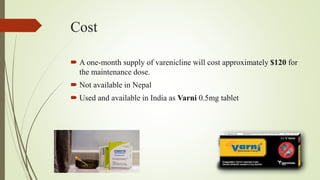
 Used and available in India as Varni 0.5mg tablet
References
 T. Varenicline. Drugs Jiménez-Ruiz, C., Berlin, I. & Hering
 Effect of Maintenance Therapy With Varenicline on Smoking
CessationA Randomized Controlled Trial Serena Tonstad, MD,
PhD; Philip Tønnesen, MD, PhD
 Varenicline ; A Review of its Use as an Aid to Smoking Cessation
Therapy Gillian M. Keating & M. Asif A. Siddiqui
 Varenicline for Tobacco Dependence J. Taylor Hays, M.D., and Jon
O. Ebbert, M.D.
 UpToDate
Thank You !

Varenicline

  • 1.
    VARENICLINE Dr. Subodh Sharma Resident(First Year) Department of Psychiatry NMCTH, Birgunj , Nepal
  • 2.
    Introduction  It isa high-affinity partial agonist for the α4β2 nicotinic acetylcholine receptor subtype (nACh)  Used as pharmacotherapeutic agent for smoking cessation.  Non nicotine drugs for smoking.
  • 3.
     Approved byFDA in 2006  Use of Cytisus plants as a smoking substitutes during World War II led to extraction of cytisine.  Cytisine analogs led to varenicline at Pfizer.
  • 4.
    Available options forSmoking Cessation  Non pharmacological Behavior therapy (individual / group/ telephone quit line) Clinical counselling  Pharmacological Nicotine replacement (patches/ gums/lozenges) Bupropion Varenicline
  • 5.
    Studies on Varenicline A meta-analysis of randomized trials found that varenicline was more effective for smoking cessation than placebo (RR 2.27, 95% CI 2.02-2.55)  Cahill K, Stevens S, Perera R, Lancaster T. Pharmacological interventions for smoking cessation: an overview and network meta-analysis. Cochrane Database Syst Rev 2013; :CD009329.  In another meta-analysis of randomized controlled trials, more patients were abstinent at 24 weeks with varenicline compared with both placebo and nicotine patch (RR 2.24, 95% CI 2.06-2.43; and RR 1.25, 95% CI 1.14- 1.37 respectively)  Cahill K, Lindson-Hawley N, Thomas KH, et al. Nicotine receptor partial agonists for smoking cessation. Cochrane Database Syst Rev 2016; :CD006103.
  • 6.
     Head-to-head double-blindedrandomized controlled trial comparing multiple agents (varenicline, bupropion, nicotine patch) and placebo, varenicline was more effective in producing six months of tobacco abstinence than other drugs or placebo. Anthenelli RM, Benowitz NL, West R, et al. Neuropsychiatric safety and efficacy of varenicline, bupropion, and nicotine patch in smokers with and without psychiatric disorders (EAGLES): a double-blind, randomized, placebo-controlled clinical trial .  Varenicline is safe for use by tobacco users with chronic obstructive pulmonary disease (COPD) Tashkin DP, Rennard S, Hays JT, et al. Effects of varenicline on smoking cessation in patients with mild to moderate COPD: a randomized controlled trial. Chest 2011; 139:591.
  • 7.
    Nonpharmacologic methods Method Versus minimalor usual care unless otherwise noted Risk ratio (95% CI) Behavioral counseling Individual counseling 1.57 (1.40-1.77) Group counseling 1.88 (1.52-2.33) Telephone quit line counseling 1.38 (1.19-1.61) Clinician counseling Brief advice 1.66 (1.42-1.94) Brief counseling 1.86 (1.60-2.15) Brief counseling (versus brief advice) 1.37 (1.20-1.56)
  • 8.
    Pharmacologic methods Method (number oftrials) Versus placebo unless otherwise noted Risk ratio (95% CI) First-line pharmacotherapies * Nicotine replacement [5] All types combined 1.55 (1.49-1.61) Combination [versus individual products] 1.25 (1.15-1.36) Patch (43) 1.64 (1.53-1.75) Gum (56) 1.49 (1.40-1.60) Lozenge (7) 1.52 (1.32-1.74) Inhaler (4) 1.90 (1.36-2.67) Nasal spray (4) 2.02 (1.49-2.73) Varenicline (27) 2.24 (2.06-2.43) Bupropion SR (46) 1.64 (1.52-1.77)
  • 9.
    Mechanism of Action Itis a high-affinity partial agonist for the α4β2 nicotinic acetylcholine receptor subtype (nACh) Release of the neurotransmitter dopamine in the nucleus accumbens, reward center of the brain when activated Reduce the feelings of craving and withdrawal caused by smoking cessation.
  • 10.
    Pharmacokinetics and Pharmacodynamics Absorption •Completely absorbed • Bioavailability: high • Peak plasma time: 3-4hrs Distribution • Protien bound <20% Metabolism • Minimal metabolism, Hepatic Excretion: urine (92%) Half life :24hrs
  • 11.
    Dosing  Initial: Days 1to 3: 0.5 mg once daily. (after food) Days 4 to 7: 0.5 mg twice daily.  Maintenance (day 8 and later): 1 mg twice daily; may consider a temporary or permanent dose reduction if usual dose is not tolerated.  Duration: Continue maintenance dose for at least 11 weeks (for a total of at least 12 weeks of treatment).  May consider extended maintenance therapy based on individual patient risk : benefit; evidence suggests relapse prevention benefits with continuing therapy for up to 1 year.
  • 12.
    Adverse effects  Nausea:Dose-dependent nausea may occur; both transient and persistent nausea has been reported. Dosage reduction may be considered for intolerable nausea  Neuropsychiatric effects: Post marketing cases of serious neuropsychiatric events (including depression, suicidal thoughts, and suicide) have been reported in patients with or without preexisting psychiatric disease  Somnambulism: Cases of somnambulism, involving harmful behavior to self, others, or property, have been reported. Discontinue treatment if somnambulism occurs
  • 13.
    Side effects  Cardiovascular:Angina pectoris (4%), chest pain (3%), peripheral edema (2%)  Central nervous system: Headache (12% to 19%), insomnia (9% to 19%), abnormal dreams (8% to 13%), irritability (11%), suicidal ideation (11%), depression (4% to 11%) Anxiety (8%), sleep disorder (3% to 5%)  Gastrointestinal: Nausea (16% to 40%), vomiting (5% to 11%) Flatulence (6% to 9%), constipation (5% to 8%), diarrhea (6%), increased appetite (3% to 4%)
  • 14.
    Use in Pregnancy FDA Category C  Available data have not suggested increased risk for major birth defects as compared with women who smoke  Studies are not conclusive of whether quitting smoking with varenicline reduses the risk of birth defects which are the result of smoking.
  • 15.
    Cost  A one-monthsupply of varenicline will cost approximately $120 for the maintenance dose.  Not available in Nepal  Used and available in India as Varni 0.5mg tablet
  • 16.
    References  T. Varenicline.Drugs Jiménez-Ruiz, C., Berlin, I. & Hering  Effect of Maintenance Therapy With Varenicline on Smoking CessationA Randomized Controlled Trial Serena Tonstad, MD, PhD; Philip Tønnesen, MD, PhD  Varenicline ; A Review of its Use as an Aid to Smoking Cessation Therapy Gillian M. Keating & M. Asif A. Siddiqui  Varenicline for Tobacco Dependence J. Taylor Hays, M.D., and Jon O. Ebbert, M.D.  UpToDate
  • 17.

Editor's Notes

  • #10 The nucleus accumbens a region in the basal forebrain rostral to the preoptic area of the hypothalamus.
  • #15 Use with caution if benefits outweighs the risk