Endocrine organs
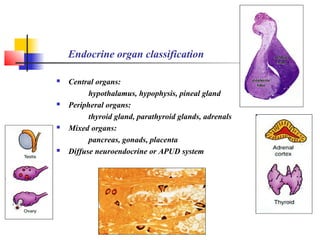
Endocrine organ classification
 Central organs:
hypothalamus, hypophysis, pineal gland
 Peripheral organs:
thyroid gland, parathyroid glands, adrenals
 Mixed organs:
pancreas, gonads, placenta
 Diffuse neuroendocrine or APUD system
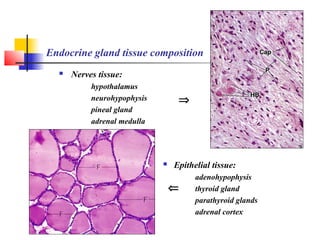
Endocrine gland tissue composition
 Nerves tissue:
hypothalamus
neurohypophysis
pineal gland
adrenal medulla
 Epithelial tissue:
adenohypophysis
thyroid gland
parathyroid glands
adrenal cortex
⇒
⇐
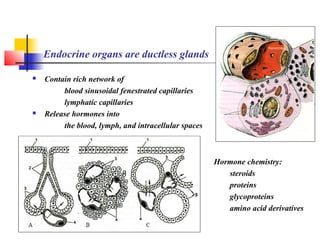
Endocrine organs are ductless glands
 Contain rich network of
blood sinusoidal fenestrated capillaries
lymphatic capillaries
 Release hormones into
the blood, lymph, and intracellular spaces
Hormone chemistry:
steroids
proteins
glycoproteins
amino acid derivatives
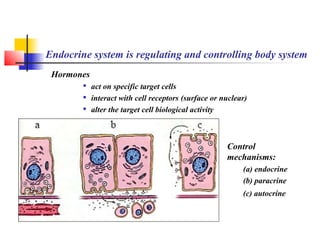
Endocrine system is regulating and controlling body system
Hormones

act on specific target cells

interact with cell receptors (surface or nuclear)

alter the target cell biological activity
Control
mechanisms:
(a) endocrine
(b) paracrine
(c) autocrine
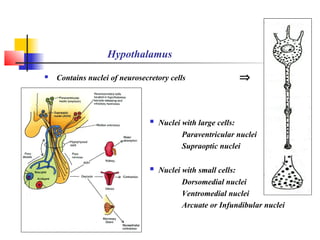
Hypothalamus
 Contains nuclei of neurosecretory cells
 Nuclei with large cells:
Paraventricular nuclei
Supraoptic nuclei
 Nuclei with small cells:
Dorsomedial nuclei
Ventromedial nuclei
Arcuate or Infundibular nuclei
⇒
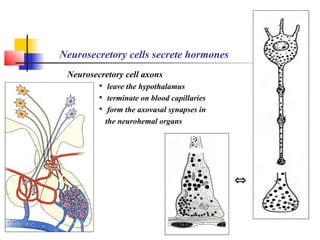
Neurosecretory cells secrete hormones
Neurosecretory cell axons

leave the hypothalamus

terminate on blood capillaries

form the axovasal synapses in
the neurohemal organs
⇔
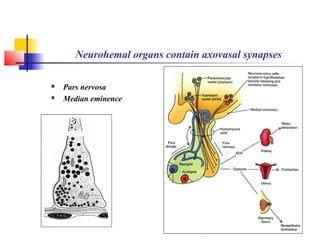
Neurohemal organs contain axovasal synapses
 Pars nervosa
 Median eminence
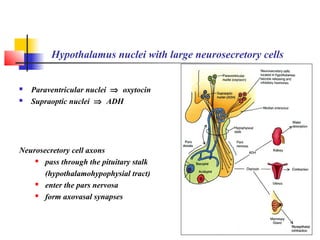
Hypothalamus nuclei with large neurosecretory cells
 Paraventricular nuclei ⇒ oxytocin
 Supraoptic nuclei ⇒ ADH
Neurosecretory cell axons
 pass through the pituitary stalk
(hypothalamohypophysial tract)
 enter the pars nervosa
 form axovasal synapses
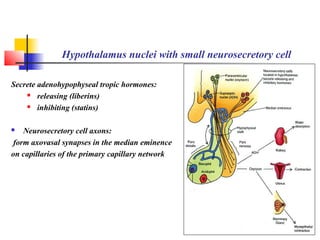
Hypothalamus nuclei with small neurosecretory cell
Secrete adenohypophyseal tropic hormones:
 releasing (liberins)
 inhibiting (statins)
 Neurosecretory cell axons:
form axovasal synapses in the median eminence
on capillaries of the primary capillary network
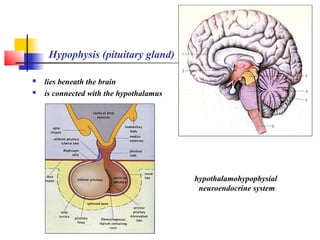
Hypophysis (pituitary gland)
 lies beneath the brain
 is connected with the hypothalamus
hypothalamohypophysial
neuroendocrine system
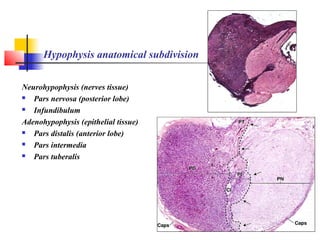
Hypophysis anatomical subdivision
Neurohypophysis (nerves tissue)
 Pars nervosa (posterior lobe)
 Infundibulum
Adenohypophysis (epithelial tissue)
 Pars distalis (anterior lobe)
 Pars intermedia
 Pars tuberalis
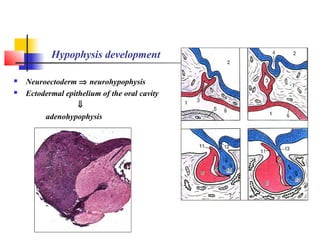
Hypophysis development
 Neuroectoderm ⇒ neurohypophysis
 Ectodermal epithelium of the oral cavity
⇓
adenohypophysis
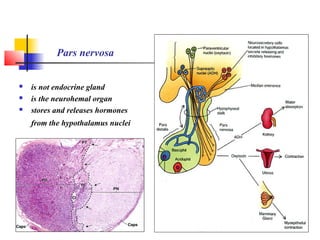
Pars nervosa
 is not endocrine gland
 is the neurohemal organ
 stores and releases hormones
from the hypothalamus nuclei
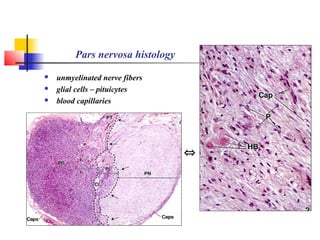
Pars nervosa histology
 unmyelinated nerve fibers
 glial cells – pituicytes
 blood capillaries
⇔
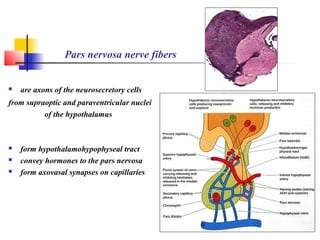
Pars nervosa nerve fibers
 are axons of the neurosecretory cells
from supraoptic and paraventricular nuclei
of the hypothalamus
 form hypothalamohypophyseal tract
 convey hormones to the pars nervosa
 form axovasal synapses on capillaries
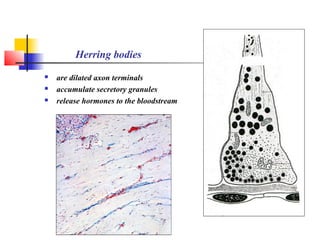
Herring bodies
 are dilated axon terminals
 accumulate secretory granules
 release hormones to the bloodstream
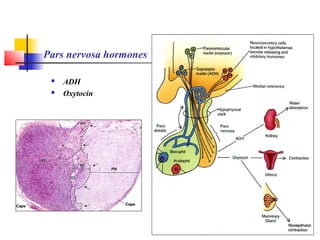
Pars nervosa hormones
 ADH
 Oxytocin
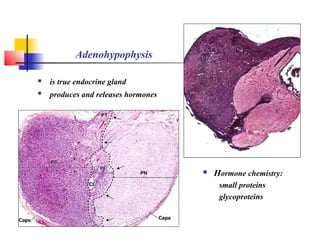
Adenohypophysis
 is true endocrine gland
 produces and releases hormones
 Hormone chemistry:
small proteins
glycoproteins
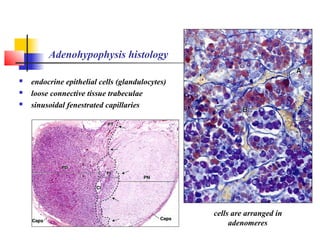
Adenohypophysis histology
 endocrine epithelial cells (glandulocytes)
 loose connective tissue trabeculae
 sinusoidal fenestrated capillaries
cells are arranged in
adenomeres
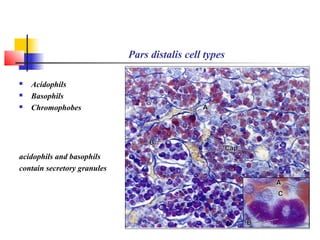
Pars distalis cell types
 Acidophils
 Basophils
 Chromophobes
acidophils and basophils
contain secretory granules
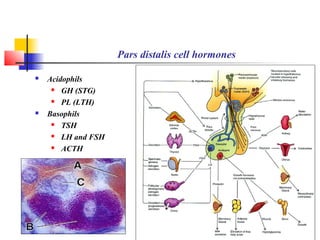
Pars distalis cell hormones
 Acidophils
 GH (STG)
 PL (LTH)
 Basophils
 TSH
 LH and FSH
 ACTH
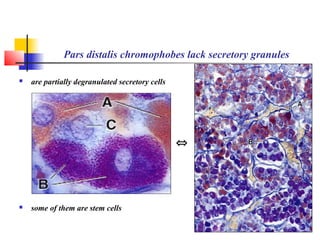
Pars distalis chromophobes lack secretory granules
 are partially degranulated secretory cells
 some of them are stem cells
⇔
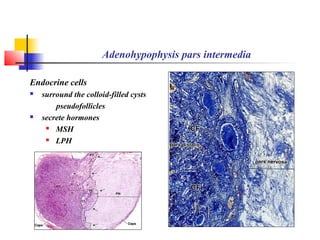
Adenohypophysis pars intermedia
Endocrine cells
 surround the colloid-filled cysts
pseudofollicles
 secrete hormones
 MSH
 LPH
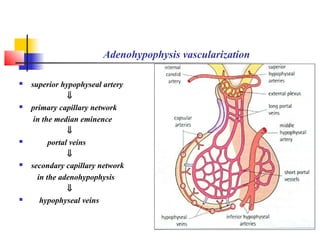
Adenohypophysis vascularization
 superior hypophyseal artery
⇓
 primary capillary network
in the median eminence
⇓
 portal veins
⇓
 secondary capillary network
in the adenohypophysis
⇓
 hypophyseal veins
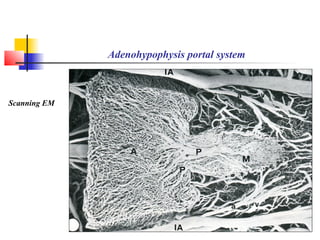
Adenohypophysis portal system
Scanning EM
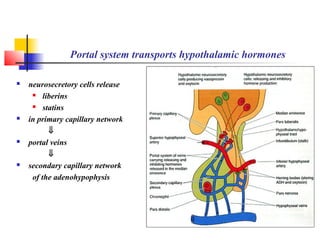
Portal system transports hypothalamic hormones
 neurosecretory cells release
 liberins
 statins
 in primary capillary network
⇓
 portal veins
⇓
 secondary capillary network
of the adenohypophysis
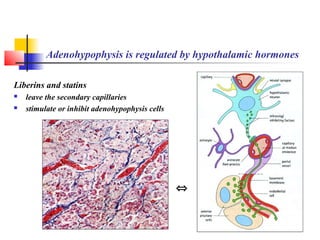
Adenohypophysis is regulated by hypothalamic hormones
Liberins and statins
 leave the secondary capillaries
 stimulate or inhibit adenohypophysis cells
⇔
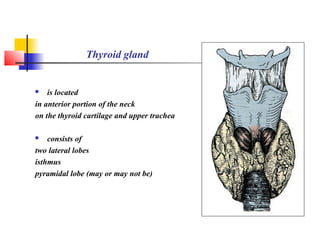
Thyroid gland
 is located
in anterior portion of the neck
on the thyroid cartilage and upper trachea
 consists of
two lateral lobes
isthmus
pyramidal lobe (may or may not be)
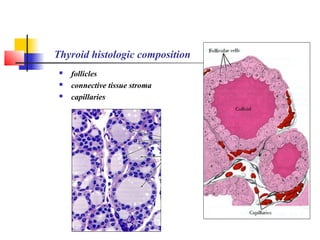
Thyroid histologic composition
 follicles
 connective tissue stroma
 capillaries
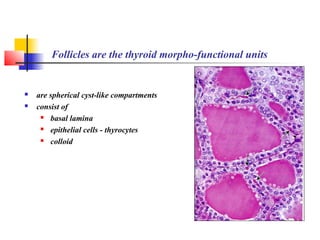
Follicles are the thyroid morpho-functional units
 are spherical cyst-like compartments
 consist of
 basal lamina
 epithelial cells - thyrocytes
 colloid
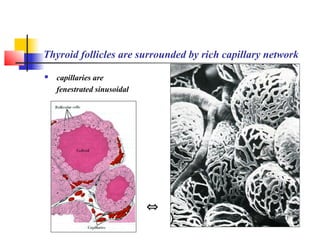
Thyroid follicles are surrounded by rich capillary network
 capillaries are
fenestrated sinusoidal
⇔
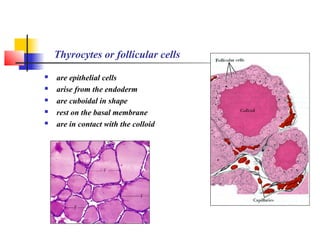
Thyrocytes or follicular cells
 are epithelial cells
 arise from the endoderm
 are cuboidal in shape
 rest on the basal membrane
 are in contact with the colloid
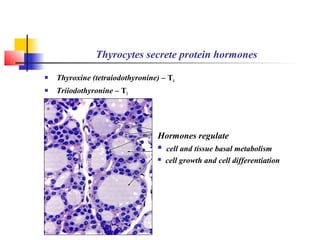
Thyrocytes secrete protein hormones
 Thyroxine (tetraiodothyronine) – T4
 Triiodothyronine – T3
Hormones regulate
 cell and tissue basal metabolism
 cell growth and cell differentiation
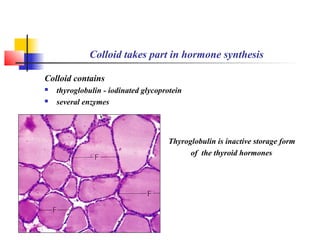
Colloid takes part in hormone synthesis
Colloid contains
 thyroglobulin - iodinated glycoprotein
 several enzymes
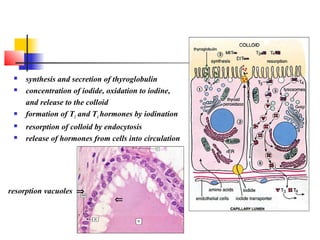
Thyroglobulin is inactive storage form
of the thyroid hormones
 synthesis and secretion of thyroglobulin
 concentration of iodide, oxidation to iodine,
and release to the colloid
 formation of T3 and T4 hormones by iodination
 resorption of colloid by endocytosis
 release of hormones from cells into circulation
resorption vacuoles ⇒
⇐
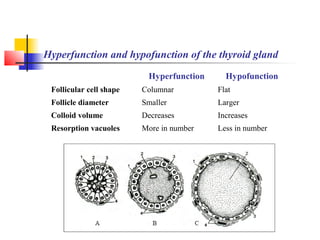
Hyperfunction and hypofunction of the thyroid gland
Hyperfunction Hypofunction
Follicular cell shape Columnar Flat
Follicle diameter Smaller Larger
Colloid volume Decreases Increases
Resorption vacuoles More in number Less in number
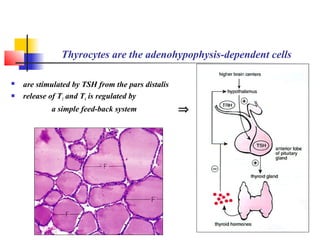
Thyrocytes are the adenohypophysis-dependent cells
 are stimulated by TSH from the pars distalis
 release of T3 and T4 is regulated by
a simple feed-back system ⇒
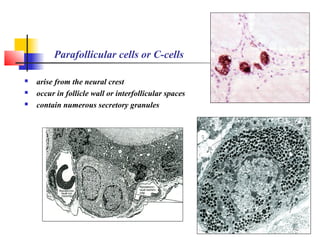
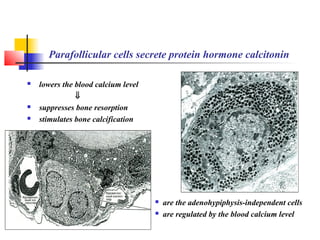
Parafollicular cells or C-cells
 arise from the neural crest
 occur in follicle wall or interfollicular spaces
 contain numerous secretory granules
Parafollicular cells secrete protein hormone calcitonin
 lowers the blood calcium level
⇓
 suppresses bone resorption
 stimulates bone calcification
 are the adenohypiphysis-independent cells
 are regulated by the blood calcium level
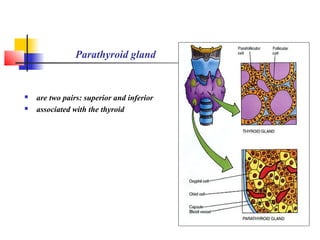
Parathyroid gland
 are two pairs: superior and inferior
 associated with the thyroid
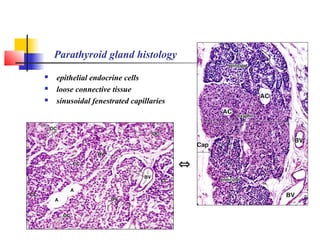
Parathyroid gland histology
 epithelial endocrine cells
 loose connective tissue
 sinusoidal fenestrated capillaries
⇔
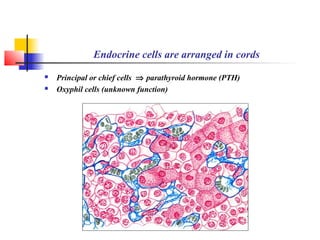
Endocrine cells are arranged in cords
 Principal or chief cells ⇒ parathyroid hormone (PTH)
 Oxyphil cells (unknown function)
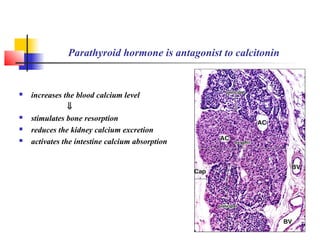
Parathyroid hormone is antagonist to calcitonin
 increases the blood calcium level
⇓
 stimulates bone resorption
 reduces the kidney calcium excretion
 activates the intestine calcium absorption
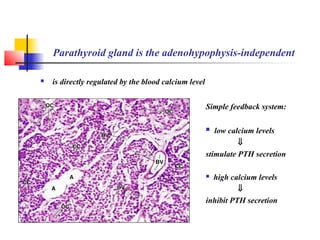
Parathyroid gland is the adenohypophysis-independent
 is directly regulated by the blood calcium level
Simple feedback system:
 low calcium levels
⇓
stimulate PTH secretion
 high calcium levels
⇓
inhibit PTH secretion
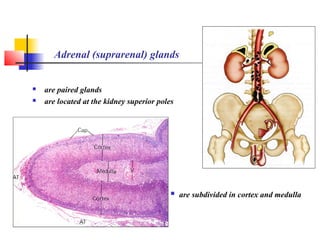
Adrenal (suprarenal) glands
 are paired glands
 are located at the kidney superior poles
 are subdivided in cortex and medulla
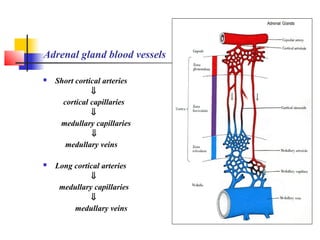
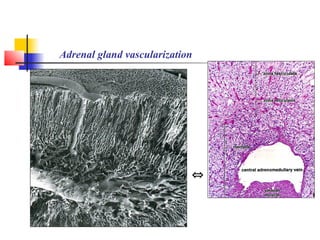
Adrenal gland blood vessels
 Short cortical arteries
⇓
cortical capillaries
⇓
medullary capillaries
⇓
medullary veins
 Long cortical arteries
⇓
medullary capillaries
⇓
medullary veins
Adrenal gland vascularization
⇔
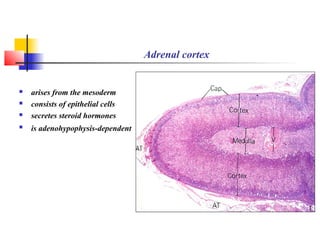
Adrenal cortex
 arises from the mesoderm
 consists of epithelial cells
 secretes steroid hormones
 is adenohypophysis-dependent
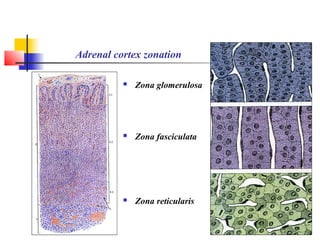
Adrenal cortex zonation
 Zona glomerulosa
 Zona fasciculata
 Zona reticularis
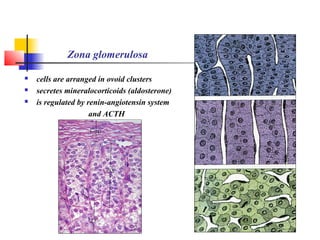
Zona glomerulosa
 cells are arranged in ovoid clusters
 secretes mineralocorticoids (aldosterone)
 is regulated by renin-angiotensin system
and ACTH
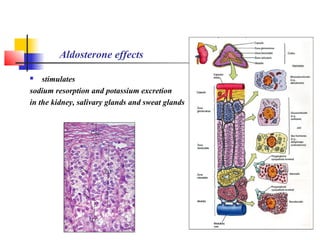
Aldosterone effects
 stimulates
sodium resorption and potassium excretion
in the kidney, salivary glands and sweat glands
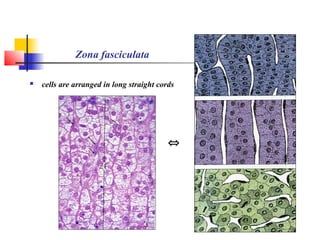
Zona fasciculata
 cells are arranged in long straight cords
⇔
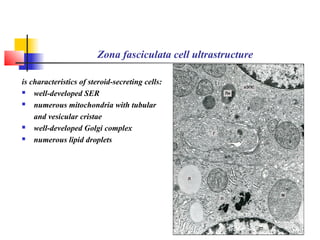
Zona fasciculata cell ultrastructure
is characteristics of steroid-secreting cells:
 well-developed SER
 numerous mitochondria with tubular
and vesicular cristae
 well-developed Golgi complex
 numerous lipid droplets
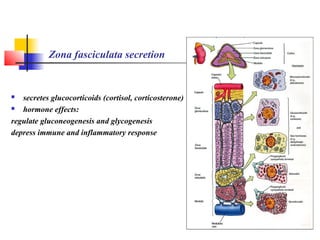
Zona fasciculata secretion
 secretes glucocorticoids (cortisol, corticosterone)
 hormone effects:
regulate gluconeogenesis and glycogenesis
depress immune and inflammatory response
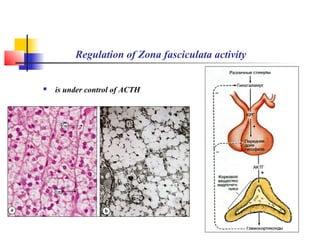
Regulation of Zona fasciculata activity
 is under control of ACTH
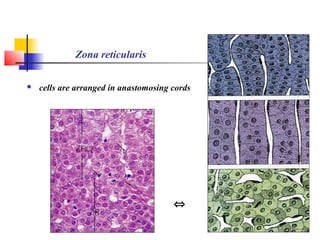
Zona reticularis
 cells are arranged in anastomosing cords
⇔
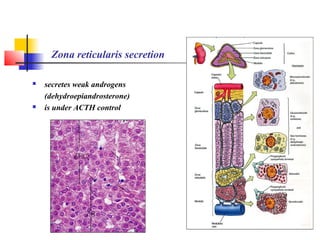
Zona reticularis secretion
 secretes weak androgens
(dehydroepiandrosterone)
 is under ACTH control
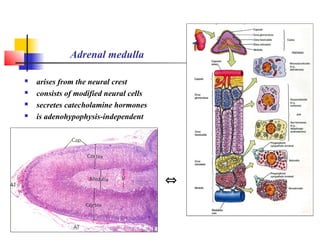
Adrenal medulla
 arises from the neural crest
 consists of modified neural cells
 secretes catecholamine hormones
 is adenohypophysis-independent
⇔
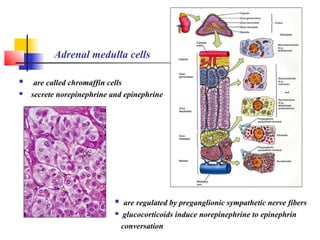
Adrenal medulla cells
 are called chromaffin cells
 secrete norepinephrine and epinephrine
 are regulated by preganglionic sympathetic nerve fibers
 glucocorticoids induce norepinephrine to epinephrin
conversation
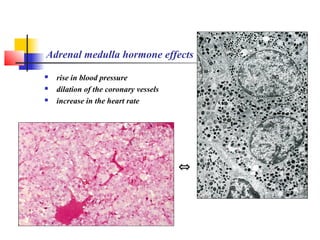
Adrenal medulla hormone effects
 rise in blood pressure
 dilation of the coronary vessels
 increase in the heart rate
⇔
The END
Thank you for attention!

Endocrine organs

  • 1.
  • 2.
    Endocrine organ classification Central organs: hypothalamus, hypophysis, pineal gland  Peripheral organs: thyroid gland, parathyroid glands, adrenals  Mixed organs: pancreas, gonads, placenta  Diffuse neuroendocrine or APUD system
  • 3.
    Endocrine gland tissuecomposition  Nerves tissue: hypothalamus neurohypophysis pineal gland adrenal medulla  Epithelial tissue: adenohypophysis thyroid gland parathyroid glands adrenal cortex ⇒ ⇐
  • 4.
    Endocrine organs areductless glands  Contain rich network of blood sinusoidal fenestrated capillaries lymphatic capillaries  Release hormones into the blood, lymph, and intracellular spaces Hormone chemistry: steroids proteins glycoproteins amino acid derivatives
  • 5.
    Endocrine system isregulating and controlling body system Hormones  act on specific target cells  interact with cell receptors (surface or nuclear)  alter the target cell biological activity Control mechanisms: (a) endocrine (b) paracrine (c) autocrine
  • 6.
    Hypothalamus  Contains nucleiof neurosecretory cells  Nuclei with large cells: Paraventricular nuclei Supraoptic nuclei  Nuclei with small cells: Dorsomedial nuclei Ventromedial nuclei Arcuate or Infundibular nuclei ⇒
  • 7.
    Neurosecretory cells secretehormones Neurosecretory cell axons  leave the hypothalamus  terminate on blood capillaries  form the axovasal synapses in the neurohemal organs ⇔
  • 8.
    Neurohemal organs containaxovasal synapses  Pars nervosa  Median eminence
  • 9.
    Hypothalamus nuclei withlarge neurosecretory cells  Paraventricular nuclei ⇒ oxytocin  Supraoptic nuclei ⇒ ADH Neurosecretory cell axons  pass through the pituitary stalk (hypothalamohypophysial tract)  enter the pars nervosa  form axovasal synapses
  • 10.
    Hypothalamus nuclei withsmall neurosecretory cell Secrete adenohypophyseal tropic hormones:  releasing (liberins)  inhibiting (statins)  Neurosecretory cell axons: form axovasal synapses in the median eminence on capillaries of the primary capillary network
  • 11.
    Hypophysis (pituitary gland) lies beneath the brain  is connected with the hypothalamus hypothalamohypophysial neuroendocrine system
  • 12.
    Hypophysis anatomical subdivision Neurohypophysis(nerves tissue)  Pars nervosa (posterior lobe)  Infundibulum Adenohypophysis (epithelial tissue)  Pars distalis (anterior lobe)  Pars intermedia  Pars tuberalis
  • 13.
    Hypophysis development  Neuroectoderm⇒ neurohypophysis  Ectodermal epithelium of the oral cavity ⇓ adenohypophysis
  • 14.
    Pars nervosa  isnot endocrine gland  is the neurohemal organ  stores and releases hormones from the hypothalamus nuclei
  • 15.
    Pars nervosa histology unmyelinated nerve fibers  glial cells – pituicytes  blood capillaries ⇔
  • 16.
    Pars nervosa nervefibers  are axons of the neurosecretory cells from supraoptic and paraventricular nuclei of the hypothalamus  form hypothalamohypophyseal tract  convey hormones to the pars nervosa  form axovasal synapses on capillaries
  • 17.
    Herring bodies  aredilated axon terminals  accumulate secretory granules  release hormones to the bloodstream
  • 18.
    Pars nervosa hormones ADH  Oxytocin
  • 19.
    Adenohypophysis  is trueendocrine gland  produces and releases hormones  Hormone chemistry: small proteins glycoproteins
  • 20.
    Adenohypophysis histology  endocrineepithelial cells (glandulocytes)  loose connective tissue trabeculae  sinusoidal fenestrated capillaries cells are arranged in adenomeres
  • 21.
    Pars distalis celltypes  Acidophils  Basophils  Chromophobes acidophils and basophils contain secretory granules
  • 22.
    Pars distalis cellhormones  Acidophils  GH (STG)  PL (LTH)  Basophils  TSH  LH and FSH  ACTH
  • 23.
    Pars distalis chromophobeslack secretory granules  are partially degranulated secretory cells  some of them are stem cells ⇔
  • 24.
    Adenohypophysis pars intermedia Endocrinecells  surround the colloid-filled cysts pseudofollicles  secrete hormones  MSH  LPH
  • 25.
    Adenohypophysis vascularization  superiorhypophyseal artery ⇓  primary capillary network in the median eminence ⇓  portal veins ⇓  secondary capillary network in the adenohypophysis ⇓  hypophyseal veins
  • 26.
  • 27.
    Portal system transportshypothalamic hormones  neurosecretory cells release  liberins  statins  in primary capillary network ⇓  portal veins ⇓  secondary capillary network of the adenohypophysis
  • 28.
    Adenohypophysis is regulatedby hypothalamic hormones Liberins and statins  leave the secondary capillaries  stimulate or inhibit adenohypophysis cells ⇔
  • 29.
    Thyroid gland  islocated in anterior portion of the neck on the thyroid cartilage and upper trachea  consists of two lateral lobes isthmus pyramidal lobe (may or may not be)
  • 30.
    Thyroid histologic composition follicles  connective tissue stroma  capillaries
  • 31.
    Follicles are thethyroid morpho-functional units  are spherical cyst-like compartments  consist of  basal lamina  epithelial cells - thyrocytes  colloid
  • 32.
    Thyroid follicles aresurrounded by rich capillary network  capillaries are fenestrated sinusoidal ⇔
  • 33.
    Thyrocytes or follicularcells  are epithelial cells  arise from the endoderm  are cuboidal in shape  rest on the basal membrane  are in contact with the colloid
  • 34.
    Thyrocytes secrete proteinhormones  Thyroxine (tetraiodothyronine) – T4  Triiodothyronine – T3 Hormones regulate  cell and tissue basal metabolism  cell growth and cell differentiation
  • 35.
    Colloid takes partin hormone synthesis Colloid contains  thyroglobulin - iodinated glycoprotein  several enzymes Thyroglobulin is inactive storage form of the thyroid hormones
  • 36.
     synthesis andsecretion of thyroglobulin  concentration of iodide, oxidation to iodine, and release to the colloid  formation of T3 and T4 hormones by iodination  resorption of colloid by endocytosis  release of hormones from cells into circulation resorption vacuoles ⇒ ⇐
  • 37.
    Hyperfunction and hypofunctionof the thyroid gland Hyperfunction Hypofunction Follicular cell shape Columnar Flat Follicle diameter Smaller Larger Colloid volume Decreases Increases Resorption vacuoles More in number Less in number
  • 38.
    Thyrocytes are theadenohypophysis-dependent cells  are stimulated by TSH from the pars distalis  release of T3 and T4 is regulated by a simple feed-back system ⇒
  • 39.
    Parafollicular cells orC-cells  arise from the neural crest  occur in follicle wall or interfollicular spaces  contain numerous secretory granules
  • 40.
    Parafollicular cells secreteprotein hormone calcitonin  lowers the blood calcium level ⇓  suppresses bone resorption  stimulates bone calcification  are the adenohypiphysis-independent cells  are regulated by the blood calcium level
  • 41.
    Parathyroid gland  aretwo pairs: superior and inferior  associated with the thyroid
  • 42.
    Parathyroid gland histology epithelial endocrine cells  loose connective tissue  sinusoidal fenestrated capillaries ⇔
  • 43.
    Endocrine cells arearranged in cords  Principal or chief cells ⇒ parathyroid hormone (PTH)  Oxyphil cells (unknown function)
  • 44.
    Parathyroid hormone isantagonist to calcitonin  increases the blood calcium level ⇓  stimulates bone resorption  reduces the kidney calcium excretion  activates the intestine calcium absorption
  • 45.
    Parathyroid gland isthe adenohypophysis-independent  is directly regulated by the blood calcium level Simple feedback system:  low calcium levels ⇓ stimulate PTH secretion  high calcium levels ⇓ inhibit PTH secretion
  • 46.
    Adrenal (suprarenal) glands are paired glands  are located at the kidney superior poles  are subdivided in cortex and medulla
  • 47.
    Adrenal gland bloodvessels  Short cortical arteries ⇓ cortical capillaries ⇓ medullary capillaries ⇓ medullary veins  Long cortical arteries ⇓ medullary capillaries ⇓ medullary veins
  • 48.
  • 49.
    Adrenal cortex  arisesfrom the mesoderm  consists of epithelial cells  secretes steroid hormones  is adenohypophysis-dependent
  • 50.
    Adrenal cortex zonation Zona glomerulosa  Zona fasciculata  Zona reticularis
  • 51.
    Zona glomerulosa  cellsare arranged in ovoid clusters  secretes mineralocorticoids (aldosterone)  is regulated by renin-angiotensin system and ACTH
  • 52.
    Aldosterone effects  stimulates sodiumresorption and potassium excretion in the kidney, salivary glands and sweat glands
  • 53.
    Zona fasciculata  cellsare arranged in long straight cords ⇔
  • 54.
    Zona fasciculata cellultrastructure is characteristics of steroid-secreting cells:  well-developed SER  numerous mitochondria with tubular and vesicular cristae  well-developed Golgi complex  numerous lipid droplets
  • 55.
    Zona fasciculata secretion secretes glucocorticoids (cortisol, corticosterone)  hormone effects: regulate gluconeogenesis and glycogenesis depress immune and inflammatory response
  • 56.
    Regulation of Zonafasciculata activity  is under control of ACTH
  • 57.
    Zona reticularis  cellsare arranged in anastomosing cords ⇔
  • 58.
    Zona reticularis secretion secretes weak androgens (dehydroepiandrosterone)  is under ACTH control
  • 59.
    Adrenal medulla  arisesfrom the neural crest  consists of modified neural cells  secretes catecholamine hormones  is adenohypophysis-independent ⇔
  • 60.
    Adrenal medulla cells are called chromaffin cells  secrete norepinephrine and epinephrine  are regulated by preganglionic sympathetic nerve fibers  glucocorticoids induce norepinephrine to epinephrin conversation
  • 61.
    Adrenal medulla hormoneeffects  rise in blood pressure  dilation of the coronary vessels  increase in the heart rate ⇔
  • 62.
    The END Thank youfor attention!